First Batch of GPT-5.6 Sol Internal Test Results Are In, Same-Task Cost is Only Half That of Fable 5

marsbitPublished on 2026-07-06Last updated on 2026-07-06

Abstract

"GPT-5.6 Sol", the preview version of OpenAI's latest model, has released its first batch of internal testing results. According to an Nvidia engineer, Sol achieved CUDA acceleration results in 30 hours that took Opus 64 hours. The model is positioned for high-difficulty reasoning and complex, long-chain tasks like coding. Initial user feedback highlights that Sol produces more concise code—approximately 1/5 the lines of Opus—with a style closer to human-written code, favoring deep optimization over brute-force trial and error. In tests, Sol demonstrated superior performance in instruction following, spatial reasoning, and front-end design consistency compared to GPT-5.5 Pro. When compared to the recently relaunched competitor Fable 5, Sol shows slightly lower overall performance and code quality in some areas. For instance, Fable 5 can generate a playable game from a single prompt faster. However, Sol's key advantage is cost: at $5 per million input tokens and $30 per million output tokens, it is roughly half the price of Fable 5 ($10/$50). Additionally, users report Fable 5's safety restrictions are overly stringent, frequently blocking tasks, whereas Sol's safeguards are reportedly more tailored and less limiting. The model is expected to roll out fully to all users in the coming days.

GPT-5.6 Sol preview has been out for almost two weeks, and the first batch of user internal test reports are finally fresh off the press!

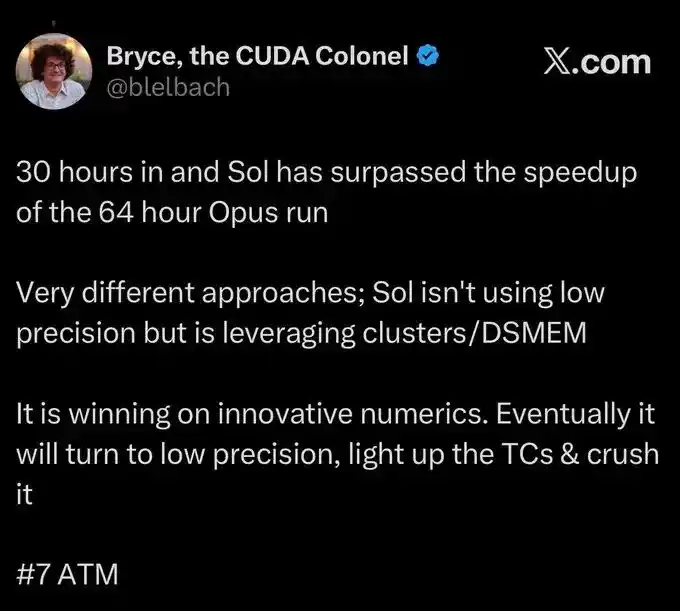
An NVIDIA principal engineer tells you in the most straightforward, no-beating-around-the-bush terms:

Sol is fierce! In just 30 hours, it achieved the CUDA acceleration effect that took Opus 64 hours.

After subsequent version optimizations, it might completely crush Opus......
Netizens haven't been idle either, they've directly started messing around, with all sorts of comparisons (trash-talking) popping up:

Take spaceship building for example. Look at the corridor inside GPT-5.6's ship. The color matching and lighting choices are very sci-fi, with clear contrast between light and dark. In contrast, the 5.5 version has a warmer, grayer tone, and the overall picture feels much flatter. It looks more like a company locker room.

Not to mention the cosmic scenes outside the ship; GPT-5.5 looks like a pixelated party. (doge)

This round goes to GPT-5.6!

As for why GPT-5.6's popularity has exploded again recently, first, its old rival Fable 5 is back, and second, the model is fin!ally! mo!ving!

After waiting for so many days, news has finally emerged that the model will officially launch in the next couple of days.

This time, it won't just be a few "partners" who can use it; everyone gets access!

(The wait-and-see crowd wins~)

Altman also personally joined the fray to show off, pushing the atmosphere to its peak:

The first time my baby said a two-word phrase, it was as mind-blowing as when GPT-5.6 discovered a brand new mathematical theory.

No doubt! Both are his own babies (doge)

First Batch of Internal Test Results Released

Scrolling through posts from internal test users, a few points of consensus are quite consistent.

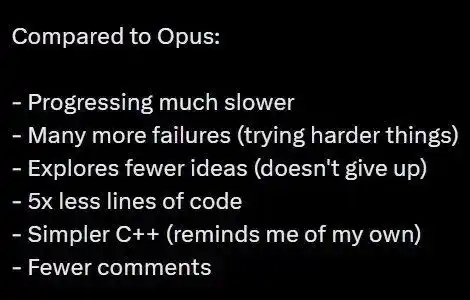
The first one, mentioned earlier by that NVIDIA engineer: code is more concise, overall code volume is less.

For the same requirement, other models might write a lot, but Sol is clearly much more restrained. It would never write five lines if it can solve it in three. The number of code lines is only 1/5 of Opus's. Especially for C++, the writing style is very similar to hand-written code, and there are fewer comments.

For projects that need long-term maintenance, Sol has the advantage.

Of course, coding isn't flawless either. For example, iterative progress is slower, and there are more failures, because Sol always tries more difficult tasks.

Compared to Opus, it also has fewer trial-and-error exploration ideas. Once it decides on a direction, it sticks to it stubbornly.

Simply put, the model abandons a lot of mindless trial and error, shifting to long-term, deep cultivation. It doesn't pursue superficially pretty output results; its core focus is on optimizing underlying performance.

This aligns well with OpenAI's positioning for Sol—

Aimed at high-difficulty reasoning, complex code, and other long-chain tasks, especially suitable for complex workflows that require planning, iteration, tool calling, and step coordination.
Using the same prompt for Sol and GPT-5.5 Pro, the comparison is also very intuitive:

Whether it's interactive SVG, 3D models, or game generation, Sol's instruction following and spatial reasoning capabilities are superior, and it's better at consistency.

In the area of front-end design, Sol also delivered cleaner, tidier work.

Compared to GPT-5.5, Sol's page layout, hierarchy, and use of whitespace are handled quite well, and the visuals are more refined. Sol passes the visual test with high marks.

Successful Sniping of Fable 5?

But as for the question netizens care about most—how does it compare to Fable 5?

The effect might still be slightly inferior.

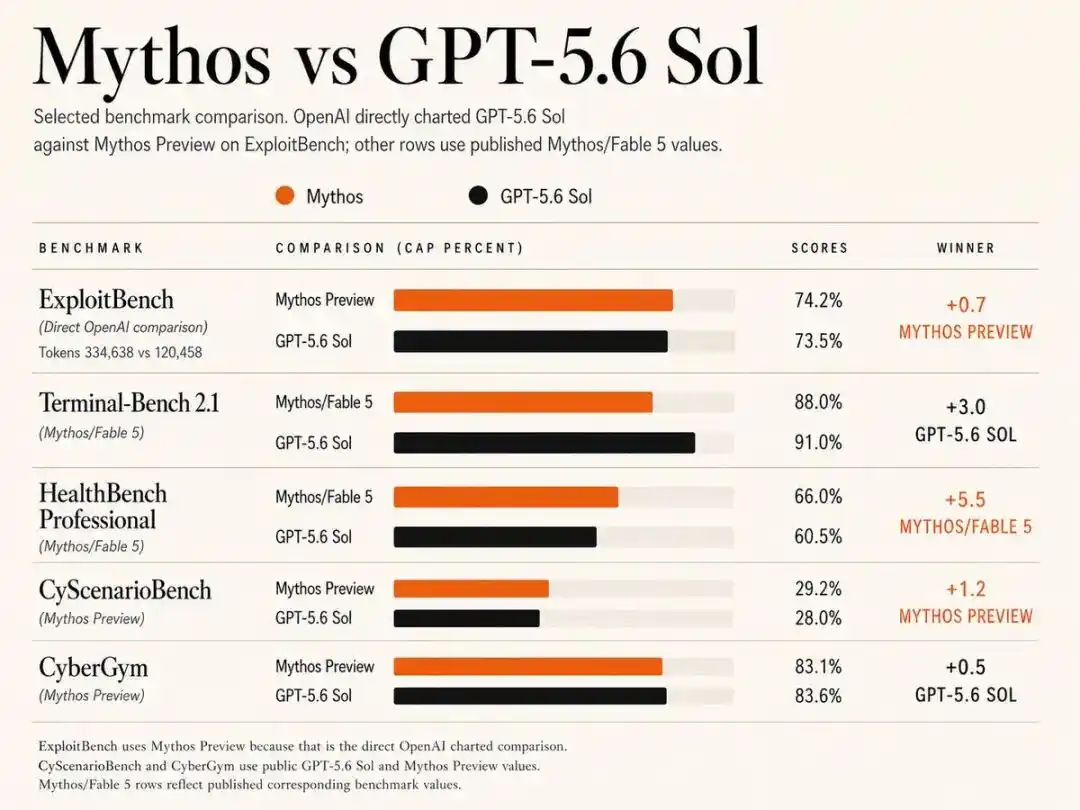
On some benchmark tests, Sol scores on par with or even surpasses Fable 5, but there's still a certain gap compared to Fable 5 in overall model experience and code quality.
For example, netizen Gipp conducted a 3D FPS game comparison.

When GPT 5.6 was still struggling to adapt to the game world, lighting, and gameplay, Fable 5 could already turn a prompt into a playable finished game.

However, Fable 5 is much more expensive, at $10 per million input tokens and $50 per million output tokens. Sol's cost is only $5 per million input tokens and $30 per million output tokens.

Sol is almost half the price!

So when model capabilities are similar, it's really hard to say who will win between Sol and Fable 5.
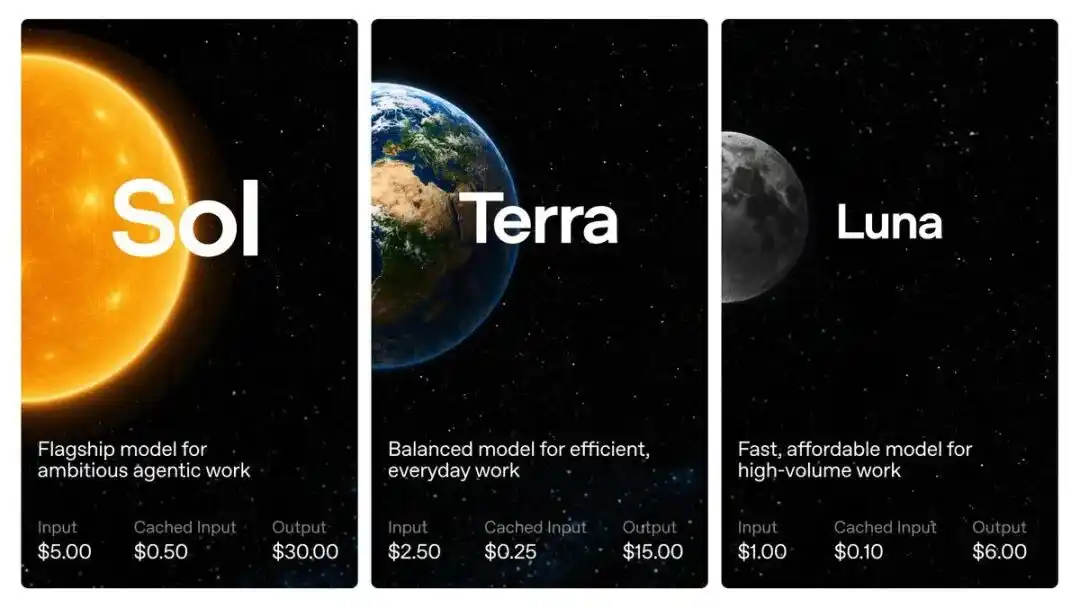
Even more critical are the safety restrictions. Since Fable 5 was sanctioned, after its comeback this time, netizens clearly feel Fable 5 simply isn't working.

Normal coding, debugging—if you're not careful, the system flags it as high-risk, and the task gets downgraded to Opus 4.8 for processing. Even a question like "how many 'r's are in 'raspberry'" gets blocked.

Netizens promptly gave Fable 5 a bad review......

The situation with GPT-5.6 is slightly better. The official team has clearly stated that more powerful safety systems have been added, and different protection strategies will be configured based on different model capabilities. The restrictions will also be somewhat less strict than Fable 5's.

Anyway, let's eagerly await GPT-5.6's full-scale launch. We'll know for sure when we test it ourselves~

Reference Links:

[1]https://x.com/mark_k/status/2073467892889272609?s=20

[2]https://x.com/kimmonismus/status/2073799386535006210

[3]https://x.com/gippp69/status/2073697790723596469

This article is from the WeChat public account "QbitAI", author: Lu Yu

Trending Cryptos

Related Questions

QWhat are the main performance advantages of GPT-5.6 Sol over previous models like Opus, according to the article?

AAccording to the article, GPT-5.6 Sol achieves the same CUDA acceleration performance in 30 hours that took Opus 64 hours. It also produces more concise code, using only about 1/5th the lines of code as Opus for the same task, which is beneficial for long-term project maintenance.

QHow does the cost of GPT-5.6 Sol compare to Fable 5 for the same task?

AThe cost of using GPT-5.6 Sol is roughly half that of Fable 5 for the same task. Specifically, Sol's cost is $5 per million input tokens and $30 per million output tokens, compared to Fable 5's $10 per million input tokens and $50 per million output tokens.

QWhat is the specific positioning and intended use case for GPT-5.6 Sol as described by OpenAI?

AOpenAI positions GPT-5.6 Sol for high-difficulty reasoning, complex coding, and other long-chain tasks. It is particularly suited for complex workflows that require planning, iteration, tool calling, and step coordination.

QWhat are some of the perceived weaknesses or trade-offs of GPT-5.6 Sol mentioned in the user testing reports?

AUser reports mention that GPT-5.6 Sol has a slower iteration speed and more failures during coding tasks because it tends to attempt more difficult challenges. It also employs fewer trial-and-error exploration strategies, preferring to persist deeply in a chosen direction.

QWhat is a key user complaint about Fable 5 mentioned in the article, and how does GPT-5.6 Sol reportedly address a similar issue?

AA key user complaint about Fable 5 is its overly restrictive safety filters, which often block legitimate tasks like coding or debugging. In contrast, the article states that GPT-5.6 Sol has implemented more powerful and nuanced safety systems with smaller restrictions tailored to different model capabilities.

Related Reads

AI Folding: Fable 5 and GPT-5.6 Are Becoming the Privilege of a Few

【AI Accessibility Gap Widens: Elite Tools Like Fable 5 and GPT-5.6 Are Becoming Privileged】 We are witnessing a growing "AI divide." A stark reality is emerging: a tiny fraction of elites, primarily in tech, are using powerful next-generation models like Fable 5 or the upcoming GPT-5.6, while the vast majority of the public only has access to "toys" - free, limited models equivalent to ChatGPT's basic versions (8B to 30B parameters). This creates a massive experiential chasm and cognitive dissonance. Industry outsiders see AI as overhyped and ineffective, unable to grasp its transformative potential, while insiders leverage these advanced models for a decisive competitive edge. The gap isn't just about model quality but product functionality. Free users get a simple chatbot. Paying elites get integrated workflow systems—capable of creating specialized agents, processing complex data, and handling real-world tasks like management, coding, and planning. Demos showcasing AI planning weddings or building apps feel disconnected from everyday needs like managing bills, groceries, or health. The cost barrier is immense, with reports of engineers spending $1000 daily on Fable 5 inference. Elite users employ sophisticated multi-model workflows, combining different AIs for ideation, architecture, execution, and review, completing complex projects in minutes instead of weeks. This divide extends to critical areas like healthcare, where free models are dangerously unreliable for medical queries. However, some argue that for 90% of common business tasks, mid-tier models like GPT-5.5 are sufficient; the perceived limitation often stems from poor integration and lack of context, not model intelligence. Ultimately, unequal access to cutting-edge AI is creating a new form of social stratification, where the most powerful tools are becoming the exclusive privilege of a few.

marsbit24m ago

AI Folding: Fable 5 and GPT-5.6 Are Becoming the Privilege of a Few

marsbit24m ago

Cathie Wood's June $77M Investment: Are Crypto Stocks a True 'Substitute' for Bitcoin?

In June, Cathie Wood's ARK Invest purchased $77 million worth of publicly traded crypto-related stocks, including Coinbase, Circle, and Bullish, during Bitcoin's worst monthly performance in four years. This aligns with the investment thesis that such stocks offer a compliant way to gain exposure to the crypto cycle without directly holding Bitcoin. However, data analysis reveals significant drawbacks. A group of nine U.S.-listed crypto companies showed 30-day annualized realized volatility between 68% and 90%, nearly double Bitcoin's 37.6%. Over 90 days, Circle's volatility reached 103.6% versus Bitcoin's 37.8%. Drawdowns were also more severe for stocks like Circle (-51.4%) and MicroStrategy (-48.6%) compared to Bitcoin's -36.4% from its January high. Correlation analysis shows most stocks share only a moderate link to Bitcoin. For example, Circle, Robinhood, and Bullish have a 90-day correlation coefficient of just 0.55–0.58 with BTC, meaning only about one-third of their price movement is explained by Bitcoin's action. The rest stems from company-specific risks: earnings, competition, fundraising, and equity dilution. MicroStrategy (MSTR) is the notable exception, acting as a leveraged Bitcoin proxy with a beta of 1.59 and 0.85 correlation. Coinbase offers relatively balanced exposure. Circle exemplifies "crypto-wrapped" corporate risk, with its recent crash tied to stablecoin competition, not Bitcoin. Robinhood's diversified business insulates it from crypto downturns but also limits upside. Bitcoin miners like RIOT and MARA have posted significant gains year-to-date, driven primarily by their pivot to AI compute services, not Bitcoin's price. The article highlights that investing in crypto stocks often means accepting amplified volatility or layering on business-specific risks absent from direct Bitcoin ownership. For instance, MicroStrategy's recent challenges—its market value falling below its Bitcoin holdings (mNAV <1) and facing potential Bitcoin sales for liquidity—demonstrate equity-specific hazards like dilution and financing pressures not faced by a direct Bitcoin holder. ARK's buying spree represents a bet on a basket of different business models with varying crypto exposure, not a simple, lower-risk substitute for holding Bitcoin.

marsbit24m ago

Cathie Wood's June $77M Investment: Are Crypto Stocks a True 'Substitute' for Bitcoin?

marsbit24m ago

Crypto Welcomes the 'July Rebound'? On-Chain Bottom Signals Align, Reversal Still Requires Breakthrough Above $70k

The cryptocurrency market is showing signs of a potential "July rebound," with Bitcoin leading a recovery above $63,000 and total market cap rising. This bounce is attributed to improved macro expectations (weaker US jobs data easing Fed hike fears), a short squeeze in derivatives, and signs of whale accumulation. Key on-chain metrics signal a potential bottom, including the Sharpe Ratio hitting extreme lows, the AHR999 index nearing historic buy zones, and miner pressure reaching significant levels. However, analysts caution this is likely a corrective rebound rather than a confirmed trend reversal. Persistent challenges include weak spot demand, negative Coinbase Premium indicating institutional caution, and ongoing selling pressure in the altcoin market. Market sentiment remains in "extreme fear" territory, and the AVIV ratio suggests the average active Bitcoin investor is still at a loss. For a true bullish reversal, Bitcoin needs to convincingly break above the key $70,000 level (aligned with the Short-Term Holder Realized Price). The path to a new parabolic bull market is seen as dependent on attracting substantially more capital, as capital efficiency has declined. While prices may be approaching a cyclical bottom zone (with estimates between $37k-$60k), the market requires more sustained positive signals for a definitive uptrend.

marsbit55m ago

Crypto Welcomes the 'July Rebound'? On-Chain Bottom Signals Align, Reversal Still Requires Breakthrough Above $70k

marsbit55m ago

Trading

Spot

Hot Articles

Discussions

Welcome to the HTX Community. Here, you can stay informed about the latest platform developments and gain access to professional market insights. Users' opinions on the price of SOL (SOL) are presented below.

活动图片