Hitungan Mundur RUU CLARITY: Bagaimana Pasar Kripto Jika Belum Tuntas Sebelum Reses Agustus?

marsbitPublished on 2026-07-05Last updated on 2026-07-05

Abstract

**CLARITY Act dalam Hitungan Mundur: Apa Dampaknya bagi Pasar Kripto Jika Tidak Lolos Sebelum Reses Agustus?** Undang-Undang Pasar Aset Digital (*CLARITY Act*), yang bertujuan memperjelas batas regulasi antara SEC dan CFTC serta memberikan jalur hukum untuk token terdesentralisasi, menghadapi tenggat waktu ketat. RUU ini harus melewati proses di Senat AS sebelum reses 10 Agustus, namun negosiasi terakhir terhambat oleh isu etika kepemilikan kripto pejabat dan klausul perlindungan pengembang (*developer*). Kemungkinan lolos tahun ini turun menjadi sekitar 40%. Jika gagal lolos sebelum reses, dampak utama di pasar diperkirakan bukan kejatuhan drastis, melainkan aliran keluar modal berkelanjutan dari produk seperti ETF, yang sudah terlihat dengan rekor penarikan dari ETF Bitcoin AS pada Juni. Aset seperti XRP, yang sangat bergantung pada kepastian status komoditas dari RUU ini, berpotensi kehilangan "premium" positif regulasinya. Sementara itu, Bitcoin dan Ethereum yang sudah diklasifikasikan sebagai komoditas mungkin terdampak lebih ringan, meski inovasi di sektor DeFi bisa terus terbebani ketidakpastian. Ada tiga skenario ke depan: (1) lolos sebelum reses Agustus, memicu pemulihan harga; (2) tertunda hingga 2027, memperpanjang periode ketidakpastian; atau (3) gagal total dan harus diajukan kembali di Kongres mendatang. Meski menghadapi rintangan politik dan waktu yang sempit, proses RUU ini hingga tahap lanjut menunjukkan upaya serius AS dalam menjawab keraguan regulasi di ...

Penulis: Qin Xiaofeng, Odaily Planet Daily

Undang-Undang Transparansi Pasar Aset Digital (RUU CLARITY) yang sangat dinantikan kembali tertunda. Senator Cynthia Lummis sebelumnya menyatakan bahwa para negosiator diperkirakan menyelesaikan teks kompromi akhir sekitar tanggal 4 Juli (Hari Kemerdekaan AS) dan "maju di bulan Juli", namun progres saat ini jelas tertinggal.

Sekarang, mendekati masa reses Senat pada 10 Agustus, jendela waktu yang tersisa semakin sempit: RUU harus mencapai ambang batas 60 suara di Senat (setidaknya membutuhkan 7 Demokrat yang berbalik mendukung), dikoordinasikan dengan teks dari Komite Pertanian Senat, digabung dengan RUU DPR, dan ditandatangani oleh Presiden. Semua ini harus diselesaikan dalam 25 hari kerja ke depan, garis waktu sangat ketat.

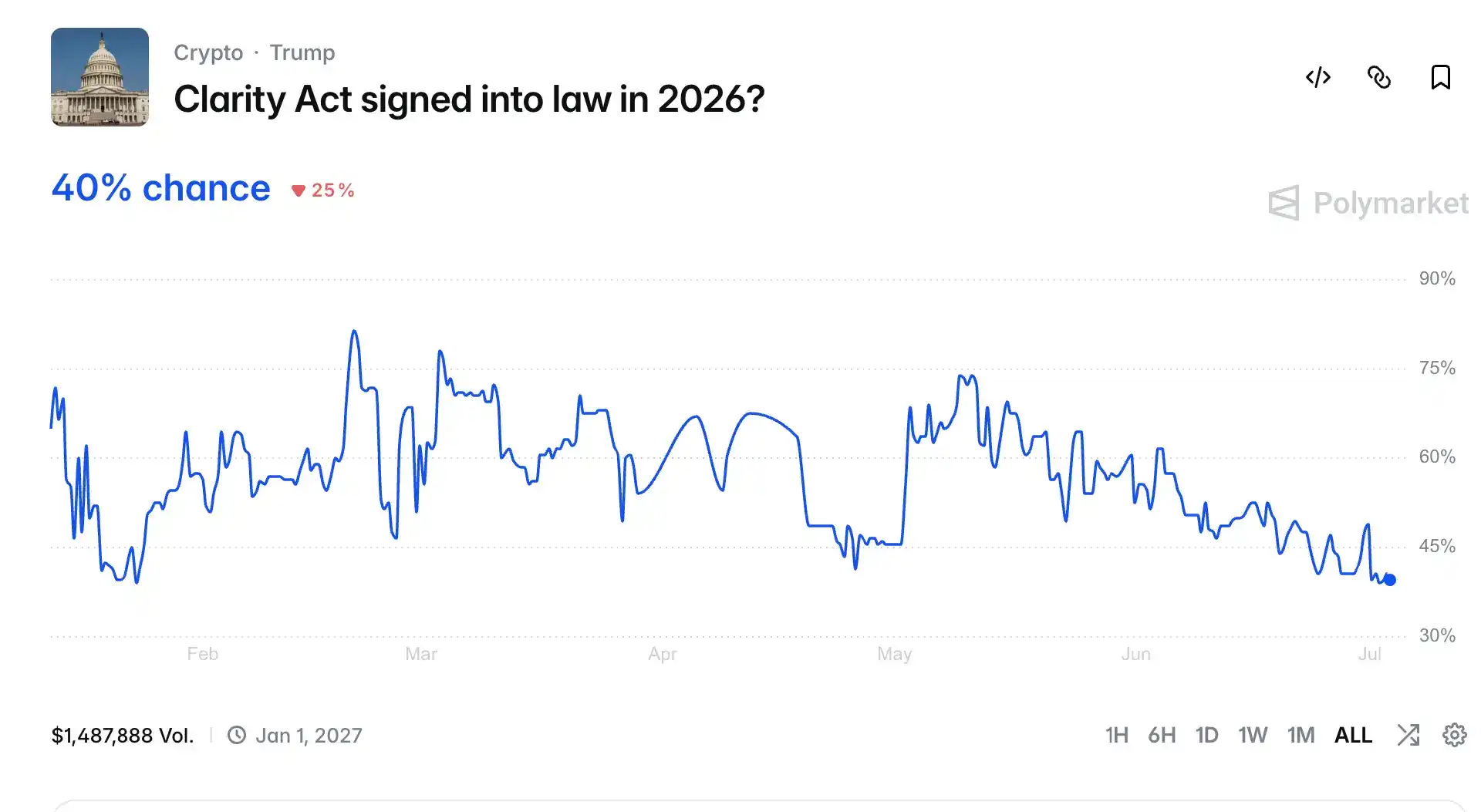
Jika melewatkan jendela sebelum reses Agustus, kemungkinan RUU CLARITY disahkan tahun ini akan semakin menurun. Faktanya, data pasar prediksi Polymarket menunjukkan, probabilitas RUU disahkan tahun ini hanya 40%; Galaxy Digital juga menurunkan probabilitas disahkan tahun 2026 menjadi 50%.
I. Tinjauan Perkembangan Terbaru RUU CLARITY

RUU CLARITY adalah legislasi struktur pasar kripto ikonik yang didorong oleh Kongres AS, bertujuan memperjelas batasan regulasi antara SEC dan CFTC, menyediakan jalur non-sekuritas untuk token terdesentralisasi, dan mewajibkan lembaga perantara komoditas digital untuk mendaftar serta memenuhi kewajiban anti-pencucian uang.

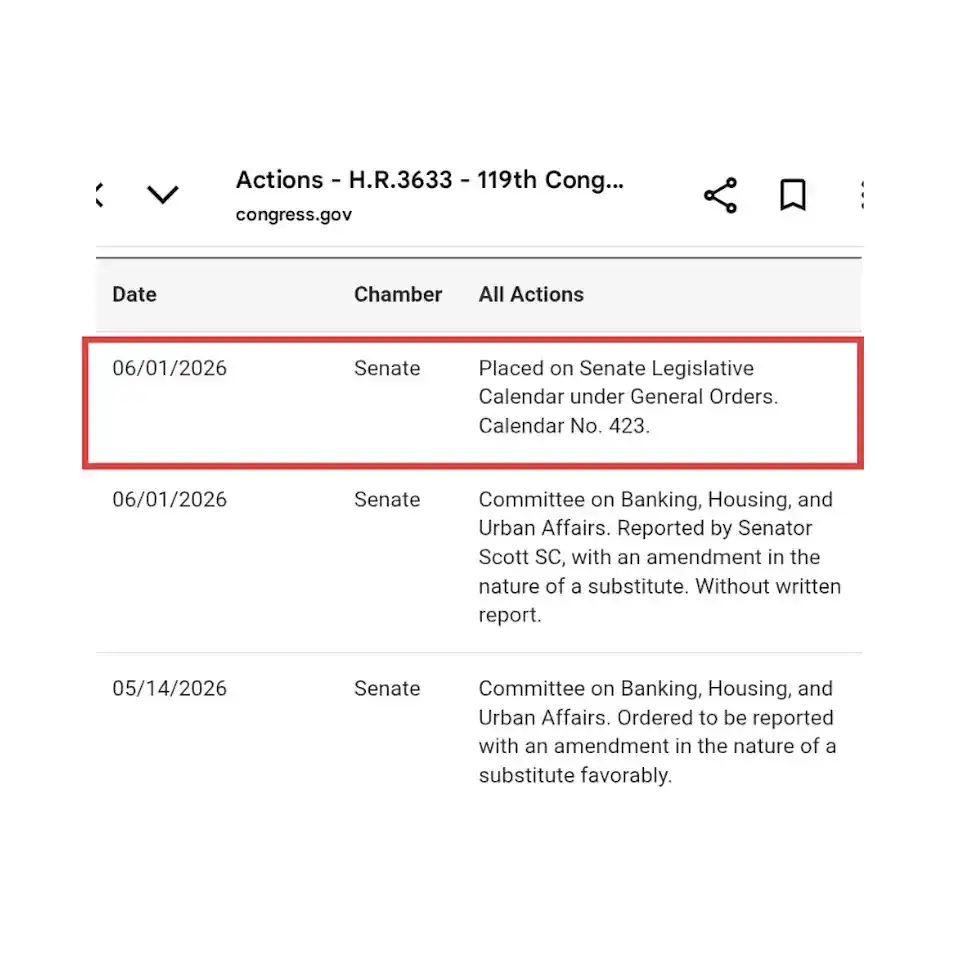
Pada 17 Juli 2025, DPR meloloskan RUU HR 3633 yang diajukan French Hill dengan 294 suara mendukung dan 134 menentang, termasuk lebih dari 70 suara dari Demokrat; pada 14 Mei 2026, Komite Perbankan Senat memajukan dan meloloskan dengan suara 15-9 (13 Republik + 2 Demokrat mendukung). Pada 1 Juni 2026, RUU CLARITY secara resmi dimasukkan ke dalam kalender legislatif Senat (Calendar No. 423), memenuhi syarat untuk dibahas penuh.

Namun, sepanjang Juni, kemajuan RUU CLARITY tidak lancar. Pada 9 Juni, negosiasi mengenai klausul etika terkait kepemilikan kripto Presiden mengalami kebuntuan, secara langsung menyebabkan beberapa anggota parlemen Demokrat melunakkan sikap atau mengajukan syarat tambahan, memperlambat ritme RUU memasuki debat pleno. Pada 10 Juni, Gedung Putih mengadakan pertemuan dengan kelompok kepolisian dan jaksa, setelah itu, perjuangan penegakan hukum seputar Pasal 604 (klausul perlindungan pengembang) dalam RUU Kepastian Regulasi Blockchain mengalami kebuntuan; jika tidak diselesaikan, kelompok penegak hukum dapat melobi menentang, dan anggota parlemen Demokrat juga mungkin memilih menentang karena dianggap "tidak cukup melindungi konsumen/memberantas kejahatan".

Secara sederhana, yang pertama adalah "ambang politik/etika", yang kedua adalah "garis merah penegakan hukum/keamanan", keduanya bersama-sama membentuk dua hambatan terakhir sebelum RUU CLARITY "melewati" Senat. Jika tidak terselesaikan, sulit mengumpulkan 60 suara dan teks akhir, sehingga tidak dapat menyelesaikan proses legislatif sebelum reses 10 Agustus. Dua negosiasi inilah yang secara langsung menghalangi kemajuan akhir RUU CLARITY, menyebabkan target 4 Juli gagal dan progres keseluruhan mandek, menjadi "batu sandungan" kunci. Saat ini negosiasi masih mencoba mencairkan kebuntuan, tetapi waktu sudah sangat mendesak.

Kepala Strategis Kebijakan Washington Stifel Financial, Brian Gardner, menyatakan bahwa agar RUU tersebut disahkan pada tahun 2026, "mungkin perlu disetujui Senat paling lambat akhir Juli, sebaiknya pada bulan Juni", dan memperingatkan bahwa jika Senat melewatkan masa reses, prospek akan memburuk secara signifikan.
Namun, pasar tampaknya tidak terlalu berharap RUU disahkan tahun ini. Kepala Galaxy Research, Alex Thorn, pada 5 Juni menurunkan prediksi disahkan tahun 2026 dari 75% menjadi 60%, dengan alasan agenda Senat yang semakin padat. Data pasar prediksi Polymarket menunjukkan probabilitas RUU disahkan tahun ini hanya 40%.

II. Apa yang Terjadi pada Kripto Jika RUU CLARITY Tidak Disahkan Tepat Waktu?

Menurut analisis CCN, jika RUU CLARITY tidak dapat disahkan sebelum reses Agustus, reaksi pasar yang paling mungkin bukanlah keruntuhan, melainkan "perlahan mengucurkan darah melalui produk premium". Faktanya, kinerja kripto sepanjang Juni yang buruk sudah menunjukkan bahwa pasar mulai menilai ulang ketidakpastian legislatif. (Catatan Odaily: Produk premium di sini terutama mengacu pada berbagai ETF spot)

Data menunjukkan, sepanjang Juni, ETF spot Bitcoin AS mengalami arus keluar bersih kumulatif sekitar $4,5 miliar, setara dengan sekitar 77.000 BTC yang ditebus; ini adalah arus keluar bersih bulanan terbesar sejak produk diluncurkan pada Januari 2024, melebihi rekor Februari 2025 sebelumnya (sekitar $3,56 miliar), mencetak rekor bulanan terburuk dalam sejarah.

Faktanya, XRP mungkin adalah aset yang paling langsung dan signifikan terkena dampak RUU ini, karena RUU akan mengklasifikasikannya sebagai komoditas secara permanen, menghilangkan risiko interpretasi institusional yang dapat dibalik. Jika tertunda lama atau gagal, XRP mungkin kehilangan sebagian "premium manfaat regulasi".

Kepala Penelitian Aset Digital Global Standard Chartered, Geoffrey Kendrick, memperkirakan target harga XRP sebesar $8, dengan syarat Senat sepenuhnya mengesahkan RUU terkait, dan ada aliran dana ETF sebesar $4 hingga $8 miliar. JPMorgan memprediksi, jika RUU disahkan, ETF XRP akan mengalami aliran dana $4,3 miliar hingga $8,4 miliar di tahun pertama. Data menunjukkan, sejak ETF spot XRP diluncurkan pada November 2025, aliran masuk bersih kumulatif sekitar $1,41 miliar, dengan 84% berasal dari ritel, aliran masuk institusional masih menunggu sinyal regulasi yang jelas.

Bagi Bitcoin, yang telah diklasifikasikan sebagai komoditas melalui interpretasi bersama SEC dan CFTC pada Maret 2026, peran utama RUU CLARITY adalah mengabadikan keputusan yang dapat dibalik ini menjadi undang-undang federal. Bahkan jika RUU gagal atau tertunda lama, narasi Bitcoin sebagai "emas digital" relatif stabil, dampak langsungnya lebih kecil.

Dampak pada ETH mirip dengan Bitcoin, Ethereum juga diklasifikasikan sebagai komoditas oleh interpretasi bersama, kegagalan RUU dapat menyebabkan protokol DeFi menghadapi ambiguitas kepatuhan yang lebih lama, menghambat inovasi dan aliran modal. Geoffrey Kendrick dari Standard Chartered memperkirakan target harga ETH hingga akhir 2026 sebesar $7.500 (kemudian diturunkan menjadi $4.000), dengan syarat RUU terkait disahkan.

Direktur Institut Kebijakan Solana, Kristin Smith, menyatakan bahwa banyak pengalokasi aset sedang aktif mengeksplorasi investasi di aset digital, tetapi karena pedoman regulasi belum jelas, mereka menunda mengalokasikan dana. Prinsip yang sama juga berlaku untuk DeFi institusional, saat ini proyek DeFi juga ditangguhkan karena menunggu keluarnya Pasal 604.

III. Ke Mana Jalan Selanjutnya?

Waktu yang tersisa untuk RUU CLARITY melewati rintangan tidak banyak lagi, berikut adalah beberapa skenario yang mungkin terjadi:

  • Pertama, disahkan sebelum reses Agustus: Katalis terbesar, harga mungkin mengalami rebound signifikan, terutama XRP dan ETF terkait;
  • Kedua, ditunda hingga 2027: Skenario yang paling tidak diinginkan pasar, proses "perlahan mengucurkan darah" diperpanjang, modal institusional terus menunggu dan melihat;
  • Ketiga, gagal dan ditunda ke Kongres berikutnya: RUU CLARITY saat ini berada di Kongres ke-119. Jika sebelum reses Agustus 2026 tidak dapat menyelesaikan pemungutan suara pleno Senat, koordinasi, dan pengesahan akhir, seluruh proses tidak dapat diselesaikan dalam Kongres ini; setelah Kongres baru dimulai (Kongres ke-120, 2027-2028), RUU harus diperkenalkan kembali, dan menjalani seluruh prosedur mulai dari pertimbangan komite, debat pleno, dll.

RUU CLARITY saat ini berada pada tahap kritis "sudah di depan gawang tapi macet", secara teknis sudah masuk kalender Senat, tetapi negosiasi politik, jendela waktu, dan dukungan lintas partai masih menjadi hambatan terbesar.

Namun, seperti dikatakan CEO First Digital, Vincent Chok: "Fakta bahwa RUU CLARITY memasuki pemungutan suara pleno Senat sendiri menunjukkan bahwa AS lebih dekat daripada sebelumnya dalam menyelesaikan ambiguitas regulasi... Sukses dalam pemungutan suara akan mempercepat proses ini, tetapi kegagalan tidak serta-merta menghentikannya. Faktanya, penundaan kerangka kerja AS justru akan menciptakan urgensi dan memperpanjang jendela waktu untuk menetapkan standar global, AS berpotensi menjadi pusat aset digital de facto secara global."


Trending Cryptos

Related Questions

QApa saja dua hambatan utama yang menghambat kemajuan akhir dari RUU CLARITY di Senat menurut artikel tersebut?

AMenurut artikel, dua hambatan utama adalah: (1) Negosiasi mengenai pasal etika yang berkaitan dengan kepemilikan aset kripto presiden yang mengalami kebuntuan, yang menyebabkan beberapa anggota parlemen Partai Demokrat melunakkan posisi mereka. (2) Perjuangan penegakan hukum di sekitar Pasal 604 dari RUU Kepastian Regulasi Blockchain (klausul perlindungan pengembang). Jika tidak diselesaikan, kelompok penegak hukum dapat melobi menentangnya.

QMengapa artikel menyebutkan bahwa jika RUU CLARITY tidak lulus sebelum reses Agustus, pasar kripto kemungkinan besar tidak akan anjlok, melainkan mengalami 'perdarahan lambat melalui produk premium'?

AArtikel menjelaskan bahwa respons pasar kemungkinan bukan anjlok karena pasar sudah mulai memberikan harga ulang (repricing) terhadap ketidakpastian peraturan ini sepanjang bulan Juni. Buktinya adalah arus keluar bersih ETF spot Bitcoin AS yang mencapai sekitar $4,5 miliar pada Juni, yang merupakan rekor terburuk sepanjang masa. 'Produk premium' yang dimaksud terutama merujuk pada berbagai ETF spot, yang mengalami penarikan dana yang signifikan.

QBagaimana dampak kegagalan atau penundaan panjang RUU CLARITY terhadap XRP dibandingkan dengan aset seperti Bitcoin dan Ethereum menurut analisis dalam artikel?

ADampaknya paling langsung dan signifikan pada XRP. RUU ini akan mengkategorikan XRP sebagai komoditas secara permanen, menghilangkan risiko interpretasi regulator yang dapat dibalik. Jika gagal atau tertunda lama, XRP dapat kehilangan sebagian 'premium manfaat regulasi'. Sementara itu, Bitcoin dan Ethereum telah diklasifikasikan sebagai komoditas melalui penjelasan bersama SEC dan CFTC pada Maret 2026. RUU CLARITY terutama berperan mengukuhkan keputusan yang dapat dibalik itu menjadi hukum federal. Jadi, narasi Bitcoin sebagai 'emas digital' relatif stabil dan kurang terpengaruh secara langsung.

QApa saja tiga skenario yang mungkin terjadi terkait nasib RUU CLARITY setelah tenggat waktu reses Agustus, seperti yang diuraikan dalam artikel?

ATiga skenario yang mungkin adalah: (1) Lulus sebelum reses Agustus: Ini akan menjadi katalis terbesar dan dapat memicu pemulihan harga yang signifikan. (2) Ditunda hingga tahun 2027: Proses 'perdarahan lambat' di pasar akan berlanjut, dan modal institusional tetap menunggu. (3) Gagal dan ditunda ke Kongres berikutnya: Jika tidak selesai sebelum reses Agustus 2026, seluruh proses legislatif harus dimulai dari awal pada Kongres ke-120 (2027-2028), dengan memperkenalkan kembali RUU dan melalui semua prosedur komite dan debat lagi.

QMenurut Vincent Chok, CEO First Digital, apa makna dari masuknya RUU CLARITY ke dalam jadwal Senat dan bagaimana dampaknya terhadap posisi Amerika Serikat di panggung global, terlepas dari hasil akhirnya?

AVincent Chok berpendapat bahwa masuknya RUU CLARITY ke dalam jadwal Senat menunjukkan bahwa Amerika Serikat lebih dekat daripada sebelumnya untuk menyelesaikan ambiguitas regulasi. Sukses dalam pemungutan suara akan mempercepat proses ini, tetapi kegagalan tidak serta-merta menghentikannya. Justru, penundaan dalam kerangka kerja AS dapat menciptakan rasa urgensi dan memperpanjang jendela waktu untuk menetapkan standar global. Dengan demikian, Amerika Serikat memiliki potensi untuk menjadi pusat aset digital de facto secara global.

Related Reads

MSTR Discloses Sale of 3,588 Bitcoins, Stock Price Drops Over 5% at One Point During Trading

MicroStrategy, the world's largest corporate holder of Bitcoin, has significantly shifted its business model. Between June 29 and July 5, the company sold 3,588 bitcoins for approximately $216 million to fund quarterly dividends for its preferred stock. This marks its largest-ever Bitcoin sale and signals a strategic pivot: Bitcoin is transitioning from a "buy-and-hold" reserve asset to a liquidity management tool for the company. This move follows a recent authorization allowing Bitcoin sales when equity fundraising is less attractive. The announcement contributed to a more than 5% intraday drop in MicroStrategy's stock price, while Bitcoin fell to around $61,800—below the company's average holding cost of roughly $75,700. The sale represents a major departure from MicroStrategy's long-standing "never sell" commitment, which saw its first minor breach in May with a $2.5 million sale. The latest, hundred-times-larger transaction underscores growing financial pressures. Analysts note the company faces about $1.5 billion in annual preferred dividend obligations, far exceeding cash flow from its software business. As of July 5, MicroStrategy holds 843,775 bitcoins. Its current operational logic involves buying Bitcoin during favorable financing conditions and selling portions to cover dividends when needed, creating a flexible capital management cycle amidst a challenging market environment.

华尔街日报6h ago

MSTR Discloses Sale of 3,588 Bitcoins, Stock Price Drops Over 5% at One Point During Trading

华尔街日报6h ago

Q-Day Countdown: Will Quantum Computing End Cryptocurrencies?

Quantum Computing's Threat to Cryptocurrency: A Countdown to Q-Day Quantum computing, specifically Shor's algorithm, poses a fundamental threat to the public-key cryptography (e.g., ECDSA, RSA) that secures blockchain networks like Bitcoin and Ethereum. This critical juncture, known as Q-Day, is estimated to occur potentially within the next 5-15 years. The core vulnerability stems from the public and immutable nature of blockchains. Assets in addresses where the public key is already exposed on-chain (e.g., spent outputs) are at direct risk, as a sufficiently powerful quantum computer could derive the private key. This threatens the very trust model of cryptocurrencies. The response lies in Post-Quantum Cryptography (PQC)—algorithms like lattice-based ML-DSA and hash-based SLH-DSA, which are resistant to quantum attacks. NIST has standardized key PQC algorithms (FIPS 203, 204, 205), providing a migration path. However, the primary challenge is not technical but socio-economic and involves complex governance: * **Bitcoin's** path is constrained by its conservative ethos. Migrating requires a soft-fork to new address types, facing hurdles like significantly larger signature sizes and, most critically, the divisive governance question of how to handle at-risk legacy UTXOs without violating core principles. * **Ethereum** is pursuing a "cryptographic agility" strategy, with a multi-layered roadmap. It leverages account abstraction for user accounts and is developing compressed hash-based signatures (e.g., leanXMSS) for its consensus layer, aiming for a full-stack upgrade over time. In conclusion, quantum computing does not spell an instant end for cryptocurrency but initiates a critical countdown. The industry has a limited "engineering comfort window" to orchestrate a coordinated, ecosystem-wide migration to PQC. The ultimate bottlenecks are the immense coordination efforts and governance decisions required for this foundational transition.

marsbit7h ago

Q-Day Countdown: Will Quantum Computing End Cryptocurrencies?

marsbit7h ago

Trump, the President Who Knows Best How to 'Trade Stocks'

Former US President Donald Trump reported a record-breaking $2.2 billion in personal income for 2025, the highest annual income ever disclosed by a sitting president. This figure, from a 927-page government ethics filing, represented a 3.5-fold increase from his $600 million income in 2024 and boosted his net worth to $6.5 billion. The primary drivers were cryptocurrency (64% of income, approximately $1.4 billion) and real estate (26%, approximately $575 million). His crypto earnings stemmed largely from the launch of his personal meme coin, $TRUMP, generating over $600 million in licensing fees, and substantial profits from the WLFI token and its parent company. Despite a sluggish property market, his Mar-a-Lago resort and associated golf clubs saw revenue surges of 50% and 27%, respectively, attributed to their use as venues for presidential events. Trump's financial disclosure also revealed an unprecedented level of stock market activity, with over 22,000 trades executed in 2025, averaging 87 trades per market day. Media analyses noted several instances where significant trading coincided with major policy announcements, such as proposed tariffs, raising questions about potential conflicts of interest. While the White House stated these trades were handled by a family-managed trust fund and not Trump directly, critics highlighted this as a departure from the blind trusts traditionally used by presidents post-Watergate. The report has intensified debate over the commercialization of the presidency. Supporters view it as a success story of a businessman-president, while critics argue it demonstrates an unprecedented conversion of public influence into private wealth, with policy decisions potentially linked to personal financial gains. The controversy centers on whether Trump's earnings represent innovative entrepreneurship or a fundamental conflict of interest, sparking renewed calls for stricter ethics reforms in US governance.

marsbit7h ago

Trump, the President Who Knows Best How to 'Trade Stocks'

marsbit7h ago

Trading

Spot

Hot Articles

What is DOGE M

Doge Matrix ($doge m): The New Breed of Community-Driven Cryptocurrency Introduction In the ever-evolving landscape of cryptocurrency, new projects constantly emerge, each aiming to capture the interest of investors and enthusiasts alike. One of the latest entrants to this domain is Doge Matrix, represented by the ticker symbol $doge m. This project has attracted attention thanks to its roots in the popular meme culture surrounding Dogecoin, establishing its place within the web3 space. This article aims to provide a comprehensive analysis of Doge Matrix, covering its overview, creator, investors, functionality, timeline, and notable aspects. What is Doge Matrix ($doge m)? Doge Matrix is a community-driven cryptocurrency project that seemingly builds upon the widespread appeal of Dogecoin, a digital currency known for its Shiba Inu mascot and its meme origins. While the overarching objectives of Doge Matrix are not extensively defined, it is characterized by a commitment to harnessing community involvement and support. Unlike traditional cryptocurrencies that often emphasize utility or intrinsic value through underlying technologies, Doge Matrix positions itself within a space that embraces the cultural phenomenon of cryptocurrencies, particularly appealing to those who resonate with the ethos of meme-based assets. Drawing on the strengths of the Dogecoin community, Doge Matrix operates as part of a broader ecosystem, inviting participation and engagement from users who share an interest in cryptocurrency and the digital landscape. Who is the Creator of Doge Matrix ($doge m)? The identity of the creator of Doge Matrix remains unknown. This lack of transparency is not an uncommon occurrence in the cryptocurrency space, where some projects are launched without revealing the identities of their founders. The absence of information regarding the founding team can raise questions among potential investors about the project’s accountability and direction. Who are the Investors of Doge Matrix ($doge m)? As it stands, there is no publicly available information detailing the investors or investment foundations that back Doge Matrix. The project appears to rely primarily on community support rather than institutional investment. This model aligns with the community-driven nature of the initiative, fostering an environment where the direction of the project is shaped by its participants rather than being dictated by a select few financial backers. How Does Doge Matrix ($doge m) Work? The specifics regarding the operational mechanisms of Doge Matrix are somewhat vague, reflecting a broader trend of projects in the meme coin space where innovative functionalities are not always clearly articulated. Nonetheless, Doge Matrix seems designed to tap into the existing cryptocurrency ecosystem by encouraging user participation while tapping into the familiar cultural references associated with Dogecoin. Its potentially unique characteristics derive from community interactions rather than technological advancements, emphasizing shared experiences and collaboration among token holders. While the exact innovations have not been explicitly outlined, the project appears to create a space where community members can engage, share ideas, and propel the project's potential forward. Timeline of Doge Matrix ($doge m) Reflecting on the project’s timeline reveals notable events that have defined its journey thus far: November 25, 2024: Doge Matrix reached its all-time high value, marking a significant milestone in its early history. January 1, 2025: Conversely, Doge Matrix hit its all-time low value, illustrating the volatility often associated with cryptocurrencies, especially in the early stages of a project's lifecycle. Ongoing: The project continues to be actively traded and supported by its community, although specific future milestones or objectives have yet to be disclosed. Key Points About Doge Matrix ($doge m) Community Focus At the heart of Doge Matrix is a commitment to community engagement. The project thrives on the premise of collaboration and shared objectives among its members, emphasizing the importance of collective effort. Unlike centralized projects that often have a defined leadership structure, Doge Matrix at present showcases a more fluid approach to governance, where every community member's voice matters. Volatility The cryptocurrency market is notorious for its volatility, and Doge Matrix is no exception. Its price history reflects significant fluctuations between high and low values, which is typical of many new cryptocurrencies but underscores the risks associated with investment in emerging tokens. Lack of Detailed Information One of the most striking features about Doge Matrix is the scarcity of detailed information regarding its technological underpinnings and operational mechanisms. This ambiguity necessitates that potential investors conduct thorough due diligence before engaging with the project. Conclusion In summary, Doge Matrix ($doge m) illustrates a new wave of cryptocurrency projects that lean heavily on community engagement and cultural relevance. While lacking in certain specifics—such as clear leadership, defined objectives, and detailed functionality—the project has managed to generate interest within the crypto community, leveraging the established appeal of meme culture. As with any investment in the cryptocurrency space, understanding the inherent risks and conducting comprehensive research is essential for potential participants. Doge Matrix stands as a reminder of the dynamic, sometimes unpredictable nature of the crypto industry, marked by constant evolution and enthusiasm for community-driven initiatives.

3.9k Total ViewsPublished 2025.02.03Updated 2025.02.03

What is DOGE M

What is $M

Understanding Mantis ($M): A New Era in Cross-Chain Interoperability In the continually evolving landscape of Web3 and cryptocurrency, new projects strive to offer innovative solutions aimed at enhancing the user experience and expanding functional possibilities within the decentralized financial ecosystem. One such project garnering attention is Mantis ($M), a pioneering protocol founded on the principles of cross-chain interoperability and intent-based settlements. This article delves into the essential aspects of Mantis, including its core functionality, creators, investment backing, innovative features, and critical milestones. What is Mantis ($M)? Mantis is described as a multi-domain intent settlement protocol that simplifies cross-chain interactions, enabling users to execute complex financial transactions across various blockchain platforms seamlessly. The protocol operates through three primary layers: Intent Expression: Users can articulate their transaction goals using natural language facilitated by the DISE LLM, an advanced AI language model. For instance, a user might express a desire to swap Ethereum (ETH) for Solana (SOL) with a specific slippage tolerance of 1%. Execution: This layer employs a network of solvers that compete to fulfill user intents. Transactions are executed using mechanisms such as Coincidence of Wants (CoWs) and Order Flow Auctions (OFAs), which ensure that user demands are met optimally. Settlement: Leveraging the Inter-Blockchain Communication (IBC) protocol, Mantis enables atomic cross-chain transactions, allowing users to operate across various supported chains, including Ethereum, Solana, and Cosmos. Mantis is engineered to introduce native yield generation for idle assets, employing cryptographic proofs to maintain the integrity of transactions throughout the entire process. Creators & Development Team Mantis was conceived by the Composable Foundation, a research-driven organization notable for its emphasis on blockchain interoperability solutions. This foundation collaborates with esteemed academic institutions, including Harvard University and the University of Lisbon, contributing to extensive research and development efforts that inform Mantis's architecture and functionality. The Composable Foundation’s commitment to fostering innovation in the blockchain space positions Mantis as a robust solution for the growing demand for interoperability among multiple blockchain networks. Investors & Backing While specific details about individual investors have not been publicly disclosed, Mantis enjoys substantial backing from various entities, including: Ecosystem grants from IBC-enabled chains, which support the protocol's growth and integration within decentralized finance ecosystems. Strategic partnerships with infrastructure providers that enhance Mantis's network capabilities and deployment strategies. Funding through the Composable Foundation's treasury, ensuring sustained financial support for ongoing development and operational costs. These collaborative efforts reflect a consensus among stakeholders about the importance of enhancing cross-chain functionality and the potential utility of Mantis's infrastructural innovations. Key Innovations Mantis sets itself apart through several pioneering innovations that enhance its functionality and utility: Chain-Agnostic Intents: Users can initiate transactions from any supported chain while settling on another. This flexibility empowers users, driving increased interaction among different platforms. AI-Powered Interface: The integration of DISE LLM allows users to conduct complex DeFi operations using natural language, thereby simplifying interactions and making blockchain technology accessible to a broader audience. Cross-Domain MEV Capture: Mantis creates an internal market for maximal extractable value (MEV) through competitions among solvers. This innovative approach allows for greater efficiency and value extraction in complex transactions. Modular Settlement Layer: The protocol supports various verification methods, including zero-knowledge proofs and optimistic rollups, providing a versatile framework that can adapt to emerging blockchain technologies. Historical Timeline Mantis's development is marked by several critical milestones that chart its trajectory and growth: | Year | Milestone | |————|————————————————————————-| | 2022 | Initial concept development within the Composable Foundation's research division. | | Q3 2024 | Launch of the testnet with bridging capabilities between Solana and Ethereum. | | Q1 2025 | Anticipated Token Generation Event (TGE) alongside the mainnet launch. | | Q2 2025 | Expected integration of DISE LLM and expansion of cross-chain capabilities. | | 2025 H2 | Planned support for over 15 chains through further IBC upgrades. | This timeline outlines Mantis's evolution, from conceptual discussions to active implementation and future growth phases. Ecosystem Growth Strategy Mantis's strategy for ecosystem growth includes several initiatives designed to encourage user participation and developer engagement: Credits System: Users can earn protocol credits by providing liquidity and engaging in referral programs. These credits are redeemable for incentives in the future, fostering a robust user community. Modular Software Development Kit (SDK): This toolkit empowers developers to create applications based on intent-driven models utilizing Mantis's infrastructure, thus promoting innovation within its ecosystem. Governance Model: As the protocol matures, $M token holders will have a voice in protocol governance, allowing them to vote on proposed upgrades and changes, thereby enhancing community engagement and decentralization. Mantis represents a significant advancement in the realm of cross-chain architecture. By seamlessly integrating advanced AI algorithms with a robust settlement framework, Mantis seeks to tackle the problems of fragmentation within multi-chain ecosystems. Its innovative approach prioritizes improved user experiences while adhering to the foundational principles of decentralization and security, setting a new standard for the future interoperability of blockchain technologies. As Mantis continues its journey of growth and implementation, it promises to be a project to watch closely in the competitive landscape of Web3 and decentralized finance. With its focus on crossing boundaries and elevating user engagement, Mantis is poised to be an integral part of the future developments in the cryptocurrency space.

384 Total ViewsPublished 2025.03.18Updated 2025.03.18

What is $M

How to Buy M

Welcome to HTX.com! We've made purchasing MemeCore (M) simple and convenient. Follow our step-by-step guide to embark on your crypto journey.Step 1: Create Your HTX AccountUse your email or phone number to sign up for a free account on HTX. Experience a hassle-free registration journey and unlock all features.Get My AccountStep 2: Go to Buy Crypto and Choose Your Payment MethodCredit/Debit Card: Use your Visa or Mastercard to buy MemeCore (M) instantly.Balance: Use funds from your HTX account balance to trade seamlessly.Third Parties: We've added popular payment methods such as Google Pay and Apple Pay to enhance convenience.P2P: Trade directly with other users on HTX.Over-the-Counter (OTC): We offer tailor-made services and competitive exchange rates for traders.Step 3: Store Your MemeCore (M)After purchasing your MemeCore (M), store it in your HTX account. Alternatively, you can send it elsewhere via blockchain transfer or use it to trade other cryptocurrencies.Step 4: Trade MemeCore (M)Easily trade MemeCore (M) on HTX's spot market. Simply access your account, select your trading pair, execute your trades, and monitor in real-time. We offer a user-friendly experience for both beginners and seasoned traders.

7.7k Total ViewsPublished 2025.07.02Updated 2026.06.02

How to Buy M

Discussions

Welcome to the HTX Community. Here, you can stay informed about the latest platform developments and gain access to professional market insights. Users' opinions on the price of M (M) are presented below.

活动图片