CLARITY法案倒计时:若8月休会前未通关,加密市场将如何?

marsbitPublished on 2026-07-05Last updated on 2026-07-05

Abstract

《数字资产市场透明度法案》(CLARITY法案)在参议院8月10日休会前通过面临严峻挑战。法案需在25个工作日内完成参议院60票表决、两院文本协调及总统签署,时间紧迫。当前主要障碍在于围绕总统加密持仓伦理条款和开发者保护条款的谈判僵局,这影响了民主党支持票数。 若8月前未通过,今年通过概率将大降。市场已开始为不确定性定价,6月美国比特币现货ETF创下最大单月净流出纪录。XRP可能因失去监管明确性而承压,比特币和以太坊所受直接影响相对较小,但DeFi等领域创新可能持续受抑。 法案若延迟或失败,可能导致机构资金继续观望,市场“缓慢出血”。前景可能是:8月前通过引发反弹;推迟至2027年延长不确定性;或在本届国会失败,需在下届国会重新推进。尽管如此,法案进入参议院审议本身已表明美国在解决加密监管模糊性方面迈出关键一步。

作者:秦晓峰,Odaily星球日报

备受关注的《数字资产市场透明度法案》(CLARITY 法案)不出意外继续延期。参议员 Cynthia Lummis 此前表示,谈判者预计在 7 月 4 日(美国独立日)前后敲定最终妥协文本并“在 7 月推进”,但目前进度明显滞后。

如今,临近参议院 8 月 10 日休会期,留下的窗口期越来越短:法案必须在参议会达到 60 票的门槛(至少需要 7 名民主党人倒戈支持),与参议院农业委员会的文本进行协调,与众议院的法案合并以及总统签署,所有这些都必须在接下来的 25 个工作日内完成,时间线极为紧张。

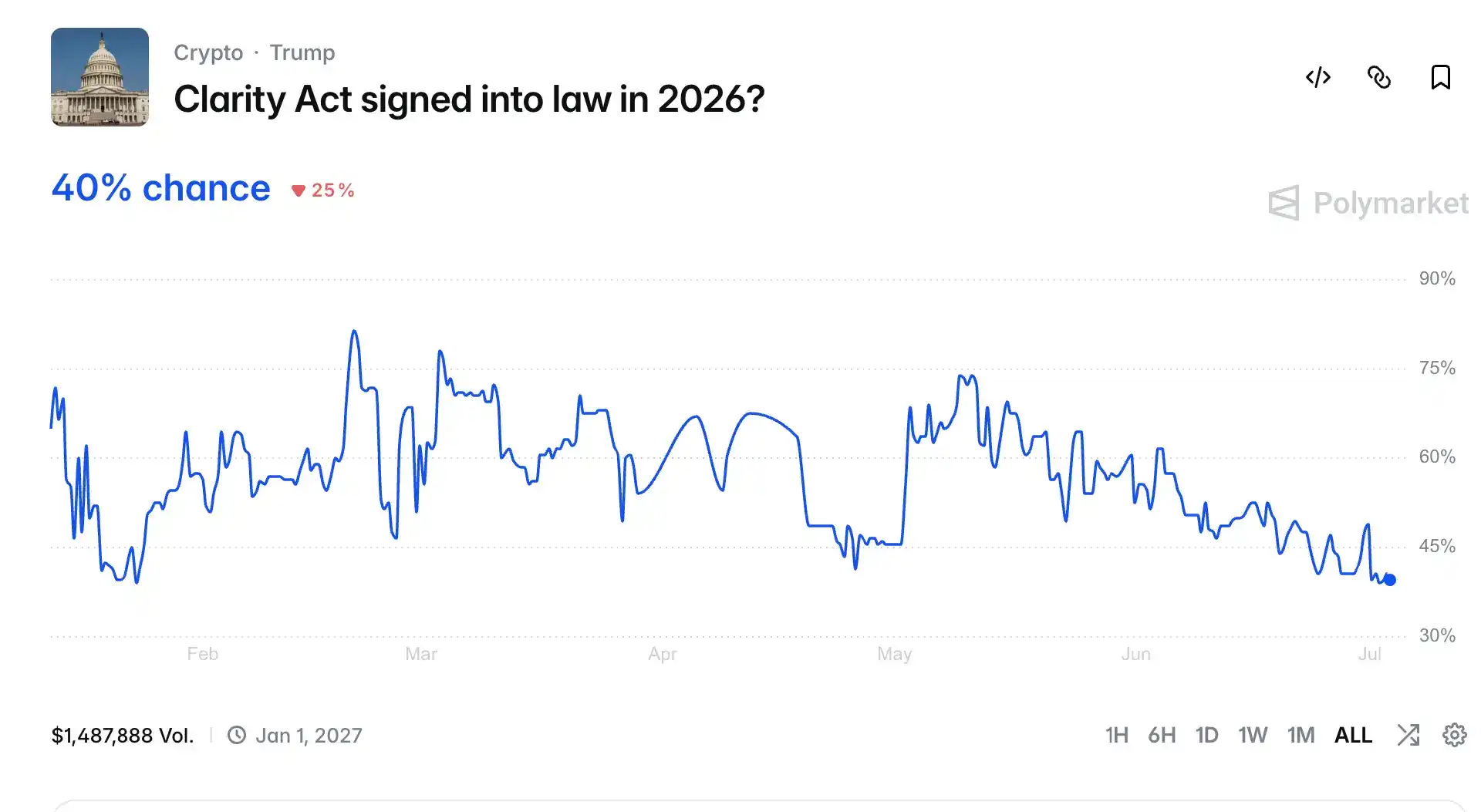
一旦错过 8 月休会前窗口,今年内 CLARITY 法案通过的概率将进一步下降。实际上,预测市场 Polymarket 的数据显示,今年法案通过概率仅为 40%;Galaxy Digital 也将 2026 年通过概率下调至 50%。
一、CLARITY 法案最新进展回顾

CLARITY 法案是美国国会推动的标志性加密货币市场结构立法,旨在明确 SEC 与 CFTC 的监管边界,为去中心化代币提供非证券路径,并要求数字商品中介机构注册及反洗钱义务。

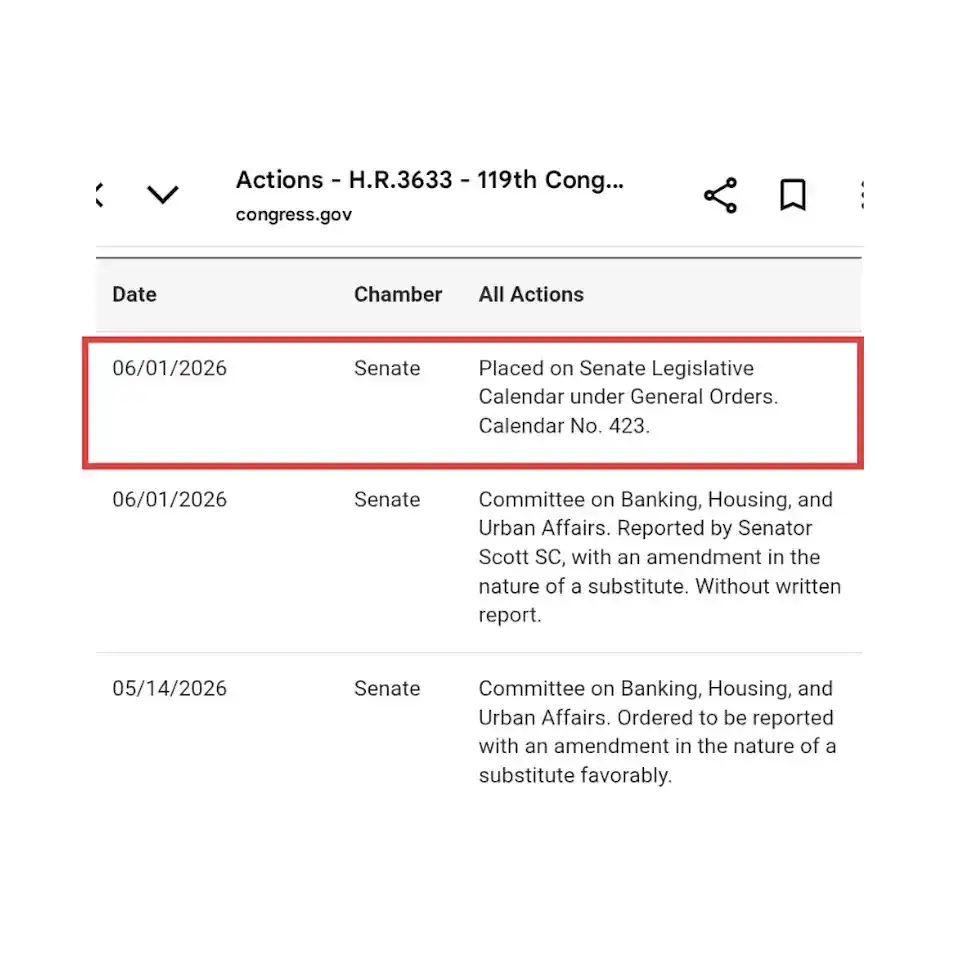
2025 年 7 月 17 日,众议院以 294 票赞成、134 票反对通过了French Hill 提出的 HR 3633 法案,其中民主党人投了 70 多票;2026 年 5 月 14 日,参议院银行委员会推进并以 15-9 票通过(13 名共和党+2 名民主党支持)。2026 年 6 月 1 日,CLARITY 法案正式列入参议院立法日历(Calendar No. 423),具备全面审议资格。

然而,整个 6 月 CLARITY 法案的推进并不顺利。6 月 9 日,围绕总统加密持仓的伦理条款谈判破裂,直接导致部分民主党议员立场软化或提出额外条件,拖慢了法案进入地板辩论的节奏。6 月 10 日,白宫与警察和检察官团体举行会议,之后,围绕《区块链监管确定性法案》中第 604 条款(开发者保护条款)的执法斗争陷入僵局;若不解决,执法团体可能游说反对,民主党议员也可能因“不够保护消费者/打击犯罪”而投反对票。

简单来讲,前者是“政治/伦理门槛”,后者是“执法/安全红线”,共同构成了 CLARITY 法案在参议院“通关”前的最后两大障碍。解决不了,就难以凑齐 60 票和最终文本,也就无法赶在 8 月 10 日休会前完成立法。这两项谈判直接阻碍了 CLARITY 法案的最终推进,导致 7 月 4 日目标落空、整体进度陷入僵局的关键“绊脚石”。目前谈判仍在尝试破冰,但时间已非常紧迫。

斯迪富金融 Stifel 首席华盛顿政策策略师 Brian Gardner 表示,为了使该法案在 2026 年获得通过,“可能需要在 7 月底之前获得参议院通过,最好是在 6 月份”,并警告说,如果参议院错过休会期,前景将大幅恶化。
然而,市场对今年通过法案已经不抱太大的希望。Galaxy Research 负责人 Alex Thorn 于 6 月 5 日将 2026 年通过该法案的预测从 75% 下调至 60%,理由是参议院的议程安排日益紧张。预测市场 Polymarket 的数据显示,今年法案通过概率仅为 40%。

二、《CLARITY 法案》未能按期通过,加密会发生什么?

根据 CCN 的分析,CLARITY 法案若在 8 月休会前无法通过,市场最可能的反应不是崩盘,而是“通过溢价产品缓慢出血”。实际上,整个 6 月加密货币表现不佳,已经说明市场已经开始为立法的不确定性重新定价。(Odaily 注:这里的溢价产品,主要指各种现货 ETF)

数据显示,整个 6 月,美国比特币现货 ETF 累计净流出约 45 亿美元,相当于约 7.7 万枚 BTC 被赎回;这是自 2024 年 1 月产品推出以来最大单月净流出,超过此前 2025 年 2 月的纪录(约 35.6 亿美元),创下历史最差月度纪录。

实际上,XRP 可能是受法案影响最直接、最显著的资产之一,因为法案将使其商品分类永久化,消除可逆的机构解释风险。若长期延迟或失败,XRP 可能失去部分“监管利好溢价”。

渣打银行全球数字资产研究主管 Geoffrey Kendrick 预计 XRP 的目标价为 8 美元,前提是参议院全面通过相关法案,并有 40 亿至 80 亿美元的 ETF 资金流入。摩根大通预测,如果该法案获得通过,XRP ETF 第一年将有 43 亿美元至 84 亿美元资金流入。数据显示,自 2025 年 11 月 XRP 现货 ETF 推出以来,累计净流入约 14.1 亿美元,其中 84%来自零售,机构流入仍待明确监管信号。

对比特币来说,其已通过 2026 年 3 月 SEC 与 CFTC 联合解释被归类为商品,CLARITY 法案的主要作用是将这一可逆决定永久化为联邦法律。即便法案失败或长期延迟,比特币作为“数字黄金”的叙事相对稳健,受直接打击较小。

对 ETH 的影响类似比特币,以太坊也被联合解释归为商品,法案失败可能导致 DeFi 协议面临更长时间的合规模糊,创新和资本流入受抑。渣打银行 Geoffrey Kendrick 预计 ETH 到 2026 年底的目标价为 7,500 美元(后来下调至 4,000 美元),前提是相关法案获得通过。

Solana 政策研究所所长 Kristin Smith 表示,许多资产配置者正在积极探索投资数字资产,但由于监管准则尚未明确,他们暂缓投入资金。同样的道理也适用于机构 DeFi,目前 DeFi 项目也因等待第 604 条款的出台而处于搁置状态。

三、前路在何处?

留给 CLARITY 法案闯关的时间并不多了,接下来可能出现以下几种情况:

  • 一是 8 月休会前通过:最大催化剂,价格可能出现显著反弹,尤其是 XRP 和相关 ETF;
  • 二是推迟至 2027 年:市场最不愿见到,“缓慢出血”过程延长,机构资本继续观望;
  • 三是失败并推至下一届:CLARITY 法案目前处于第 119 届国会。若在 2026 年 8 月休会前未能完成参议院地板投票、协调和最终通过,整个流程就无法在本届国会内结束;新一届国会(第 120 届,2027-2028 年)开始后,必须重新引入法案,重新走完委员会审议、地板辩论等全部程序。

《CLARITY 法案》当前处于“临门一脚却卡壳”的关键阶段,技术上已进入参议院日历,但政治谈判、时间窗口和跨党派支持仍是最大障碍。

然而,正如 First Digital 首席执行官 Vincent Chok 所言:“CLARITY 法案进入参议院地板投票本身就表明美国比以往任何时候都更接近解决监管模糊性......成功投票将加速这一进程,但失败不会必然阻止它。实际上,美国框架的延迟反而会创造紧迫感,并延长设定全球标准的时间窗口,美国有可能成为事实上的全球数字资产中心。”

Trending Cryptos

Related Questions

QCLARITY法案在8月休会前必须完成哪些关键步骤才能通过?

A法案必须在接下来的25个工作日内完成以下关键步骤:在参议院获得至少60票的支持(至少需要7名民主党人倒戈),与参议院农业委员会的文本进行协调,与众议院的法案合并,以及最终由总统签署。

Q根据文章,阻碍CLARITY法案在参议院推进的最后两大障碍是什么?

A最后两大障碍是:第一,围绕总统加密持仓的伦理条款谈判破裂,导致部分民主党议员立场软化或提出额外条件;第二,围绕《区块链监管确定性法案》中第604条款(开发者保护条款)的执法斗争陷入僵局,执法团体可能因此游说反对。

Q如果CLARITY法案今年未能通过,市场对XRP(瑞波币)最可能的影响是什么?

A如果法案长期延迟或失败,XRP可能失去其“监管利好溢价”。因为该法案将使XRP的商品分类永久化,消除可逆的监管解释风险。缺乏这一明确性,其价格上涨预期(如渣打银行预测的8美元目标价)将受到抑制,相关的ETF资金流入也可能不及预期。

Q文章中提到,若法案未通过,比特币和以太坊受到的影响有何不同?

A对比特币直接影响较小,因其已通过SEC与CFTC联合解释被归类为商品,“数字黄金”的叙事相对稳健。对以太坊影响类似,但法案失败可能导致其生态中的DeFi协议面临更长时间的合规模糊,从而抑制创新和资本流入。

Q如果CLARITY法案未能在本届国会(第119届)通过,后续立法流程会怎样?

A如果法案在2026年8月休会前未能完成所有立法程序,整个流程将无法在第119届国会内结束。进入新一届国会(第120届,2027-2028年)后,必须重新引入法案,并从头开始走完委员会审议、地板辩论等全部立法程序。

Related Reads

MSTR Discloses Sale of 3,588 Bitcoins, Stock Price Drops Over 5% at One Point During Trading

MicroStrategy, the world's largest corporate holder of Bitcoin, has significantly shifted its business model. Between June 29 and July 5, the company sold 3,588 bitcoins for approximately $216 million to fund quarterly dividends for its preferred stock. This marks its largest-ever Bitcoin sale and signals a strategic pivot: Bitcoin is transitioning from a "buy-and-hold" reserve asset to a liquidity management tool for the company. This move follows a recent authorization allowing Bitcoin sales when equity fundraising is less attractive. The announcement contributed to a more than 5% intraday drop in MicroStrategy's stock price, while Bitcoin fell to around $61,800—below the company's average holding cost of roughly $75,700. The sale represents a major departure from MicroStrategy's long-standing "never sell" commitment, which saw its first minor breach in May with a $2.5 million sale. The latest, hundred-times-larger transaction underscores growing financial pressures. Analysts note the company faces about $1.5 billion in annual preferred dividend obligations, far exceeding cash flow from its software business. As of July 5, MicroStrategy holds 843,775 bitcoins. Its current operational logic involves buying Bitcoin during favorable financing conditions and selling portions to cover dividends when needed, creating a flexible capital management cycle amidst a challenging market environment.

华尔街日报5h ago

MSTR Discloses Sale of 3,588 Bitcoins, Stock Price Drops Over 5% at One Point During Trading

华尔街日报5h ago

Q-Day Countdown: Will Quantum Computing End Cryptocurrencies?

Quantum Computing's Threat to Cryptocurrency: A Countdown to Q-Day Quantum computing, specifically Shor's algorithm, poses a fundamental threat to the public-key cryptography (e.g., ECDSA, RSA) that secures blockchain networks like Bitcoin and Ethereum. This critical juncture, known as Q-Day, is estimated to occur potentially within the next 5-15 years. The core vulnerability stems from the public and immutable nature of blockchains. Assets in addresses where the public key is already exposed on-chain (e.g., spent outputs) are at direct risk, as a sufficiently powerful quantum computer could derive the private key. This threatens the very trust model of cryptocurrencies. The response lies in Post-Quantum Cryptography (PQC)—algorithms like lattice-based ML-DSA and hash-based SLH-DSA, which are resistant to quantum attacks. NIST has standardized key PQC algorithms (FIPS 203, 204, 205), providing a migration path. However, the primary challenge is not technical but socio-economic and involves complex governance: * **Bitcoin's** path is constrained by its conservative ethos. Migrating requires a soft-fork to new address types, facing hurdles like significantly larger signature sizes and, most critically, the divisive governance question of how to handle at-risk legacy UTXOs without violating core principles. * **Ethereum** is pursuing a "cryptographic agility" strategy, with a multi-layered roadmap. It leverages account abstraction for user accounts and is developing compressed hash-based signatures (e.g., leanXMSS) for its consensus layer, aiming for a full-stack upgrade over time. In conclusion, quantum computing does not spell an instant end for cryptocurrency but initiates a critical countdown. The industry has a limited "engineering comfort window" to orchestrate a coordinated, ecosystem-wide migration to PQC. The ultimate bottlenecks are the immense coordination efforts and governance decisions required for this foundational transition.

marsbit6h ago

Q-Day Countdown: Will Quantum Computing End Cryptocurrencies?

marsbit6h ago

Trump, the President Who Knows Best How to 'Trade Stocks'

Former US President Donald Trump reported a record-breaking $2.2 billion in personal income for 2025, the highest annual income ever disclosed by a sitting president. This figure, from a 927-page government ethics filing, represented a 3.5-fold increase from his $600 million income in 2024 and boosted his net worth to $6.5 billion. The primary drivers were cryptocurrency (64% of income, approximately $1.4 billion) and real estate (26%, approximately $575 million). His crypto earnings stemmed largely from the launch of his personal meme coin, $TRUMP, generating over $600 million in licensing fees, and substantial profits from the WLFI token and its parent company. Despite a sluggish property market, his Mar-a-Lago resort and associated golf clubs saw revenue surges of 50% and 27%, respectively, attributed to their use as venues for presidential events. Trump's financial disclosure also revealed an unprecedented level of stock market activity, with over 22,000 trades executed in 2025, averaging 87 trades per market day. Media analyses noted several instances where significant trading coincided with major policy announcements, such as proposed tariffs, raising questions about potential conflicts of interest. While the White House stated these trades were handled by a family-managed trust fund and not Trump directly, critics highlighted this as a departure from the blind trusts traditionally used by presidents post-Watergate. The report has intensified debate over the commercialization of the presidency. Supporters view it as a success story of a businessman-president, while critics argue it demonstrates an unprecedented conversion of public influence into private wealth, with policy decisions potentially linked to personal financial gains. The controversy centers on whether Trump's earnings represent innovative entrepreneurship or a fundamental conflict of interest, sparking renewed calls for stricter ethics reforms in US governance.

marsbit6h ago

Trump, the President Who Knows Best How to 'Trade Stocks'

marsbit6h ago

Trading

Spot

Hot Articles

What is DOGE M

Doge Matrix ($doge m): The New Breed of Community-Driven Cryptocurrency Introduction In the ever-evolving landscape of cryptocurrency, new projects constantly emerge, each aiming to capture the interest of investors and enthusiasts alike. One of the latest entrants to this domain is Doge Matrix, represented by the ticker symbol $doge m. This project has attracted attention thanks to its roots in the popular meme culture surrounding Dogecoin, establishing its place within the web3 space. This article aims to provide a comprehensive analysis of Doge Matrix, covering its overview, creator, investors, functionality, timeline, and notable aspects. What is Doge Matrix ($doge m)? Doge Matrix is a community-driven cryptocurrency project that seemingly builds upon the widespread appeal of Dogecoin, a digital currency known for its Shiba Inu mascot and its meme origins. While the overarching objectives of Doge Matrix are not extensively defined, it is characterized by a commitment to harnessing community involvement and support. Unlike traditional cryptocurrencies that often emphasize utility or intrinsic value through underlying technologies, Doge Matrix positions itself within a space that embraces the cultural phenomenon of cryptocurrencies, particularly appealing to those who resonate with the ethos of meme-based assets. Drawing on the strengths of the Dogecoin community, Doge Matrix operates as part of a broader ecosystem, inviting participation and engagement from users who share an interest in cryptocurrency and the digital landscape. Who is the Creator of Doge Matrix ($doge m)? The identity of the creator of Doge Matrix remains unknown. This lack of transparency is not an uncommon occurrence in the cryptocurrency space, where some projects are launched without revealing the identities of their founders. The absence of information regarding the founding team can raise questions among potential investors about the project’s accountability and direction. Who are the Investors of Doge Matrix ($doge m)? As it stands, there is no publicly available information detailing the investors or investment foundations that back Doge Matrix. The project appears to rely primarily on community support rather than institutional investment. This model aligns with the community-driven nature of the initiative, fostering an environment where the direction of the project is shaped by its participants rather than being dictated by a select few financial backers. How Does Doge Matrix ($doge m) Work? The specifics regarding the operational mechanisms of Doge Matrix are somewhat vague, reflecting a broader trend of projects in the meme coin space where innovative functionalities are not always clearly articulated. Nonetheless, Doge Matrix seems designed to tap into the existing cryptocurrency ecosystem by encouraging user participation while tapping into the familiar cultural references associated with Dogecoin. Its potentially unique characteristics derive from community interactions rather than technological advancements, emphasizing shared experiences and collaboration among token holders. While the exact innovations have not been explicitly outlined, the project appears to create a space where community members can engage, share ideas, and propel the project's potential forward. Timeline of Doge Matrix ($doge m) Reflecting on the project’s timeline reveals notable events that have defined its journey thus far: November 25, 2024: Doge Matrix reached its all-time high value, marking a significant milestone in its early history. January 1, 2025: Conversely, Doge Matrix hit its all-time low value, illustrating the volatility often associated with cryptocurrencies, especially in the early stages of a project's lifecycle. Ongoing: The project continues to be actively traded and supported by its community, although specific future milestones or objectives have yet to be disclosed. Key Points About Doge Matrix ($doge m) Community Focus At the heart of Doge Matrix is a commitment to community engagement. The project thrives on the premise of collaboration and shared objectives among its members, emphasizing the importance of collective effort. Unlike centralized projects that often have a defined leadership structure, Doge Matrix at present showcases a more fluid approach to governance, where every community member's voice matters. Volatility The cryptocurrency market is notorious for its volatility, and Doge Matrix is no exception. Its price history reflects significant fluctuations between high and low values, which is typical of many new cryptocurrencies but underscores the risks associated with investment in emerging tokens. Lack of Detailed Information One of the most striking features about Doge Matrix is the scarcity of detailed information regarding its technological underpinnings and operational mechanisms. This ambiguity necessitates that potential investors conduct thorough due diligence before engaging with the project. Conclusion In summary, Doge Matrix ($doge m) illustrates a new wave of cryptocurrency projects that lean heavily on community engagement and cultural relevance. While lacking in certain specifics—such as clear leadership, defined objectives, and detailed functionality—the project has managed to generate interest within the crypto community, leveraging the established appeal of meme culture. As with any investment in the cryptocurrency space, understanding the inherent risks and conducting comprehensive research is essential for potential participants. Doge Matrix stands as a reminder of the dynamic, sometimes unpredictable nature of the crypto industry, marked by constant evolution and enthusiasm for community-driven initiatives.

3.9k Total ViewsPublished 2025.02.03Updated 2025.02.03

What is DOGE M

What is $M

Understanding Mantis ($M): A New Era in Cross-Chain Interoperability In the continually evolving landscape of Web3 and cryptocurrency, new projects strive to offer innovative solutions aimed at enhancing the user experience and expanding functional possibilities within the decentralized financial ecosystem. One such project garnering attention is Mantis ($M), a pioneering protocol founded on the principles of cross-chain interoperability and intent-based settlements. This article delves into the essential aspects of Mantis, including its core functionality, creators, investment backing, innovative features, and critical milestones. What is Mantis ($M)? Mantis is described as a multi-domain intent settlement protocol that simplifies cross-chain interactions, enabling users to execute complex financial transactions across various blockchain platforms seamlessly. The protocol operates through three primary layers: Intent Expression: Users can articulate their transaction goals using natural language facilitated by the DISE LLM, an advanced AI language model. For instance, a user might express a desire to swap Ethereum (ETH) for Solana (SOL) with a specific slippage tolerance of 1%. Execution: This layer employs a network of solvers that compete to fulfill user intents. Transactions are executed using mechanisms such as Coincidence of Wants (CoWs) and Order Flow Auctions (OFAs), which ensure that user demands are met optimally. Settlement: Leveraging the Inter-Blockchain Communication (IBC) protocol, Mantis enables atomic cross-chain transactions, allowing users to operate across various supported chains, including Ethereum, Solana, and Cosmos. Mantis is engineered to introduce native yield generation for idle assets, employing cryptographic proofs to maintain the integrity of transactions throughout the entire process. Creators & Development Team Mantis was conceived by the Composable Foundation, a research-driven organization notable for its emphasis on blockchain interoperability solutions. This foundation collaborates with esteemed academic institutions, including Harvard University and the University of Lisbon, contributing to extensive research and development efforts that inform Mantis's architecture and functionality. The Composable Foundation’s commitment to fostering innovation in the blockchain space positions Mantis as a robust solution for the growing demand for interoperability among multiple blockchain networks. Investors & Backing While specific details about individual investors have not been publicly disclosed, Mantis enjoys substantial backing from various entities, including: Ecosystem grants from IBC-enabled chains, which support the protocol's growth and integration within decentralized finance ecosystems. Strategic partnerships with infrastructure providers that enhance Mantis's network capabilities and deployment strategies. Funding through the Composable Foundation's treasury, ensuring sustained financial support for ongoing development and operational costs. These collaborative efforts reflect a consensus among stakeholders about the importance of enhancing cross-chain functionality and the potential utility of Mantis's infrastructural innovations. Key Innovations Mantis sets itself apart through several pioneering innovations that enhance its functionality and utility: Chain-Agnostic Intents: Users can initiate transactions from any supported chain while settling on another. This flexibility empowers users, driving increased interaction among different platforms. AI-Powered Interface: The integration of DISE LLM allows users to conduct complex DeFi operations using natural language, thereby simplifying interactions and making blockchain technology accessible to a broader audience. Cross-Domain MEV Capture: Mantis creates an internal market for maximal extractable value (MEV) through competitions among solvers. This innovative approach allows for greater efficiency and value extraction in complex transactions. Modular Settlement Layer: The protocol supports various verification methods, including zero-knowledge proofs and optimistic rollups, providing a versatile framework that can adapt to emerging blockchain technologies. Historical Timeline Mantis's development is marked by several critical milestones that chart its trajectory and growth: | Year | Milestone | |————|————————————————————————-| | 2022 | Initial concept development within the Composable Foundation's research division. | | Q3 2024 | Launch of the testnet with bridging capabilities between Solana and Ethereum. | | Q1 2025 | Anticipated Token Generation Event (TGE) alongside the mainnet launch. | | Q2 2025 | Expected integration of DISE LLM and expansion of cross-chain capabilities. | | 2025 H2 | Planned support for over 15 chains through further IBC upgrades. | This timeline outlines Mantis's evolution, from conceptual discussions to active implementation and future growth phases. Ecosystem Growth Strategy Mantis's strategy for ecosystem growth includes several initiatives designed to encourage user participation and developer engagement: Credits System: Users can earn protocol credits by providing liquidity and engaging in referral programs. These credits are redeemable for incentives in the future, fostering a robust user community. Modular Software Development Kit (SDK): This toolkit empowers developers to create applications based on intent-driven models utilizing Mantis's infrastructure, thus promoting innovation within its ecosystem. Governance Model: As the protocol matures, $M token holders will have a voice in protocol governance, allowing them to vote on proposed upgrades and changes, thereby enhancing community engagement and decentralization. Mantis represents a significant advancement in the realm of cross-chain architecture. By seamlessly integrating advanced AI algorithms with a robust settlement framework, Mantis seeks to tackle the problems of fragmentation within multi-chain ecosystems. Its innovative approach prioritizes improved user experiences while adhering to the foundational principles of decentralization and security, setting a new standard for the future interoperability of blockchain technologies. As Mantis continues its journey of growth and implementation, it promises to be a project to watch closely in the competitive landscape of Web3 and decentralized finance. With its focus on crossing boundaries and elevating user engagement, Mantis is poised to be an integral part of the future developments in the cryptocurrency space.

384 Total ViewsPublished 2025.03.18Updated 2025.03.18

What is $M

How to Buy M

Welcome to HTX.com! We've made purchasing MemeCore (M) simple and convenient. Follow our step-by-step guide to embark on your crypto journey.Step 1: Create Your HTX AccountUse your email or phone number to sign up for a free account on HTX. Experience a hassle-free registration journey and unlock all features.Get My AccountStep 2: Go to Buy Crypto and Choose Your Payment MethodCredit/Debit Card: Use your Visa or Mastercard to buy MemeCore (M) instantly.Balance: Use funds from your HTX account balance to trade seamlessly.Third Parties: We've added popular payment methods such as Google Pay and Apple Pay to enhance convenience.P2P: Trade directly with other users on HTX.Over-the-Counter (OTC): We offer tailor-made services and competitive exchange rates for traders.Step 3: Store Your MemeCore (M)After purchasing your MemeCore (M), store it in your HTX account. Alternatively, you can send it elsewhere via blockchain transfer or use it to trade other cryptocurrencies.Step 4: Trade MemeCore (M)Easily trade MemeCore (M) on HTX's spot market. Simply access your account, select your trading pair, execute your trades, and monitor in real-time. We offer a user-friendly experience for both beginners and seasoned traders.

7.7k Total ViewsPublished 2025.07.02Updated 2026.06.02

How to Buy M

Discussions

Welcome to the HTX Community. Here, you can stay informed about the latest platform developments and gain access to professional market insights. Users' opinions on the price of M (M) are presented below.

活动图片