Solana launches SGP governance as staked supply crosses 68%: Details

ambcryptoPublished on 2026-07-02Last updated on 2026-07-02

Abstract

The Solana Foundation has launched Solana Governance Proposals (SGP), a new on-chain mechanism allowing validators to vote on ecosystem issues through stake-weighted voting. With nearly 68% of SOL's supply already staked, SGP aims to boost validator participation, further strengthening network security and health. The launch coincides with strong on-chain momentum for Solana, including record Real-World Asset (RWA) value exceeding $3 billion and a 17.3% spike in Open Interest to $2.3 billion, potentially driven by growing institutional demand and infrastructure like SPCX. Despite broader market weakness, factors like corporate treasury accumulation and a potential tightening of liquid supply from increased staking suggest SOL's movement around $80 may signal trend continuation rather than mere resistance.

Voting power is a strong incentive to attract validators and improve overall network health.

The idea is simple: Giving validators a say in governance brings more participation into the network. More validators means stronger security, improving network health, developer activity, and, in turn, more demand.

In this context, Solana’s latest move is getting attention.

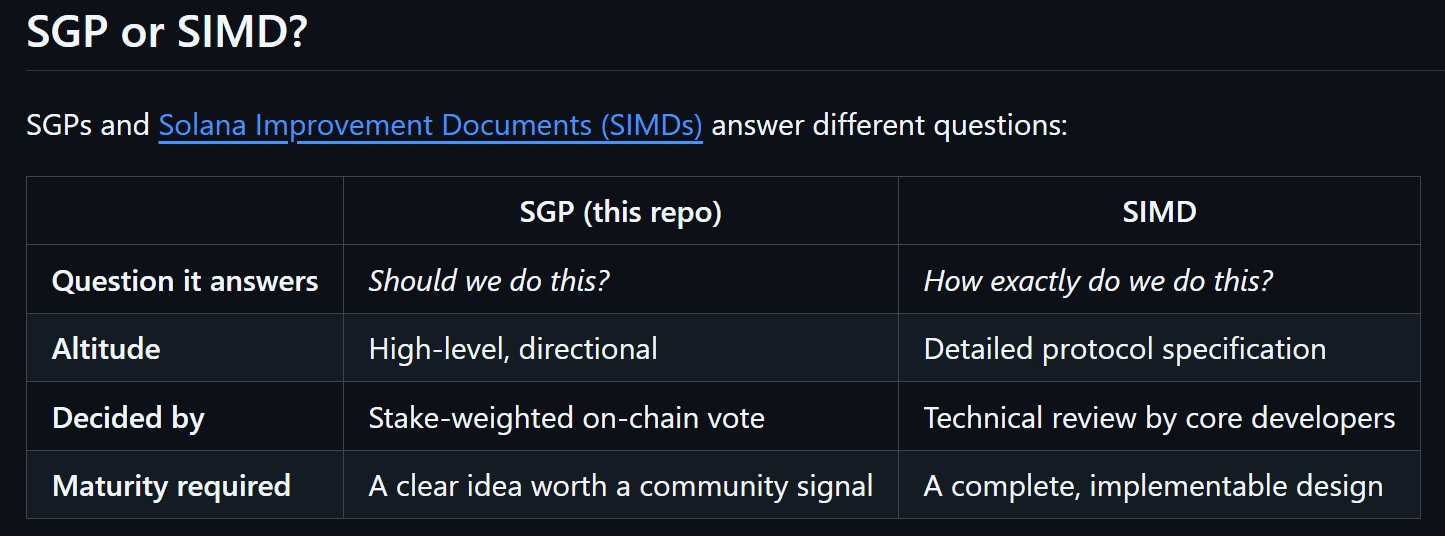
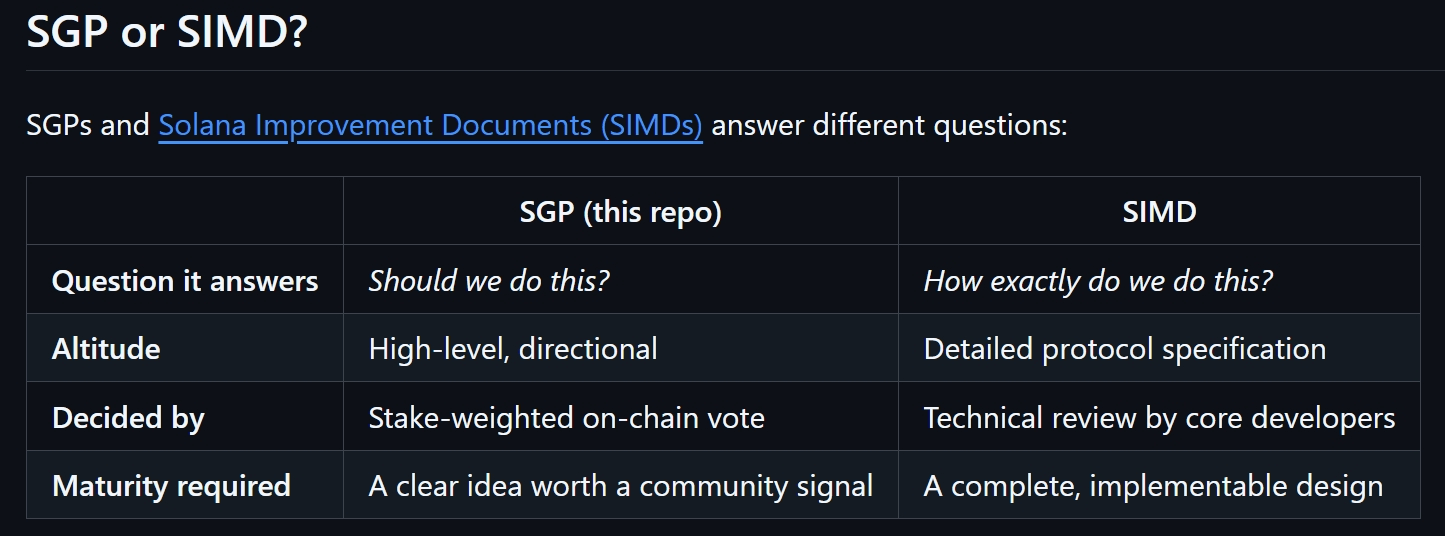
The Solana Foundation has launched Solana Governance Proposals (SGP), a new on-chain governance mechanism that lets validators vote on ecosystem governance issues through stake-weighted voting.
Source: X

Interestingly, any validator with at least 100,000 delegated SOL can submit an SGP. However, a proposal must first gain backing from at least 15% of the network’s total staked SOL before moving to a formal vote.

From a technical standpoint, the impact could be notable.

According to Blockworks data, nearly 68% of Solana’s circulating supply is already staked across more than 700 validators. With SGP now live, governance participation could become more active, potentially pushing more SOL into staking and further strengthening the validator ecosystem.

From a market standpoint, the timing couldn’t be better. With Q3 just underway, the launch adds another bullish catalyst, positioning Solana [SOL] to build on its recent momentum as network participation and staking activity continue to improve.

Why Solana’s OI spike could signal strength

Despite broader market weakness, Solana closed June with strong on-chain momentum.

The move was fundamentally driven. Solana’s total RWA value climbed to a new all-time high above $3 billion, rising more than 25% month over month and outperforming every other major chain.

The launch of SPCX on Solana has further strengthened its RWA infrastructure, making the sector an increasingly important growth driver for the network heading into H2.

Notably, that momentum is now feeding into the derivatives market.

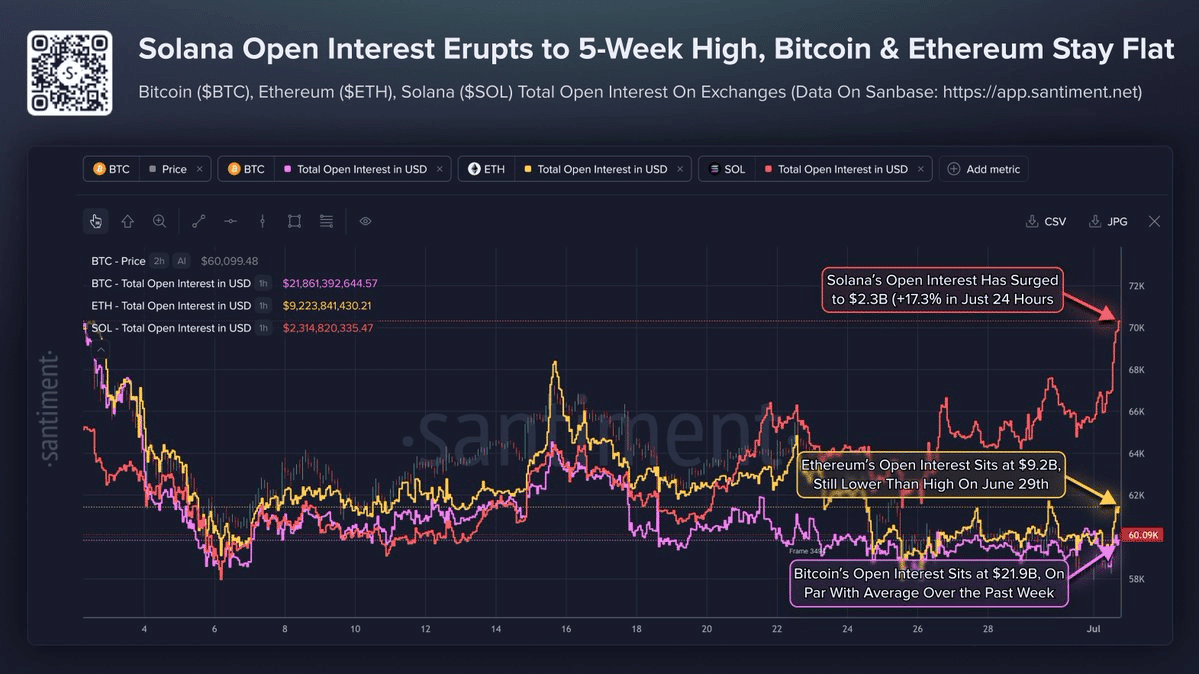
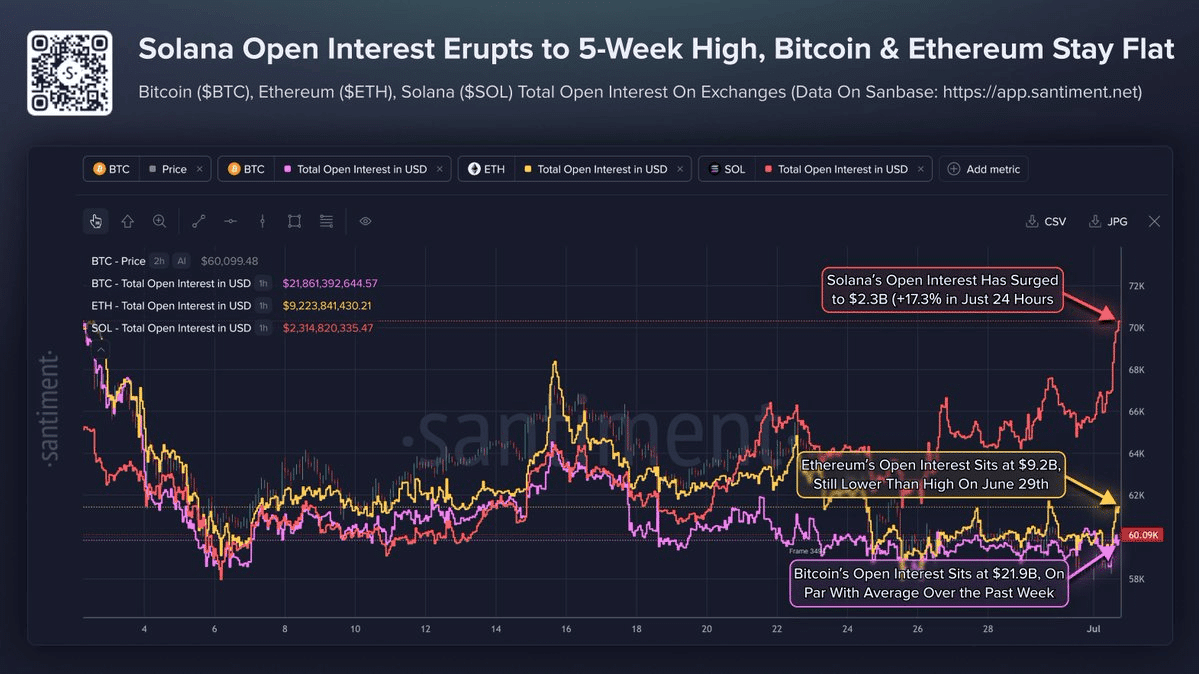
As the chart below shows, SOL Open Interest jumped 17.3% over the past 24 hours to a five-week high of $2.3 billion, while Bitcoin and Ethereum Open Interest remained largely flat.

The likely catalyst is Solana’s expanding role in tokenized equities, xStocks, and other on-chain financial products.
Source: Santiment

Normally, a sharp jump in Open Interest signals rising leverage and the risk of a volatile unwind. Even so, Solana’s current setup looked different.

With SOL trading around $80, Forward Industries resumed accumulating the asset.

The largest corporate SOL treasury added more than 500,000 SOL during fiscal Q3 at an average purchase price of $79, taking total holdings to 7.55 million. That suggested the latest Open Interest expansion may have been supported by renewed demand.

Meanwhile, SGP is giving validators a bigger role in protocol governance, creating stronger incentives to stake and participate in the network. If more SOL continues moving into staking, the liquid supply could tighten further.

In that context, SOL’s retest of the $80 level looks less like a resistance test and more like the early stages of a broader trend continuation.


Final Summary

  • SGP gives validators more governance power, encouraging higher staking participation.
  • Strong RWA growth, treasury buying, and rising Open Interest are driving SOL’s momentum beyond speculation.


Trending Cryptos

Related Questions

QWhat is Solana Governance Proposals (SGP) and what is its main purpose?

ASolana Governance Proposals (SGP) is a new on-chain governance mechanism launched by the Solana Foundation. Its main purpose is to give validators a say in ecosystem governance through stake-weighted voting, aiming to increase validator participation, strengthen network security, and improve overall network health and demand.

QWhat is the minimum amount of delegated SOL a validator needs to submit an SGP?

AA validator needs at least 100,000 delegated SOL to submit a Solana Governance Proposal (SGP).

QAccording to the article, what percentage of Solana's circulating supply is currently staked?

AAccording to Blockworks data cited in the article, nearly 68% of Solana's circulating supply is already staked across more than 700 validators.

QWhat recent financial development for Solana is highlighted as a key growth driver, and what milestone did it reach?

AThe article highlights Solana's Real World Asset (RWA) sector as a key growth driver. It reached a new all-time high, with its total RWA value climbing above $3 billion, representing more than a 25% increase month over month.

QWhat corporate action does the article mention as potentially supporting the recent increase in Solana's Open Interest?

AThe article mentions that Forward Industries, the largest corporate SOL treasury, resumed accumulating SOL. It added over 500,000 SOL during fiscal Q3, suggesting the Open Interest expansion may have been supported by this renewed institutional demand.

Related Reads

A Decade of Change: The Demise of Crypto Startups

"The Decade-Long Transformation: The Demise of Crypto Startups" The article traces the dramatic evolution of the cryptocurrency industry from its anarchic beginnings to its current highly regulated and institutionalized state. In the early days (circa 2017), launching a crypto startup was remarkably simple: a whitepaper, a GitHub repository, and a Telegram group could attract thousands of retail investors via an Initial Coin Offering (ICO). Founders operated anonymously with near-zero regulatory and financial barriers, enabling rapid, global innovation but also widespread fraud. By 2026, the landscape is fundamentally different. To operate in major markets like the US, EU, and Asia, crypto businesses must now navigate a complex web of regulations akin to traditional finance. Compliance costs are prohibitive: estimates for a US multi-state operation range from $750,000 to $1.2 million in the first three years, with annual costs exceeding $2 million thereafter. Regulations like MiCA in the EU and New York's BitLicense have created high capital and operational hurdles that act as barriers to entry. Simultaneously, venture capital investment has shifted dramatically. Following the collapses of Terra and FTX, funding has concentrated in later-stage, established companies, creating a "barbell market." Early-stage and seed funding has shrunk significantly, while mega-funds like Andreessen Horowitz's $15 billion pool dominate. Most capital now flows to trading platforms, lending infrastructure, and B2B services. This environment favors mergers and acquisitions as the primary path for growth. Companies like Coinbase and Ripple are acquiring firms like Deribit and Hidden Road not for their technology, but for their licenses, banking relationships, and institutional trust—assets far more valuable than code. Distribution channels, compliance, and brand reputation have become the new moats, overshadowing pure technical innovation. The industry's maturation brings benefits: reduced scams, increased institutional participation, and clearer regulatory frameworks. However, it comes at a cost. The low-barrier, experimental ethos that defined crypto's first decade is fading. Entrepreneurs without substantial capital, pre-existing licenses, or institutional connections face immense challenges. Funding for exploratory fields like decentralized social media or novel governance models is drying up. Ultimately, the crypto industry is replicating the consolidation pattern seen in banking and tech after the 2008 financial crisis. While this brings stability and legitimacy, it raises a critical question: in this new, resource-intensive reality, is there still room for the disruptive, from-scratch innovation that gave birth to the sector?

Foresight News18m ago

A Decade of Change: The Demise of Crypto Startups

Foresight News18m ago

Trading

Spot

Hot Articles

Discussions

Welcome to the HTX Community. Here, you can stay informed about the latest platform developments and gain access to professional market insights. Users' opinions on the price of SOL (SOL) are presented below.

活动图片