Is Cardano’s price rally over? Here’s why ADA could target $0.30 next

ambcryptoPublished on 2026-07-06Last updated on 2026-07-06

Abstract

Cardano (ADA) has started Q3 with a strong 30% rally, outperforming many altcoins. However, it faces a key resistance at $0.20, a level it has failed to break previously, leading to a recent 2% pullback. On-chain data shows a concerning 68% yearly drop in Total Value Locked (TVL), suggesting liquidity hasn't kept pace with the price rise. Despite this, the network has consistently added thousands of new wallets since mid-2023, indicating growing user adoption beneath the surface. If ADA can decisively break above the $0.20 resistance, turning it into support, the next targets could be $0.25 and potentially $0.30, especially within a historically bullish July for altcoins. The current cooldown may represent a healthy reset rather than a trend reversal.

Every sharp parabolic rally can easily be written off as another hype cycle.

At first glance, Cardano [ADA] seems to fit that narrative. After three consecutive red quarters, each posting average losses of more than 40%, ADA had become one of the weakest-performing major altcoins this cycle. But is that trend finally starting to reverse?

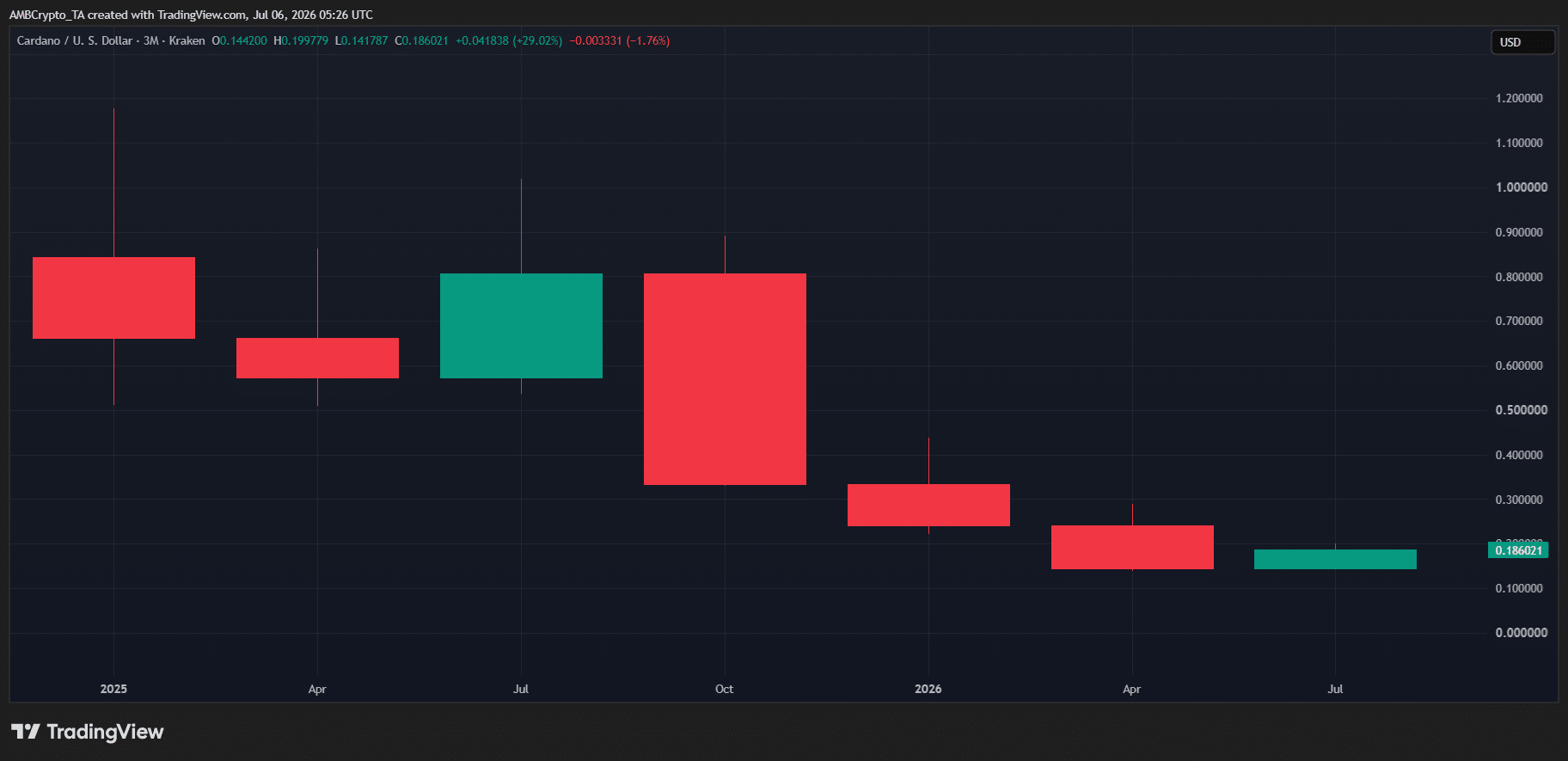
From the technical standpoint, ADA has kicked off Q3 with a strong 30% rally, outperforming the broader altcoin market. More notably, its gains are over 2.3x larger than Ethereum’s [ETH] so far this quarter, suggesting that capital may be rotating back into ADA as momentum begins to build.
Source: TradingView (ADA/USDT)

But zooming into the charts, things start looking a bit different.

On the daily timeframe, ADA has already pulled back more than 2% in under 48 hours after pushing above the $0.20 level, a resistance it also failed to clear back in mid-June. That repeated rejection keeps a breakdown firmly in play. Pair that with a near-parabolic run over the past week, and it’s not surprising to see traders taking profits instead of chasing higher prices.

At first glance, that makes it easy to label ADA’s rally as just another hype cycle. The fundamentals don’t help that case either. Cardano’s total value locked (TVL) has dropped nearly 68% over the past year. According to DefiLlama, TVL has fallen from $276.19 million to around $89.16 million today, a sharp decline that suggests on-chain liquidity has yet to catch up with the recent price action.

Taken together, the charts and on-chain data make ADA’s recent 2% pullback look like the start of a deeper correction. But markets are all about timing. And right now, the timing suggests FOMO is still in play.

On-chain data strengthens ADA’s bullish case

Cardano’s strong start to Q3 could be the first sign that momentum is finally shifting back in ADA’s favor.

The technicals, however, still have one job to do: flip resistance into support. Currently, $0.20 remains the key level to watch. A clean break above it could be enough to bring FOMO, with $0.25 acting as the next major hurdle. If that level gives way, a move toward $0.30 starts looking increasingly realistic.

The broader backdrop is also turning supportive. Altcoin momentum continues to build, and July has historically been one of the strongest months for the sector. That makes ADA’s recent cooldown look more like a healthy reset than a trend reversal, putting the focus on what the on-chain data is saying.
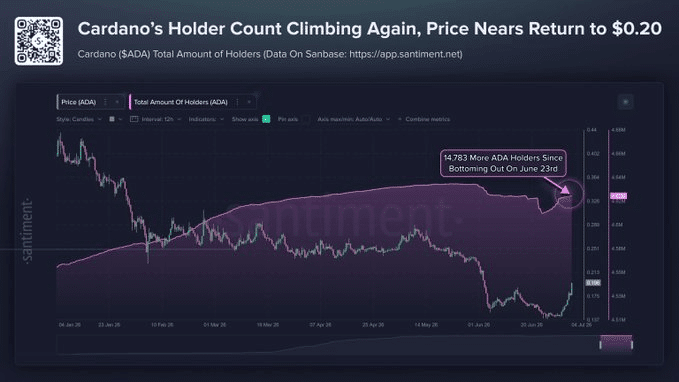
Source: Santiment

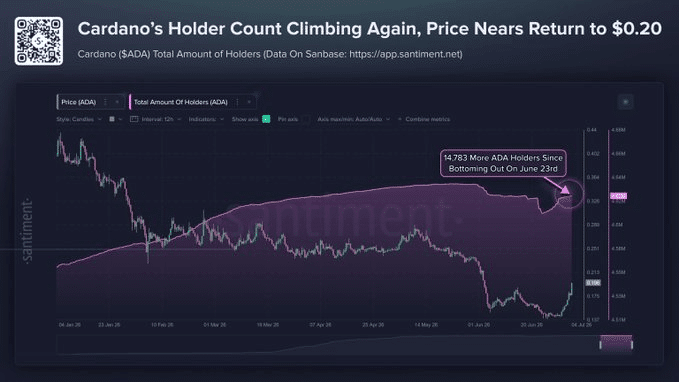
According to Santiment, Cardano has added 14,783 new non-empty wallets since its June 2023 low.

The timing is key. Just weeks ago, ADA was at the center of peak FUD, with concerns over ecosystem growth and technical weakness. Yet wallet growth continued to climb even as TVL kept slipping.

That’s an interesting divergence. Liquidity may still be lagging, but user participation isn’t. If anything, it suggests conviction is quietly building beneath the surface, increasing the odds that price eventually catches up. If ADA can reclaim $0.20, the path toward $0.30 starts looking much more realistic.


Final Summary

Trending Cryptos

Related Questions

QWhat is the key resistance level that ADA needs to break to potentially target $0.30, according to the article?

AThe key resistance level is $0.20. The article states that a clean break above this level could bring FOMO, with $0.25 as the next major hurdle, and if that level gives way, a move toward $0.30 becomes more realistic.

QHow much has Cardano's Total Value Locked (TVL) declined over the past year, according to the article?

ACardano's TVL has declined nearly 68% over the past year, falling from $276.19 million to around $89.16 million.

QWhat on-chain metric from Santiment does the article cite to support a potential bullish case for ADA?

AThe article cites wallet growth. According to Santiment, Cardano has added 14,783 new non-empty wallets since its June 2023 low, suggesting increasing user participation and conviction despite the decline in TVL.

QHow does the article characterize ADA's recent 2% pullback after reaching above $0.20?

AThe article suggests the pullback could look like the start of a deeper correction based on charts and on-chain data, but within the broader context of building altcoin momentum, it may instead appear more like a healthy reset than a trend reversal.

QHow did ADA's price performance in Q3 compare to Ethereum's, according to the technical analysis in the article?

AADA kicked off Q3 with a strong 30% rally, and its gains were over 2.3x larger than Ethereum's (ETH) gains so far in the quarter, suggesting capital may be rotating back into ADA.

Related Reads

1600 Lines of Code Create an Underwater Manhattan, Fable 5 Leaves Karpathy Stunned

Title: Fable 5 Stuns Karpathy with 3D Worlds Built from 1600 Lines of Code An AI model, Fable 5, has demonstrated a remarkable leap in generating complex, interactive 3D worlds with minimal code. Showcased by Peter Gostev of Arena.ai, the model created 63 diverse 3D environments across themes like immersive cityscapes, explorable famous paintings, natural wonders, and cosmic phenomena. Many were generated in a single attempt. A standout creation is a detailed, submerged Manhattan built with only 1600 lines of Three.js code. Other highlights include traversable versions of Van Gogh's "Starry Night," a bear catching a salmon with realistic physics, and a split Red Sea. The model's ability to cohesively manage vast numbers of elements within a scene represents a significant technical advancement. Andrej Karpathy, who recently joined Anthropic's pre-training team, expressed amazement, particularly at how the model intuitively understood and rendered complex real-world interactions like a fish struggling when caught. He coined the term "fablemaxxing" to describe this qualitative leap. While Fable 5 excels at world-building, Gostev notes current limitations in creating engaging, long-form gameplay. The model also sometimes requires prompting to fully utilize its capabilities. Having topped the Agent Arena benchmark for real-world task completion, Fable 5 signals that the boundaries of AI-generated content are rapidly expanding, with its full potential yet to be discovered.

marsbit6m ago

1600 Lines of Code Create an Underwater Manhattan, Fable 5 Leaves Karpathy Stunned

marsbit6m ago

From ANSEM to CZ, The Celebrity Coin Relay Race Between Solana and BSC

The past week was a whirlwind of on-chain activity, sparked by the meteoric rise of $ANSEM, a Solana-based meme coin that surged 600x and hit a $100 million market cap in a single day. This rally began when crypto influencer Ansem announced his return to buying Solana meme coins and publicly advocated for an airdrop from the platform pump.fun. Ansem’s subsequent "soft claim" of the token—promising to airdrop creator revenue to followers—ignited a frenzy, drawing comparisons to past community-led token distributions. However, his dual role as a co-founder of the trading terminal Bullpen, which later hosted the $ANSEM airdrop, suggests a strategic promotional element. The narrative quickly shifted to "celebrity coins," where tokens named after influencers are sent to their public addresses in hopes of endorsement. While a similar coin, $TJR, briefly gained traction, it faltered after the influencer TJR urged focus back on $ANSEM. Attention then turned to projects Ansem endorsed and coins found in his wallet, like $manlet, but momentum on Solana began to stall. The action then migrated to BSC with the viral resurgence of a 2021 tweet from former Binance CEO CZ, referencing a "final form" bull. This sparked the explosive launch of $CZ, which briefly approached a $90 million market cap despite expectations that CZ wouldn't actively engage like Ansem. Another BSC token, $TCC, gained attention due to CZ's interactions with its promoter. The BSC ecosystem saw faster-paced, albeit volatile, "celebrity coin" plays, with tokens like $dingaling experiencing rapid pumps and dumps without official endorsements. Currently, BSC shows more momentum for new token launches than Solana, with the market awaiting a new narrative to succeed the fleeting "celebrity coin" trend.

marsbit16m ago

From ANSEM to CZ, The Celebrity Coin Relay Race Between Solana and BSC

marsbit16m ago

A Decade of Change: The Demise of Crypto Startups

"The Decade-Long Transformation: The Demise of Crypto Startups" The article traces the dramatic evolution of the cryptocurrency industry from its anarchic beginnings to its current highly regulated and institutionalized state. In the early days (circa 2017), launching a crypto startup was remarkably simple: a whitepaper, a GitHub repository, and a Telegram group could attract thousands of retail investors via an Initial Coin Offering (ICO). Founders operated anonymously with near-zero regulatory and financial barriers, enabling rapid, global innovation but also widespread fraud. By 2026, the landscape is fundamentally different. To operate in major markets like the US, EU, and Asia, crypto businesses must now navigate a complex web of regulations akin to traditional finance. Compliance costs are prohibitive: estimates for a US multi-state operation range from $750,000 to $1.2 million in the first three years, with annual costs exceeding $2 million thereafter. Regulations like MiCA in the EU and New York's BitLicense have created high capital and operational hurdles that act as barriers to entry. Simultaneously, venture capital investment has shifted dramatically. Following the collapses of Terra and FTX, funding has concentrated in later-stage, established companies, creating a "barbell market." Early-stage and seed funding has shrunk significantly, while mega-funds like Andreessen Horowitz's $15 billion pool dominate. Most capital now flows to trading platforms, lending infrastructure, and B2B services. This environment favors mergers and acquisitions as the primary path for growth. Companies like Coinbase and Ripple are acquiring firms like Deribit and Hidden Road not for their technology, but for their licenses, banking relationships, and institutional trust—assets far more valuable than code. Distribution channels, compliance, and brand reputation have become the new moats, overshadowing pure technical innovation. The industry's maturation brings benefits: reduced scams, increased institutional participation, and clearer regulatory frameworks. However, it comes at a cost. The low-barrier, experimental ethos that defined crypto's first decade is fading. Entrepreneurs without substantial capital, pre-existing licenses, or institutional connections face immense challenges. Funding for exploratory fields like decentralized social media or novel governance models is drying up. Ultimately, the crypto industry is replicating the consolidation pattern seen in banking and tech after the 2008 financial crisis. While this brings stability and legitimacy, it raises a critical question: in this new, resource-intensive reality, is there still room for the disruptive, from-scratch innovation that gave birth to the sector?

Foresight News1h ago

A Decade of Change: The Demise of Crypto Startups

Foresight News1h ago

Trading

Spot

Hot Articles

Discussions

Welcome to the HTX Community. Here, you can stay informed about the latest platform developments and gain access to professional market insights. Users' opinions on the price of S (S) are presented below.

活动图片