Chainlink gains 8,000 new holders – Can LINK break its downtrend?

ambcryptoPublished on 2026-06-30Last updated on 2026-06-30

Abstract

Chainlink (LINK) added over 8,000 new holders in five days, pushing its non-empty wallet count to 892.8K, signaling continued user adoption despite ongoing price weakness. This growth is attributed to interest in real-world asset tokenization and institutional blockchain initiatives. On-chain data shows persistent exchange outflows, indicating accumulation rather than distribution, though this has not yet translated to a price breakout. LINK continues to trade within a descending channel, defending the $7.00 support level but struggling to challenge the upper resistance near $8.31. The RSI remains weak but not oversold. Despite the bearish trend, derivatives data shows a positive funding rate, reflecting sustained bullish conviction among leveraged traders. The summary suggests that if wallet growth and accumulation continue, LINK could eventually challenge the downtrend once stronger spot demand returns.

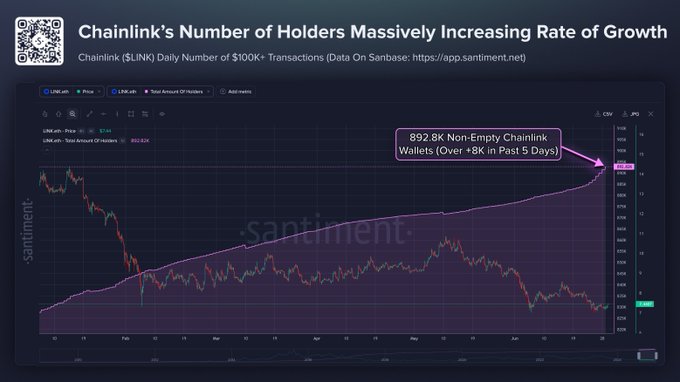
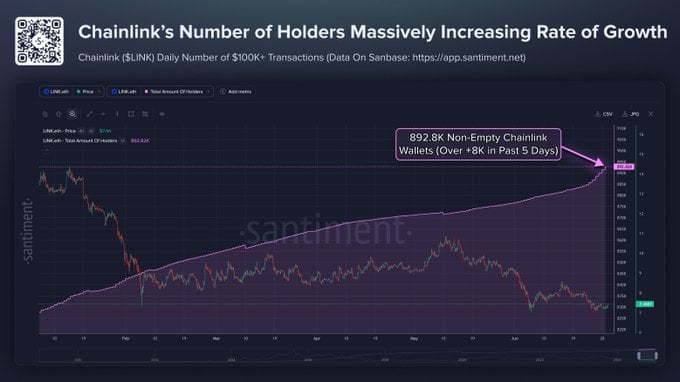
Chainlink’s [LINK] holder base accelerated sharply, reaching 892.8K non-empty wallets after adding more than 8,000 holders over the past five days. The growth unfolded while LINK remained below its local highs, highlighting continued user adoption despite lingering price weakness.

Fresh interest around real-world asset tokenization and institutional blockchain initiatives appeared to support the expanding wallet count. Rather than reflecting speculative activity alone, the steady rise in holders suggested broader participation across the network.

As a result, Chainlink strengthened its on-chain foundation even though price action remained under pressure.
Source: Santiment/X

Why did exchange outflows remain dominant?

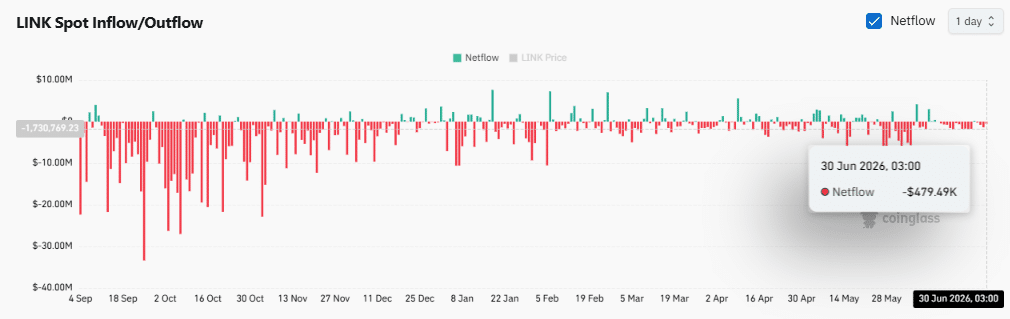
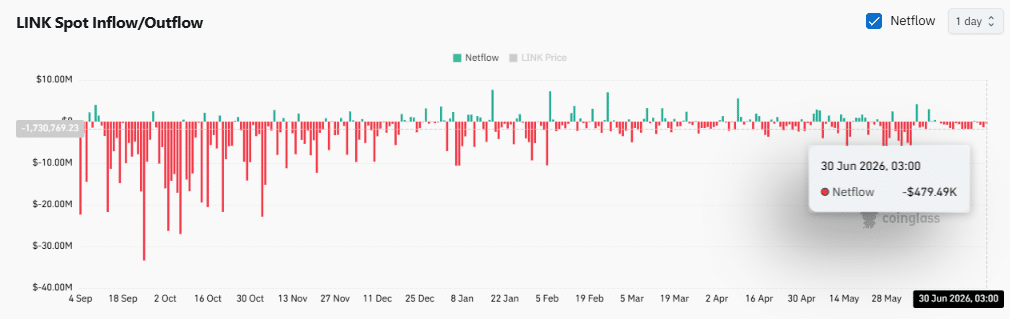
Exchange activity continued favoring withdrawals despite LINK’s recent consolidation. At press time, CoinGlass data recorded a daily spot netflow of -$479.49K, showing that more tokens left exchanges than entered them.

Such outflows often reflected reduced immediate selling availability as investors shifted holdings into private wallets or long-term storage. However, price failed to respond with an immediate recovery because broader market sentiment remained cautious.

Selling pressure eased compared to previous periods of heavier exchange inflows, yet buyers had not generated enough conviction to reverse the prevailing trend. Even so, persistent negative netflows aligned with the expanding holder count, suggesting accumulation continued beneath the surface instead of aggressive distribution.
Source: CoinGlass

Can buyers protect the demand zone?

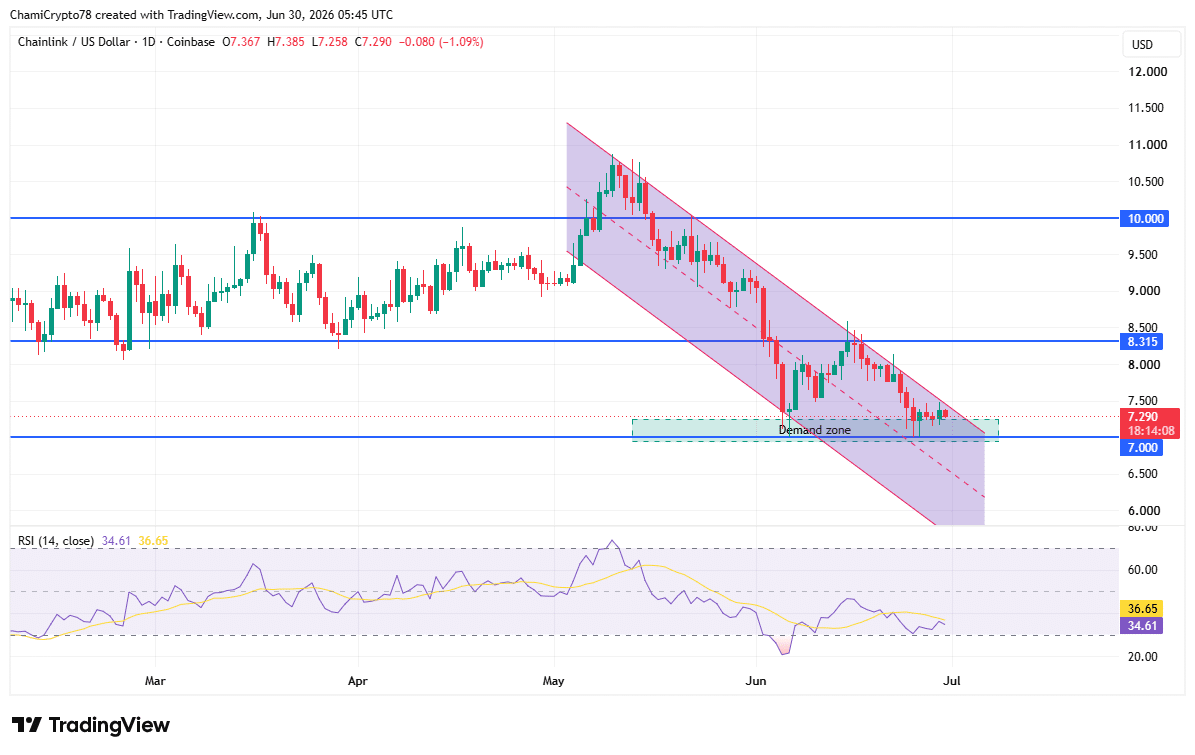
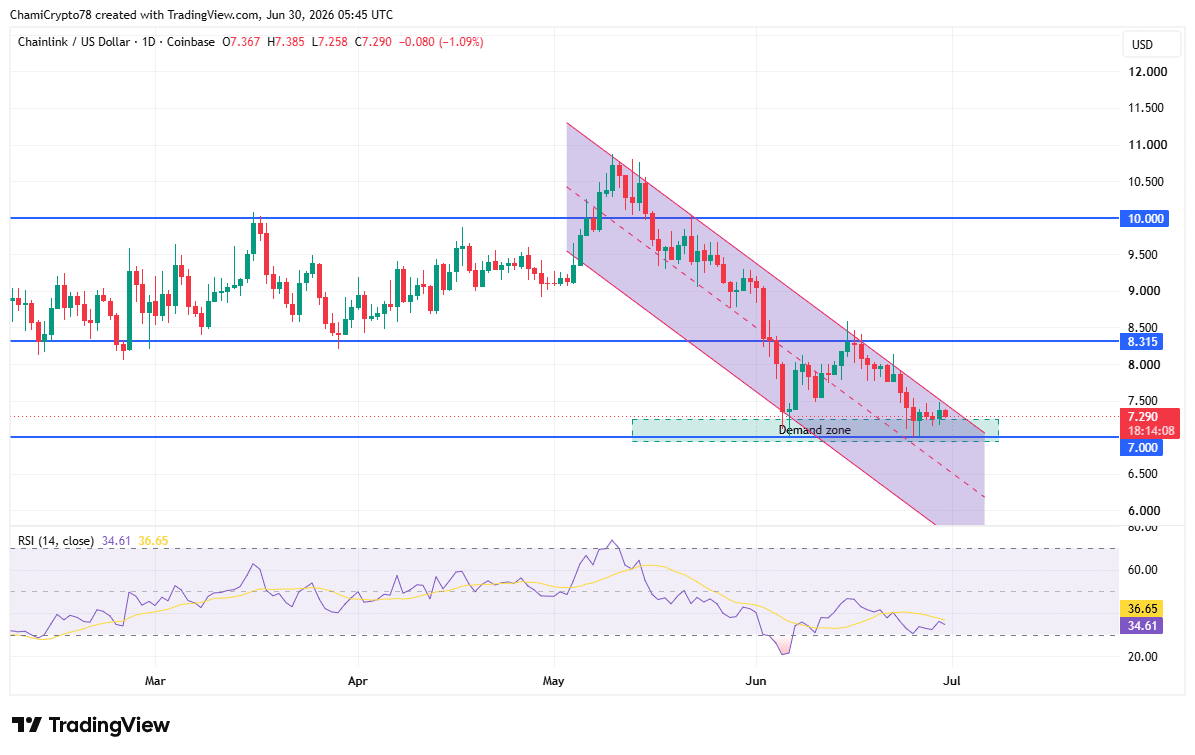
Chainlink continued trading inside a well-defined descending channel after failing to reclaim higher resistance levels.

Price repeatedly defended the $7.00 demand zone, preventing sellers from extending the broader decline despite several downside attempts. Buyers managed to stabilize the price above that support, although recovery lacked sufficient strength to challenge the channel’s upper boundary near $8.31.

Meanwhile, the RSI hovered around 34.6 as of writing, remaining below the neutral 50 level and reflecting weak buying participation rather than renewed bullish strength. Even so, the indicator stayed above deeply oversold territory, indicating selling pressure had moderated instead of accelerating.

Until LINK escapes the descending channel with stronger buying volume, the broader technical structure would likely remain cautious despite continued support around the current demand area.
Source: TradingView

Long traders refused to abandon bullish conviction

Derivatives positioning continued favoring buyers despite the prolonged corrective structure.

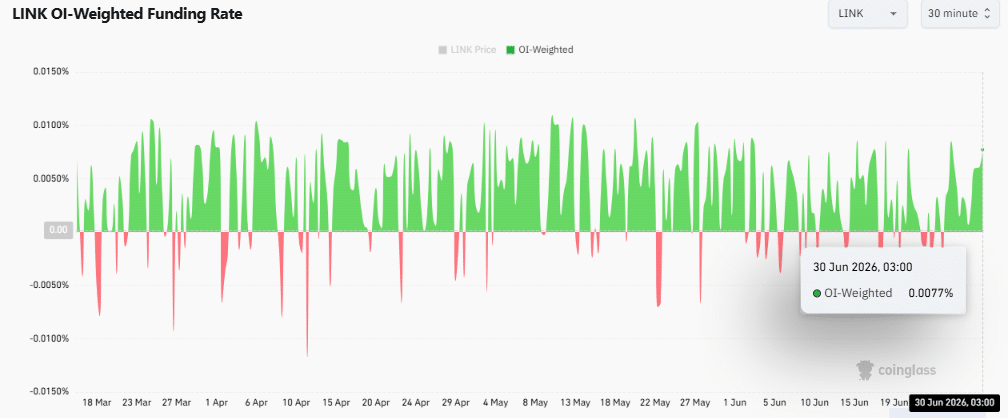
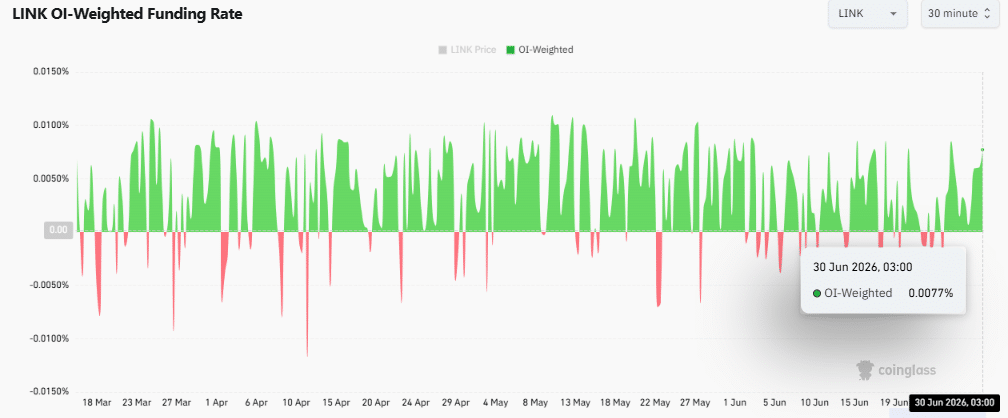
At press time, the OI-Weighted Funding Rate reached 0.0077%, remaining firmly in positive territory and showing that long traders still paid premiums to maintain leveraged exposure.

That positioning suggested participants continued expecting higher prices even while LINK traded inside its descending channel. However, optimistic funding alone had not delivered a decisive breakout because spot demand remained relatively restrained.

Even so, sustained positive funding reflected confidence that the current support region could eventually produce a stronger recovery. If leveraged sentiment stays constructive while on-chain accumulation continues expanding, derivatives positioning could reinforce buying interest once technical resistance levels start giving way.
Source: CoinGlass

To sum up, Chainlink combined accelerating network growth, continued exchange outflows, and positive funding despite remaining inside a falling channel. Buyers successfully defended the $7.00 demand zone, but they had not reclaimed higher resistance yet.

If wallet growth continues and accumulation strengthens further, LINK could eventually challenge the prevailing downtrend once stronger spot demand returns.


Final Summary

  • Chainlink adoption keeps expanding while exchange outflows suggest investors continue accumulating LINK.
  • LINK holds key support despite weak RSI as bullish funding reflects trader confidence.

Trending Cryptos

Related Questions

QWhat recent development in Chainlink's holder base does the article highlight?

AThe article highlights that Chainlink's holder base accelerated sharply, adding more than 8,000 new non-empty wallets over five days to reach 892.8K total.

QWhat does the negative daily spot netflow of -$479.49K for LINK indicate?

AThe negative daily spot netflow indicates that more LINK tokens were withdrawn from exchanges than deposited, suggesting reduced immediate selling availability as investors moved holdings to private wallets.

QWhat is the key price support level that LINK buyers have been defending according to the article?

AAccording to the article, LINK buyers have been successfully defending the key demand and support zone at the $7.00 price level.

QWhat does the positive OI-Weighted Funding Rate of 0.0077% signal about trader sentiment?

AThe positive OI-Weighted Funding Rate signals that leveraged long traders are still paying premiums to maintain their positions, reflecting continued bullish conviction and expectation of higher prices.

QWhat broader factor does the article suggest could help LINK eventually challenge its downtrend?

AThe article suggests that if wallet growth continues and on-chain accumulation strengthens further, LINK could eventually challenge the prevailing downtrend once stronger spot market demand returns.

Related Reads

Crypto Payment Cards with $1.5 Billion Monthly Transaction Volume, Stuck in the 1990s

Monthly crypto payment card transaction volume has reached $15 billion, but the industry's development stage is comparable to debit cards in the 1990s, before they became a mainstream financial staple. A key limitation is the lack of established daily financial relationships, such as direct salary deposits and recurring bill payments, with crypto wallets. Despite annualized transaction volumes of approximately $18 billion, the market is concentrated and immature. The leading provider, RedotPay, commands over half the market share. User adoption is heavily skewed towards emerging markets like Bangladesh, India, and Nigeria, where access to USD and stable financial services is limited, rather than developed economies. The sector features four primary business models: 1) Card-issuing infrastructure providers, 2) Exchange-affiliated cards for user retention, 3) Decentralized wallet/DeFi cards with self-custody but high complexity, and 4) Stablecoin-focused digital banks, which dominate transaction volume by offering integrated financial services. The article argues that a pure payment functionality is insufficient for long-term success, mirroring the historical trajectory of traditional debit cards. Future winners will need to: 1) Control the upstream flow of funds, 2) Secure defensible niches in underserved markets, and 3) Most crucially, build core account relationships that integrate into users' daily financial lives. Without this evolution, crypto cards risk remaining niche prepaid tools rather than becoming universal financial infrastructure.

Foresight News29m ago

Crypto Payment Cards with $1.5 Billion Monthly Transaction Volume, Stuck in the 1990s

Foresight News29m ago

$7.8 Billion in Theft and Losses Reveals the Truth: Security Costs Have Become an Unavoidable Liquidity Tax for DeFi

"7.8 Billion in Thefts Reveals the Truth: Security Costs Have Become DeFi's Unavoidable 'Liquidity Tax'" A summary of Q2 2026 data reveals that security risks are now a fundamental capital cost in DeFi, directly impacting user returns and liquidity decisions. DeFiLlama recorded 88 hacking incidents with quantified losses totaling $780.3 million in Q2. April was the worst month with $644.8 million lost. DeFi protocol attacks accounted for $735.8 million, while cross-chain bridge exploits resulted in $354.4 million in losses (note: some event categorizations overlap). Cumulatively, DeFi hacks have reached $7.85 billion, with bridge losses at $3.26 billion. The quarter highlighted two primary risk categories: high-value infrastructure vulnerabilities (e.g., bridges, oracles, admin keys) causing massive single losses, and more frequent contract logic bugs. This signals a critical market shift: from post-incident analysis to preemptive pricing of risk. Users and liquidity providers now implicitly factor in the security of the entire asset pathway—not just pool APY—into their decisions. This hidden "risk premium" manifests through wider spreads, higher liquidity incentives, and capital migration towards perceived safer routes. Cross-chain bridge risks, responsible for over $353 million in Q2 losses, exemplify this change. Asset routing credibility is now part of the transaction. Following incidents like KelpDAO and THORChain, markets are demanding safer bridges, asset insurance, and clearer risk disclosure, increasing the cost of capital for riskier pathways. Consequently, security spending is transforming from a defensive cost into a core distribution cost for attracting liquidity. Protocols must invest more in audits, bug bounties, real-time monitoring, and insurance to remain competitive. Users are increasingly demanding transparency about fund flow paths, associated risks, and contingency plans. The key indicators for the industry's direction will be whether capital continues consolidating in trusted channels, if projects delay launches for enhanced audits, if insurance premiums rise, and if aggregators start displaying security risk metrics. Q2 2026 may be remembered not just as a bad period, but as the point when DeFi underwent a fundamental asset risk repricing, where security became a persistent,隐性 tax on all on-chain activity.

Foresight News58m ago

$7.8 Billion in Theft and Losses Reveals the Truth: Security Costs Have Become an Unavoidable Liquidity Tax for DeFi

Foresight News58m ago

Trading

Spot

Hot Articles

How to Buy LINK

Welcome to HTX.com! We've made purchasing ChainLink (LINK) simple and convenient. Follow our step-by-step guide to embark on your crypto journey.Step 1: Create Your HTX AccountUse your email or phone number to sign up for a free account on HTX. Experience a hassle-free registration journey and unlock all features.Get My AccountStep 2: Go to Buy Crypto and Choose Your Payment MethodCredit/Debit Card: Use your Visa or Mastercard to buy ChainLink (LINK) instantly.Balance: Use funds from your HTX account balance to trade seamlessly.Third Parties: We've added popular payment methods such as Google Pay and Apple Pay to enhance convenience.P2P: Trade directly with other users on HTX.Over-the-Counter (OTC): We offer tailor-made services and competitive exchange rates for traders.Step 3: Store Your ChainLink (LINK)After purchasing your ChainLink (LINK), store it in your HTX account. Alternatively, you can send it elsewhere via blockchain transfer or use it to trade other cryptocurrencies.Step 4: Trade ChainLink (LINK)Easily trade ChainLink (LINK) on HTX's spot market. Simply access your account, select your trading pair, execute your trades, and monitor in real-time. We offer a user-friendly experience for both beginners and seasoned traders.

9.3k Total ViewsPublished 2024.03.29Updated 2026.06.02

How to Buy LINK

Discussions

Welcome to the HTX Community. Here, you can stay informed about the latest platform developments and gain access to professional market insights. Users' opinions on the price of LINK (LINK) are presented below.

活动图片