Giải Vô Địch Bóng Đá Thế Giới Gây Sốc! Người Chơi Polymarket Lỗ 1 Triệu USD

marsbitPublished on 2026-06-16Last updated on 2026-06-16

Abstract

Tác giả: Bảo Di Long, Wall Street News Một nhà giao dịch trên thị trường dự đoán đã mất gần 1 triệu USD sau khi Cape Verde cầm hòa Tây Ban Nha với tỷ số 0-0 trong trận đấu vòng bảng World Cup. Dù được đánh giá cao với xác suất thắng khoảng 92%, Tây Ban Nha đã không thể vượt qua thủ môn 40 tuổi Vozinha của Cape Verde, người có màn trình diễn xuất sắc. Trên nền tảng Polymarket, người dùng "betoor619" đã đặt cược gần 1,1 triệu USD vào chiến thắng của Tây Ban Nha, một chiến lược "rủi ro thấp, lợi nhuận thấp" điển hình với kỳ vọng lãi chỉ khoảng 85.000 USD. Kết quả bất ngờ khiến họ lỗ gần 100 vạn USD, trở thành khoản lỗ lớn nhất trong lịch sử giao dịch của tài khoản này. Trận hòa này là một trong nhiều bất ngờ tại World Cup, đồng thời cho thấy sự phổ biến ngày càng tăng của các nền tảng dự đoán như Polymarket trong cá cược thể thao, với tổng khối lượng giao dịch cho trận đấu này lên tới 64 triệu USD. Các nền tảng này cho phép giao dịch ẩn danh bằng ví tiền mã hóa, một cơ chế gây ra nhiều tranh cãi về quy định.

Tác giả: Bao Yilong, Wall Street Insights

Trận hòa giữa Cape Verde và Tây Ban Nha tại vòng bảng World Cup đã khiến một nhà giao dịch thị trường dự đoán chịu thiệt hại gần 1 triệu USD.

Vào rạng sáng ngày 16 tháng 6 theo giờ Bắc Kinh, trong trận đấu vòng bảng đầu tiên bảng H của World Cup 2026 Mỹ-Canada-Mexico, Cape Verde, đội bóng lần đầu tiên lọt vào vòng chung kết World Cup với tổng giá trị đội hình dưới 55 triệu euro, đã cầm hòa 0-0 trước ứng viên vô địch hàng đầu Tây Ban Nha, đội xếp hạng 2 thế giới với tổng giá trị đội hình lên tới 1,22 tỷ euro.

Kết quả này đã làm đảo lộn hoàn toàn cơ cấu tỷ lệ cược trên thị trường dự đoán và gây ra tổn thất lớn cho nhiều nhà giao dịch đặt cược nặng vào chiến thắng của Tây Ban Nha. Dữ liệu từ Polymarket cho thấy, một nhà giao dịch cá cược Tây Ban Nha thắng đã lỗ gần một triệu USD.

Đặt cược triệu đô: Chiến lược "đổi rủi ro thấp lấy sự chắc chắn" thất bại

Theo hồ sơ giao dịch công khai của Polymarket, một nhà giao dịch có tên người dùng "betoor619" đã thiết lập một vị thế mua lớn trị giá gần 1,1 triệu USD khi tỷ lệ thắng của Tây Ban Nha vào khoảng 92%.
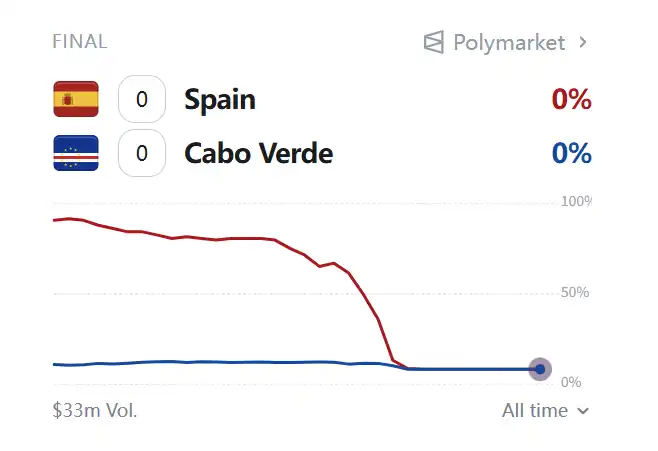
Biến động đường cong tỷ lệ thắng của Tây Ban Nha trước Cape Verde trên Polymarket

Nếu Tây Ban Nha thắng thuận lợi, người dùng này dự kiến chỉ thu lời khoảng 85.000 USD, đây là một chiến lược điển hình "rủi ro thấp, lợi nhuận thấp": đặt cược vào sự kiện có xác suất cao, dùng số vốn lớn để đổi lấy lợi nhuận ổn định nhỏ.

Nhưng cuối cùng, người dùng này kết thúc với khoản lỗ gần 1 triệu USD.
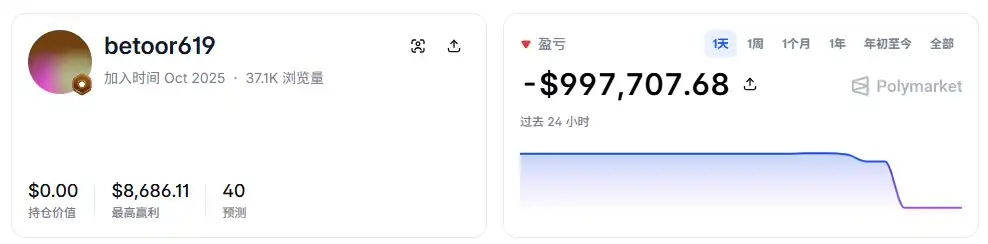
Người dùng Polymarket "betoor619" lỗ 997.000 USD trong 24 giờ qua

Hồ sơ cho thấy, tài khoản này được mở vào tháng 10 năm ngoái, trước đây lãi lỗ trên một sự kiện duy nhất chưa bao giờ vượt quá 9.000 USD, quy mô đặt cược lần này lớn hơn gấp hàng trăm lần so với kỷ lục trước đó.

Các nhà giao dịch khác cũng đặt cược lớn vào chiến thắng của Tây Ban Nha, nhưng đa số đồng thời thực hiện giao dịch phòng ngừa rủi ro (hedge), phần nào bù đắp được tổn thất.

Polymarket cho phép các nhà giao dịch lớn đóng vai trò nhà tạo lập thị trường, đồng thời nắm giữ cả vị thế mua và bán trong cùng một kèo cược, cơ chế tương tự như các tổ chức phố Wall kiếm lời chênh lệch giá thông qua mua bán cùng một cổ phiếu.

Đằng sau kết quả bất ngờ, thủ môn 40 tuổi của Cape Verde lập công lớn

Tây Ban Nha trước đó được coi là ứng viên vô địch nặng ký nhất của World Cup năm nay.

Wall Street Insights đề cập, mô hình của Goldman Sachs dự đoán xác suất vô địch của họ lên tới 25%, cao nhất trong tất cả các đội tham dự. Trong khi đó, Cape Verde không chỉ lần đầu tham dự World Cup mà trong đội hình cũng không có bất kỳ cầu thủ chuyên nghiệp nổi tiếng nào.

Nhân vật then chốt làm đảo ngược tất cả là thủ môn Josimar José Évora Dias, biệt danh Vozinha. Cầu thủ 40 tuổi này đã có bảy pha cứu thua quan trọng trong trận đấu, và rời sân trong nước mắt sau trận, giành danh hiệu Cầu thủ xuất sắc nhất trận đấu.

Sau trận, Vozinha cho biết, vấn đề visa đã khiến mẹ anh không thể tận mắt chứng kiến khoảnh khắc lịch sử này. Theo quy định hiện hành, khách đến từ một số quốc gia, bao gồm Cape Verde, phải nộp khoản tiền đặt cọc hoàn lại cao nhất lên tới 15.000 USD. Anh mô tả trận đấu này là mục tiêu mà anh đã nỗ lực "suốt sự nghiệp" của mình.

Trận hòa này cũng là một trong nhiều kết quả bất ngờ khác trong những ngày khai mạc World Cup, sau khi đội tuyển Nhật Bản hồi Chủ nhật đã lội ngược dòng, gỡ hòa ở phút bù giờ trước Hà Lan.

Sự mở rộng của nền tảng: Từ cá cược chính trị đến con đường phổ biến hóa cá cược thể thao

Các nền tảng thị trường dự đoán như Polymarket trong những năm gần đây đã nhanh chóng thoát khỏi vòng tròn nhỏ hẹp, trước đây chủ yếu được biết đến như công cụ cá cược cho các sự kiện địa chính trị và kinh tế, giờ đây đã trở thành nền tảng cá cược phổ biến cho các sự kiện thể thao lớn toàn cầu như World Cup.

Người dùng nền tảng giao dịch thông qua ví tiền điện tử, có thể sử dụng tài khoản ẩn danh để thao tác mà không cần tiết lộ danh tính thật hoặc địa điểm. Cơ chế này đã gây ra chỉ trích từ một số nhà lập pháp, cho rằng nền tảng không thu thập thông tin nền tảng cần thiết về người dùng như các công ty môi giới hay cá cược truyền thống.

Hồ sơ giao dịch công khai đồng thời cũng cung cấp một cánh cửa sổ để bên ngoài quan sát, có thể thấy được quy mô và rủi ro cao trong việc đặt cược của người dùng tại các giải đấu. Chỉ riêng trận đấu với Tây Ban Nha hôm thứ Hai, tổng giá trị giao dịch của người dùng Polymarket đã lên tới 64 triệu USD.


Related Questions

QĐiều gì đã khiến người chơi trên Polymarket thua lỗ gần 1 triệu USD trong trận đấu giữa Tây Ban Nha và Cape Verde?

ANgười chơi có tên 'betoor619' đã đặt cược gần 1.1 triệu USD vào chiến thắng của Tây Ban Nha khi tỷ lệ thắng của đội này là khoảng 92%, một chiến lược 'rủi ro thấp, lợi nhuận thấp'. Tuy nhiên, trận đấu kết thúc với tỷ số hòa 0-0, khiến khoản cược này mất gần như toàn bộ giá trị, dẫn đến thua lỗ gần 1 triệu USD.

QNgười chơi 'betoor619' trên Polymarket có lịch sử giao dịch như thế nào trước sự kiện này?

ATài khoản 'betoor619' được mở vào tháng 10 năm ngoái. Trước sự kiện này, mức lời/lỗ của người chơi này trên một sự kiện đơn lẻ chưa bao giờ vượt quá 9,000 USD. Lần đặt cược vào trận Tây Ban Nha vs Cape Verde có quy mô gấp hơn trăm lần so với các lịch sử giao dịch trước đây.

QAi là nhân vật chính giúp Cape Verde cầm hòa Tây Ban Nha và lý do nào khiến khoảnh khắc này đặc biệt với anh?

AThủ môn 40 tuổi Josimar José Évora Dias, biệt danh Vozinha, là nhân vật chính với 7 pha cứu thua quan trọng, giúp Cape Verde cầm hòa Tây Ban Nha và giành danh hiệu Cầu thủ xuất sắc nhất trận. Khoảnh khắc này đặc biệt vì đây là mục tiêu cả sự nghiệp của anh. Anh cũng tiếc nuối vì mẹ mình không thể đến xem do vấn đề thị thực, yêu cầu đặt cọc bảo lãnh lên tới 15,000 USD.

QPolymarket đã phát triển như thế nào từ một nền tảng nhỏ thành nơi phổ biến cho cá cược thể thao?

ABan đầu, Polymarket chủ yếu được biết đến như một công cụ cá cược cho các sự kiện địa chính trị và kinh tế. Gần đây, nó đã trở thành nền tảng cá cược phổ biến cho các sự kiện thể thao lớn toàn cầu như World Cup. Người dùng giao dịch bằng ví tiền mã hóa với tài khoản ẩn danh, không cần tiết lộ danh tính thật hoặc địa điểm.

QTổng khối lượng giao dịch trên Polymarket cho trận đấu giữa Tây Ban Nha và Cape Verde là bao nhiêu?

AChỉ riêng trong trận đấu giữa Tây Ban Nha và Cape Verde vào thứ Hai, tổng khối lượng giao dịch của người dùng trên Polymarket đã lên tới 64 triệu USD.

Related Reads

OpenAI's Hyperliquid Pre-IPO Pricing Venture: Why Did It Last Only Half a Year?

The article discusses the rise and fall of Pre-IPO pricing markets on the Hyperliquid blockchain. Trade.xyz, an anonymous team, successfully built the largest pre-market for SpaceX (SPCX) by launching a contract with a clear anchor: the eventual Nasdaq listing price. This provided inherent price stability and validation. In contrast, Ventuals, a team backed by Paradigm, failed despite holding exclusive contracts for highly sought-after companies like OpenAI and Anthropic. Its key mistake was its pricing mechanism. For companies with no near-term IPO date, Ventuals' oracle relied partly on opaque private market transactions and, critically, partly on its own contract's moving average price. This created a self-referential feedback loop where prices were artificially propped up and detached from genuine supply and demand, leading to illiquid markets. Ventuals shut down after nine months, settling positions at final prices of $1,341.80 for OpenAI and $1,618.90 for Anthropic. Ironically, some employees and late-stage investors of these very companies reportedly used these flawed Ventuals prices for valuation reference, highlighting the acute demand for any price signal in illiquid private markets. The article concludes that while demand for pre-IPO trading is real and growing, with players like Coinbase now entering the space, the fundamental challenge remains: without a public listing to provide a definitive price anchor, these markets struggle to establish truly accurate and liquid pricing. The need for a transparent, self-correcting market is the critical lesson from Ventuals' failure.

marsbit14m ago

OpenAI's Hyperliquid Pre-IPO Pricing Venture: Why Did It Last Only Half a Year?

marsbit14m ago

With Daily Active Users Reaching 3-4 Times That of the Industry's Second Place, Which Crack in the Office Agent Market Has Tencent's WorkBuddy Torn Open?

Tencent's AI office assistant, WorkBuddy, has achieved daily active users (DAU) 3-4 times that of the industry's second-place product, primarily driven by non-technical users like HR, operations, and administrative staff. Its rapid growth, starting with a public beta in March 2026, highlights a key strategic divergence from competitors like OpenAI's Codex and Anthropic's Claude Code. Unlike those tools, which originated as developer-focused assistants (in command lines or IDEs) and are now expanding towards office scenarios, WorkBuddy was built from the ground up for non-technical office workers. Its development was user-driven, initiated after腾讯云's team observed non-technical employees using their CodeBuddy coding tool for general tasks. WorkBuddy's design is defined by three core decisions aimed at lowering barriers: 1) Using natural language instead of technical concepts, so users describe their goal without needing to understand prompts or agents. 2) Providing pre-packaged "Skill" templates for common office tasks like data processing, content creation, and research. 3) Natively integrating into existing腾讯 ecosystems like腾讯 Docs and WeChat, making the agent a seamless part of the user's workflow rather than a separate tool. This "scenario encapsulation" approach, prioritizing the shortest path for users to get work done, contrasts with the "underlying capability" focus of Codex and Claude, which offer more flexibility but require more technical setup. Analysts confirm WorkBuddy's leading market position in China by mid-2026, with massive user and request growth following its launch. Recognizing the same trend of surging non-technical adoption, OpenAI and Anthropic are now pivoting their products with features like role-based plugins (Codex) and a simplified desktop interface (Claude Cowork). However, adapting tools built for developers requires significant changes to interaction models and integrations. WorkBuddy currently holds an estimated six-month lead in delivering a complete solution for non-technical office users. Its recently launched enterprise version aims to solidify this advantage. The competition underscores two valid paths: embedding agent capabilities directly into familiar work environments versus building powerful, general-purpose agents that users must learn to access. WorkBuddy's early success demonstrates the effectiveness of the former strategy for mainstream office adoption.

marsbit22m ago

With Daily Active Users Reaching 3-4 Times That of the Industry's Second Place, Which Crack in the Office Agent Market Has Tencent's WorkBuddy Torn Open?

marsbit22m ago

Dalio's Latest Warning: Don't Get Carried Away by AI, Real Returns on US Stocks in the Next 5-10 Years Could Be -5% to -10%

Ray Dalio, founder of Bridgewater Associates, warns investors against excessive concentration in AI stocks. He argues the current market, dominated by a few AI giants, mirrors historical patterns where revolutionary new technologies lead to high risk, volatility, and uncertainty. While acknowledging AI's transformative potential, Dalio emphasizes that most investors fail at this stage of the cycle by over-concentrating in a handful of leading companies. He cites inherent risks: companies cannot accurately forecast investment needs or external shocks (e.g., monetary policy, geopolitics, taxes), face potential disruption from future technologies and international competition (notably from China), and experience significant price swings. Dalio's core advice is diversification, calling it his "Holy Grail of Investing." He presents a mathematical case that a well-diversified portfolio of 15-20 uncorrelated, good bets offers a superior risk-adjusted return compared to a concentrated position. Dalio also offers a cautious outlook, suggesting U.S. stocks may deliver real returns of -5% to -10% over the next 5-10 years based on valuation and bubble indicators. He concludes that in the face of high uncertainty, the prudent strategy is not to avoid betting entirely, but to avoid large, concentrated bets where one lacks sufficient informational edge. Instead, investors should build a strategically balanced, diversified portfolio.

marsbit1h ago

Dalio's Latest Warning: Don't Get Carried Away by AI, Real Returns on US Stocks in the Next 5-10 Years Could Be -5% to -10%

marsbit1h ago

Trading

Spot
Futures

Hot Articles

What is USDC(WORMHOLE)

USD Coin (Wormhole): A Comprehensive Overview Introduction In the rapidly evolving world of cryptocurrencies, USD Coin (Wormhole), referred to as $USDC(Wormhole), stands out as a pioneering solution within the DeFi (Decentralized Finance) landscape. Operating on several blockchain platforms, including Solana, USD Coin (Wormhole) is more than just a digital representation of the United States dollar. It embodies the innovative spirit of modern finance, enabling seamless cross-chain transactions and enhanced interoperability among diverse blockchain ecosystems through the advanced Wormhole protocol. What is USD Coin (Wormhole)? USD Coin (Wormhole) is a tokenized version of the US dollar designed to facilitate frictionless transactions across different blockchain networks. Its primary aim is to bolster liquidity and enhance the functionality of the DeFi ecosystem. By leveraging the Wormhole protocol, which establishes a robust cross-chain communication network, users can effortlessly transfer USDC tokens across various platforms. This cross-chain capability marks a significant advancement in cryptocurrency use, promoting a more interconnected and efficient ecosystem where assets can flow freely between different blockchains. The value proposition of USD Coin (Wormhole) lies not only in its stability, being pegged to the US dollar, but also in its ability to bridge gaps between disparate blockchain environments. This innovative approach fosters a greater level of participation among users and developers, paving the way for new and exciting applications within decentralized finance. Who is the creator of USD Coin (Wormhole)? The origins of USD Coin (Wormhole) are intricately tied to the Wormhole network, which was developed by Jump Crypto. While specific individual creators are not prominently documented, Jump Crypto is notable for its involvement in advancing blockchain technology and supporting its applications in finance. By creating the Wormhole network, Jump Crypto has played a vital role in promoting cross-chain asset transfers, enhancing the efficiency and diversity of cryptocurrency usage. Who are the investors of USD Coin (Wormhole)? The success of USD Coin (Wormhole) is supported by investments from several notable funds and organizations within the cryptocurrency realm. Key investors include: Coinbase Ventures: A prominent venture capital arm backed by one of the leading cryptocurrency exchanges in the industry, Coinbase Ventures provides essential capital and strategic support to promising blockchain projects. Arrington XRP Capital: Specializing in digital assets, Arrington XRP Capital recognizes the potential of innovative projects like USD Coin (Wormhole) and has invested accordingly to back its development. Jump Trading: As the parent organization of Jump Crypto, Jump Trading brings not only investment but a wealth of expertise in trading technology and market dynamics to bolster the Wormhole project. How Does USD Coin (Wormhole) Work? The operational framework of USD Coin (Wormhole) is intricately designed to facilitate effective cross-chain transactions, maximizing security and efficiency. Here’s a simplified overview of how it functions: Asset Locking: When a user wishes to transfer USDC from one blockchain to another, they first lock their tokens on the source blockchain. This process ensures that the assets are secure and are set to be either burned or moved later. Token Minting: After the tokens are locked, an equivalent amount of USDC is minted on the destination blockchain. This provides the user with access to their funds on a new platform, reflecting the flexibility that the Wormhole protocol enables. Cross-Chain Transfer: The Wormhole protocol efficiently facilitates the entire transfer process. It ensures that once the USDC is minted on the destination chain, the equivalent tokens are burned on the source chain. The result is a seamless transfer of value between two distinct blockchain environments. This cross-chain methodology ensures that transactions remain secure and transparent, significantly enhancing liquidity within the different DeFi ecosystems. Timeline of USD Coin (Wormhole) Understanding the evolution of USD Coin (Wormhole) provides vital context for its significance in the cryptocurrency arena. Here’s a timeline highlighting important milestones in the project’s history: 2021: The Wormhole project is launched, establishing a framework for cross-chain asset transfers and setting the stage for the development of USD Coin (Wormhole). 2022: The Wormhole network experiences a significant challenge with a security breach that results in a $325 million theft. However, the incident is later addressed and refunded by Jump Crypto, showcasing the project’s commitment to security and transparency. 2023: USD Coin (Wormhole) integrates with Circle’s Cross-Chain Transfer Protocol (CCTP), enhancing its capabilities for cross-chain transfers and further solidifying its place within the DeFi ecosystem. 2024: Ongoing development and expansion of the Wormhole network continue, aimed at increasing the utility and reach of USD Coin (Wormhole) as well as enhancing its operational framework. Key Features The success of USD Coin (Wormhole) can be attributed to several key features that differentiate it from other cryptocurrency offerings: Cross-Chain Interoperability At the core of USD Coin (Wormhole) is its ability to facilitate seamless transfers across multiple blockchain networks. This interoperability serves as a cornerstone for decentralized finance, allowing various platforms to interact with each other, thereby accelerating the evolution of financial services. Security Wormhole employs a well-designed Guardian Network comprised of node validators that ensure secure cross-chain transactions. This collective oversight minimizes the risk of fraud and provides users with confidence that their assets are protected during cross-chain transfers. Liquidity Enhancement By enabling USDC to circulate freely across different blockchains, USD Coin (Wormhole) enhances liquidity in the DeFi ecosystem. This increased liquidity can foster more efficient trading, contribute to better pricing strategies, and improve the overall market dynamics encompassing various digital assets. Conclusion USD Coin (Wormhole) is a pivotal innovation in the blockchain space, reinforcing the capabilities of decentralized finance (DeFi) and establishing a more connected financial ecosystem. With its robust framework for cross-chain transactions, security features, and strong backing from reputable investors, USD Coin (Wormhole) is positioned to play a key role in the future of cryptocurrency. As the digital finance landscape continues to evolve, USD Coin (Wormhole) not only embraces the future of interconnectivity among blockchain networks but also reaffirms the power of tokenization and blockchain technology in transforming how we perceive and utilize value in a digital world. By navigating the complexities of cross-chain functionality, it demonstrates a sophisticated approach to enabling financial inclusivity and innovation in the world of cryptocurrencies.

1.2k Total ViewsPublished 2024.04.01Updated 2024.12.03

What is USDC(WORMHOLE)

What is W$C

World$tateCoin ($W$C): A Comprehensive Exploration of the Emerging Cryptocurrency Project Introduction In the ever-evolving landscape of cryptocurrencies, World$tateCoin ($W$C) has emerged as a project that aims to harness the power of web3 technologies to create a distinctive digital ecosystem. As traditional models of online interaction undergo significant transformation, World$tateCoin seeks to establish itself in this budding third generation of the internet. This article will delve into the intricacies of World$tateCoin, providing an overview of the project, its objectives, and its potential impact on the web3 space. What is World$tateCoin ($W$C)? World$tateCoin ($W$C) is designed as a cryptocurrency that facilitates seamless transactions within a web3 environment. Aimed at creating a decentralized platform where users can interact with various web3 applications, $W$C intends to streamline user experience and enhance accessibility to digital services. While the project aspires to become an integral part of the web3 landscape, detailed insights into its specific objectives and use cases remain limited, raising questions regarding its potential role and utility in a rapidly advancing digital context. The essence of web3 revolves around decentralization and empowering users with greater control over their interactions online. World$tateCoin intends to align with these principles, although specific applications and functionalities of the currency are still under discussion within the community. Who is the Creator of World$tateCoin ($W$C)? In exploring the origins of World$tateCoin, information regarding its creator remains elusive. As of now, there is no publicly available data identifying the individuals or organizations behind the project. This obscurity may cast a shadow of uncertainty over the project’s credibility, but the commitment to innovation within the cryptocurrency framework could be a driving force for its adoption in the future. The lack of identifiable leadership may result in hurdles related to trust and transparency—elements that are crucial for establishing a strong community in the crypto space. Who are the Investors of World$tateCoin ($W$C)? Current research does not reveal any specific investors or backing organizations involved with World$tateCoin. It is not uncommon for emerging cryptocurrency projects to either attract discreet investments or operate in a minimalist financial structure during their initial phase. The ambiguity surrounding investment supports and funding methodologies could affect the project’s sustainability and growth prospects. When assessing new projects within the cryptocurrency domain, investors generally look for transparency regarding financial backing and support from established entities. The absence of this information might necessitate a cautious approach for potential users and stakeholders interested in the future of World$tateCoin. How Does World$tateCoin ($W$C) Work? The operational mechanics of World$tateCoin are grounded in the principles of decentralization, a hallmark of web3 technologies. By facilitating transactions directly between users without the intervention of intermediaries, $W$C is designed to enhance trust and efficiency. However, comprehensive documentation detailing the unique features and operational framework that distinguish World$tateCoin from other cryptocurrencies is markedly sparse. This lack of information complicates the understanding of how $W$C functions within the broader web3 ecosystem and what unique propositions it brings to users and developers alike. Nevertheless, the fundamental goal of allowing for decentralized transactions holds the promise of a more liberated financial landscape, should the project deliver on its aspirations of implementing robust mechanisms and user-friendly interfaces. Timeline of World$tateCoin ($W$C) Constructing a timeline that encapsulates the historical progression of World$tateCoin poses challenges due to an absence of significant documentation on key events and milestones. Nevertheless, an approximate sequence of hypothetical phases can be envisaged, constituting a path forward for the project: Initial Concept (Date Unknown): Conceptualization of the World$tateCoin framework in the broader context of web3 technologies. Development Phase (Date Unknown): Commencement of technical development and coding processes. Community Engagement (Date Unknown): Outreach to potential users and stakeholders to foster community interest in the project. Launch Target (Date Unknown): Announcing an expected launch date, contingent on the progress of development and testing phases. Due to the lack of substantiated dates and details surrounding these phases, stakeholders will need to remain vigilant and engaged with the project's communications for updates regarding its trajectory. Key Topics About World$tateCoin ($W$C) As the project unfolds, certain key subjects arise that embody the potential and aspirations of World$tateCoin: Decentralization: The core philosophy driving the project, aimed at fostering direct user interactions. Web3 Integration: The goal of mirroring web3 principles and enabling seamless user access to an array of digital services. Digital Currency: Positioned as a currency to facilitate internet-based transactions, World$tateCoin aims to inject additional liquidity into the web3 market. Challenge of Information Scarcity: The notable absence of detailed information regarding the project's foundations, creators, and operational methods, necessitating increased transparency from developers to build community trust. Conclusion World$tateCoin ($W$C) is positioned within an exciting yet uncertain terrain of cryptocurrency and web3 integration. While it aims to cultivate a decentralized environment, the limited availability of information regarding its creators, investors, and specific functionalities presents challenges for potential stakeholders and users. In the dynamic world of cryptocurrencies, transparency, engagement, and well-structured communication are vital for the success of projects such as World$tateCoin. As the landscape continues to evolve, stakeholders will be eager to see how the project can solidify its place within the web3 narrative and contribute to the ongoing transformation of the digital ecosystem.

1.0k Total ViewsPublished 2024.04.01Updated 2024.12.03

What is W$C

How to Buy W

Welcome to HTX.com! We've made purchasing Wormhole (W) simple and convenient. Follow our step-by-step guide to embark on your crypto journey.Step 1: Create Your HTX AccountUse your email or phone number to sign up for a free account on HTX. Experience a hassle-free registration journey and unlock all features.Get My AccountStep 2: Go to Buy Crypto and Choose Your Payment MethodCredit/Debit Card: Use your Visa or Mastercard to buy Wormhole (W) instantly.Balance: Use funds from your HTX account balance to trade seamlessly.Third Parties: We've added popular payment methods such as Google Pay and Apple Pay to enhance convenience.P2P: Trade directly with other users on HTX.Over-the-Counter (OTC): We offer tailor-made services and competitive exchange rates for traders.Step 3: Store Your Wormhole (W)After purchasing your Wormhole (W), store it in your HTX account. Alternatively, you can send it elsewhere via blockchain transfer or use it to trade other cryptocurrencies.Step 4: Trade Wormhole (W)Easily trade Wormhole (W) on HTX's spot market. Simply access your account, select your trading pair, execute your trades, and monitor in real-time. We offer a user-friendly experience for both beginners and seasoned traders.

6.0k Total ViewsPublished 2024.04.02Updated 2026.06.02

How to Buy W

Discussions

Welcome to the HTX Community. Here, you can stay informed about the latest platform developments and gain access to professional market insights. Users' opinions on the price of W (W) are presented below.

活动图片