SemiAnalysis Report Claims Delay in Two Key Technologies, Triggers Sharp Decline in 'Optoelectronics', Sparking Online Debate Over CPO

marsbitPublished on 2026-06-10Last updated on 2026-06-10

Abstract

A report from analysis firm SemiAnalysis, claiming significant delays in two key AI data center technologies, triggered a sharp sell-off in the photonics sector and sparked intense online debate. The report, dated June 10, states that NVIDIA's 800VDC power architecture rollout is pushed to 2028 and CPO (Co-Packaged Optics) mass production is likely delayed until 2028 or even 2029. Following the news, U.S. optical communication stocks fell sharply, with AAOI dropping 17% and Lumentum down about 8%. The delays were attributed to engineering challenges like photonic engine yield and cost-effectiveness, not a disappearance of demand. Simultaneously, an interview with NVIDIA's networking SVP Gilad Shainer presented an opposing, optimistic view, stating CPO is "the most exciting thing" and shipments would begin scaling in the second half of the year. This contradiction fueled debate on social media. Bears pointed to unresolved reliability and maintenance hurdles for CPO. Bulls argued the delay simply redirects capital to interim solutions like traditional pluggable optical modules and NPO (Near-Packaged Optics), extending their revenue runway. Some users questioned the report's internal logic and timing, noting similar views had circulated earlier. Analysts highlighted potential beneficiaries, including companies in the 1.6T pluggable modules, NPO, and 400VDC power transition supply chains. The consensus suggests the market reaction reflects a recalibration of the technology ado...

Source: Wall Street News

A report from the star AI industry chain analysis firm SemiAnalysis, which directly pointed to delays in two core technological pathways for AI data centers, ignited severe volatility in the optical communication sector on June 10th, simultaneously sparking intense debate about future technology roadmaps and investment opportunities in both the investment and industrial communities.

The report suggests that NVIDIA's 800VDC power architecture shipments will be delayed until 2028, and the mass production of CPO (Co-Packaged Optics) may be postponed to 2028 or even 2029. The simultaneous downward revision of these two expectations caught the market off guard.

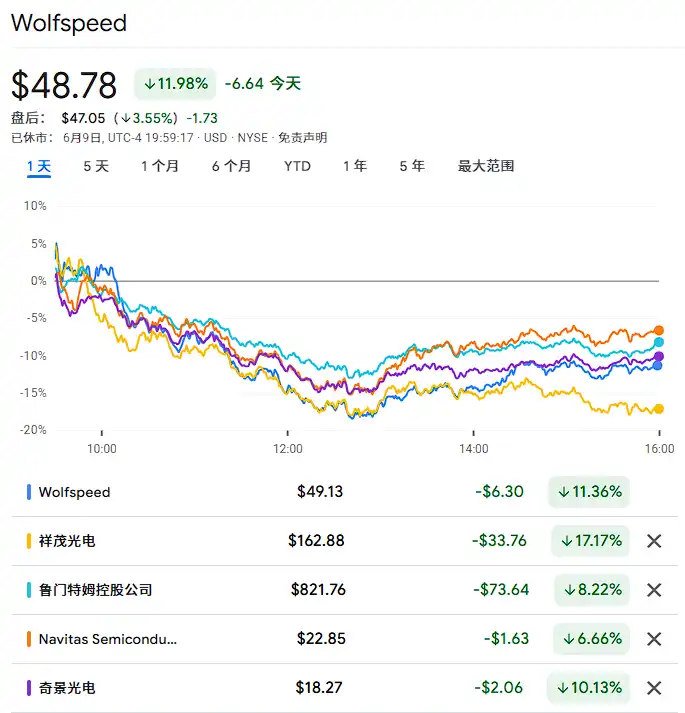
After the news broke, the US stock market's optical communication sector generally suffered heavy losses. Applied Optoelectronics (AAOI) plummeted by 17% in a single day, Lumentum fell by about 8%, and companies mentioned in the report as warranting caution, such as Himax Technologies (HIMX), Navitas Semiconductor Corp, and Wolfspeed, also faced significant pressure.
Concurrently with the release of the SemiAnalysis report, interview content with an NVIDIA executive was also published. According to资深半导体和科技投资记者Tae Kim, NVIDIA's Senior Vice President of Networking, Gilad Shainer, expressed a starkly optimistic stance on CPO's prospects at the 2026 Computex exhibition, stating directly that "CPO is the most exciting technology right now," and announced that volume shipments would begin in the second half of the year. This sparked a heated online debate about the CPO timeline on social platforms.

Notably, several market observers pointed out that the CPO delay does not mean the demand for optical interconnects disappears, but rather it is more likely to redirect capital flows back to traditional pluggable optical modules and the NPO (Near Package Optics) track — this logic led some investors to seek opportunities among oversold stocks during the panic selling.

SemiAnalysis Report Core: Dual Delays in Two Technological Pathways

In this research note distributed to institutional clients, SemiAnalysis presented two core judgments with profound market impact.

800VDC Power Architecture Delayed Until After 2028.

The report indicates that NVIDIA's originally planned large-scale adoption of a single-ended 800VDC power design has seen its shipment window significantly pushed back. Hyperscale cloud providers are currently more inclined to stick with mature low-voltage solutions or gradually transition to 400VDC, rather than rushing to switch to 800VDC.

The report argues that the marginal efficiency gains of 800VDC under current grid power supply conditions are insufficient to justify its system complexity. In contrast, 400VDC products are expected to start ramping in Q2 2026, with significant growth in 2027.

CPO Mass Production Timeline Lags Significantly Behind Market Expectations.

The report states that CPO shipment volumes in 2027 will be substantially lower than previous aggressive forecasts, and the timeline for mass production may be delayed until 2028 or even 2029. The main bottlenecks are concentrated at three levels:

Optical engine connection yield (optimistically around 95%, but CPO production driven by a single ASIC remains extremely limited), ASIC integration difficulty, and overall cost economics.

Scale-out CPO switch shipment volumes face downward revision risks, and shipments of Sidecar relying on new platforms like Rubin Ultra/Kyber are also postponed to a 2028 window.

At the individual stock level, SemiAnalysis maintains a relatively positive view on companies like Amphenol, Vertiv, and Legrand, while adopting a cautious stance towards Lumentum, Himax Technologies, Navitas Semiconductor, and Wolfspeed.

However, the report itself acknowledges that CPO, as an important direction for future data center network architecture, is not denied; the core reason for the delay lies in unresolved engineering challenges, not disappearing demand.

Simultaneously, the report also points out that some NPO (Near Package Optics) projects may accelerate.

NVIDIA Executive Publicly Counters, Tae Kim's Exclusive Interview Draws Attention

Just as the SemiAnalysis report was widely circulated among institutional circles,资深半导体和科技投资记者Tae Kim published an excerpt from a one-on-one interview with NVIDIA's Senior Vice President of Networking, Gilad Shainer, during Computex in his Substack column. The content starkly contrasted with SemiAnalysis's assessment.
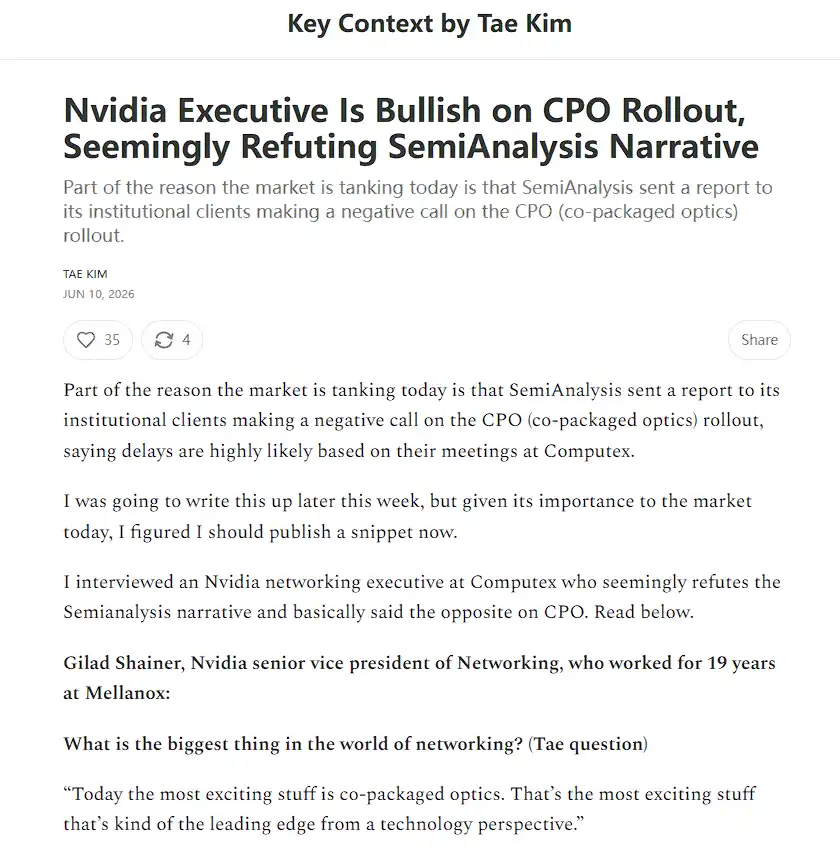
Shainer stated in the interview, "The most exciting thing today is co-packaged optics, it's the leading edge of technology."

He further revealed that NVIDIA is ready to start shipping, that partner Lambda had published a blog confirming receipt of CPO switches, that volume shipments of CPO would accelerate in the second half of the year, extending from scale-out to scale-up scenarios. "If it were up to me, I would put CPO everywhere that we use optical networking."

Tae Kim added in his article that Shainer's overall demeanor and body language during the interview showed high enthusiasm for both near-term and long-term ramp-up of CPO. He stated that this statement "seems to directly contradict the narrative from SemiAnalysis."

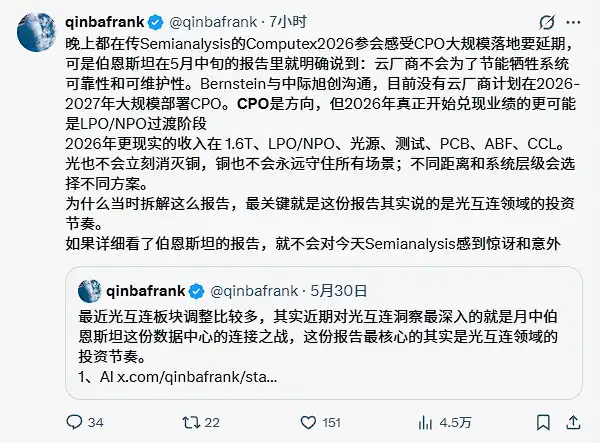
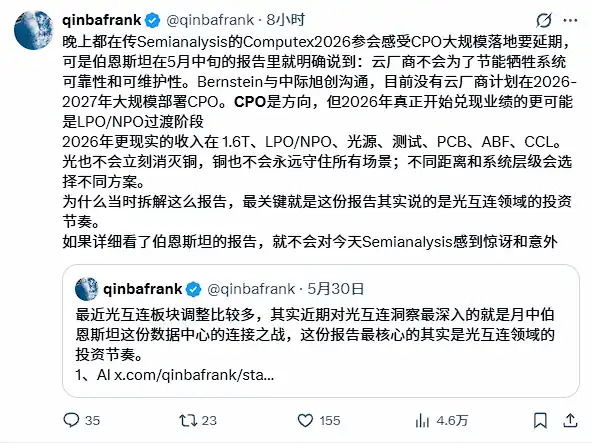
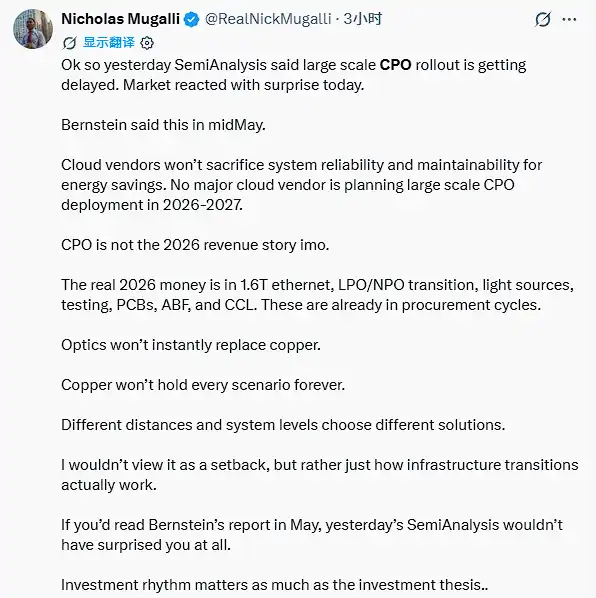
This discrepancy plunged the market into an information war. User @qinbafrank on social platform X pointed out that Bernstein had already clearly stated in a mid-May report that cloud providers would not sacrifice system reliability for energy savings, and that no cloud provider currently plans large-scale CPO deployment in 2026-2027. "If you had read the Bernstein report in detail, you wouldn't be surprised by SemiAnalysis today."
Online Debate: Is CPO Delay a Negative or a Market Overreaction?

The market volatility triggered by the report quickly spread to social media, where opinions on the investment logic surrounding the CPO delay diverged significantly.

Bearish View: Yield and Reliability Are Real Bottlenecks.

SemiAnalysis emphasized in its report that in the CPO architecture, the optical engine is co-packaged with a large ASIC worth tens of thousands of dollars on the same substrate. If the optical engine fails due to laser aging or fiber damage, it often requires the entire motherboard to be disassembled and returned to the factory. The maintenance cost and downtime risk are far higher than with traditional pluggable modules. This engineering challenge is considered the core obstacle preventing large-scale CPO adoption in the short term.

Bullish View: CPO Delay Actually Benefits Pluggable Modules and NPO.

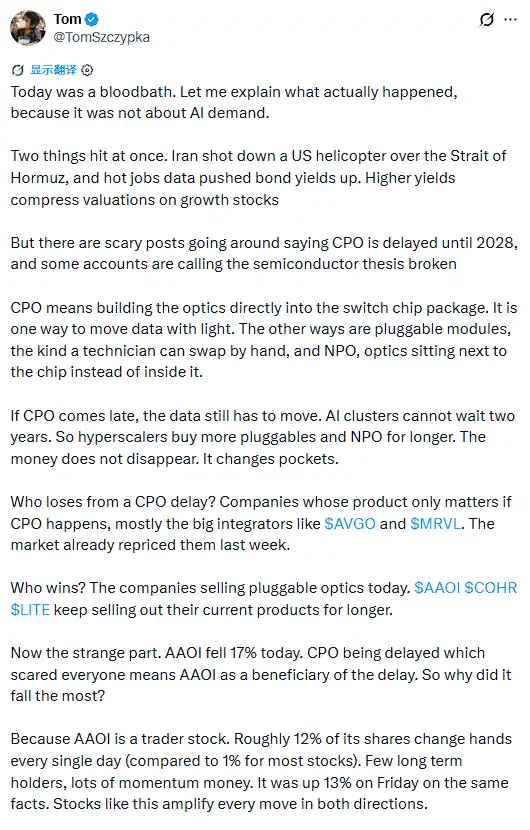
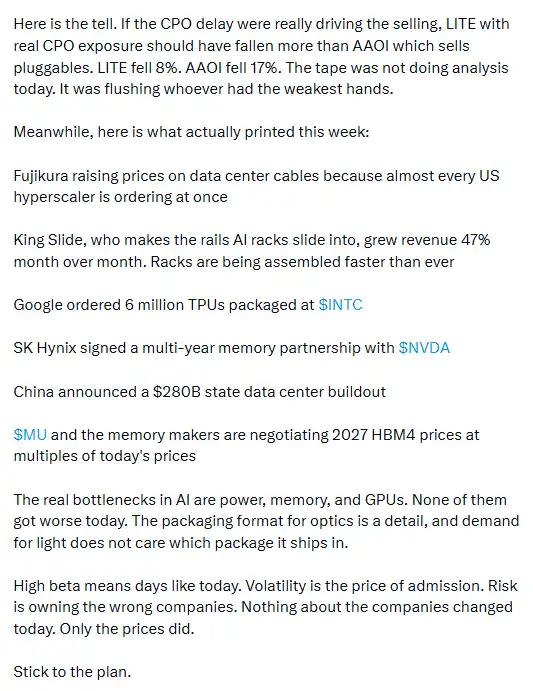
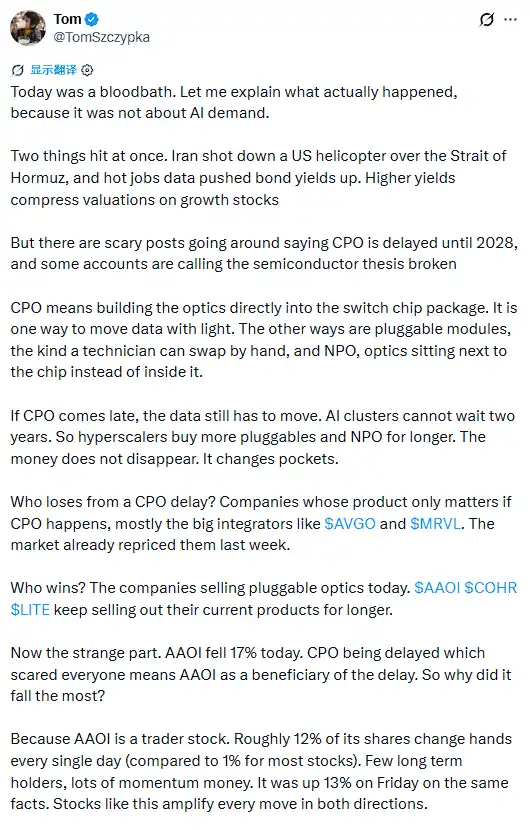
User @TomSzczypka on social platform X analyzed, "If CPO comes later, data still needs to be transmitted, AI clusters can't wait two years, hyperscalers will buy more pluggable modules and NPO for longer. The money doesn't disappear, it just changes pockets."

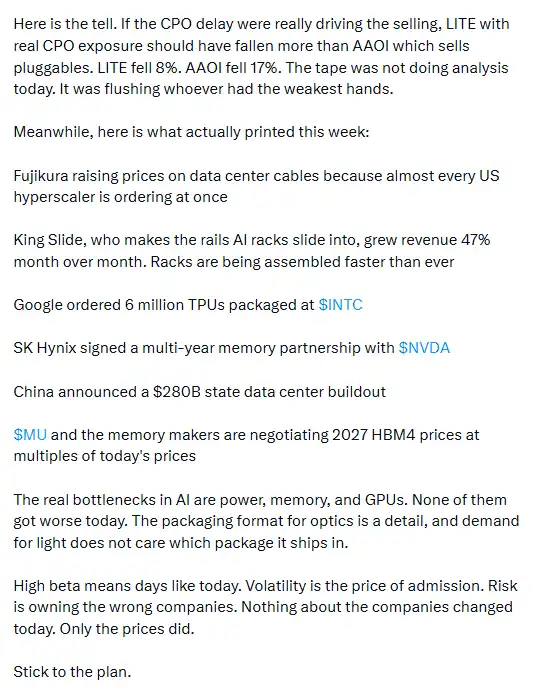
He also pointed out that the fact that Applied Optoelectronics' decline (17%) far exceeded Lumentum's (8%) on that day itself indicated that the market's sell-off was not based on rational analysis but was flushing out the weakest holdings.
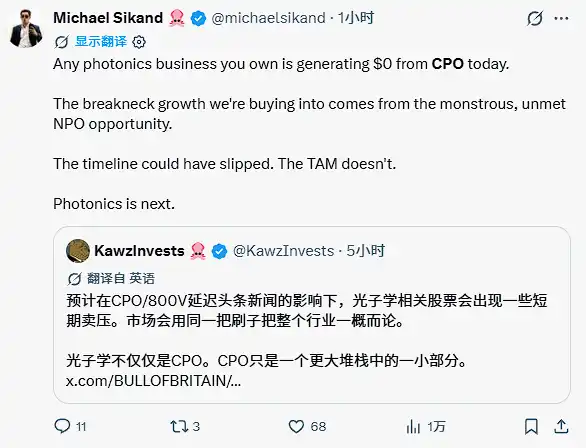
User @michaelsikand stated that currently, revenue from CPO for any photonics company is zero, and the current high growth comes from the huge, unmet NPO opportunity. "The timeline may slip, but the TAM doesn't."
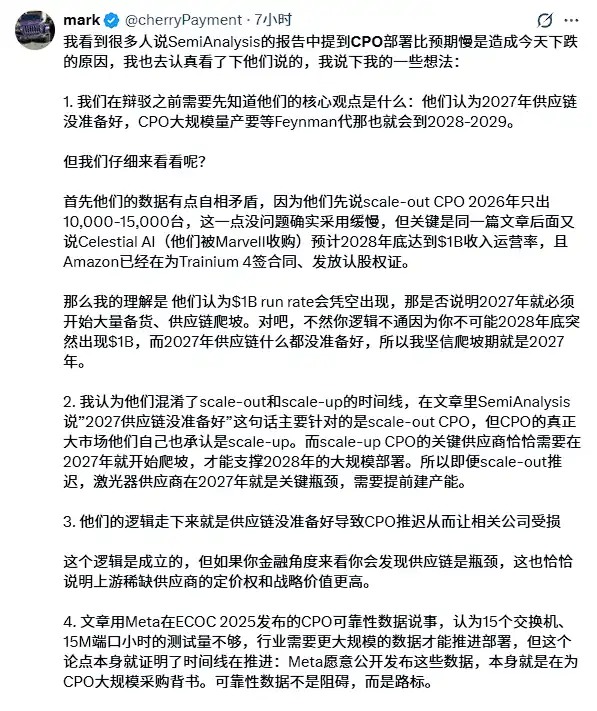
Voices questioning the report's logic also exist.

User @cherryPayment posted a lengthy article pointing out internal contradictions in the SemiAnalysis report: on one hand, it says the supply chain won't be ready in 2027; on the other hand, it predicts Celestial AI (acquired by Marvell) will reach a $1 billion revenue run rate by the end of 2028, and Amazon has already signed contracts for Trainium 4. "You can't suddenly have $1 billion by end of 2028 with the supply chain not ready for anything in 2027."

He also pointed out that SemiAnalysis's target audience is the procurement decision-makers at hyperscale cloud providers, and its conclusion is "no need to all-in yet," not an investment timing judgment for the capital market. "They are analyzing deployment pace, not investment timing."
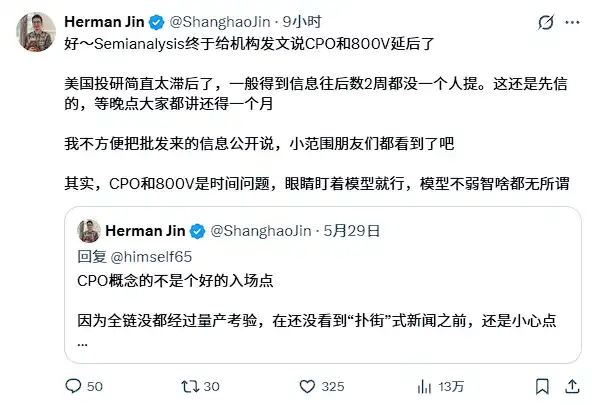
User @Herman Jin on platform X criticized the timeliness of information from US investment research firms, arguing that delays in CPO and 800VDC were "a matter of time," and such information had long been circulating in institutional circles; the SemiAnalysis report merely formalized known information on paper.
Unexpected Beneficiaries: Copper Connections and Pluggable Modules

Against the backdrop of widespread market pressure, some analysts turned their attention to potential beneficiaries of the CPO delay.

User @qinbafrank梳理认为,梳理认为梳理认为梳理认为,梳理认为梳理认为梳理认为 the more realistic revenue opportunities in 2026 are concentrated in 1.6T pluggable modules, LPO/NPO, light sources, testing, PCB, ABF, and CCL segments. "Optics won't eliminate copper immediately, and copper won't hold onto all scenarios forever; different distances and system levels will choose different solutions."
The CEO of Lumentum also recently stated that interest in NPO from non-NVIDIA customers has increased noticeably over the past two months.

User @RealNickMugalli analyzed that at 1.6T rates and 200G per channel, copper cables, even with retimer technology, have reached their physical limits. Optical solutions become a mandatory option, not an optional one, within reasonable distances, and the potential market size for NPO might even exceed that of CPO.
SemiAnalysis also noted in its report that some NPO projects may accelerate, and 400VDC products will start ramping in Q2 2026. For companies like Amphenol and Vertiv, the report maintains a relatively positive stance, believing they benefit from sustained demand during the 400VDC transition.

User @TomSzczypka cited this week's industry chain data to support that AI infrastructure demand has not weakened:

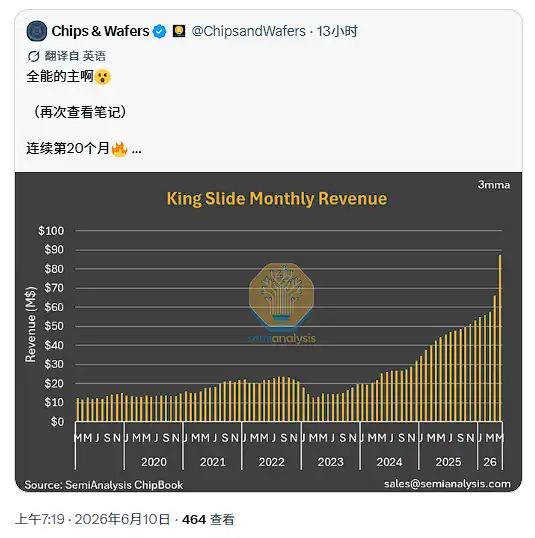
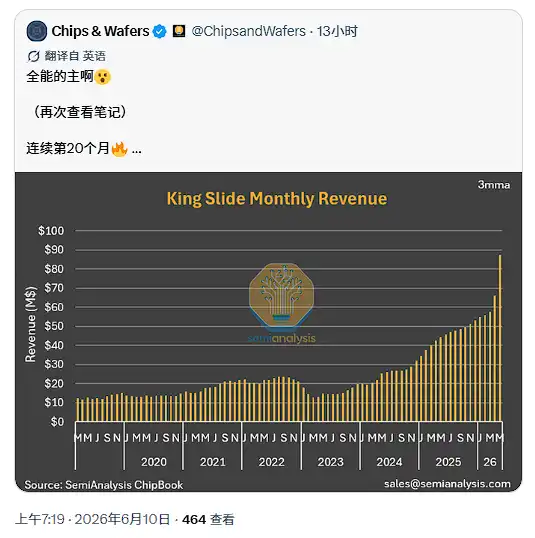
Fujikura raised prices for data center cables because almost all US hyperscalers placed orders simultaneously; King Slide's rack rail revenue increased 47% sequentially; Google ordered 6 million TPUs from Intel; SK Hynix signed a multi-year memory supply agreement with NVIDIA, etc.

"The real bottlenecks for AI are power, memory, and GPUs. None of these three have gotten any worse today."
Meanwhile, @tuolaji2024 posted on social platform X, stating that memory (HBM/DRAM), as the real physical bottleneck, remains completely unaffected by this technology delay event.
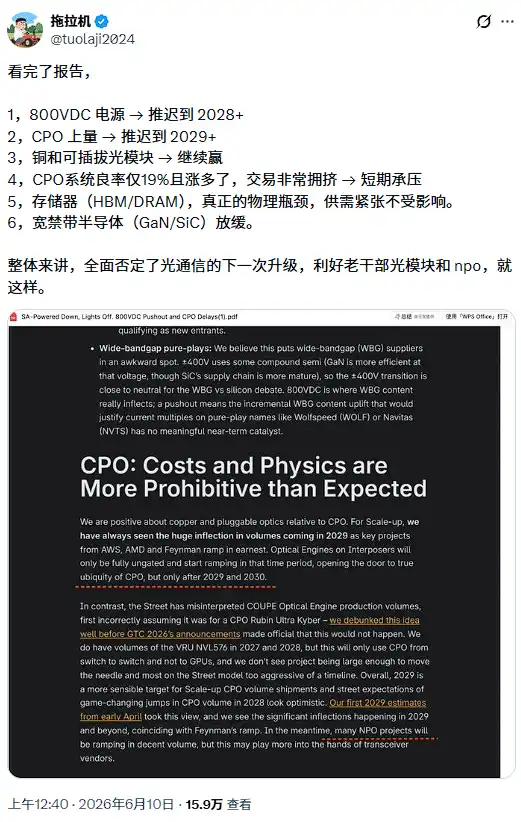
Analysis points out that, synthesizing various viewpoints, the market volatility triggered by this SemiAnalysis report reflects more of a recalibration of the technology roadmap timeline, rather than a fundamental reversal of overall AI data center demand.

Related Questions

QWhat are the two key technology delays identified in the SemiAnalysis report that impacted the stock market?

AThe SemiAnalysis report identified that the timeline for mass production of CPO (Co-packaged Optics) has been delayed to 2028 or even 2029, and the deployment of Nvidia's 800VDC power architecture has been postponed to after 2028.

QAccording to the article, what is the primary engineering challenge hindering the large-scale adoption of CPO technology?

AThe primary engineering challenge is the high maintenance cost and downtime risk. If an optical engine fails within a CPO module, it often requires replacing the entire motherboard, which is more complex and costly than simply replacing a traditional pluggable optical module.

QWhat opposing view did NVIDIA executive Gilad Shainer express regarding CPO in his interview with Tae Kim?

ANVIDIA's Senior Vice President of Networking, Gilad Shainer, expressed strong optimism about CPO, calling it 'the most exciting thing in the technology front line.' He stated that NVIDIA is ready to begin shipping and that volume production will accelerate in the second half of the year, seemingly contradicting the delayed timeline in the SemiAnalysis report.

QHow did some investors interpret the CPO delay in terms of potential investment opportunities?

ASome investors argued that a delay in CPO adoption would redirect capital flows to other areas. They saw potential opportunities in established technologies like traditional pluggable optical modules and the accelerating NPO (Near-Package Optics) market, as data transmission needs remain immediate and strong.

QAccording to the article, what are cited as the 'true bottlenecks' for AI infrastructure that remain unaffected by the CPO/800VDC delays?

AThe article cites power supply, storage (specifically HBM/DRAM), and GPUs as the 'true bottlenecks' for AI infrastructure. These areas remain in tight supply and are unaffected by the delays in optical and power delivery technologies discussed in the report.

Related Reads

2029 Finale Prediction: When Cryptocurrency Completely "Vanishes", Who Can Remain in This Financial Upheaval?

By 2029, the crypto industry will have transformed into a largely invisible but foundational layer for traditional finance. This timeline outlines the key shifts from now until then. By mid-2026, the most sought-after assets on-chain will not be traditional tokens, but synthetic perpetual contracts for private, high-growth companies (like SpaceX, OpenAI). These become primary price discovery tools, highlighting the market's craving for real-world asset value. Most altcoins enter a sustained bear market as their fundamental lack of asset-backed value is exposed. In late 2026, the "AI + Crypto" narrative largely fades as AI giants prove they don't need crypto infrastructure, except for prediction markets betting on model performance. Simultaneously, a quiet but significant wave of tokenization for institutional assets (money market funds, private credit) begins. The industry splits into a noisy speculative economy and a silent institutional one. Throughout 2027, major public blockchain foundations pivot decisively to serve institutional clients, building compliance toolkits and sales teams. However, key sectors hit growth ceilings: private perpetual contracts are legally restricted from public promotion, stable币 growth is capped by looming political uncertainty, and tokenization projects remain cautious. In 2028, following a U.S. election assumed to maintain a regulatory (not prohibitive) stance, a pivotal change occurs. After a major liquidation crisis exposes the flaws of synthetic contracts lacking a real-asset anchor, new regulations allow the *public solicitation* of private security sales (secondary market shares) to accredited investors. This creates a legitimate, direct on-ramp for retail capital into previously illiquid private equity. By 2029, the resulting bull market is driven by trading in real, innovative company shares (biotech, robotics, AI labs), not speculative tokens. "Crypto" as a distinct asset class recedes; it becomes the mundane, unseen plumbing for this new global private markets infrastructure. Tokens that survive are those capturing real cash flows from this infrastructure. Speculation persists but is marginalized. The core questions posed at the start are answered: token value is tied to legally enforceable claims on real assets, frontier tech adoption happens via private market channels, and crypto's absorption into traditional finance is marked by its becoming boring and invisible. The key validation for this entire thesis is whether, by late 2028, a legal pathway exists for ordinary accredited investors to access private assets directly.

marsbit41m ago

2029 Finale Prediction: When Cryptocurrency Completely "Vanishes", Who Can Remain in This Financial Upheaval?

marsbit41m ago

After the U.S. Banned Fable 5, Zhipu's Stock Soared 47%

On June 15, Chinese AI company Zhipu's stock surged up to 47.6% in Hong Kong, closing with a 32.82% gain. This sharp rise followed two key industry events. On June 12, Anthropic was compelled by a U.S. government export control order to suspend global access to its latest flagship models, Claude Fable 5 and Claude Mythos 5, impacting developers and businesses reliant on them. The next day, Zhipu announced it was opening access to its new open-source flagship model, GLM-5.2, for all Coding Plan users, with API and model weights (under the MIT license) to follow. The Anthropic incident highlighted a critical shift in the AI industry: beyond raw capability, the stability, continuous accessibility, and control over AI models are becoming equally vital, especially as AI integrates deeper into business workflows. Zhipu's move, emphasizing that "frontier intelligence should not belong to a few nor be subject to arbitrary revocation," positioned its open, accessible model as an alternative. GLM-5.2 focuses on "Long Horizon Tasks" with a 1M context window, aiming for consistency in complex, extended projects. Market analysts suggest this event exposes the risk of dependency on closed-source models subject to single jurisdiction policies, potentially accelerating a shift toward domestic base models and localized deployments. The investment response indicates a new valuation metric is emerging—prioritizing which companies can provide AI capabilities that are not only advanced but also reliably and sustainably accessible.

marsbit42m ago

After the U.S. Banned Fable 5, Zhipu's Stock Soared 47%

marsbit42m ago

PANews Column Registration and Article Submission Guide

"PANews Column Registration and Submission Guide" provides instructions for users to register as columnists and publish articles on the PANews platform. Key application requirements are emphasized: content should focus on in-depth analysis within Crypto, Web3, blockchain, data, and viewpoints. Content primarily for brand/product introductions will not be approved, and heavily AI-generated content will be rejected. Promotional (PR/soft) content is directed to the business channel. **Registration Process:** * **Web:** Go to the official website footer, click "Apply for Column," and register with a phone number or email (login via verification code, no password). Fill in the column name, description, upload an avatar, and submit links to previously published work. * **Mobile:** Navigate to "My" -> "Contribute & Create" and complete the form. **Article Submission Tutorial:** 1. Log in to the PANews website. 2. Access the "Creator Center" from your personal homepage. 3. Use the editor to create and publish articles. **Video Upload:** The platform supports embedding videos from third-party sites (e.g., Bilibili). Copy the embed code from the source video, use the editor's "Insert/Edit media" button, paste the code under the "Embed" tab, and adjust the display size (recommended: width 100%, height 560px). **PANews Skills (AI Agent Tool):** PANews offers an official AI Agent skill set called PANews Skills, enabling AI tools to query platform content, track trends, and publish column articles directly. It includes three main skills: 1. `panews`: For tracking daily must-read lists, popular articles, and funding news. 2. `panews-creator`: For managing columns, publishing articles, and uploading images. 3. `panews-web-viewer`: For parsing PANews webpages into Markdown. These skills are compatible with various AI Agent tools (OpenClaw, Cursor, Claude Code, ChatGPT, Gemini, etc.). To use the `panews-creator` skill, users must obtain a specific authentication value from the PANews website after logging into their columnist account.

marsbit53m ago

PANews Column Registration and Article Submission Guide

marsbit53m ago

I Built Myself an Investment Workbench Using AI

For the past two weeks, I've been immersed in Vibe Coding—using AI to write code from natural language descriptions. This process has enabled me to quickly build functional tools that address long-standing personal ideas. Previously, I had many concepts but found execution too cumbersome. Key ideas included a unified dashboard for assets across US stocks, Crypto, HK stocks, and A-shares; a real-time alert system for price movements; an investment map visualizing sector relationships; and a tool to correlate prediction market bets with news and market data. Traditional development hurdles meant these often remained unrealized. Using AI (Codex, Claude Code, and DeepSeek API), I built four initial tools: 1. A **Cross-Market Asset Dashboard** showing total assets, daily P&L, and holdings by market, with added features for alerts and sector mapping. It's deployed locally for privacy. 2. A **Prediction Market (PM) Monitor** tracking bets on events (e.g., company valuations) and correlating probability shifts with news and market movements. I categorize bets by conviction to filter noise. 3. A **Simple Operations Backend** for managing my writing workflow (topics, progress, publishing). It's cloud-deployed for mobile access. 4. A **One-Click Formatting Tool** that automates converting drafts into various platform-specific formats, saving manual effort. While these tools are basic, they represent a significant shift: AI lowers the barrier to creating personalized systems. I believe individual investors can now feasibly build core systems for: * **Asset Observation** (tracking holdings and changes) * **Signal Monitoring** (watching for key market shifts) * **Sector Mapping** (understanding network relationships within a sector) * **Performance Review** (documenting rationale and outcomes) The power of Vibe Coding is its fast feedback loop. Ideas can be implemented, tested, and iterated on rapidly, turning "want-to-do" into "done." This marks the start of my new phase, where I'll share investment thoughts, tool tests, on-chain operations, and educational Web3 content.

marsbit1h ago

I Built Myself an Investment Workbench Using AI

marsbit1h ago

Trading

Spot
Futures

Hot Articles

Discussions

Welcome to the HTX Community. Here, you can stay informed about the latest platform developments and gain access to professional market insights. Users' opinions on the price of AI (AI) are presented below.

活动图片