Broadcom vs AMD, Cổ phiếu chip AI nào đáng đầu tư nhất sau NVIDIA?

marsbitPublished on 2026-06-09Last updated on 2026-06-09

Abstract

Tác giả Justin Pope phân tích cuộc cạnh tranh giữa Broadcom (AVGO) và AMD để trở thành công ty chip AI đáng đầu tư thứ hai sau Nvidia. Trong khi AMD chọn con đường cạnh tranh trực tiếp với Nvidia trong chip GPU AI đa dụng (đạt một số thành công, ví dụ hợp đồng với Meta), thì Broadcom lại theo đuổi chiến lược khác biệt: thiết kế chip tùy chỉnh (XPU) cho các khối lượng công việc AI cụ thể của từng khách hàng lớn như Anthropic, Google, Meta và OpenAI. Chiến lược này mang lại lợi thế về hiệu quả và mối quan hệ khách hàng bền chặt hơn. Bài viết nhận định rằng Broadcom có vị thế cạnh tranh vượt trội hơn so với AMD. Mặc dù giá cổ phiếu Broadcom cao hơn (thể hiện qua tỷ lệ P/S kỳ hạn), nhưng mức cao hơn này là xứng đáng bởi triển vọng tăng trưởng mạnh mẽ hơn. CEO Hock Tan của Broadcom vẫn giữ vững mục tiêu doanh thu chip AI đạt 100 tỷ USD/năm vào năm tài chính 2027, bất chấp việc cổ phiếu giảm mạnh sau báo cáo quý gần đây. Vì vậy, bài viết kết luận rằng Broadcom là lựa chọn tốt hơn để đầu tư trong lĩnh vực chip AI.

Tác giả: Justin Pope

Biên dịch: Tidesight Research

Dẫn nhập: Ngoài NVIDIA, cuộc cạnh tranh cho vị trí thứ hai trong lĩnh vực chip AI đang nóng lên. AMD chọn con đường đối đầu trực diện với NVIDIA bằng chip GPU đa dụng, trong khi Broadcom theo đuổi lộ trình khác biệt với chip tùy chỉnh (XPU), thu hút được những khách hàng hàng đầu như Anthropic, Google, Meta và OpenAI.

Sau báo cáo tài chính mới nhất, giá cổ phiếu Broadcom lao dốc, nhưng CEO vẫn kiên định với mục tiêu doanh thu chip AI đạt 100 tỷ USD/năm vào năm tài chính 2027. Nhà phân tích Justin Pope của Motley Fool cho rằng, ngay cả khi định giá của Broadcom cao hơn, việc trả mức cao hơn này cũng đáng giá.

Chú thích ảnh: Nguồn Getty Images

NVIDIA vẫn giữ vững vị trí số một trong thị trường chip trung tâm dữ liệu AI. Nhưng chiếc bánh AI quá lớn, vị trí thứ hai cũng rất có giá trị. Theo ước tính của Statista, thị trường chip AI sẽ tăng trưởng lên 3330 tỷ USD vào năm 2030.

Điều này có nghĩa là các công ty khác cũng có cơ hội mang lại lợi nhuận đáng kể cho nhà đầu tư. Broadcom (AVGO, giảm 7.49% trong ngày) và AMD (giảm 11.01% trong ngày) là hai ứng viên cạnh tranh nhất. Cả hai đều đạt được tiến triển trong lĩnh vực chip AI, nhưng xét tổng thể, một công ty rõ ràng đáng nắm giữ hơn công ty còn lại.

AMD chọn một con đường khó hơn

Vấn đề cốt lõi là: Làm thế nào một công ty có quy mô nhỏ hơn có thể giành thị phần từ một gã khổng lồ ngành?

Chiến lược của AMD là cạnh tranh trực diện với NVIDIA trong lĩnh vực chip AI đa dụng. Công bằng mà nói, họ thực sự đã đạt được một số thành quả. Doanh thu trung tâm dữ liệu Q1 năm 2026 tăng 57% so với cùng kỳ, đạt 5,8 tỷ USD.

AMD được hưởng lợi từ tâm lý không muốn đặt tất cả trứng vào một giỏ NVIDIA của các khách hàng AI siêu lớn. AMD gần đây tuyên bố sẽ cung cấp 6 GW GPU Instinct cho Meta, trong đó GW đầu tiên là phiên bản tùy chỉnh.

Tuy nhiên, AMD rất khó có khả năng thực sự đe dọa vị thế thống trị của NVIDIA. Meta và các khách hàng khác của NVIDIA đã bị ràng buộc sâu với hệ sinh thái phần mềm CUDA của NVIDIA. Hào sâu bảo vệ của CUDA không thể bị vượt qua chỉ bằng thông số phần cứng.
Lộ trình chip tùy chỉnh của Broadcom mới là kẻ chiến thắng

Để tạo ra một lỗ hổng trên hào sâu của NVIDIA, cần phải đi một con đường khác. Broadcom đã làm được điều này với chip XPU.

Khác với AMD nhấn mạnh chip AI đa dụng, Broadcom thiết kế chip tùy chỉnh riêng cho khối lượng công việc AI của từng khách hàng. Cách tiếp cận này mang lại lợi thế về hiệu quả và khiến mối quan hệ khách hàng trở nên bám sâu hơn. Hiện tại, Broadcom đang thiết kế chip tùy chỉnh cho các công ty như Anthropic, Alphabet (công ty mẹ của Google), Meta và OpenAI.

Khi nhu cầu điện toán chuyển từ huấn luyện sang suy luận, hiệu quả trở nên quan trọng hơn, lợi thế của chip tùy chỉnh sẽ càng được phát huy.

Sau báo cáo tài chính quý II mới nhất, Phố Wall bán tháo mạnh Broadcom, chủ yếu do dự báo doanh thu AI quý III thấp hơn kỳ vọng. Tuy nhiên, CEO Hock Tan trong cuộc gọi báo cáo tài chính đã tái khẳng định, kỳ vọng dài hạn của công ty về doanh số chip AI hàng năm đạt 100 tỷ USD vào năm tài chính 2027 vẫn không thay đổi. Doanh thu AI quý II là 10,8 tỷ USD, và không gian tăng trưởng vẫn còn rất lớn khi các dự án chip tùy chỉnh lần lượt được triển khai.

Đắt có lý do

Broadcom sở hữu danh sách khách hàng AI hàng đầu và đang liên tục tiến tới mục tiêu doanh thu hàng năm 100 tỷ USD, vị thế cạnh tranh của họ thực sự tốt hơn AMD. Các nhà đầu tư có thể nhận thấy cổ phiếu Broadcom đắt hơn cổ phiếu AMD, nhưng mức cao hơn này là hợp lý.
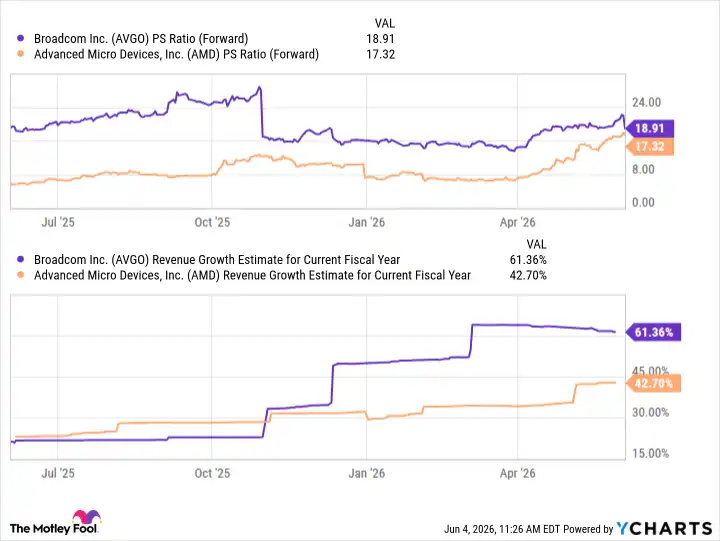
Chú thích: So sánh tỷ lệ Giá/Doanh thu kỳ hạn của AVGO và AMD, Nguồn: YCharts

Các nhà phân tích dự kiến tốc độ tăng trưởng của Broadcom sẽ nhanh hơn nhiều so với AMD, và khoảng cách định giá giữa hai công ty không quá lớn. Đặc biệt trong đợt điều chỉnh giảm sau báo cáo tài chính này, Broadcom càng đáng để mua vào.
Related Questions

QTheo bài viết, đâu là chiến lược khác biệt chính giữa Broadcom và AMD trong cuộc đua AI chip?

AAMD lựa chọn cạnh tranh trực diện với NVIDIA trên con đường GPU đa dụng (general-purpose GPU), trong khi Broadcom đi theo con đường khác biệt là sản xuất chip tùy chỉnh (XPU) được thiết kế riêng cho khối lượng công việc AI của từng khách hàng lớn.

QTại sao bài viết cho rằng AMD có thể gặp khó khăn trong việc thách thức vị thế của NVIDIA?

ABài viết lập luận rằng các khách hàng siêu khổng lồ AI (hyper-scaler) đã bị 'khóa chặt' vào hệ sinh thái phần mềm CUDA của NVIDIA. Hào sản phẩm này của NVIDIA rất khó vượt qua chỉ bằng thông số phần cứng, khiến cho con đường cạnh tranh trực diện của AMD trở nên khó khăn hơn.

QMục tiêu doanh thu chip AI hàng năm của Broadcom cho năm tài chính 2027 là bao nhiêu, theo CEO Hock Tan?

ACEO Hock Tan của Broadcom vẫn giữ vững mục tiêu doanh thu chip AI hàng năm đạt 100 tỷ USD vào năm tài chính 2027, bất chấp việc định hướng doanh thu quý III thấp hơn kỳ vọng.

QBài viết nêu tên những công ty khách hàng AI hàng đầu nào đang sử dụng chip tùy chỉnh (XPU) của Broadcom?

ABài viết liệt kê các khách hàng AI hàng đầu của Broadcom bao gồm Anthropic, Alphabet (công ty mẹ của Google), Meta và OpenAI.

QLý do chính nào khiến bài viết kết luận rằng cổ phiếu Broadcom đắt hơn AMD nhưng vẫn đáng để đầu tư?

ABài viết lập luận rằng mức cao hơn (premium) về định giá của Broadcom là hợp lý vì công ty có vị thế cạnh tranh vượt trội với danh sách khách hàng hàng đầu và tốc độ tăng trưởng dự kiến nhanh hơn đáng kể so với AMD, đặc biệt là sau đợt điều chỉnh giá gần đây.

Related Reads

For Those Still Obsessed with Altcoins, Just Buy HOOD

The author expresses bullish sentiment on Robinhood (HOOD) stock, citing multiple positive catalysts. Recent monthly operational data shows record highs in key metrics like total assets, funded customers, and margin balances. On the news front, Robinhood launched its own prediction market (Rothera), received approval to act as an IPO underwriter, and was selected to manage the new "Trump Accounts" for U.S. newborns, ensuring a long-term user base. Insiders and institutions are also buying or raising price targets. The core investment thesis, however, focuses on HOOD's evolving valuation narrative. Historically viewed as a "crypto proxy," its stock price was highly correlated with Bitcoin and its revenue heavily dependent on cryptocurrency trading fees. Recent data indicates this dependence is waning: crypto-related revenue hit a multi-quarter low of 13% of total revenue in Q1 2026, and the stock price has recently decoupled from BTC's trend. The author argues HOOD is transforming into a more diversified platform. Its growth is now driven by equities, options, prediction markets, and IPO-related services. This reduces its cyclical vulnerability to crypto bear markets. Crucially, if the crypto market recovers, HOOD would still benefit from increased trading activity. Therefore, for investors still hoping for gains from altcoins but concerned about their risks and liquidity, the author suggests HOOD offers a compelling alternative with higher safety margins—it can rise with a crypto bull run but isn't reliant on one.

Odaily星球日报3m ago

For Those Still Obsessed with Altcoins, Just Buy HOOD

Odaily星球日报3m ago

Cryptocurrency & Stock Market Indicator丨SpaceX Discloses Holding 18,712 Bitcoins Worth $1.18 Billion; Strategy Spends $100 Million Two Weeks in a Row to Scoop Up BTC at Low Levels (June 16)

"Coin-Stock Barometer: SpaceX discloses holding 18,712 Bitcoin worth $1.18B; Strategy spends another $100M accumulating BTC (June 16) SpaceX has officially disclosed holding 18,712 Bitcoin in its S-1 filing, valued at ~$1.18B, becoming the 8th largest public company Bitcoin holder. Its average cost is ~$35,000 per BTC. In weekly BTC treasury news, Strategy (formerly MicroStrategy) purchased another 1,587 BTC (~$100M) last week, increasing its total to 846,842 BTC. Mara Holdings added 1,000 BTC. However, Metaplanet and others made no purchases. Nakamoto sold ~600 BTC to repay ~$45M in debt. Global public companies (excluding miners) now hold 1,121,341 BTC. In other crypto treasury developments: - Metaplanet acquired Siiibo Securities to build a Bitcoin-focused financial ecosystem in Japan. - Bitmine increased its ETH holdings by 76,881 last week. - SharpLink's cumulative ETH staking rewards surpassed 21,119 ETH. - Forward Industries' acquisition offers for two SOL treasury companies, including Brera Holdings (holding 2.1M SOL), were rejected. - Tron Inc.'s TRX holdings surpassed 700 million. - Avalanche Treasury Co. (AVAT) begins trading on Nasdaq. - AIFC detailed plans to use WLFI tokens for collateral/loans. Market perspectives on U.S. stocks vary. 'White-Haired Stock God' Serenity sees the current cycle as retail-to-institution transfers, where negative reports may signal institutional accumulation. Morgan Stanley suggests a rotation from tech to cyclical stocks could occur. Citrini believes the U.S. stock market hasn't peaked but expects frequent 10-15% pullbacks in the coming months."

marsbit9m ago

Cryptocurrency & Stock Market Indicator丨SpaceX Discloses Holding 18,712 Bitcoins Worth $1.18 Billion; Strategy Spends $100 Million Two Weeks in a Row to Scoop Up BTC at Low Levels (June 16)

marsbit9m ago

Do Robots Also Need Encrypted Wallets? Stablecoin Giant Tether Bets on German Company NEURA Robotics

Do Robots Need Crypto Wallets? Stablecoin Giant Tether Bets on German Firm NEURA Robotics German robotics company NEURA Robotics has secured up to $1.4 billion in what is claimed to be the largest-ever funding round in the full-stack robotics industry, valuing the company at $7 billion. The Series C round attracted major investors like Tether, Qualcomm, Amazon, NVIDIA, Bosch, and the European Investment Bank. NEURA, founded in 2019, initially focused on AI-powered collaborative robots (cobots) for industrial automation, later expanding to autonomous mobile robots, service robots, and humanoid robots. Its core strategy is evolving from a hardware manufacturer to the operator of "Neuraverse," a platform designed to enable different robots to share learned experiences and data, creating network effects. A key, crypto-focused aspect of this investment is Tether's involvement. Tether plans to integrate its open-source Wallet Development Kit (WDK) into NEURA's robot platforms. This would embed self-custody wallet functionality, allowing robots to autonomously handle payments and settlements for tasks under pre-set rules—envisioning use cases in logistics or Robotics-as-a-Service (RaaS) models. This move could position stablecoins and crypto wallets as potential "machine payment infrastructure." Additionally, the partnership will see Tether's QVAC (QuantumVerse Automatic Computer) edge-AI framework tested and deployed within Neuraverse. This aims to enable low-latency, offline-capable AI decision-making directly on robots, reducing reliance on cloud computing for critical, time-sensitive operations. The investment underscores Tether's broader ambition to expand beyond being just a stablecoin issuer into AI, energy, and digital infrastructure, with NEURA's robotics network serving as a testbed for merging crypto-based financial layers with edge-based intelligence for the future of automation.

marsbit26m ago

Do Robots Also Need Encrypted Wallets? Stablecoin Giant Tether Bets on German Company NEURA Robotics

marsbit26m ago

AMD Launches Compact AI Host, Directly Challenging NVIDIA DGX Spark

In June 2026, AMD announced the Ryzen AI Halo, a compact AI developer desktop to rival NVIDIA's DGX Spark. Both feature 128GB unified memory for running 200B+ parameter models locally. Priced from $2,949 to $3,999, AMD undercuts NVIDIA's $3,999+ DGX Spark. The core divergence lies in architecture and philosophy. Ryzen AI Halo uses an x86-based Ryzen AI Max+ 395 APU (CPU+GPU+NPU), runs standard Windows/Linux, and emphasizes general-purpose PC flexibility. DGX Spark uses an ARM-based Grace Blackwell Superchip, runs a custom DGX OS, and includes a high-speed ConnectX-7 NIC for cluster prototyping, anchoring it to NVIDIA's full-stack CUDA ecosystem. AMD's ROCm software has improved, with simpler installation and support for major frameworks, but still lags behind CUDA's 17-year maturity in community support and cutting-edge library availability. AMD's broader strategy focuses on becoming a viable second-source supplier. Key moves include acquiring design capabilities via ZT Systems (while outsourcing manufacturing) and securing two major 6GW GPU supply deals with OpenAI and Meta in late 2025/early 2026. These contracts validate AMD's role in diversifying the AI supply chain, rather than outright beating NVIDIA. NVIDIA counters with a tightly integrated stack from desktop (DGX Spark) to data center, emphasizing seamless scalability and enterprise software subscriptions (AI Enterprise). In summary, Ryzen AI Halo represents AMD's pragmatic path: offering a cost-effective, open-ecosystem alternative for developers wary of vendor lock-in, while its large data center contracts aim to capture share from customers seeking a second GPU supplier. The choice boils down to a familiar, flexible PC environment with potential software gaps (AMD) versus a premium, optimized, but locked-in ecosystem (NVIDIA).

marsbit26m ago

AMD Launches Compact AI Host, Directly Challenging NVIDIA DGX Spark

marsbit26m ago

Trading

Spot
Futures

Hot Articles

How to Buy CHIP

Welcome to HTX.com! We've made purchasing USD.AI (CHIP) simple and convenient. Follow our step-by-step guide to embark on your crypto journey.Step 1: Create Your HTX AccountUse your email or phone number to sign up for a free account on HTX. Experience a hassle-free registration journey and unlock all features.Get My AccountStep 2: Go to Buy Crypto and Choose Your Payment MethodCredit/Debit Card: Use your Visa or Mastercard to buy USD.AI (CHIP) instantly.Balance: Use funds from your HTX account balance to trade seamlessly.Third Parties: We've added popular payment methods such as Google Pay and Apple Pay to enhance convenience.P2P: Trade directly with other users on HTX.Over-the-Counter (OTC): We offer tailor-made services and competitive exchange rates for traders.Step 3: Store Your USD.AI (CHIP)After purchasing your USD.AI (CHIP), store it in your HTX account. Alternatively, you can send it elsewhere via blockchain transfer or use it to trade other cryptocurrencies.Step 4: Trade USD.AI (CHIP)Easily trade USD.AI (CHIP) on HTX's spot market. Simply access your account, select your trading pair, execute your trades, and monitor in real-time. We offer a user-friendly experience for both beginners and seasoned traders.

1.7k Total ViewsPublished 2026.04.21Updated 2026.06.02

How to Buy CHIP

Discussions

Welcome to the HTX Community. Here, you can stay informed about the latest platform developments and gain access to professional market insights. Users' opinions on the price of CHIP (CHIP) are presented below.

活动图片