史上最严重的存储短缺,把三星推上全球第二

marsbitPublished on 2026-05-06Last updated on 2026-05-06

原文标题:AI Has Made Memory Chips One of the World』s Most Profitable Products

原文作者:Jiyoung Sohn、Andrew Barnett,the Wall Street Journal

原文编译:Peggy,BlockBeats

编者按:英伟达曾是 AI 基建周期里最显眼的赢家,但最新一轮芯片行情正在说明,AI 的瓶颈并不只在 GPU,也在存储。

过去一年,全球资本开支持续涌向 AI,先是推高了 HBM 等高带宽内存的需求,随后又挤压了传统 DRAM 与 NAND 闪存的供给。当大模型训练需要 GPU 与 HBM 配套,当推理需求又带动通用服务器扩张,存储芯片便从一个周期性行业,变成了 AI 产业链中最稀缺、也最赚钱的环节之一。

这也是三星、SK 海力士和美光业绩集体爆发的原因。存储芯片一季度涨价近 100%,使得三星一季度净利润超过 300 亿美元,半导体业务贡献了绝大部分利润;存储芯片价格在 2026 年前三个月环比上涨近一倍,远超市场原本预期。更重要的是,这并非单纯的短期涨价行情,而是一场供需结构的重新定价:新晶圆厂建设周期漫长,HBM 又占用更多产能,传统存储供应被进一步压缩。

在这个背景下,存储芯片正在从「配套部件」变成「战略资源」。服务器、PC 和手机厂商开始支付溢价锁定产能,甚至接受五年期合同、预付款和共同投资建厂。过去依靠握手协议维系的供应关系,正在转向更强约束的长期绑定。换句话说,AI 竞争已经不只是模型、算力和云平台之间的竞争,也开始变成对底层供应链的争夺。

最值得关注的,不是存储芯片公司今年赚了多少钱,而是 AI 基础设施的瓶颈正在从单一算力扩散到更广泛的硬件体系。GPU 决定模型能否训练,HBM 决定数据能否高速交换,DRAM 与 NAND 则影响推理和服务器扩张的成本结构。当越来越多企业相信「谁掌握存储供应,谁就能掌握 AI」时,存储芯片的暴利周期,实际上也是 AI 基建进入资源竞赛阶段的一个信号。

以下为原文:

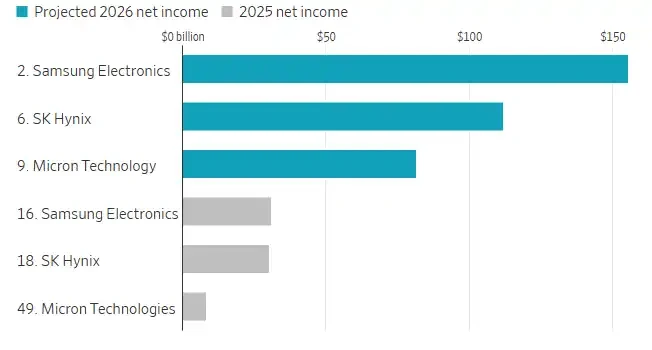
按净利润排名,进入全球前 20 的芯片制造商。
截至去年底,全球对人工智能的投资已经将存储芯片行业推入一轮「超级繁荣周期」。利润刷新纪录,价格也被预计将在 2026 年前三个月较上一季度再上涨 50%。

但事情的发展并没有止步于此。实际情况甚至更好,而且好得多。

周四,三星电子公布的一季度净利润折合超过 300 亿美元。这不仅远远超过其此前的单季度利润纪录,也几乎逼近这家韩国公司过去创下的全年利润高点。三星第一季度约 94% 的营业利润来自半导体业务。

三星在存储芯片领域的主要竞争对手——韩国 SK 海力士和美国美光科技——近期也交出了同样令人惊讶的业绩。这三家公司主导着全球存储市场,而存储芯片正与英伟达的处理器芯片一起,被用于 AI 计算。

半导体公司的年度净利润
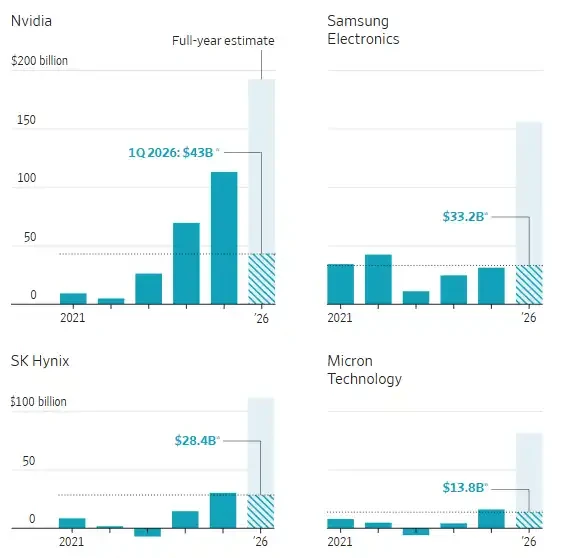
第一季度数据中,三星和 SK 海力士对应的是截至 2026 年 3 月的财季(实际业绩);美光对应的是截至 2025 年 2 月的财季(实际业绩);英伟达对应的是截至 2026 年 4 月的财季(预估业绩)。

注:三星数据包含其全部业务,但半导体业务贡献了大部分利润。汇率按 1 美元兑 1421.22 韩元计算。来源:FactSet Andrew Barnett /《华尔街日报》

尽管市场越来越担心 AI 服务最终能否真正带来可观利润,但参与相关基础设施建设的公司,已经收获了一轮史诗级红利。

而这轮历史性行情短期内似乎还看不到结束迹象。三星存储业务执行副总裁 Jaejune Kim 在周四的财报电话会上表示,从三星已经预订的订单来看,供应短缺预计明年还会进一步加剧。他说:「当前可供应的产能远远无法满足客户需求。」

今年以来,三星股价已上涨 72%。SK 海力士股价上涨 90%,美光则上涨 65%。

公司市场份额
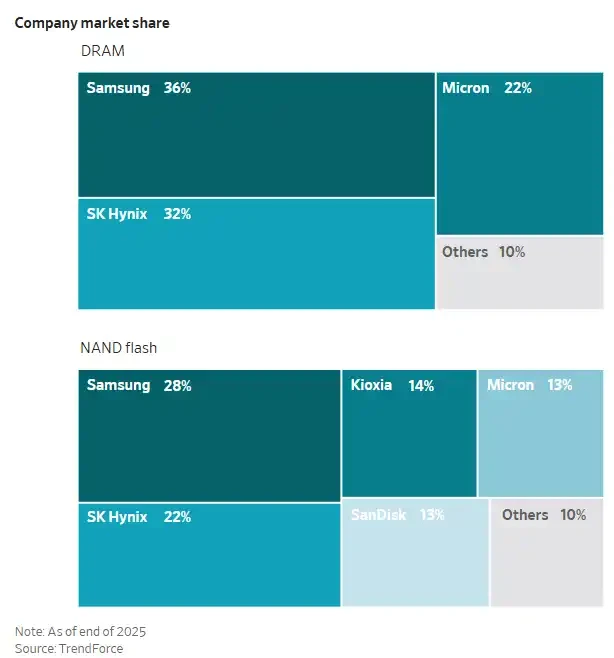
据科技市场研究机构 TrendForce 的数据,2026 年前三个月,存储芯片价格较上一季度上涨近 100%,大约是最初预期涨幅的两倍。

近年来,存储芯片制造商一直优先生产 AI 所需的专用存储芯片,也就是高带宽内存(HBM)。这反过来限制了智能手机、个人电脑和通用服务器所使用的传统存储芯片供应。训练大型语言模型通常需要将英伟达的图形处理器(GPU)与 HBM 搭配使用。

更近一段时间,推理需求开始上升。所谓推理,是指已经训练好的 AI 模型对用户提问作出回应所需的计算过程。这带动了通用服务器需求增长,而通用服务器使用的是传统存储芯片,也由此将三星、SK 海力士和美光的盈利能力推上了一个新的台阶。

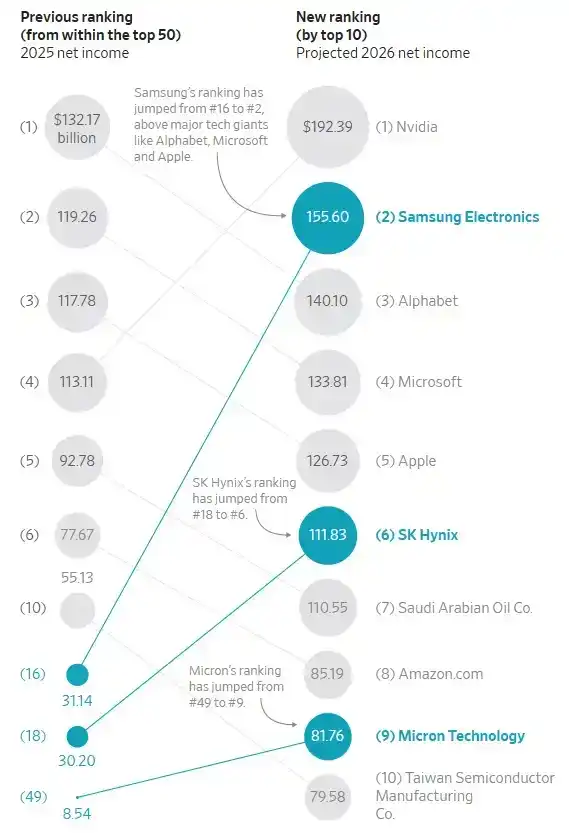
根据 FactSet 的估算,这三家公司预计将在 2026 年合计实现约 3500 亿美元净利润。它们各自都有望跻身全球最赚钱的上市公司前十,其中三星预计将超过 Alphabet、微软和苹果,跃升至第二位。一年前,这几家存储芯片制造商还没有任何一家进入前十。

部分芯片制造公司按净利润排名
一座芯片制造工厂,也就是晶圆厂,成本可能超过 200 亿美元,而且需要数年时间才能建成。行业分析师表示,三星、SK 海力士和美光都在建设新工厂,但产能很可能要到 2027 年底或 2028 年才会全面释放。与此同时,许多生产线已经被分配给 HBM,而与传统存储芯片相比,HBM 会占用更多产能。

存储芯片主要分为两大类:一类是 DRAM,用于服务器、个人电脑和其他电子设备中的临时存储,以支持更快的数据处理;另一类是 NAND 闪存,用于长期数据存储,例如手机里的照片存储。

HBM 则是通过将 DRAM 芯片一层层堆叠起来制成,随后与英伟达等公司生产的处理器一起封装,以加速 AI 计算。英伟达与三星、SK 海力士和美光都有密切合作。

Counterpoint 半导体研究分析师 MS Hwang 表示,这两类存储芯片的营业利润率都已较通常水平大约翻了一番,其中 DRAM 的利润率达到约 80%,NAND 闪存则最高可达 60%。

存储芯片合约价格
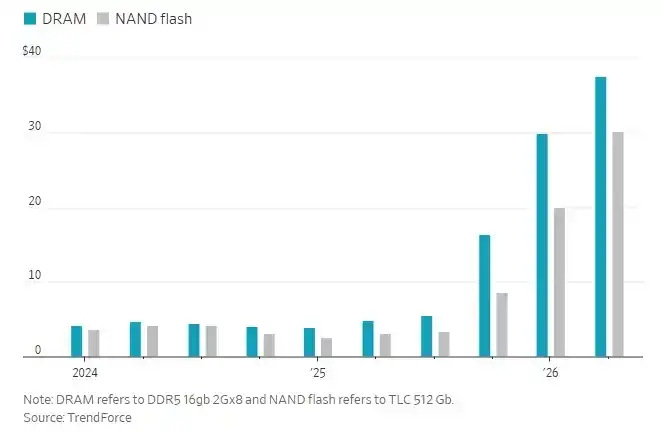
Counterpoint 的 Hwang 补充称,服务器、PC 和智能手机领域的许多大公司,正在支付溢价、大量采购存储芯片,以此锁定更多供应,并限制竞争对手能够获得的产能。他说:「背后的逻辑是,谁能掌控存储供应,谁就能主导 AI。」

全球电子元器件分销商 Fusion Worldwide 执行副总裁 Marcus Chen 表示:「我们今天看到的,是市场有史以来最严重的一次存储短缺。」Chen 服务的大多数客户,目前只能拿到所需存储芯片的 30% 到 50%。「有些客户甚至更少。」他说。

过去很长一段时间,客户和存储芯片制造商主要依靠「握手协议」来确保长期供应;但现在,在一些情况下,双方正在转向具有约束力的正式合同。花旗半导体分析师 Peter Lee 表示,有些合同期限长达五年,并要求客户预付约 30% 的费用,或共同承担新建存储芯片工厂的投资成本。Lee 说:「我们已经看到客户愿意做到这种程度。」

原文链接

Related Reads

How the $900 Billion Anthropic Was Built?

Anthropic, the AI startup behind Claude, is reportedly in early talks to raise at least $30 billion in new funding, targeting a valuation exceeding $900 billion. This would propel it past OpenAI's recent $852 billion valuation. The funding round is expected to close by late May 2026. The company's valuation surge is driven by extraordinary revenue growth, reportedly reaching an annualized $30 billion by March 2026 from $1 billion in December 2024. However, OpenAI questions this figure, suggesting a net revenue closer to $22 billion after cloud platform fees. Despite high revenue, Anthropic's gross margin is reportedly around 40%, and it is not yet profitable, with breakeven projected for 2028. A significant portion of the new capital would fund massive, pre-committed computing infrastructure with partners like Amazon, Google, and Microsoft. This highlights a new AI financing model where high valuations fuel compute spending, which in turn requires even higher future valuations to sustain. Notably, many early-stage investors are reportedly sitting out this round. Bankers privately estimate a potential IPO valuation between $400-500 billion, creating a rare scenario where the final private funding round valuation ($900B+) could far exceed the expected public market debut. Anthropic is targeting an IPO between October 2026 and the first half of 2027. Its public listing is poised to be a critical test for the entire AI sector's valuation logic, potentially validating or challenging the high-stakes "valuation-compute-valuation" cycle that has defined private market investments.

链捕手2m ago

How the $900 Billion Anthropic Was Built?

链捕手2m ago

UBS Enters the Fray, 20 Swiss Banks Now Offer Crypto Trading, Covering 2.5 Million Accounts

Global wealth management giant UBS has entered the cryptocurrency market, offering Bitcoin and Ethereum trading to select private banking clients in Switzerland as of January 2026. This move is part of a broader trend in Switzerland, where approximately 20 banks now provide crypto services, collectively covering over 2.5 million accounts. Client data from Zurich Cantonal Bank (ZKB) challenges the stereotype of crypto being solely for the young, revealing that the average buyer is aged 30-50 and predominantly male. Notably, over 40% of these clients previously held no investment portfolio, indicating crypto is activating dormant capital. The business case is proving substantial. For several Swiss banks, crypto-related activities already contribute a significant and disproportionate share of profits, with unit economics often outperforming traditional banking services. This institutional adoption in Switzerland reflects a global trend, with a recent survey showing 73% of institutional investors planning to increase crypto allocations in 2026. Switzerland's early regulatory clarity through its DLT Act and established custody infrastructure have provided a foundation for this growth. However, upcoming challenges include the implementation of the OECD's Crypto Asset Reporting Framework (CARF) in 2027 and ongoing reforms by Swiss regulator FINMA. The final shape of these regulations will be crucial in determining whether Switzerland can maintain its leading position in the global banking crypto sector.

marsbit4m ago

UBS Enters the Fray, 20 Swiss Banks Now Offer Crypto Trading, Covering 2.5 Million Accounts

marsbit4m ago

Circle Releases Arc Network Whitepaper: Can the New Economic Mechanism Drive It to Become the "Clearing Coordination Layer" for Institutional-Grade Stablecoin Payments?

Circle has released the whitepaper for its Arc Network, detailing plans for a new economic coordination layer using the proposed ARC token. Arc is a Layer 1 blockchain designed for enterprise-level stablecoin payments, featuring USDC as its native gas token, a high-performance consensus mechanism for instant transaction finality, and optional enterprise privacy features. Currently operating on a Proof-of-Authority (PoA) model, the network plans a future transition to a Proof-of-Stake (PoS) system. The ARC token is intended to serve as the network's native coordination asset, facilitating governance, enabling staking rewards, and managing fee mechanisms. User fees paid in stablecoins would be converted to ARC, with portions distributed as rewards and burned. The governance model will blend token-based voting with institutional oversight, especially for high-sensitivity matters like security and compliance. While positioning Arc as a potential settlement layer for institutional stablecoin payments, the whitepaper acknowledges challenges. These include the network's current centralization, the unfinished and potentially volatile ARC token economics, and the evolving global regulatory landscape for stablecoins. The development signals a broader industry trend where Web3 infrastructure competition is shifting from pure performance to factors like liquidity, compliance, and institutional-grade stability.

marsbit40m ago

Circle Releases Arc Network Whitepaper: Can the New Economic Mechanism Drive It to Become the "Clearing Coordination Layer" for Institutional-Grade Stablecoin Payments?

marsbit40m ago

18-Year-Old Hacker's Boastful Discord Display Leads to Uncovering of $19 Million Theft Case

An 18-year-old hacker from the U.S., Dritan Kapllani Jr., has been exposed by on-chain investigator ZachXBT for his alleged involvement in multiple cryptocurrency social engineering attacks, with total funds stolen estimated at $19 million. The case gained attention after Dritan inadvertently revealed his involvement during a Discord voice call in April 2026, where he screen-shared his Exodus wallet containing approximately $3.68 million to show off his wealth during a "Band 4 Band" argument. Tracing this wallet address led investigators to uncover its connection to a major theft from March 14, 2026, where 185 Bitcoin (worth around $13 million at the time) was stolen. Approximately $5.3 million from that heist was funneled into Dritan’s wallet. Further analysis linked the same wallet to over $5.85 million from other social engineering attacks dating back to 2025. While Dritan has not yet been formally charged, he is identified as "Co-Conspirator 1" in recently unsealed court documents related to the 185 Bitcoin theft case. Another individual, Meme coin KOL yelotree, is also implicated for allegedly assisting with money laundering through a car rental business. Dritan, who had been living a lavish lifestyle and was previously seen as untouchable within hacking circles, turned 18 recently, making him legally accountable. His previous "immunity" has ended as law enforcement closes in.

Odaily星球日报1h ago

18-Year-Old Hacker's Boastful Discord Display Leads to Uncovering of $19 Million Theft Case

Odaily星球日报1h ago

Trading

Spot
Futures

Hot Articles

Discussions

Welcome to the HTX Community. Here, you can stay informed about the latest platform developments and gain access to professional market insights. Users' opinions on the price of AI (AI) are presented below.

活动图片