Litecoin’s MWEB Bug Let An Attacker Create 85,034 LTC

bitcoinistPublished on 2026-04-29Last updated on 2026-04-29

Litecoin developers have disclosed that a critical validation flaw in the network’s Mimblewimble Extension Block implementation allowed an attacker to create an inflated pegout of 85,034.47285734 LTC in March 2026, before a coordinated emergency response recovered the funds and neutralized the accounting imbalance.

The incident, detailed in a postmortem published by Litecoin developer David Burkett on April 28, also set the stage for a second April event in which a later exploit attempt triggered a denial-of-service failure mode, disrupted upgraded mining nodes, and led to a 13-block invalid chain being reorged out.

A Critical Litecoin MWEB Validation Failure

According to the postmortem, the root issue was a missing validation check in Litecoin’s MWEB block connection path. MWEB inputs are supposed to reference previous MWEB outputs, while carrying metadata used by balance and spend validation logic. That metadata must match the actual MWEB UTXO being spent.

In normal mempool and block construction paths, that check existed. But it was not fully enforced during block connection. That gap allowed a malicious block producer to include an MWEB input whose supplied metadata did not match the real UTXO, making a small input appear capable of supporting a much larger pegout.

“The intended rule is simple: when an MWEB input spends a previous output, the metadata supplied by the input must match the actual MWEB UTXO identified by the input’s output ID,” the postmortem states. “That check existed in some paths, including normal mempool and block construction paths. But it was not fully enforced in the block connection path.”

The exploit occurred at block height 3,073,882. The attacker used an MWEB input with an actual value described as unknown, but “not more than 1.2084693 LTC,” while using fake commitment data to generate a pegout of 85,034.47285734 LTC. The inflated funds were initially sent to a transparent Litecoin address and later split into three transparent-chain outpoints.

Because exploitation required bypassing normal transaction relay and block-building checks, the attacker needed to mine a block or control a miner willing to include malformed MWEB data.

Miner Coordination, Frozen Outputs And Recovery

Once developers identified the vulnerability and confirmed it had already been exploited, they coordinated privately with major mining pools. The aim was to prevent further exploit blocks without immediately alerting the actor before the inflated outputs could be contained.

Litecoin Core 0.21.5 and 0.21.5.1 were deployed as emergency miner-focused releases. The latter added a historical exception for the already-accepted exploit block and temporarily rejected spends of the three attacker-controlled transparent outputs.

The attacker later attempted to spend at least one frozen output, but upgraded miners rejected the transaction. Developers then contacted the actor, who agreed to sign a recovery transaction returning the funds except for an 850 LTC bounty.

“The actor later signed a recovery transaction,” the postmortem says. “That transaction paid: 84,184.47278630 LTC total to the recovery address, split across two outputs. 850.00000000 LTC to an address controlled by the actor as the agreed bounty.”

The postmortem adds that Charlie purchased 850 LTC to cover the bounty gap. The full 85,034.47285734 LTC was then pegged back into MWEB at block height 3,078,098, and the resulting MWEB output was frozen. This was designed to restore MWEB’s internal supply balance while ensuring the rebalancing output could not be spent.

Litecoin developers said no confirmed user funds were ultimately lost in the March incident. Still, the response required emergency miner coordination, staged releases and special-case handling of historical exploit data.

April Attempt Triggered A 13-Block Invalid Chain

The second incident began on April 25 at block height 3,095,931, when another actor attempted to use the same original exploit path. Upgraded nodes rejected the malformed MWEB data, but the rejection exposed a separate mutated-block handling issue.

The postmortem explains that some serialized MWEB body data could be mutated without changing the canonical Litecoin block hash. When an upgraded node received such a mutated MWEB block over peer-to-peer channels, it could fail while applying the MWEB body, classify the failure as “BLOCK_MUTATED,” and retain the bad serialized data for that block hash. That could interfere with later valid block processing and mining RPC flows such as submitblock.

“During the April incident, this caused upgraded mining nodes to reject the bad block but also become unable to continue normal mining operations quickly enough,” the postmortem states. “Unupgraded miners, which did not enforce the MWEB fix, continued extending the invalid chain until upgraded miners coordinated and overtook it.”

The invalid chain ran through block height 3,095,943, producing 13 bad blocks in total before the valid chain overtook it. Litecoin developers emphasized that this was not a rollback of valid Litecoin history, but a reorg of an invalid chain produced by miners that had not upgraded or had not fully enforced the MWEB validation rules.

Third-Party Losses Remain A Key Open Issue

While the March exploit was recovered internally, the April reorg affected some external infrastructure. The postmortem says NEAR Intents processed a swap of 11,000 LTC for 7.78814476 BTC before those LTC were removed from the valid chain, resulting in what Litecoin described as a “large loss” for NEAR Intents. THORChain was also affected, with an attacker swapping 10 LTC for 0.00719957 BTC before the reorg invalidated the Litecoin side of the transaction.

Other attempted swaps were reportedly prevented in time, but exact third-party transaction IDs and final loss amounts were still being collected.

Litecoin Core 0.21.5.4 was released on April 25 to address the mutated-block DoS failure mode by erasing stored block data for blocks classified as mutated, allowing valid data for the same block hash to be accepted later. Users, miners, exchanges and services were urged to upgrade to Litecoin Core 0.21.5.4 or later and verify that nodes are syncing normally.

At press time, LTC traded at $55.95.
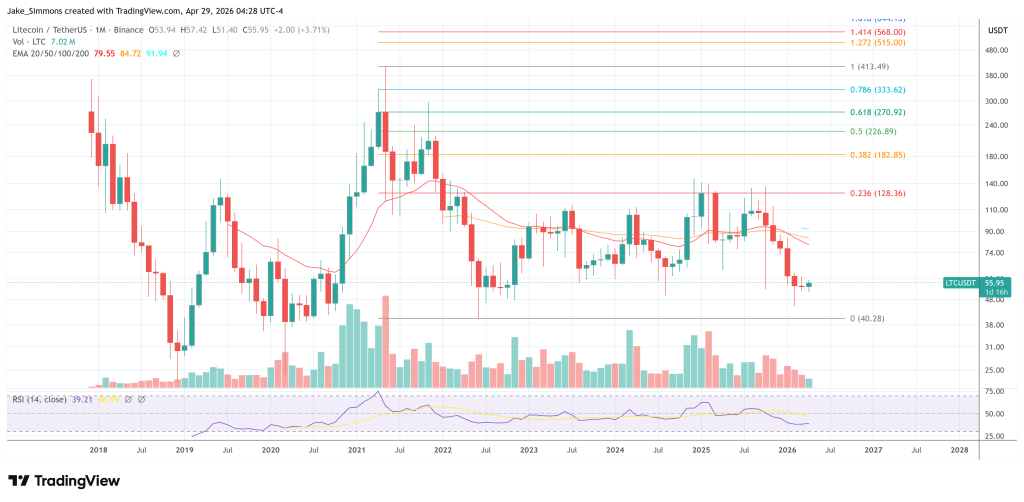
Litecoin remains in bearish territory, 1-week chart | Source: LTCUSDT on TradingView.com

Trending Cryptos

Related Reads

Report Interpretation: J.P. Morgan Details Micron's Pre-Earnings Sentiment, Current Hardware Sector Dynamics

Morgan Stanley analyst Joshua Meyers' report (June 21, 2026) highlights key trends in the hardware and semiconductor sector ahead of Micron's earnings. The core takeaways are: 1. **Micron & Memory:** Memory remains a high-conviction long theme, driven by strong AI demand and rising ASPs. However, investor focus is shifting to the sustainability of Micron's >80% gross margins and the specifics of potential new long-term supply agreements (SCAs). 2. **Hardware Supply Chain:** AI-related demand for servers, networking, and storage remains robust, but company performance is diverging. Celestica (CLS) shows improved margin confidence, Western Digital and Seagate benefit from pricing, Fabrinet (FN) sees predictable AI optics growth, and Teradyne (TER) anticipates a new Google customer. 3. **AI Capex & WFE Forecasts:** JPMorgan increased its Wafer Fab Equipment (WFE) market growth forecasts to 28% in 2026 and 29% in 2027. AI infrastructure financing is evolving, with higher project-level debt reducing constraints on capex expansion. The report signals that while the AI-driven hardware cycle is strong, the market is entering a phase focused on execution verification (e.g., Micron's SCA details, Fabrinet's ramp with Amazon) and valuation sustainability. Key near-term signals include Micron's guidance, Arista Networks' outlook, and the pace of demand normalization post potential tariff-related pull-ins.

marsbit2h ago

Report Interpretation: J.P. Morgan Details Micron's Pre-Earnings Sentiment, Current Hardware Sector Dynamics

marsbit2h ago

Research Report Analysis: The Fed's New Chair's Debut – New Leader, But Same Script?

Report Analysis: Federal Reserve's New Chair Debut – A New Captain, But the Same Script? Morgan Stanley's chief global economist Seth B. Carpenter analyzes the first FOMC meeting under new Fed Chair Kevin Warsh in a June 21 report. Warsh deliberately avoided providing forward guidance on interest rates, aligning with his philosophy. However, market expectations for a rate hike this year were reinforced. Key signals lie elsewhere: inflation may fall more than expected, and quantitative tightening (QT) could be more aggressive than anticipated. The FOMC's "dot plot" suggests only one rate hike in 2026. Carpenter argues that if inflation undershoots forecasts, the logic for even a single hike weakens, especially as projections indicate potential rate cuts in 2027. On QT, Warsh's stance is clear. Carpenter notes that measures like halving the Treasury's account balance could shrink the Fed's balance sheet by around $500 billion with minimal market impact. Combined with adjustments to reserve interest and liquidity rules, the ultimate QT scale may exceed expectations, though its market effect might be less disruptive unless the Fed actively sells Mortgage-Backed Securities (MBS). While Warsh initiated a review of the Fed's policy framework, the 2% inflation target remains intact for now. The report concludes that the market may be overestimating the significance of reduced forward guidance and the near-term rate hike risk, while potentially underestimating the scope and manageable nature of the coming balance sheet reduction. The key debates will hinge on upcoming core PCE data, the specifics of the QT path, and the framework review's findings.

marsbit2h ago

Research Report Analysis: The Fed's New Chair's Debut – New Leader, But Same Script?

marsbit2h ago

Critical Game Week: BTC Retracement Confirmation vs. HYPE Support Battle | Guest Analysis

This weekly analysis outlines a critical juncture for BTC and HYPE markets, focusing on key price level confirmations. **BTC Analysis:** BTC is at a pivotal point after a five-wave rally from the June 5th low of $59,100. The price has broken below a short-term rising channel's lower boundary, with the current move seen as a pullback to test this breakdown. Failure to reclaim this level could lead to a retest of the $59,000-$60,000 support zone. The core scenario hinges on this channel retest outcome. * **Key Levels:** Resistance at $64,500-$65,000 (channel boundary) and $69,500-$70,500. Support at $59,000-$60,000 and $55,000. * **Strategy:** A core bearish stance is maintained (20% short from last week), with short-term plans for tactical trades. Three detailed contingency plans (A/B/C) are provided for short positions on resistance tests or breakdowns, emphasizing strict stop-loss discipline. **HYPE Analysis:** HYPE shows strong momentum but is currently in a corrective phase after hitting a new high of $76.94. The price is retesting the crucial $64-$66 support area. * **Key Levels:** Resistance near $77 and $80-$82. Support at $64-$66 and $52-$54. * **Strategy:** The short-term approach is "buy on dips, avoid chasing rallies." A long position is considered only if clear stabilization signals appear at the $64-$66 or deeper $52-$54 support zones, with tight risk controls. **General Risk Management:** A standardized trailing stop-loss protocol is emphasized: set initial stop, breakeven at +1% profit, then trail stops upward to lock in gains. *Disclaimer: All analysis is presented as a personal trading framework, not investment advice. Market conditions are complex and require dynamic adjustment.*

marsbit3h ago

Critical Game Week: BTC Retracement Confirmation vs. HYPE Support Battle | Guest Analysis

marsbit3h ago

Research Report Interpretation: Citi Attends AWS Summit, Bullish on Cloud Business Acceleration but Data Governance Remains Key Variable

Citi analyst Tyler Radke's team attended the AWS New York Summit (June 17-18), engaging with over 10 clients and partners. In a June 19 report, they highlighted the summit's focus on scaling agent AI for enterprise deployment. Citi maintains a "Buy" rating on Amazon, forecasting AWS revenue growth to accelerate to 37% in FY27 from 30% in FY26, noting this estimate may be conservative. Key takeaways: 1. **AWS Strategy Shift:** AWS is moving from proof-of-concepts to scalable deployment. New offerings like AWS Context (building enterprise knowledge graphs), Amazon Quick (cross-application AI assistant), and security tool Continuum address core enterprise pain points for AI adoption. 2. **Data Infrastructure Beneficiaries:** Data infrastructure companies like Snowflake, Elastic, Oracle, and ClickHouse are seen as direct beneficiaries of scaling AI workloads, as evidenced by strong growth and use cases presented. 3. **Critical Role of Data Governance:** As AI agents scale from hundreds to thousands, effective data governance becomes the key variable for deploying AI in core business processes. AWS Context represents AWS's strategic extension from providing compute/models to offering a data governance infrastructure layer. The report emphasizes that without solving data governance, AI will remain confined to pilot projects. The investment thesis focuses on AWS revenue acceleration and data infrastructure vendors' growth, while monitoring signals like AWS's quarterly revenue growth, Bedrock AgentCore task volume, and pricing impacts on companies like Elastic.

marsbit3h ago

Research Report Interpretation: Citi Attends AWS Summit, Bullish on Cloud Business Acceleration but Data Governance Remains Key Variable

marsbit3h ago

Trading

Spot
Futures

Hot Articles

Discussions

Welcome to the HTX Community. Here, you can stay informed about the latest platform developments and gain access to professional market insights. Users' opinions on the price of S (S) are presented below.

活动图片