Solana RWA holders jump 440% YoY – Can it bridge gap to Ethereum’s XAUT?

ambcryptoPublished on 2026-04-06Last updated on 2026-04-06

Abstract

Solana's RWA ecosystem is experiencing explosive growth, with a 440% year-over-year surge in holders, totaling 218,000. This positions Solana as a major hub for tokenized real-world assets, which now have a total on-chain market cap of $24 billion. While Tether Gold (XAUT) on Ethereum leads the RWA market at $3.3 billion, Solana is gaining momentum through its strong focus on tokenized U.S. Treasuries. These assets, which make up over 50% of the RWA market, could generate revenue to strengthen Solana's digital asset treasuries (DATs) and support long-term network growth. The IMF has warned that the rapid growth of on-chain RWAs could disrupt traditional finance. Solana's expansion in this sector suggests it could become a viable alternative to Ethereum for institutional capital seeking tokenized assets.

When the International Monetary Fund (IMF) sounds the alarm, it signals that the threat is real.

Recently, the IMF has been pointing out how fast the Real World Asset (RWA) market is growing on-chain, warning that TradFi players could fall behind if this keeps up.

The logic is simple: More real-world capital is moving onto blockchain, which could change how central banks manage money and financial stability.

Notably, the numbers back it up.

The on-chain market cap of total RWAs has just hit a new all-time high of $24 billion, with Tether Gold [XAUT] leading the pack at $3.3 billion. What’s really interesting is how the market reacted immediately, with much of the momentum flowing toward Solana [SOL] as more investors look to take advantage of its growing RWA ecosystem.
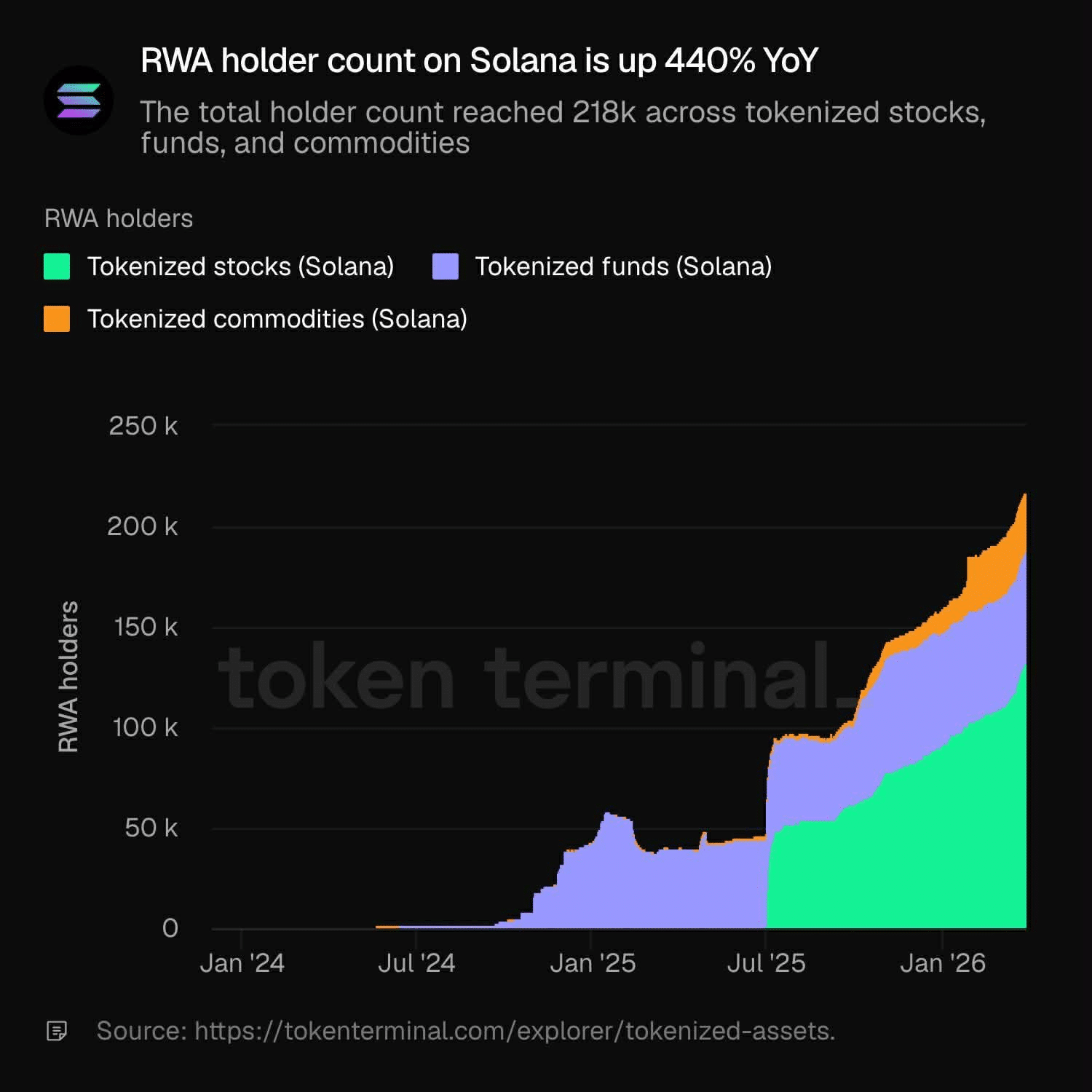
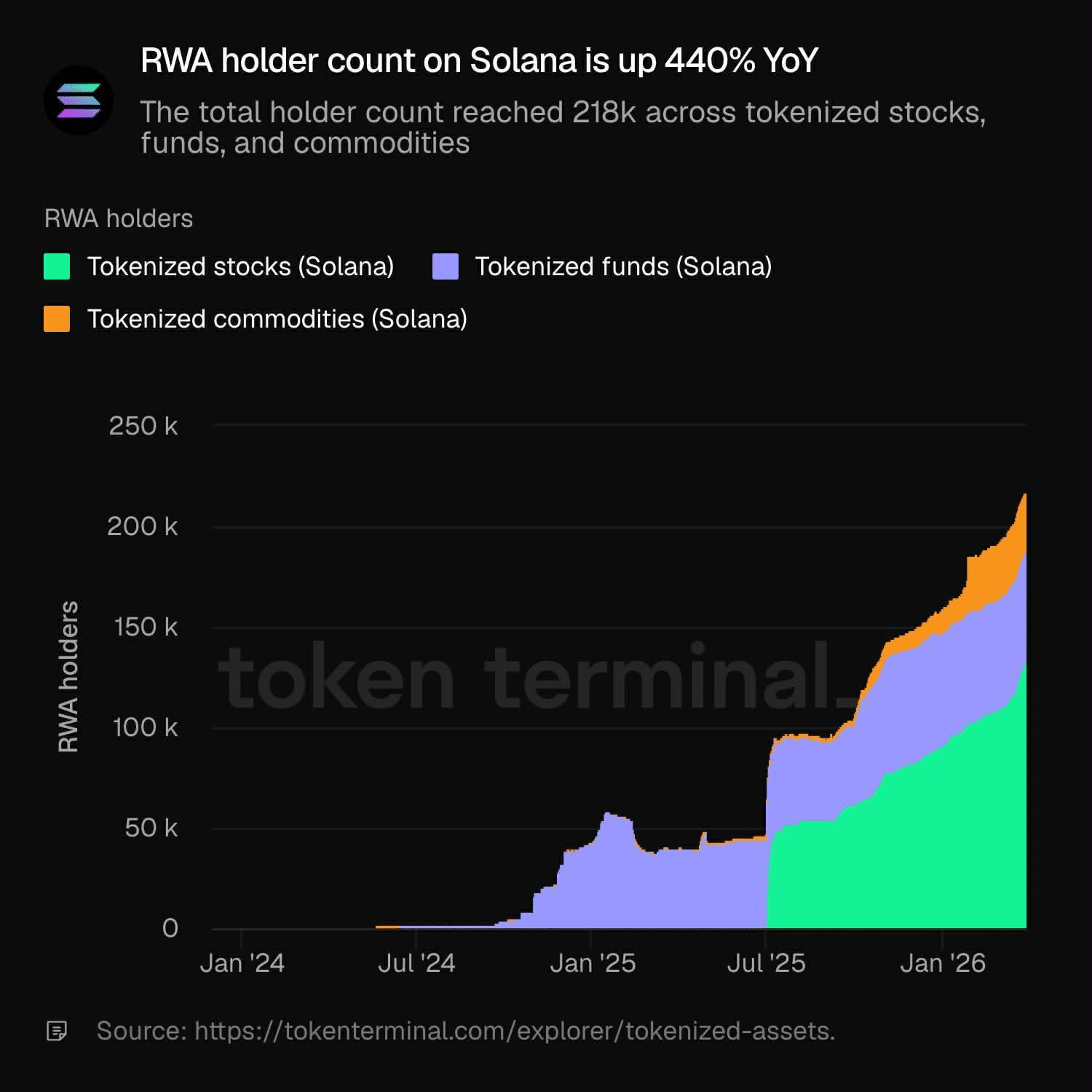
Source: Token Terminal

The real story? Solana’s RWA holder count.

As the chart showed, the number of RWA holders on Solana was up 440% year-over-year, totaling 218,000 across tokenized stocks, funds, and commodities.

This surge signals more than hype.

Instead, it’s a clear sign that Solana is becoming a go-to network for tokenized real-world assets.

Against this backdrop, the IMF’s raising alarms starts to make sense.

XAUT’s lead in the RWA space is particularly noteworthy. Its growth comes at a time of heightened geopolitical tensions, which usually push capital into traditional safe havens.

But instead of sticking to the old playbook, investors are flowing into a tokenized version of gold, showing how RWAs are changing the way capital moves.

That said, this also complicates the narrative around Solana as the go-to network for RWAs.

XAUT currently trades only on Ethereum [ETH], raising the question: Can Solana capture this momentum indirectly, or does it need its own tokenized gold options to really cement its position in the RWA space?

Solana’s long road to dominating tokenized real-world assets

At the aggregate level, the RWA market is over 50% made up of U.S. Treasury assets.

Solana is clearly positioning itself to capture a slice of this momentum.

According to RWA.xyz, after stablecoins, Solana’s most concentrated RWAs are U.S. Treasuries, essentially tokenized versions of government debt that allow investors to hold U.S. debt on-chain and earn routine interest.

This is significant for a few reasons. Solana treasury companies are showing weak price action. Every small pump gets retraced, signaling that market confidence in treasuries hasn’t caught up with on-chain growth yet.

Take the largest SOL DAT, Forward Industries (NASDAQ: FWDI), for instance. It’s still over 80% below its pre-October crash levels.
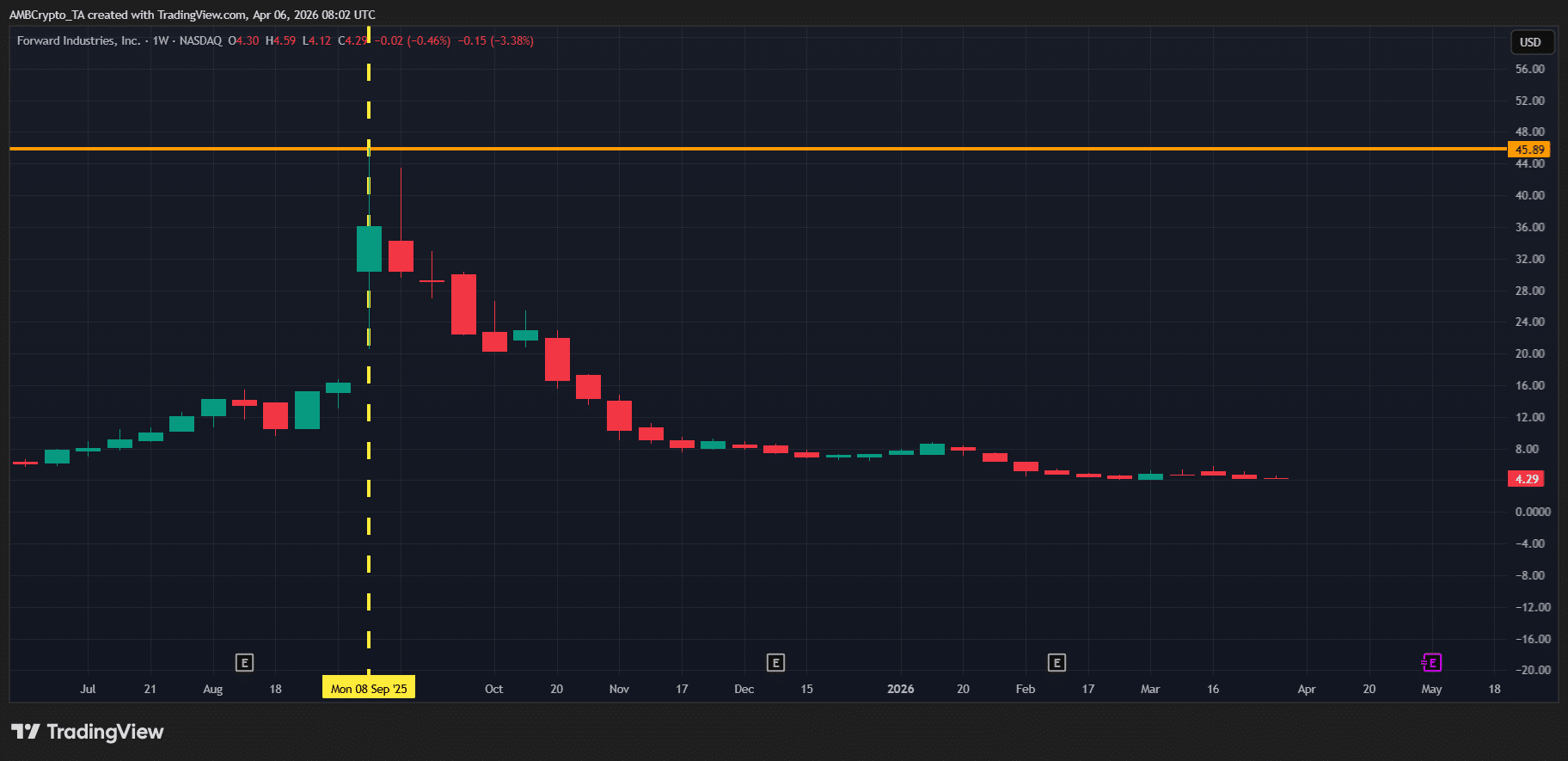
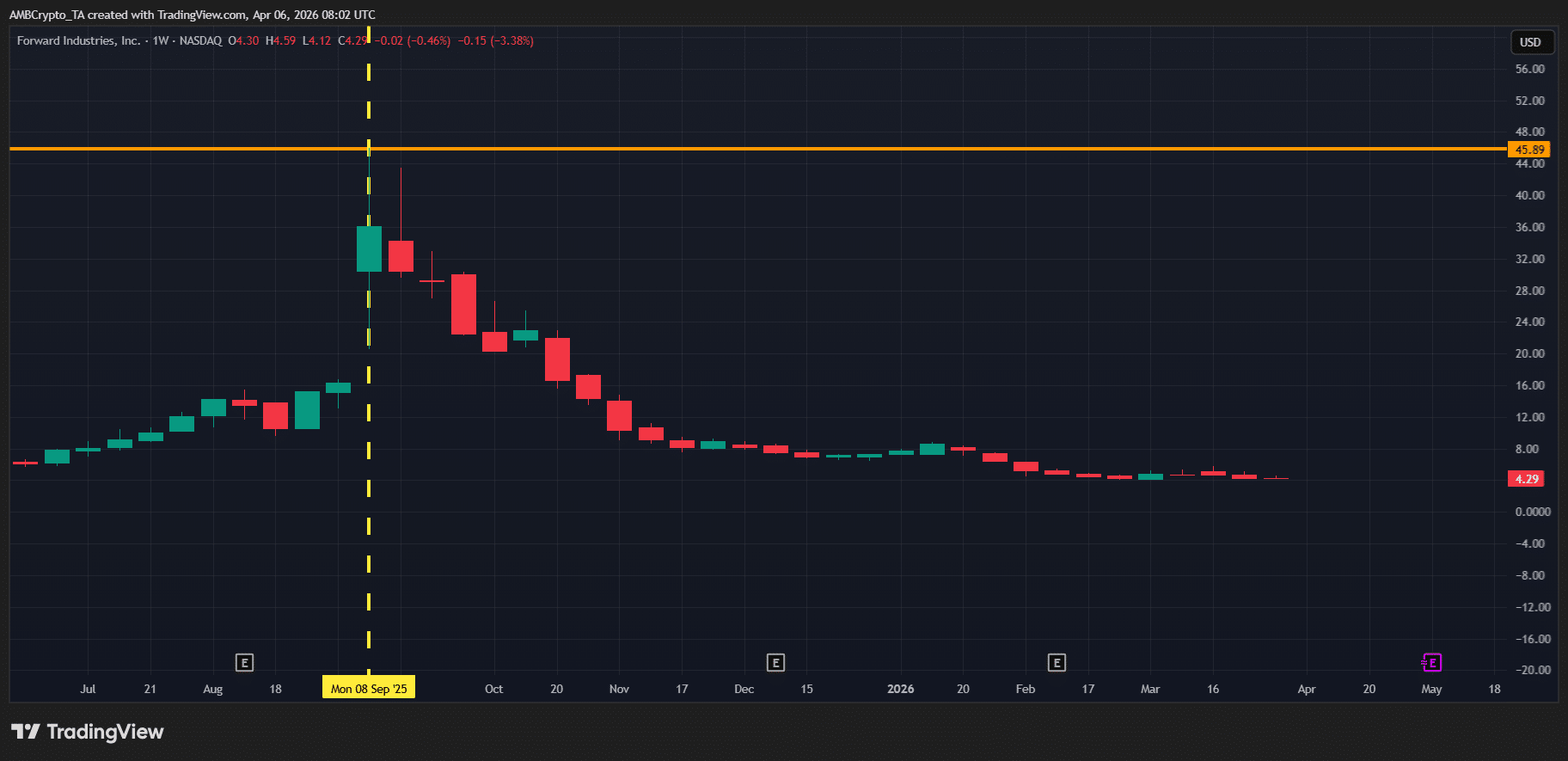
Source: TradingView (FWDI/USD)

Against this backdrop, Solana’s RWA flows act as a key catalyst.

On a macro level, tokenized U.S. Treasuries could generate revenue for Digital Asset Treasuries (DATs), which can then be used to stockpile more SOL.

With Solana already holding a strong position in tokenized bonds, this is a tangible strategy that can strengthen treasuries and support long-term network growth.

Looking at the bigger picture (RWA market growth, Solana’s rising RWA holder count, and strong capital flows into U.S. Treasuries), Solana could emerge as a viable alternative to Ethereum’s XAUT play.

If the network continues to expand its RWA ecosystem, it has the potential to establish itself as a leading hub for tokenized assets, attracting substantial institutional capital in the process.


Final Summary

  • Solana is emerging as a major hub for on-chain RWAs, with a 440% YoY increase in holders.
  • Strong flows into tokenized U.S. Treasuries could make Solana a viable alternative to Ethereum’s XAUT, offering a pathway to strengthen DATs.


Related Questions

QWhat is the year-over-year growth in the number of RWA holders on the Solana network, and what does this surge signify?

AThe number of RWA holders on Solana grew by 440% year-over-year, totaling 218,000. This surge is more than just hype; it's a clear sign that Solana is becoming a go-to network for tokenized real-world assets.

QWhich token is the on-chain RWA market cap leader, and on which blockchain does it currently trade?

ATether Gold (XAUT) is the on-chain RWA market cap leader with $3.3 billion. It currently trades only on the Ethereum blockchain.

QAccording to the article, what is the primary component (over 50%) of the aggregate RWA market?

AU.S. Treasury assets make up over 50% of the aggregate RWA market.

QWhat potential strategy is mentioned for Solana's Digital Asset Treasuries (DATs) to strengthen themselves and support long-term network growth?

ATokenized U.S. Treasuries could generate revenue for Digital Asset Treasuries (DATs), which can then be used to stockpile more SOL, thereby strengthening the treasuries and supporting long-term network growth.

QWhat key concern does the International Monetary Fund (IMF) raise regarding the article's subject matter?

AThe IMF warns that the fast-growing Real World Asset (RWA) market on-chain could cause traditional finance (TradFi) players to fall behind, potentially changing how central banks manage money and financial stability.

Related Reads

Warsh's Debut: Will the FED Chair Who Knows Crypto Best Bring Surprises or Shocks to the Market?

Kevin Warsh, the new Federal Reserve Chairman, prepares for his inaugural press conference amidst a challenging macroeconomic landscape: resurgent inflation, a bond market sell-off, and political pressure from President Trump for rate cuts. Uniquely, Warsh holds indirect investments in over 20 crypto and Web3 entities (e.g., Solana, dYdX), making him the first Fed Chair with disclosed crypto exposure. His stance may combine a hawkish, inflation-focused monetary policy with a crypto-friendly regulatory philosophy that shifts from Powell’s “same risk, same rule” approach toward a framework acknowledging blockchain’s productivity value. Warsh’s leadership could impact crypto markets across three dimensions: a paradigm shift in regulation (potentially accelerating pro-innovation legislation and stable币 rules), a re-pricing of risk premiums based on clearer communication and his view of AI as a structural disinflationary force, and a long-term reallocation of global institutional capital driven by increased legitimacy. Two potential scenarios for the press conference are outlined. A “positive surprise” would involve a dovish-leaning tone on rates coupled with signals of regulatory openness, potentially boosting crypto asset valuations. Conversely, a “negative shock” would see a more hawkish-than-expected stance on inflation and rates, triggering a broad risk-asset selloff that crypto markets would not escape. While ethics rules required Warsh to divest his crypto holdings upon confirmation, his deep understanding of the technology may fundamentally lower policy uncertainty and build a more receptive long-term foundation for digital assets’ integration into the mainstream financial system.

marsbit18m ago

Warsh's Debut: Will the FED Chair Who Knows Crypto Best Bring Surprises or Shocks to the Market?

marsbit18m ago

Pricing OpenAI Pre-IPO: A New, Life-or-Death Business on Hyperliquid Lasting Half a Year

Pricing OpenAI Pre-IPO: Hyperliquid's High-Stakes, Six-Month Business Venture The article analyzes the nascent market for pre-IPO perpetual contracts on the Hyperliquid blockchain, exemplified by two contrasting teams: Trade.xyz and Ventuals. Trade.xyz, an anonymous team, successfully built the largest pre-market on Hyperliquid. Its strategy focused on near-term events, like the SpaceX IPO. By listing a SpaceX contract with a known launch date and price, the market had a tangible "anchor" (the eventual Nasdaq opening price) to converge upon, which kept speculation in check. This approach fueled significant growth. In stark contrast, Ventuals, backed by Paradigm, failed despite holding coveted contracts for OpenAI and Anthropic. Its critical flaw was its pricing mechanism for these companies, which have no imminent IPO. Ventuals' oracle price was half-derived from infrequent private market transactions and half from its own contract's moving average. This created a self-reinforcing loop where buying pressure artificially inflated the price, disconnecting it from real supply and demand. The market became illiquid and structurally skewed. Ventuals shut down nine months after launch, reportedly through an acquisition. Its final settlement prices—OpenAI at ~$1,341 and Anthropic at ~$1,618—were thus partially products of its flawed model. Ironically, some company employees and late-stage VCs reportedly used these prices for valuation reference, highlighting the desperate demand for price discovery in opaque private markets. The failure of Ventuals exposes the core challenge of this business: price for illiquid, non-public assets requires a robust, self-correcting market, which is absent without a definitive public listing event. Nevertheless, demand is driving major players like Coinbase and traditional finance (e.g., Citi) to enter the space, aiming to provide 24/7 trading for coveted private company shares. The venture's ultimate viability, however, hinges on solving the fundamental pricing problem Ventuals could not.

marsbit2h ago

Pricing OpenAI Pre-IPO: A New, Life-or-Death Business on Hyperliquid Lasting Half a Year

marsbit2h ago

Trading

Spot
Futures

Hot Articles

Discussions

Welcome to the HTX Community. Here, you can stay informed about the latest platform developments and gain access to professional market insights. Users' opinions on the price of XAUT (XAUT) are presented below.

活动图片