Pourquoi Saylor Achete-t-il Toujours le Sommet du Bitcoin ? Un Expert Explique

bitcoinistPublished on 2026-03-30Last updated on 2026-03-30

Abstract

Selon Dylan LeClair de Metaplanet, Michael Saylor n'achète pas délibérément le Bitcoin au sommet par erreur de timing, mais parce que le modèle de trésorerie de sa société, MicroStrategy, est pro-cyclique. Il explique que les marchés des capitaux sont plus ouverts et faciles d'accès lorsque le Bitcoin est fort, ce qui permet à l'entreprise d'émettre plus facilement des actions pour lever des fonds et les convertir en BTC. Ainsi, les achats ont lieu lorsque les conditions de financement sont optimales, et non par volonté de surpayer. LeClair évoque également l'évolution de ce modèle avec l'émission de titres privilégiés (comme le STRC), permettant de lever des capitaux même lorsque le Bitcoin est faible. Cette approche attire des investisseurs en fixed income recherchant un rendement élevé avec une volatilité modérée. MicroStrategy est désormais présenté comme l'acheteur marginal du Bitcoin, acquérant plus que l'ensemble des ETF, et optimisant sa structure financière pour renforcer sa stratégie d'accumulation de BTC.

La réputation de Michael Saylor d'acheter du Bitcoin près des sommets locaux est moins une erreur de timing qu'une fonction du modèle de trésorerie, selon Dylan LeClair, directeur de la stratégie Bitcoin chez Metaplanet. Dans une interview, LeClair a soutenu que ce schéma apparent reflète le moment où les marchés de capitaux sont les plus ouverts, et non un effort délibéré pour suivre les sommets.

Pourquoi Saylor Continue d'Acheter le Sommet du Bitcoin

LeClair a déclaré que cette critique méconnaît la mécanique derrière les achats de Strategy. « Le modèle de trésorerie Bitcoin est très procyclique », a-t-il dit. « Donc, quand les temps sont bons, généralement sur un marché de quatre ans ou de minute en minute, il est plus facile de lever des capitaux. Et donc les marchés de capitaux sont grands ouverts quand le Bitcoin est fort pour les actions ordinaires. Mais quand il est faible, ils ne le sont pas. »

Cette dynamique, a-t-il dit, aide à expliquer pourquoi les achats de Strategy arrivent souvent lorsque le Bitcoin se négocie déjà fermement. Si l'action de l'entreprise performe bien et que sa valeur d'entreprise est élevée par rapport à ses détentions de Bitcoin, il devient plus facile et plus attractif d'émettre des actions et de convertir ce capital en plus de BTC. « Quand nous vendons des actions, nous achetons littéralement minute par minute », a déclaré LeClair, se référant à la propre description du processus par Saylor. « Donc, quand un achat hebdomadaire sort, les gens disent : eh bien, Strategy a encore acheté le plus haut de la fourchette. Eh bien, en fait, non, la causalité est inversée. »

Selon LeClair, Strategy n'achète pas la force parce qu'elle veut payer plus cher. Elle achète lorsque sa fenêtre de financement est la plus forte. Cette distinction est importante, surtout pour les sociétés de trésorerie Bitcoin cotées dont la capacité à lever des capitaux est étroitement liée au sentiment, aux multiples de capitaux propres et à la liquidité du marché.

Il a déclaré que ce modèle évolue désormais. Là où Strategy reposait autrefois principalement sur l'émission d'actions ordinaires et, parfois, sur des obligations convertibles, LeClair a souligné l'importance croissante des offres d'actions privilégiées, en particulier STRC, comme un changement potentiel dans la façon dont les entreprises liées au Bitcoin financent leurs achats dans différents régimes de marché. L'attrait est que les actions privilégiées peuvent permettre aux entreprises de continuer à lever des capitaux même lorsque le Bitcoin est faible et que l'émission d'actions ordinaires est moins attractive.

« Ce qui est vraiment, vraiment intéressant avec STRC, c'est qu'ils ont maintenant un mécanisme pour lever des fonds, quelles que soient les conditions du marché », a-t-il déclaré. « Donc le Bitcoin peut être fort, le Bitcoin peut être faible. Si STRC est à 100, ils peuvent lever beaucoup, beaucoup d'argent. » Il a ajouté que Strategy avait déjà utilisé cette structure de manière agressive, affirmant que Saylor avait levé 1,2 milliard de dollars en une semaine sans vendre de MSTR.

LeClair a présenté cela comme plus qu'un simple ajustement de financement. Il l'a décrit comme un nouveau pont entre l'exposition au BTC et les pools de capitaux qui ne peuvent pas acheter de BTC au comptant ou même des ETF directement. « Il y a des milliers de milliards de dollars d'obligations à revenu fixe dans le monde qui veulent une faible volatilité et un rendement élevé », a-t-il dit. « Et donc Saylor dit, d'accord, eh bien, je vais concevoir, je vais concevoir un titre pour vous. »

Cet angle plus large des marchés de capitaux a traversé une grande partie de l'interview de LeClair. Bien qu'il ait déclaré que la thèse centrale de Metaplanet sur le BTC n'avait pas changé malgré la baisse du marché, il a reconnu que l'exécution avait changé. Sur les marchés forts, les entreprises de trésorerie peuvent s'appuyer sur la levée de fonds en actions ordinaires. Dans des conditions plus faibles, d'autres instruments peuvent compter davantage. « Les moyens par lesquels nous naviguons sur les marchés de capitaux ont été un peu ajustés », a-t-il déclaré.

LeClair a également suggéré que Strategy devient l'acheteur marginal du Bitcoin, affirmant que Saylor achète maintenant plus que les ETF combinés. En même temps, il a déclaré que l'entreprise améliore sa structure de capital en émettant de nouveaux titres tout en rendant sa dette convertible existante moins significative par rapport au reste du bilan. À son avis, cette combinaison crée un moteur d'acquisition de BTC de plus en plus puissant.

Au moment de la rédaction, le BTC se négociait à 67 639 $.
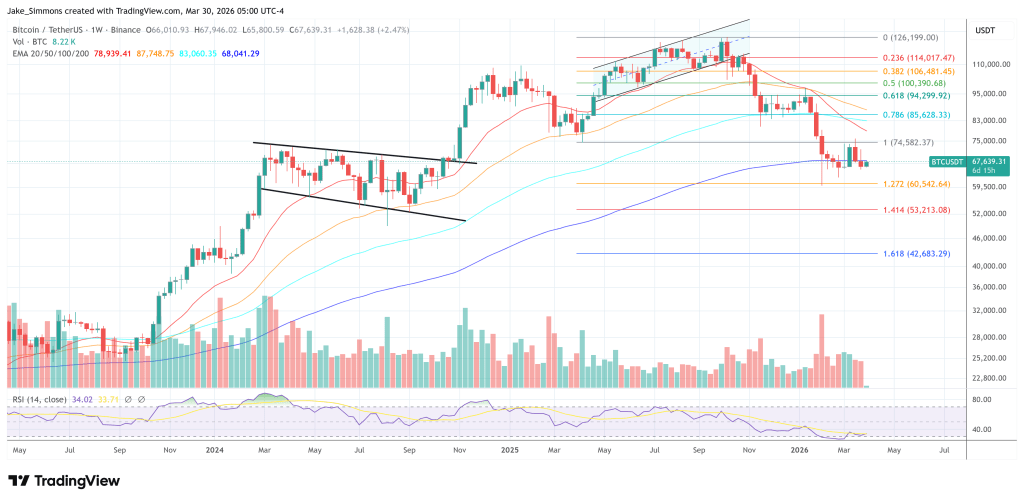
Le BTC doit reconquérir la MME hebdomadaire sur 200 semaines, graphique hebdomadaire | Source : BTCUSDT sur TradingView.com

Image en vedette de YouTube, graphique de TradingView.com

Related Questions

QPourquoi Michael Saylor achète-t-il souvent du Bitcoin à des sommets locaux, selon Dylan LeClair ?

ASelon Dylan LeClair, cela est dû au modèle de trésorerie pro-cyclique de MicroStrategy. Les marchés des capitaux sont plus ouverts et il est plus facile de lever des capitaux lorsque le Bitcoin est fort, ce qui conduit à des achats lors des périodes de force des prix, et non par volonté délibérée d'acheter au top.

QQuel est le principal avantage des émissions d'actions privilégiées (comme le STRC) pour les entreprises liées au Bitcoin ?

ALe principal avantage est de permettre aux entreprises de lever des capitaux de manière agressive, que le Bitcoin soit fort ou faible sur le marché, sans nécessairement devoir émettre des actions ordinaires qui peuvent être moins attractives dans des conditions de marché défavorables.

QComment Dylan LeClair décrit-il le rôle de MicroStrategy dans l'achat de Bitcoin actuellement ?

AIl suggère que MicroStrategy est devenu l'acheteur marginal de Bitcoin, achetant désormais plus que l'ensemble des ETF combinés, et qu'elle améliore sa structure de capital pour créer un moteur d'acquisition de BTC de plus en plus puissant.

QQuel nouveau pont vers les capitaux Dylan LeClair évoque-t-il dans l'interview ?

AIl décrit les nouvelles structures de titres, comme les actions privilégiées, comme un pont qui permet à des pools de capitaux (comme les fonds à revenu fixe recherchant un rendement élevé et une faible volatilité) d'obtenir une exposition au Bitcoin sans pouvoir acheter directement du BTC au spot ou via des ETF.

QQuel était le prix du Bitcoin mentionné à la fin de l'article ?

AAu moment de la publication, le Bitcoin s'échangeait à 67 639 dollars.

Related Reads

With Daily Active Users Reaching 3-4 Times That of the Industry's Second Place, Which Crack in the Office Agent Market Has Tencent's WorkBuddy Torn Open?

Tencent's AI office assistant, WorkBuddy, has achieved daily active users (DAU) 3-4 times that of the industry's second-place product, primarily driven by non-technical users like HR, operations, and administrative staff. Its rapid growth, starting with a public beta in March 2026, highlights a key strategic divergence from competitors like OpenAI's Codex and Anthropic's Claude Code. Unlike those tools, which originated as developer-focused assistants (in command lines or IDEs) and are now expanding towards office scenarios, WorkBuddy was built from the ground up for non-technical office workers. Its development was user-driven, initiated after腾讯云's team observed non-technical employees using their CodeBuddy coding tool for general tasks. WorkBuddy's design is defined by three core decisions aimed at lowering barriers: 1) Using natural language instead of technical concepts, so users describe their goal without needing to understand prompts or agents. 2) Providing pre-packaged "Skill" templates for common office tasks like data processing, content creation, and research. 3) Natively integrating into existing腾讯 ecosystems like腾讯 Docs and WeChat, making the agent a seamless part of the user's workflow rather than a separate tool. This "scenario encapsulation" approach, prioritizing the shortest path for users to get work done, contrasts with the "underlying capability" focus of Codex and Claude, which offer more flexibility but require more technical setup. Analysts confirm WorkBuddy's leading market position in China by mid-2026, with massive user and request growth following its launch. Recognizing the same trend of surging non-technical adoption, OpenAI and Anthropic are now pivoting their products with features like role-based plugins (Codex) and a simplified desktop interface (Claude Cowork). However, adapting tools built for developers requires significant changes to interaction models and integrations. WorkBuddy currently holds an estimated six-month lead in delivering a complete solution for non-technical office users. Its recently launched enterprise version aims to solidify this advantage. The competition underscores two valid paths: embedding agent capabilities directly into familiar work environments versus building powerful, general-purpose agents that users must learn to access. WorkBuddy's early success demonstrates the effectiveness of the former strategy for mainstream office adoption.

marsbit1m ago

With Daily Active Users Reaching 3-4 Times That of the Industry's Second Place, Which Crack in the Office Agent Market Has Tencent's WorkBuddy Torn Open?

marsbit1m ago

Dalio's Latest Warning: Don't Get Carried Away by AI, Real Returns on US Stocks in the Next 5-10 Years Could Be -5% to -10%

Ray Dalio, founder of Bridgewater Associates, warns investors against excessive concentration in AI stocks. He argues the current market, dominated by a few AI giants, mirrors historical patterns where revolutionary new technologies lead to high risk, volatility, and uncertainty. While acknowledging AI's transformative potential, Dalio emphasizes that most investors fail at this stage of the cycle by over-concentrating in a handful of leading companies. He cites inherent risks: companies cannot accurately forecast investment needs or external shocks (e.g., monetary policy, geopolitics, taxes), face potential disruption from future technologies and international competition (notably from China), and experience significant price swings. Dalio's core advice is diversification, calling it his "Holy Grail of Investing." He presents a mathematical case that a well-diversified portfolio of 15-20 uncorrelated, good bets offers a superior risk-adjusted return compared to a concentrated position. Dalio also offers a cautious outlook, suggesting U.S. stocks may deliver real returns of -5% to -10% over the next 5-10 years based on valuation and bubble indicators. He concludes that in the face of high uncertainty, the prudent strategy is not to avoid betting entirely, but to avoid large, concentrated bets where one lacks sufficient informational edge. Instead, investors should build a strategically balanced, diversified portfolio.

marsbit1h ago

Dalio's Latest Warning: Don't Get Carried Away by AI, Real Returns on US Stocks in the Next 5-10 Years Could Be -5% to -10%

marsbit1h ago

Rain Valuation Approaches $20 Billion: The Battle for U-Cards Extends to Rewards Systems

Rain, a stablecoin payments infrastructure company, is shifting the competitive focus for U Cards from simple issuance to user retention and repeated usage. On June 15, Rain launched "Rain Rewards," an embedded loyalty program capability within its card-issuing infrastructure. This allows partner businesses—like fintech platforms and neobanks—to configure branded loyalty points, earning rules, redemptions, and merchant promotions directly within their card products. The system, built from the 2025 acquisition of Uptop, ensures points are only issued upon final transaction settlement, preventing liabilities from refunds. Trials, such as with Avalanche Card, reportedly boosted spending by 25% among enrolled users. Founded by Farooq Malik and Charles Yoo-Naut, Rain evolved from a tool for managing Web3 company expenses into a full-stack enterprise platform. It is a Principal Member of Visa and Mastercard, enabling partners to issue stablecoin-backed cards and wallets while leveraging traditional payment networks. Notably, the popular U Card Plasma One is issued by Rain under Visa's authority. Rain also integrates with Visa's stablecoin settlement pilot, using USDC for network settlement. Rain's rapid funding reflects growing institutional interest in stablecoin payment infrastructure. It raised a $245 million Series A in March 2025, a $58 million Series B in August 2025, and a $250 million Series C in January of this year, reaching a $19.5 billion valuation. Annualized transaction volume exceeds $3 billion, serving over 200 partners including Western Union and Nuvei. Beyond cards, Rain is expanding into programmable payments. Its June 2026 "Agent Control Layer" allows businesses to set spending rules—like merchant categories, amounts, and frequency—for AI agents before transactions occur. This positions Rain not as a single product but as an operating system for stablecoin payments, handling everything from card issuance and wallet management to rewards, on/off-ramps, and automated compliance. The goal is to enable seamless, often invisible, real-world spending of on-chain assets.

Foresight News1h ago

Rain Valuation Approaches $20 Billion: The Battle for U-Cards Extends to Rewards Systems

Foresight News1h ago

Trading

Spot
Futures

Hot Articles

What is $BITCOIN

DIGITAL GOLD ($BITCOIN): A Comprehensive Analysis Introduction to DIGITAL GOLD ($BITCOIN) DIGITAL GOLD ($BITCOIN) is a blockchain-based project operating on the Solana network, which aims to combine the characteristics of traditional precious metals with the innovation of decentralized technologies. While it shares a name with Bitcoin, often referred to as “digital gold” due to its perception as a store of value, DIGITAL GOLD is a separate token designed to create a unique ecosystem within the Web3 landscape. Its goal is to position itself as a viable alternative digital asset, although specifics regarding its applications and functionalities are still developing. What is DIGITAL GOLD ($BITCOIN)? DIGITAL GOLD ($BITCOIN) is a cryptocurrency token explicitly designed for use on the Solana blockchain. In contrast to Bitcoin, which provides a widely recognized value storage role, this token appears to focus on broader applications and characteristics. Notable aspects include: Blockchain Infrastructure: The token is built on the Solana blockchain, known for its capacity to handle high-speed and low-cost transactions. Supply Dynamics: DIGITAL GOLD has a maximum supply capped at 100 quadrillion tokens (100P $BITCOIN), although details regarding its circulating supply are currently undisclosed. Utility: While precise functionalities are not explicitly outlined, there are indications that the token could be utilized for various applications, potentially involving decentralized applications (dApps) or asset tokenization strategies. Who is the Creator of DIGITAL GOLD ($BITCOIN)? At present, the identity of the creators and development team behind DIGITAL GOLD ($BITCOIN) remains unknown. This situation is typical among many innovative projects within the blockchain space, particularly those aligning with decentralized finance and meme coin phenomena. While such anonymity may foster a community-driven culture, it intensifies concerns about governance and accountability. Who are the Investors of DIGITAL GOLD ($BITCOIN)? The available information indicates that DIGITAL GOLD ($BITCOIN) does not have any known institutional backers or prominent venture capital investments. The project seems to operate on a peer-to-peer model focused on community support and adoption rather than traditional funding routes. Its activity and liquidity are primarily situated on decentralized exchanges (DEXs), such as PumpSwap, rather than established centralized trading platforms, further highlighting its grassroots approach. How DIGITAL GOLD ($BITCOIN) Works The operational mechanics of DIGITAL GOLD ($BITCOIN) can be elaborated on based on its blockchain design and network attributes: Consensus Mechanism: By leveraging Solana’s unique proof-of-history (PoH) combined with a proof-of-stake (PoS) model, the project ensures efficient transaction validation contributing to the network's high performance. Tokenomics: While specific deflationary mechanisms have not been extensively detailed, the vast maximum token supply implies that it may cater to microtransactions or niche use cases that are still to be defined. Interoperability: There exists the potential for integration with Solana’s broader ecosystem, including various decentralized finance (DeFi) platforms. However, the details regarding specific integrations remain unspecified. Timeline of Key Events Here is a timeline that highlights significant milestones concerning DIGITAL GOLD ($BITCOIN): 2023: The initial deployment of the token occurs on the Solana blockchain, marked by its contract address. 2024: DIGITAL GOLD gains visibility as it becomes available for trading on decentralized exchanges like PumpSwap, allowing users to trade it against SOL. 2025: The project witnesses sporadic trading activity and potential interest in community-led engagements, although no noteworthy partnerships or technical advancements have been documented as of yet. Critical Analysis Strengths Scalability: The underlying Solana infrastructure supports high transaction volumes, which could enhance the utility of $BITCOIN in various transaction scenarios. Accessibility: The potential low trading price per token could attract retail investors, facilitating wider participation due to fractional ownership opportunities. Risks Lack of Transparency: The absence of publicly known backers, developers, or an audit process may yield skepticism regarding the project's sustainability and trustworthiness. Market Volatility: The trading activity is heavily reliant on speculative behavior, which can result in significant price volatility and uncertainty for investors. Conclusion DIGITAL GOLD ($BITCOIN) emerges as an intriguing yet ambiguous project within the rapidly evolving Solana ecosystem. While it attempts to leverage the “digital gold” narrative, its departure from Bitcoin's established role as a store of value underscores the need for a clearer differentiation of its intended utility and governance structure. Future acceptance and adoption will likely depend on addressing the current opacity and defining its operational and economic strategies more explicitly. Note: This report encompasses synthesised information available as of October 2023, and developments may have transpired beyond the research period.

379 Total ViewsPublished 2025.05.13Updated 2025.05.13

What is $BITCOIN

Discussions

Welcome to the HTX Community. Here, you can stay informed about the latest platform developments and gain access to professional market insights. Users' opinions on the price of BTC (BTC) are presented below.

活动图片