Tại Sao Saylor Luôn Mua Bitcoin Ở Đỉnh? Chuyên Gia Giải Thích

bitcoinistPublished on 2026-03-30Last updated on 2026-03-30

Abstract

Theo Dylan LeClair, Giám đốc Chiến lược Bitcoin tại Metaplanet, việc Michael Saylor thường mua Bitcoin ở các đỉnh cục bộ không phải do thời điểm kém mà là đặc điểm của mô hình kho bạc. LeClair giải thích rằng các công ty như MicroStrategy dễ huy động vốn nhất khi thị trường mạnh và cổ phiếu hoạt động tốt, dẫn đến các đợt mua thường trùng với thời điểm Bitcoin đã tăng mạnh. Ông nhấn mạnh nguyên nhân không phải là cố tình mua đỉnh, mà là tận dụng cửa sổ tài chính thuận lợi. LeClair cũng đề cập đến sự phát triển của mô hình, với việc sử dụng các công cụ như cổ phiếu ưu đãi (ví dụ STRC) để huy động vốn ngay cả khi thị trường yếu, tạo ra cơ chế mua BTC mạnh mẽ và linh hoạt hơn.

Theo Dylan LeClair, Giám đốc Chiến lược Bitcoin tại Metaplanet, danh tiếng của Michael Saylor trong việc mua Bitcoin gần các đỉnh cao cục bộ không phải là vấn đề về thời điểm mà là một phần hoạt động của mô hình kho bạc. Trong một cuộc phỏng vấn, LeClair lập luận rằng mô hình rõ ràng này phản ánh thời điểm thị trường vốn mở cửa nhất, không phải là một nỗ lực có chủ đích để đuổi theo các đỉnh.

Tại Sao Saylor Tiếp Tục Mua Bitcoin Ở Đỉnh

LeClair cho biết những chỉ trích này hiểu sai về cơ chế đằng sau việc mua hàng của MicroStrategy. "Mô hình kho bạc Bitcoin có tính chu kỳ thuận rất cao," ông nói. "Vì vậy, khi thời điểm tốt, thường là trong một thị trường bốn năm hoặc từng phút, thì việc huy động vốn là dễ dàng nhất. Và vì vậy, thị trường vốn mở cửa rộng rãi khi Bitcoin mạnh đối với vốn cổ phần phổ thông. Nhưng khi nó yếu, thì không."

Ông nói rằng động thái đó giúp giải thích tại sao các giao dịch mua của MicroStrategy thường đến khi Bitcoin đã được giao dịch mạnh. Nếu cổ phiếu của công ty hoạt động tốt và giá trị doanh nghiệp của nó cao so với lượng Bitcoin nắm giữ, việc phát hành cổ phiếu và chuyển đổi số vốn đó thành nhiều BTC hơn sẽ trở nên dễ dàng và hấp dẫn hơn. "Khi chúng tôi bán cổ phiếu, chúng tôi mua theo từng phút," LeClair nói, đề cập đến mô tả của chính Saylor về quy trình. "Vì vậy, khi một giao dịch mua hàng tuần được công bố, mọi người thường nói, chà, MicroStrategy lại mua ở mức cao nhất trong khoảng. Nhưng không, quan hệ nhân quả bị đảo ngược."

Theo lời kể của LeClair, MicroStrategy không mua vào lúc mạnh vì họ muốn trả giá cao. Họ mua khi cánh cửa tài chính của họ mạnh nhất. Sự khác biệt đó rất quan trọng, đặc biệt là đối với các công ty kho bạc Bitcoin niêm yết có khả năng huy động vốn được liên kết chặt chẽ với tâm lý, hệ số nhân vốn cổ phần và tính thanh khoản của thị trường.

Ông cho biết mô hình đó hiện đang phát triển. Nơi mà MicroStrategy từng dựa chủ yếu vào việc phát hành cổ phiếu phổ thông và đôi khi là trái phiếu chuyển đổi, LeClair chỉ ra tầm quan trọng ngày càng tăng của các đợt chào bán vốn cổ phần ưu đãi, đặc biệt là STRC, như một sự thay đổi tiềm năng trong cách các công ty liên kết với Bitcoin tài trợ cho các giao dịch mua trong các chế độ thị trường khác nhau. Điểm hấp dẫn là cổ phiếu ưu đãi có thể cho phép các công ty tiếp tục huy động vốn ngay cả khi Bitcoin yếu và việc phát hành vốn cổ phần phổ thông trở nên kém hấp dẫn hơn.

"Điều thực sự, thực sự thú vị với STRC là họ hiện có một cơ chế để về cơ bản có thể huy động bất kể điều kiện thị trường," ông nói. "Vì vậy, Bitcoin có thể mạnh, Bitcoin có thể yếu. Nếu STRC ở mức 100, họ có thể huy động rất, rất nhiều tiền." Ông nói thêm rằng MicroStrategy đã sử dụng cấu trúc đó một cách mạnh mẽ, nói rằng Saylor đã huy động được 1,2 tỷ USD trong một tuần mà không bán MSTR.

LeClair coi đó là hơn cả một điều chỉnh tài chính. Ông mô tả nó như một cây cầu mới giữa việc tiếp xúc với BTC và các nguồn vốn không thể mua BTC giao ngay hoặc thậm chí là ETF trực tiếp. "Có hàng nghìn tỷ đô la trái phiếu trên thế giới muốn biến động thấp, lợi suất cao," ông nói. "Và vì vậy Saylor nói, được rồi, tôi sẽ thiết kế, tôi sẽ kỹ thuật bảo mật cho bạn."

Góc độ thị trường vốn rộng lớn hơn đó xuyên suốt phần lớn cuộc phỏng vấn của LeClair. Mặc dù ông nói rằng luận điểm cốt lõi về BTC của Metaplanet không thay đổi bất chấp sự sụt giảm của thị trường, nhưng ông thừa nhận rằng việc thực hiện đã thay đổi. Trong các thị trường mạnh, các công ty kho bạc có thể dựa vào việc gây quỹ vốn cổ phần phổ thông. Trong điều kiện yếu hơn, các công cụ khác có thể quan trọng hơn. "Cách chúng tôi điều hướng thị trường vốn đã được điều chỉnh một chút," ông nói.

LeClair cũng gợi ý rằng MicroStrategy đang trở thành người mua biên của Bitcoin, lập luận rằng Saylor hiện đang mua nhiều hơn tổng số ETF. Đồng thời, ông cho biết công ty đang cải thiện cấu trúc vốn bằng cách phát hành các chứng khoán mới trong khi làm cho khoản nợ chuyển đổi hiện có của mình trở nên ít quan trọng hơn so với phần còn lại của bảng cân đối kế toán. Theo quan điểm của ông, sự kết hợp đó đang tạo ra một động cơ mua lại BTC ngày càng mạnh mẽ.

Vào thời điểm biên tập, BTC được giao dịch ở mức 67.639 USD.
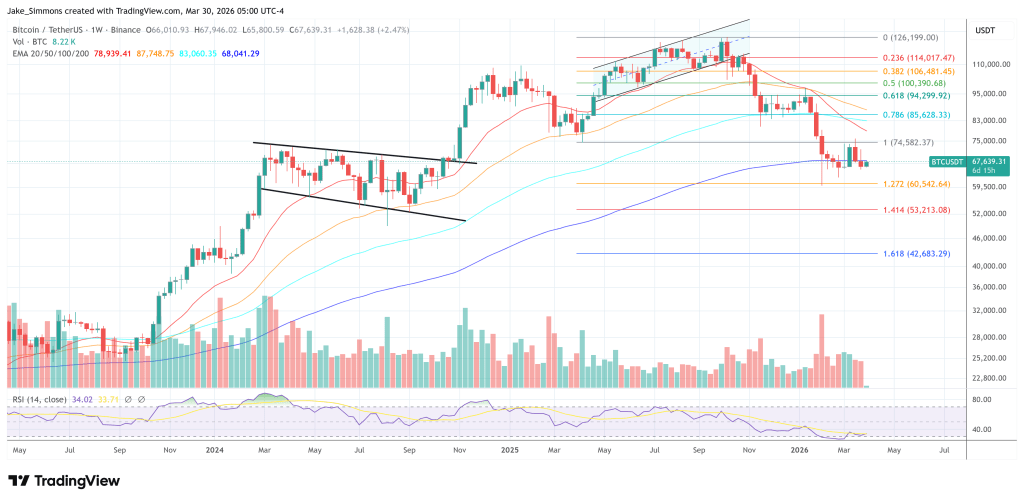
BTC phải thu hồi lại EMA 200 tuần, biểu đồ 1 tuần | Nguồn: BTCUSDT trên TradingView.com

Hình ảnh nổi bật từ YouTube, biểu đồ từ TradingView.com

Related Questions

QTại sao Michael Saylor thường mua Bitcoin ở các đỉnh giá cục bộ?

ATheo Dylan LeClair, việc Michael Saylor thường mua Bitcoin ở các đỉnh giá không phải do thời điểm không tốt mà là do mô hình kho bạc hoạt động theo chu kỳ. Khi thị trường mạnh, việc huy động vốn dễ dàng hơn, nên MicroStrategy thường mua Bitcoin vào những thời điểm giá đã tăng cao.

QMô hình kho bạc Bitcoin của MicroStrategy hoạt động như thế nào?

AMô hình kho bạc Bitcoin của MicroStrategy rất pro-cyclical (theo chu kỳ). Khi thị trường mạnh và cổ phiếu của công ty hoạt động tốt, họ dễ dàng phát hành cổ phiếu để huy động vốn và chuyển thành Bitcoin. Ngược lại, khi thị trường yếu, việc huy động vốn khó khăn hơn.

QCơ chế tài chính mới nào đang được MicroStrategy sử dụng?

AMicroStrategy đang sử dụng cơ chế phát hành cổ phiếu ưu đãi (preferred equity), đặc biệt là STRC, cho phép họ huy động vốn ngay cả khi Bitcoin yếu. Cơ chế này giúp công ty tiếp cận các nguồn vốn cố định có lợi nhuận cao và ít biến động.

QTại sao STRC được coi là một cơ chế quan trọng?

ASTRC cho phép MicroStrategy huy động vốn trong mọi điều kiện thị trường, dù Bitcoin mạnh hay yếu. Nó hoạt động như một cầu nối giữa việc tiếp cận Bitcoin và các quỹ vốn không thể mua trực tiếp Bitcoin hoặc ETF, mang lại nguồn tài chính ổn định và linh hoạt.

QMicroStrategy hiện đang đóng vai trò gì trên thị trường Bitcoin?

ATheo Dylan LeClair, MicroStrategy đang trở thành người mua biên của Bitcoin, mua nhiều hơn cả các quỹ ETF cộng lại. Đồng thời, công ty đang cải thiện cấu trúc vốn bằng cách phát hành chứng khoán mới và giảm tầm quan trọng của nợ chuyển đổi, tạo ra một động cơ mua Bitcoin ngày càng mạnh mẽ.

Related Reads

Behind HYPE's Repeated Record Highs, the 'Minions' in the Ecosystem Can't Keep Up

While HYPE, the native token of the Hyperliquid ecosystem, surges to new all-time highs above $76 and attracts significant institutional ETF inflows, a starkly different reality unfolds within its HyperEVM application layer. Multiple core DeFi protocols across lending, NFTs, stablecoins, and DEXs have announced shutdowns between May and June. The article argues HYPE functions more like an "application stock" than a traditional ecosystem token. Its value is anchored to the trading fees from Hyperliquid's core perpetual contracts platform (HyperCore), which boasts a diversified revenue stream from crypto, commodities, and indices. Approximately 97% of protocol fees fund buybacks and burns of HYPE. This means HYPE's price is largely decoupled from the health of projects built on HyperEVM. The closures of significant projects like lending protocol HypurrFi (peak TVL >$300M) and NFT marketplace Drip.Trade highlight a structural tension. Hyperliquid's minimalist philosophy offers infrastructure without official grants, liquidity support, or marketing coordination for HyperEVM projects. This forces protocols into a fiercely competitive environment from day one. Furthermore, the success of HyperCore creates a liquidity vacuum, and mechanisms like HIP-3 (allowing direct perpetual market deployment) divert user attention and capital away from application-layer projects. The stronger the core perpetual trading business becomes, the more difficult it is for peripheral "DeFi lego" projects to survive and capture value, despite the flagship token's rising price.

Foresight News8m ago

Behind HYPE's Repeated Record Highs, the 'Minions' in the Ecosystem Can't Keep Up

Foresight News8m ago

Conversation with Arthur Hayes: AI Has Drained Market Liquidity, BTC Will Be Below 100k by Year-End

In this June 2026 podcast interview, BitMEX co-founder Arthur Hayes explains his decision to sell his major crypto holdings (HYPE, NEAR, Worldcoin, Zcash). His rationale is based on a macro view linking oil prices, the Iran conflict, US politics, and an impending AI bubble burst. Hayes argues that high oil prices, driven by the ongoing war, will pressure domestic US inflation. To salvage the Republican Party's chances in the midterm elections, he believes Donald Trump may pivot to a populist, anti-AI stance—advocating for taxes and regulation—which would deflate the AI investment narrative. He sees the AI sector, particularly massive capital expenditure on data centers, as having absorbed nearly all excess market liquidity (around $1.5 trillion in debt issuance since 2025), starving other assets like Bitcoin. He highlights the upcoming SpaceX IPO at a ~$1.8 trillion valuation and 100x price-to-sales ratio as a potential tipping point. If these hyped IPOs underperform, it could shatter market confidence in AI. In such a scenario, all risk assets, including crypto, would fall together as correlations converge to 1 during a broad correction. Hayes has moved his portfolio into Treasuries and energy stocks (like ExxonMobil), predicting Bitcoin will be below $100k by year-end. He sees a potential crypto bull market only after the AI frenzy cools, liquidity stops flowing exclusively into AI, and possibly after a significant market downturn prompts new monetary stimulus.

marsbit19m ago

Conversation with Arthur Hayes: AI Has Drained Market Liquidity, BTC Will Be Below 100k by Year-End

marsbit19m ago

Fed's Internal Doves Flock to Hawkish Stance, Warsh's Debut "Between a Rock and a Hard Place"

U.S. Federal Reserve officials who previously advocated for rate cuts, including Governor Christopher Waller, have recently shifted their stance, with many now not ruling out the possibility of future rate hikes. This sets a challenging stage for new Fed Chair Kevin Warsh's first policy meeting. Appointed by President Trump based on his dovish views, Warsh now faces a committee where the debate has pivoted from "when to cut" to "whether to hike," driven by persistent inflation above 3%, a strong labor market, and supply-side pressures from AI infrastructure demands and geopolitical tensions. Key figures illustrate the shift. Governor Waller, once concerned about employment, now says data has pushed him toward considering rate increases. Even moderate voices like Governor Lisa Cook, while expecting inflation to ease, have indicated readiness to hike if it fails to do so. Long-time hawks such as regional Fed presidents Beth Hammack, Lorie Logan, and Neel Kashkari have grown more vocal, arguing that the real policy rate is effectively falling and that action may soon be needed. The upcoming Fed meeting is expected to keep rates steady but will likely remove the "easing bias" from its statement, signaling a neutral stance between cuts and hikes. The quarterly "dot plot" is anticipated to show most officials projecting no cuts this year, with some potentially indicating hikes. Chair Warsh, a critic of the Fed's reliance on forward guidance like the dot plot, must navigate communicating this pivot using tools he has questioned, all while steering policy in a direction counter to the preferences of the president who appointed him. The consensus suggests the Fed's next move could well be a rate increase.

marsbit1h ago

Fed's Internal Doves Flock to Hawkish Stance, Warsh's Debut "Between a Rock and a Hard Place"

marsbit1h ago

The Trillion-Yuan Market Cap 'Yi Zhong Tian': Who is the True Value King?

The article analyzes the three leading Chinese optical module companies, collectively nicknamed "Yi Zhong Tian": Xinyisheng, Zhongji Innolight, and TFC Optical Communication. It evaluates their "cost-performance" not by current stock price, but through three lenses: PEG ratio (growth vs. valuation), earnings quality, and premium/discount for certainty. Xinyisheng shows the most attractive PEG ratio and high profitability, but its valuation reflects discounts for risks like high customer concentration and reliance on overseas markets. Zhongji Innolight, the most expensive, commands a premium for its market leadership, dominant share in key products like 800G/1.6T modules, and higher earnings certainty, though it faces geopolitical risks. TFC Optical, as an upstream component supplier ("water seller"), has the highest gross margin and bets on the long-term CPO/NPO architecture trend, but trades at a high valuation with more stable, less explosive growth. The core argument is that while these companies dominate module assembly, the true profit pool and technological moat lie upstream in laser and switch chips, currently controlled by U.S. firms like Lumentum and Coherent. The long-term "cost-performance" for these Chinese leaders hinges on whether the domestic industry, exemplified by companies like Yuanjie Technology, can successfully move up the value chain into high-power laser chips. Otherwise, their high growth may remain confined to the lower-margin assembly segment.

marsbit1h ago

The Trillion-Yuan Market Cap 'Yi Zhong Tian': Who is the True Value King?

marsbit1h ago

Trading

Spot
Futures

Hot Articles

What is $BITCOIN

DIGITAL GOLD ($BITCOIN): A Comprehensive Analysis Introduction to DIGITAL GOLD ($BITCOIN) DIGITAL GOLD ($BITCOIN) is a blockchain-based project operating on the Solana network, which aims to combine the characteristics of traditional precious metals with the innovation of decentralized technologies. While it shares a name with Bitcoin, often referred to as “digital gold” due to its perception as a store of value, DIGITAL GOLD is a separate token designed to create a unique ecosystem within the Web3 landscape. Its goal is to position itself as a viable alternative digital asset, although specifics regarding its applications and functionalities are still developing. What is DIGITAL GOLD ($BITCOIN)? DIGITAL GOLD ($BITCOIN) is a cryptocurrency token explicitly designed for use on the Solana blockchain. In contrast to Bitcoin, which provides a widely recognized value storage role, this token appears to focus on broader applications and characteristics. Notable aspects include: Blockchain Infrastructure: The token is built on the Solana blockchain, known for its capacity to handle high-speed and low-cost transactions. Supply Dynamics: DIGITAL GOLD has a maximum supply capped at 100 quadrillion tokens (100P $BITCOIN), although details regarding its circulating supply are currently undisclosed. Utility: While precise functionalities are not explicitly outlined, there are indications that the token could be utilized for various applications, potentially involving decentralized applications (dApps) or asset tokenization strategies. Who is the Creator of DIGITAL GOLD ($BITCOIN)? At present, the identity of the creators and development team behind DIGITAL GOLD ($BITCOIN) remains unknown. This situation is typical among many innovative projects within the blockchain space, particularly those aligning with decentralized finance and meme coin phenomena. While such anonymity may foster a community-driven culture, it intensifies concerns about governance and accountability. Who are the Investors of DIGITAL GOLD ($BITCOIN)? The available information indicates that DIGITAL GOLD ($BITCOIN) does not have any known institutional backers or prominent venture capital investments. The project seems to operate on a peer-to-peer model focused on community support and adoption rather than traditional funding routes. Its activity and liquidity are primarily situated on decentralized exchanges (DEXs), such as PumpSwap, rather than established centralized trading platforms, further highlighting its grassroots approach. How DIGITAL GOLD ($BITCOIN) Works The operational mechanics of DIGITAL GOLD ($BITCOIN) can be elaborated on based on its blockchain design and network attributes: Consensus Mechanism: By leveraging Solana’s unique proof-of-history (PoH) combined with a proof-of-stake (PoS) model, the project ensures efficient transaction validation contributing to the network's high performance. Tokenomics: While specific deflationary mechanisms have not been extensively detailed, the vast maximum token supply implies that it may cater to microtransactions or niche use cases that are still to be defined. Interoperability: There exists the potential for integration with Solana’s broader ecosystem, including various decentralized finance (DeFi) platforms. However, the details regarding specific integrations remain unspecified. Timeline of Key Events Here is a timeline that highlights significant milestones concerning DIGITAL GOLD ($BITCOIN): 2023: The initial deployment of the token occurs on the Solana blockchain, marked by its contract address. 2024: DIGITAL GOLD gains visibility as it becomes available for trading on decentralized exchanges like PumpSwap, allowing users to trade it against SOL. 2025: The project witnesses sporadic trading activity and potential interest in community-led engagements, although no noteworthy partnerships or technical advancements have been documented as of yet. Critical Analysis Strengths Scalability: The underlying Solana infrastructure supports high transaction volumes, which could enhance the utility of $BITCOIN in various transaction scenarios. Accessibility: The potential low trading price per token could attract retail investors, facilitating wider participation due to fractional ownership opportunities. Risks Lack of Transparency: The absence of publicly known backers, developers, or an audit process may yield skepticism regarding the project's sustainability and trustworthiness. Market Volatility: The trading activity is heavily reliant on speculative behavior, which can result in significant price volatility and uncertainty for investors. Conclusion DIGITAL GOLD ($BITCOIN) emerges as an intriguing yet ambiguous project within the rapidly evolving Solana ecosystem. While it attempts to leverage the “digital gold” narrative, its departure from Bitcoin's established role as a store of value underscores the need for a clearer differentiation of its intended utility and governance structure. Future acceptance and adoption will likely depend on addressing the current opacity and defining its operational and economic strategies more explicitly. Note: This report encompasses synthesised information available as of October 2023, and developments may have transpired beyond the research period.

380 Total ViewsPublished 2025.05.13Updated 2025.05.13

What is $BITCOIN

Discussions

Welcome to the HTX Community. Here, you can stay informed about the latest platform developments and gain access to professional market insights. Users' opinions on the price of BTC (BTC) are presented below.

活动图片