Batas dan Saluran Keuangan: Logika Penetapan Harga Baru Pasar Global

比推Published on 2026-03-11Last updated on 2026-03-11

Abstract

Ringkasan Artikel: "Batas dan Saluran Keuangan: Logika Penetapan Harga Baru Pasar Global" Pasar keuangan global sedang mengalami transformasi mendalam dengan adopsi aset digital dan DeFi (Keuangan Terdesentralisasi). Meskipun raksasa manajemen aset seperti BlackRock dan Apollo berinvestasi besar dalam token DeFi seperti $UNI dan $Morpho, tantangan seperti penarikan dana besar-besaran dan peringatan tentang RWA (Real World Assets) sebagai saluran likuiditas tetap ada. DeFi masih berjuang untuk menetapkan suku bunga bebas risiko yang andal, dengan stablecoin seperti USDT dan USDC mendominasi karena skala dan likuiditasnya. Namun, ketergantungan pada obligasi pemerintah AS sebagai acuan suku bunga menciptakan kerentanan, karena kebijakan AS tidak mempertimbangkan dampaknya pada ekosistem blockchain. Solusi yang muncul adalah Vault (brankas) on-chain, yang menawarkan produk terdesentralisasi untuk fixed-rate lending, manajemen risiko, dan pinjaman tanpa jaminan. Namun, Vault masih menghadapi tantangan dalam menghasilkan imbal hasil tinggi dan mengelola risiko secara efektif. Masa depan keuangan global terletak pada saluran (broker) yang efisien, yang memfasilitasi interaksi antar pasar dan mengintegrasikan aset tradisional dengan digital. Platform seperti broker neo (Robinhood) dapat menjadi jembatan menuju adopsi massal, sementara BNB dan CEX (Pusat Pertukaran Terpusat) sementara masih memegang peran penting. Kesimpulannya, meskipun DeFi dan RWA membuka peluang baru, pemben...

Ditulis oleh: Master Zuo

Judul asli: Batas Keuangan, Nilai Saluran Pasar Global


Vault Manajemen Aset On-Chain dan Saluran

Betapapun banyak kebohongan yang ditenun, kebenaran akan tetap menyinari kontur yang terang.

Minat raksasa manajemen aset terhadap Vault on-chain semakin meningkat, mimpi DeFi yang menjadi arus utama tampaknya sedang menjadi kenyataan.

Ini adalah zaman terbaik, BlackRock membeli token $UNI, Apollo berkomitmen membeli token $Morpho senilai ratusan juta dolar, Wall Street secara kolektif melihat masa depan DeFi dengan optimis.

Ini adalah zaman terburuk, BlackRock, Blackstone, dan Blue Owl menghadapi gelombang penebusan terkonsentrasi, pendiri Aave memperingatkan Wall Street sedang menggunakan RWA sebagai saluran keluar likuiditas.

Krisis selalu mengandung harga beli yang langka, menghadapi inflasi harga aset di masa depan, kekuatan baru berdebar-debar, sama sekali mengabaikan gunung es di depan.

Tidak peduli apa sebutannya, DeFi/RWA/Vault, keuangan on-chain harus memakan lapisan gula, sekaligus menembakkan peluru kembali, hanya dengan pandai menghancurkan dunia lama,才有可能 membangun Eden baru.

Bahkan apel manis ini dapat diwujudkan — suku bunga bebas risiko.

Mimpi Suku Bunga Bebas Risiko

Berdasarkan stablecoin aset on-chain, membangun pasar suku bunga bebas risiko, barulah memiliki kemampuan tawar-menawar di hadapan raksasa manajemen aset tradisional.

Kita mulai dari sebuah pertanyaan untuk menentukan titik jangkar diskusi, mengapa DeFi hingga kini belum memiliki suku bunga bebas risiko?

Atau, mengubahnya menjadi narasi linear bagaimana "Surat Utang AS" menjadi suku bunga acuan DeFi.
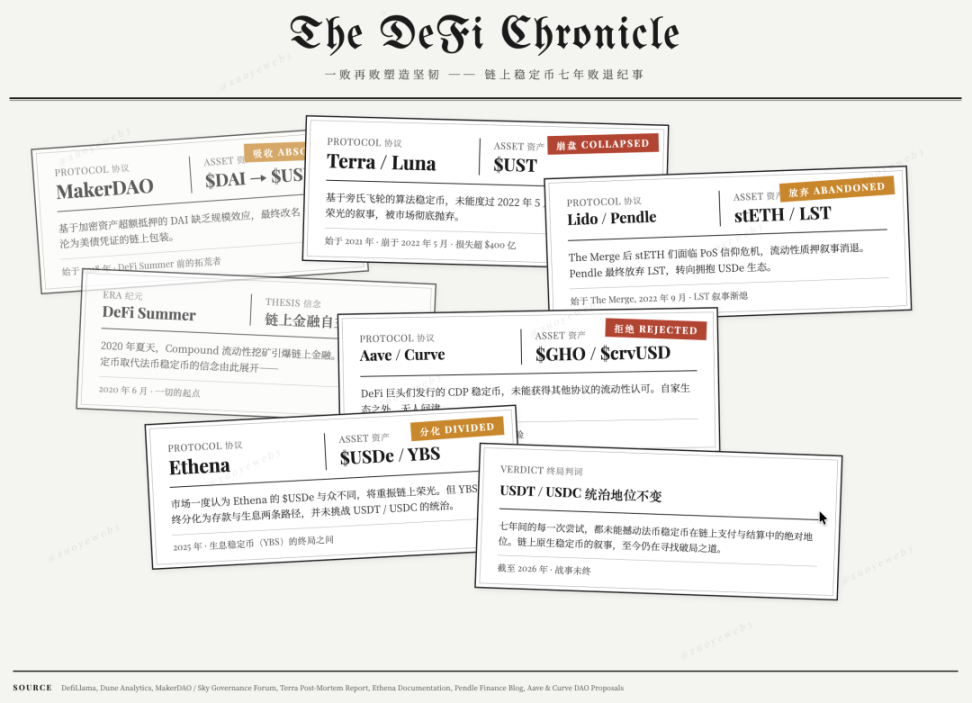
Keterangan gambar: Kronologi Stablecoin

Sumber gambar: @zuoyeweb3

Dengan DeFi Summer 2020 sebagai titik awal, kegagalan berulang membentuk ketangguhan:

  • Dimulai 2018, DAI berbasis aset kripto kekurangan efek skala, $USDS akhirnya menjadi sertifikat Surat Utang AS

  • Dimulai 2021, $UST berbasis skema Ponzi tidak melewati krisis penarikan 2022, kisah membangun kembali kejayaan algoritmik stabil dibuang orang

  • 2022, stETH pasca-The Merge menghadapi krisis kepercayaan PoS, Pendle akhirnya meninggalkan LST dan beralih ke USDe

  • 2023/24, stablecoin CDP yang diterbitkan oleh raksasa DeFi seperti Aave/Curve tidak diakui oleh protokol lain

  • 2025, pasar一度认为 $USDe milik Ethena berbeda, membangkitkan kembali kejayaan on-chain, tetapi stablecoin penghasil bunga akhirnya terbagi menjadi deposito dan aktivitas penghasil bunga, tidak menantang dominasi USDT/USDC di bidang masing-masing.

Fakta sudah sangat jelas, bukan USDT yang menelan keuntungan pengguna, melainkan DeFi memilih efek skala USDT/USDC.

Mengambil keuntungan Surat Utang AS sebesar $300 miliar, untuk ditukar dengan dasar transaksi seluruh pasar, DeFi dan pasar kripto tidak bisa dibilang rugi.

Tapi, apa harganya.

Harganya bukan pada klaim penantang stablecoin penghasil bunga bahwa Tether mengambil keuntungan dengan jahat, atau tuduhan egois perbankan yang melarang penghasilan bunga dari Coinbase dan Trump Jr.

Buah pahit yang dimakan DeFi adalah suku bunga bebas risiko Surat Utang AS disalurkan ke on-chain melalui stablecoin, tetapi Surat Utang AS adalah aset pemerintah AS, yang bertindak tidak akan peduli perasaan on-chain.

Ini juga alasan fundamental kebangkrutan tokenomics, UNI bergantung pada A16Z, A16Z bergantung pada pendanaan dolar, dolar adalah perwujudan Surat Utang AS, maka UNI hanya bergantung pada turunan keempat Surat Utang AS, lalu mengapa tidak langsung membeli Surat Utang AS, belum lagi tidak ada perantara yang mengambil untung.

Surat Utang AS adalah patokan DeFi secara de facto, tetapi DeFi hanya bisa menerima secara pasif, tidak dapat berinteraksi dua arah dengannya, ini adalah akar segala kebahagiaan atau penderitaan.
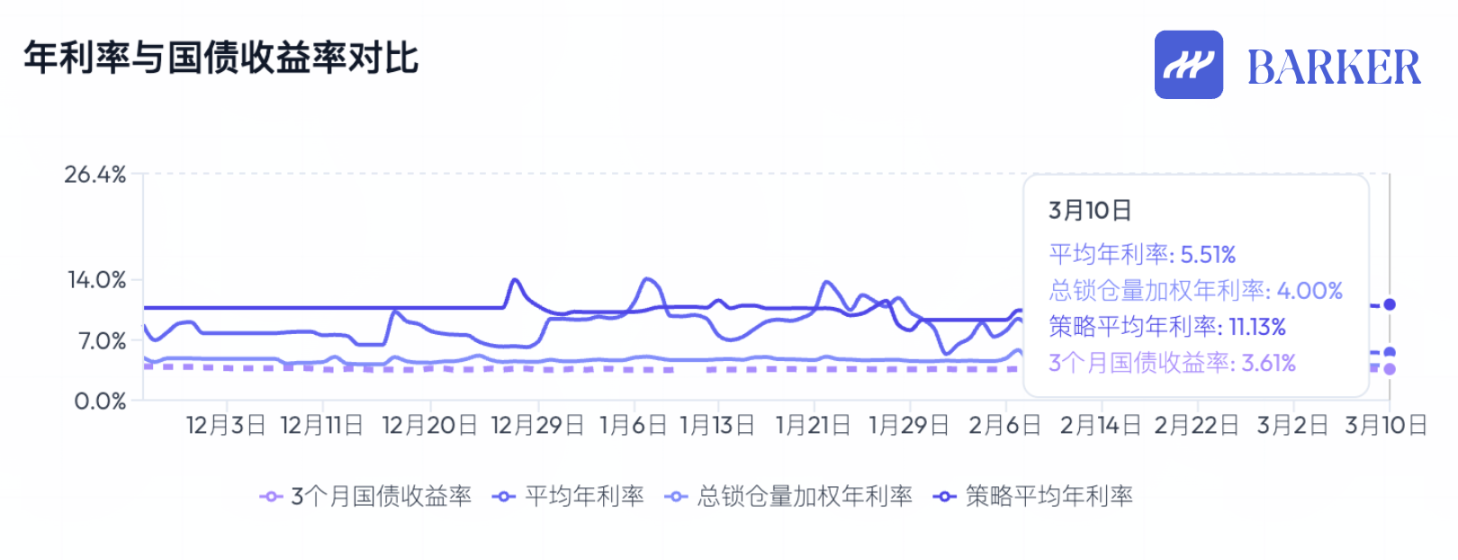
Keterangan gambar: Perbandingan imbal hasil tahunan stablecoin on-chain dan Surat Utang AS

Sumber gambar: @BarkerMoneyX

Penyelamatan DeFi tidak pernah berhenti, meskipun tokenomics bangkrut dan arsitektur tata kelola DAO runtuh, arah keseluruhan DeFi masih jelas:

  1. Investasi dan pendanaan suku bunga tetap, sistem penilaian risiko yang diakui, pinjaman tanpa jaminan —> poros pasar tahap berikutnya, menyimpan semacam bentuk produk untuk semua orang;

  2. Masa ekspansi public chain, exchange, protokol DeFi berakhir, bentuk aplikasi baru berubah menjadi Vault (brankas),暂时不能确定 Vault adalah bentuk produk untuk semua orang, tetapi ini adalah titik awal tahap baru.

Perlu diperhatikan, public chain, exchange hanya tidak lagi menjadi pusat penangkapan nilai, tidak berarti saat nol, periode inflasi harga aset mereka berakhir, selanjutnya hanya pertumbuhan linear yang mulus.

Ini juga dapat meneruskan hubungan progresif UNI dan Surat Utang AS, Aave/Morpho lebih mendekati manajemen aset itu sendiri, bisnis mereka tidak memiliki banyak ruang narasi, tetapi sangat diperlukan untuk industri.

Produk bintang sejati pasti adalah Vault yang digunakan massal berdasarkan public chain dan protokol DeFi, berbasis aset RWA yang tersebar, memicu mekanisme inflasi harga aset.

Untuk penggunaan massal, Kurator memilih bersekutu dengan exchange, Morpho masuk ke Coinbase melalui Stakehouse, Aave memperluas pengguna ritel melalui U card seperti Metamask.

Berdasarkan aset RWA, Kurator bekerja sama dengan penyedia penitipan seperti Galaxy, terus berpindah antara aset kripto dan aset nyata, misalnya Grove membeli obligasi CLO Galaxy.

Tapi唯独缺少 memicu mekanisme inflasi harga aset Vault, bahkan sebelum manajemen aset besar-besaran on-chain kali ini, token BUILD BlackRock sudah上线, USYC Circle juga mendukung penghasilan bunga, tetapi tidak dapat mengulangi kesuksesan sendiri.

Vault tidak memiliki token sendiri tidak penting, inflasi harga aset adalah suatu mekanisme, saham AS, real estat, obligasi, tulip, kartu grafis dan Mac Mini,都有自己的 siklus naik turun harga, Vault saat ini hanya memiliki kotak hitam penghasil bunga, tetapi始终没有解决 dua masalah:

  1. Dari mana sebenarnya imbal hasil tinggi berasal?

  2. Bagaimana menangani risiko tinggi?

Menuju Sistem Keuangan Baru

Bentuk saluran sedang berevolusi, Vault bukanlah titik akhir.

Industri kripto berevolusi sangat cepat, sebelum tahun ini, kita tidak pernah berani membayangkan sistem keuangan global benar-benar on-chain, tetapi hari ini adalah kenyataan yang tidak terbantahkan sedang berlangsung.

Belum sampai pesta kemenangan, RWA hanya dapat sebagai sumber dana, Vault masih permainan deposito yang membosankan, berbagai Kurator belum menunjukkan efek merek, Vault label putih seperti Veda sangat mendekati SaaS, dan operator Kurator hanya赚 biaya manajemen.

Ini sama sekali tidak memiliki imajinasi inflasi harga, jika manajemen aset tradisional skala $2 triliun saja menerima siksaan siklus, sulit dibayangkan Vault dapat bertahan.
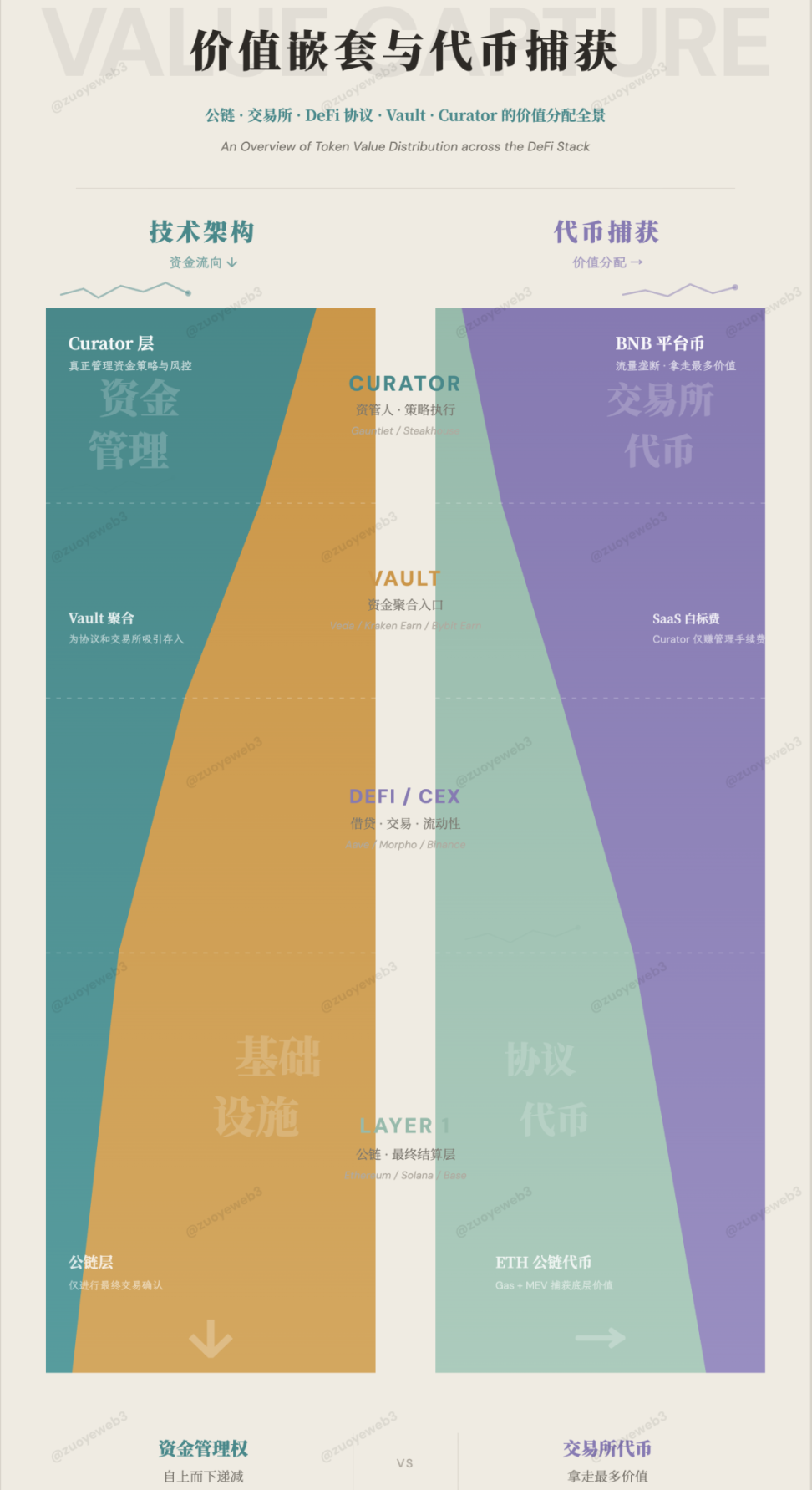
Keterangan gambar: Aliran dana dan distribusi nilai

Sumber gambar: @zuoyeweb3

Manajemen aset on-chain bukan didorong emosi sementara, dalam arti tertentu sama seperti IOE perbankan,总不能 mundur ke era kertas, bahkan Spark mulai menyatukan perhitungan penyesuaian margin posisi CEX/DEX, DeFi menjadi langkah selanjutnya TradFi.

Apakah Vault, setelah menyerap cukup banyak dana, akan memicu pembentukan suku bunga bebas risiko, adalah titik permainan terbesar siklus ini.

Pada periode DeFi Summer sebelumnya, TVL adalah indikator penentu, volume dana memetakan koefisien kekayaan token, menciptakan penambangan yang berlanjut hingga airdrop, studio dan Binance Alpha, logika intinya adalah "proyek membutuhkan lebih banyak volume dana untuk mendukung pertumbuhan token".

Tapi Vault, untuk pertama kalinya muncul permintaan deposito yang besar, tetapi tidak dapat mendukung token sendiri, bahkan jika Morpho merebut lebih banyak pangsa pasar Aave, tidak dapat memicu kenaikan harga token yang meledak.

Diperluas, Hyperliquid dibandingkan Binance, Lighter dibandingkan Hyperliquid, skala pasar dan harga token mereka menunjukkan ketidakseimbangan besar, ini adalah perubahan besar yang belum pernah terjadi di DeFi.

Di satu sisi, infrastruktur lama masih terus menyedot darah, misalnya setelah efek listing hilang $BNB seharusnya turun, tetapi CEX masih memiliki volume pengguna yang lebih besar daripada seluruh on-chain +DeFi, fakta yang sangat ironis, exchange lah yang memiliki investor ritel, protokol DeFi, seperti Aave, Morpho telah sepenuhnya menjadi wilayah少数专业人士.

Dalam latar belakang ini, risiko tinggi Vault&Kurator berasal dari kode dan struktur:

  • Bahasa pemrograman kontrak tidak dapat diubah Curve akan bermasalah, tim xUSD自行增发

  • Aave mengakhiri harmoni permukaan DAO dan tim pengembangan, Re7 memukul reputasi manajemen aset on-chain

Dalam latar belakang ini, imbal hasil tinggi Vault&Kurator berasal dari apa?

Saya tahu bukan arbitrase regulasi, biaya HLP dan stimulasi token, tetapi banyak orang masih bersikeras pada ketiganya, berpikir kepatuhan keuangan tradisional membentuk reputasi too big to fail.

Sama sekali melupakan fakta tokenomics sudah bangkrut,同时 volume deposito Vault terus tumbuh, Sky sudah terintegrasi mendalam ke sistem Morpho, masa depan Aave V4 juga institusionalisasi dan modularisasi berjalan paralel.

Dan, artikel ini一直强调 volume dana Vault tidak memicu mekanisme inflasi harga, inilah dilema struktural Vault.

Imbal hasil Vault, pada dasarnya berasal dari efisiensi transaksi pasar global, jika CEX tidak menyediakan Vault tertentu, maka konfigurasi on-chain, Kurator yang dipersonifikasikan刚好适合 berputar di antara berbagai orang.

Pasar global TradFi, bahkan seperti saham AS,也要面临开户, waktu transaksi yang lama dan batasan proses,总不能说 saham AS secara bertahap membuka transaksi sepanjang waktu dan DTCC on-chain juga untuk arbitrase吧?

Masalah terakhir, mekanisme apa yang dapat memicu inflasi harga aset, membuat dana yang mengendap di Vault menciptakan legenda price-to-dream.

Dengan kata lain, apa yang kurang dari Vault ke inflasi harga aset?

Kurang saluran, kurang渠道 untuk saling menggabungkan dana, personifikasi Kurator menghalangi pemrograman Lego DeFi.

Saat ini, CEX berfungsi sebagai penampung sementara, masih menjadi tempat terjalinnya dana paling cepat.

Mengacu pada evolusi Perp DEX, merebut pangsa pasar kontrak CEX, sumber dana RWA, semuanya sedang merebut pasar CEX.

CEX hanya memiliki存量, mereka sendiri tidak dapat menyelesaikan masalah akuisisi pengguna baru, apalagi membantu Vault memperluas ke pengguna miliaran, Vault saat启动贴牌造车, di masa depan都要 membangun pabrik super sendiri.

Saya menduga saluran akan berupa bentuk produk Broker tertentu.

Dalam pembagian kerja sosial yang tinggi, exchange这种集入金, transaksi, penitipan dan kliring于一体的 Super App akan逐渐分业经营, kepatuhan Binance di kerangka Abu Dhabi ADGM即是 tiga bagian terpisah.

Ini akan memudahkan profesionalitas penanganan dana secara fundamental,同时 memanfaatkan sistem pembukuan terpadu blockchain, dan membutuhkan koordinasi tengah Vault&Kurator.

Mengacu pada Neobroker seperti Robinhood/Trade Republic, menarik pengguna muda, ritel untuk berpartisipasi dalam transaksi profesional,进而 membangun bentuk bisnis manajemen aset, perencanaan keuangan,模式 stablecoin为前端, Kurator mengelola Vault更为高效.

Singkatnya, Binance memonopoli aliran dana, BNB mendapatkan pemberdayaan terkuat, selanjutnya Broker bertanggung jawab atas interaksi dana,某种 bentuk aset,甚至 aliran bisnis murni都足够 menguntungkan, lagipula Robinhood hanyalah kedok kecil market maker yang sangat menguntungkan.

Kesimpulan

Dibandingkan kode, transaksi, regulasi dan token justru lebih stabil.

Kredit swasta dan siklus RWA terhenti,抢发 dokumen No. 402有种预感, DeFi bukan tidak dapat menjadi saluran keluar likuiditas, melainkan缺乏 mekanisme inflasi harga aset.

Manajemen aset ≈ Aave/Morpho, perlahan akan seperti public chain, mengakhiri misi sejarah mereka, mereka akan ada dalam jangka panjang, tetapi hanya pertumbuhan skala, harga token趋于 stabil;

Vault&Kurator ≈ manajer dana bintang, sedang cepat mendapatkan pelanggan dan memonopoli pasar, raksasa化已经有 tanda-tanda awal,能否 terus menangkap nilai高度 diragukan;

Saluran ≈ CEX (sementara), justru memiliki ruang inovasi terbesar, memudahkan kebebasan dana,总会 mendapatkan hadiah tertinggi.

Pasar global yang efisien, sedang berjalan pada public chain yang tidak membutuhkan token tradisional, ini adalah命题 era berikutnya, setiap orang harus menjawab.


Twitter:https://twitter.com/BitpushNewsCN

Grup TG Bitpush:https://t.me/BitPushCommunity

Berlangganan TG Bitpush: https://t.me/bitpush

Tautan asli:https://www.bitpush.news/articles/7618714

Related Questions

QApa yang dimaksud dengan 'tingkat bebas risiko' dalam konteks DeFi dan mengapa sulit dicapai?

ATingkat bebas risiko (risk-free rate) dalam DeFi merujuk pada imbal hasil stabil dan terjamin yang tidak terpengaruh volatilitas pasar. Sulit dicapai karena DeFi masih bergantung pada stablecoin seperti USDT/USDC yang terikat dengan aset tradisional (seperti obligasi pemerintah AS), sehingga tidak memiliki kontrol penuh atas penetapan suku bunga mandiri. Imbal hasil saat ini lebih merupakan 'cerminan' dari suku bunga tradisional, bukan produk asli DeFi.

QBagaimana peran Vault dan Curator dalam evolusi ekosistem keuangan terdesentralisasi (DeFi)?

AVault berfungsi sebagai penyimpanan aset terkelola di blockchain yang menawarkan imbal hasil, sementara Curator adalah pengelola atau operator yang mengatur strategi investasi Vault. Mereka bersama-sama berperan dalam menarik institusi tradisional ke ekosistem DeFi, meningkatkan likuiditas, dan menciptakan produk keuangan yang lebih terakses. Namun, tantangannya adalah menciptakan mekanisme ekspansi nilai aset yang berkelanjutan, bukan sekadar menawarkan imbal hasil pasif.

QMengapa token seperti UNI atau MORPHO tidak mengalami kenaikan harga signifikan meskipun adopsi institusional meningkat?

AToken seperti UNI atau MORPHO tidak mengalami apresiasi harga kuat karena ekonomi token tradisional dianggap 'bangkrut' – nilai token tidak lagi secara langsung terkait dengan pertumbuhan protokol. Institusi seperti BlackRock berinvestasi dalam produk dasar (seperti Vault), bukan untuk spekulasi token. Selain itu, protokol DeFi seperti Aave/Morpho telah menjadi wilayah profesional, bukan retail, sehingga mengurangi tekanan beli spekulatif.

QApa yang dimaksud dengan 'saluran' (channel) dalam konteks artikel dan mengapa penting untuk masa depan DeFi?

A'Saluran' (channel) merujuk pada infrastruktur yang memfasilitasi aliran dan interaksi modal antara TradFi dan DeFi, seperti broker berbasis blockchain atau platform yang memisahkan fungsi perdagangan, penyimpanan, dan penyelesaian. Penting karena meningkatkan efisiensi pasar global, memungkinkan integrasi yang lebih dalam dengan keuangan tradisional, dan menciptakan mekanisme baru untuk ekspansi nilai aset – sesuatu yang tidak dapat dilakukan oleh Vault saja.

QBagaimana hubungan antara RWA (Real World Assets) dan stabilitas sistem keuangan berbasis blockchain?

ARWA (Aset Dunia Nyata) seperti obligasi atau surat utang yang di-tokenisasi memberikan stabilitas dengan menghubungkan DeFi dengan aset bernilai intrinsik di dunia nyata, mengurangi ketergantungan pada volatilitas crypto murni. Namun, RWA juga berisiko menjadi 'saluran keluar likuiditas' bagi institusi tradisional, yang dapat memicu ketidakstabilan jika terjadi penarikan massal. Kunci nya adalah menciptakan siklus nilai yang seimbang, bukan sekadar menjadi sumber dana satu arah.

Related Reads

Warsh's Debut: Will the FED Chair Who Knows Crypto Best Bring Surprises or Shocks to the Market?

Kevin Warsh, the new Federal Reserve Chairman, prepares for his inaugural press conference amidst a challenging macroeconomic landscape: resurgent inflation, a bond market sell-off, and political pressure from President Trump for rate cuts. Uniquely, Warsh holds indirect investments in over 20 crypto and Web3 entities (e.g., Solana, dYdX), making him the first Fed Chair with disclosed crypto exposure. His stance may combine a hawkish, inflation-focused monetary policy with a crypto-friendly regulatory philosophy that shifts from Powell’s “same risk, same rule” approach toward a framework acknowledging blockchain’s productivity value. Warsh’s leadership could impact crypto markets across three dimensions: a paradigm shift in regulation (potentially accelerating pro-innovation legislation and stable币 rules), a re-pricing of risk premiums based on clearer communication and his view of AI as a structural disinflationary force, and a long-term reallocation of global institutional capital driven by increased legitimacy. Two potential scenarios for the press conference are outlined. A “positive surprise” would involve a dovish-leaning tone on rates coupled with signals of regulatory openness, potentially boosting crypto asset valuations. Conversely, a “negative shock” would see a more hawkish-than-expected stance on inflation and rates, triggering a broad risk-asset selloff that crypto markets would not escape. While ethics rules required Warsh to divest his crypto holdings upon confirmation, his deep understanding of the technology may fundamentally lower policy uncertainty and build a more receptive long-term foundation for digital assets’ integration into the mainstream financial system.

marsbit1h ago

Warsh's Debut: Will the FED Chair Who Knows Crypto Best Bring Surprises or Shocks to the Market?

marsbit1h ago

Trading

Spot
Futures

Hot Articles

What is G$

Understanding GoodDollar ($G$): A Blueprint for Decentralized Universal Basic Income Introduction In the ever-evolving landscape of cryptocurrency and blockchain technology, initiatives that seek to address pressing social issues have garnered increased attention. One such project is GoodDollar ($G$), a Web3-based universal basic income (UBI) solution. GoodDollar endeavors to tackle inequality and bridge the wealth gap by creating and distributing accessible economic resources to those most in need. Through its innovative use of decentralized finance (DeFi), GoodDollar presents a unique model that could potentially reshape the way financial assistance is perceived and delivered globally. What is GoodDollar ($G$)? GoodDollar is a cryptocurrency protocol that facilitates the issuance and distribution of digital tokens, referred to as $G$, to its registered users on a daily basis. These tokens function as a form of universal basic income, promoting financial empowerment for individuals from various backgrounds, especially those traditionally excluded from the financial system. Operating on the blockchain, GoodDollar utilizes multiple chains, including Ethereum, Celo, and Fuse, ensuring broad access and usability. The fundamental goal of GoodDollar is to make cryptocurrency accessible and beneficial to everyone, irrespective of their economic starting point. The Creator of GoodDollar ($G$) Details concerning the creator of GoodDollar remain somewhat obscure. However, it is notably highlighted that the project has strong backing from eToro, a widely recognized investment platform that provided the initial funding and foundational support for GoodDollar's development. The vision behind the project is not solely profit-driven but leans heavily towards social entrepreneurship, aiming for a systemic change in economic accessibility. Investors of GoodDollar ($G$) GoodDollar enjoys the financial backing and operational support of eToro. This partnership has played a significant role in launching the protocol and its subsequent developments. While eToro was instrumental in establishing the foundation of the project, GoodDollar envisions transitioning towards a model funded by its community in the long run. This shift to community funding is in line with GoodDollar's commitment to decentralization, allowing its users to have a direct stake in the project's future. How Does GoodDollar ($G$) Work? GoodDollar's operational framework relies heavily on DeFi principles to generate interest from staked cryptocurrencies. This mechanism allows the project to mint and distribute $G$ tokens as a digital basic income for users worldwide. Several key features contribute to GoodDollar's uniqueness and innovation: Universal Basic Income (UBI): Every day, registered users receive free tokens, establishing an automatic income stream intended to alleviate financial pressures. Sustainable Economic Model: The project’s tokenomics aim to balance supply and demand for $G$ tokens, ensuring that the value remains stable over time. Reserve-Backed Tokens: Each $G$ token is backed by a reserve of cryptocurrencies, providing it with inherent value and reliability, a crucial aspect for maintaining user trust. Decentralized Governance: GoodDollar incorporates a democratic approach to decision-making through token-powered decentralized governance. This allows community members to actively participate in the shaping of the project's trajectory, making it truly community-driven. Global Accessibility: GoodDollar has established a considerable community footprint, boasting over 640,000 members spanning 181 countries. Such widespread reach is instrumental in facilitating UBI on a global scale. Timeline of GoodDollar ($G$) The evolution of GoodDollar is marked by several significant milestones throughout its history: 2019: The launch of the GoodDollar wallet marked the first step in operationalizing its vision of delivering UBI through cryptocurrency. 2020: Following the successful wallet rollout, the GoodDollar protocol officially debuted. This marked a crucial phase in its mission to provide daily distributed income. 2021: The project advanced further with the introduction of its Decentralized Autonomous Organization (DAO), fostering a greater level of community involvement and governance. 2022: GoodDollar unveiled its DeFi-friendly version 2 (V2), striving for enhanced user engagement and operational efficiency. The same year also saw the transition to a decentralized governance structure via GoodDAO. 2022: A new roadmap was conceptualized, focusing on initiatives like a grant program designed to promote $G$-related entrepreneurial ventures and an upgraded GoodDollar Marketplace. Key Features of GoodDollar ($G$) The GoodDollar project introduces numerous critical features aimed at redefining the landscape of basic income: Universal Basic Income: Delivering daily free tokens to its users fundamentally underscores its mission to eliminate economic precarity. Multi-Chain Operation: Leveraging multiple blockchain networks enhances accessibility and scalability, ensuring broader participation. Engagement with Decentralized Finance: The use of DeFi allows for sustainable funding of the UBI model, reinforcing its viability as an economic solution. Community Engagement and Governance: GoodDollar envisions a model where the community influences operations through democratic participation, fostering transparency and accountability. Global Community: Boasting a diverse global community enables the project to implement UBI solutions tailored to various cultural and economic contexts. Conclusion GoodDollar represents a transformative leap towards incorporating the principles of universal basic income through the innovative lens of blockchain technology. By harnessing decentralized finance, the project not only provides a solution to financial inequality but also actively engages users in its governance and operations. With a growing community and evolving roadmap, GoodDollar stands as a significant player in the intersection of cryptocurrency and social good, paving the way for a more equitable financial future. As it continues to evolve, GoodDollar’s journey may ultimately inspire other initiatives to consider similar models, furthering the cause of economic empowerment for all.

977 Total ViewsPublished 2024.04.01Updated 2024.12.03

What is G$

How to Buy G

Welcome to HTX.com! We've made purchasing Gravity (G) simple and convenient. Follow our step-by-step guide to embark on your crypto journey.Step 1: Create Your HTX AccountUse your email or phone number to sign up for a free account on HTX. Experience a hassle-free registration journey and unlock all features.Get My AccountStep 2: Go to Buy Crypto and Choose Your Payment MethodCredit/Debit Card: Use your Visa or Mastercard to buy Gravity (G) instantly.Balance: Use funds from your HTX account balance to trade seamlessly.Third Parties: We've added popular payment methods such as Google Pay and Apple Pay to enhance convenience.P2P: Trade directly with other users on HTX.Over-the-Counter (OTC): We offer tailor-made services and competitive exchange rates for traders.Step 3: Store Your Gravity (G)After purchasing your Gravity (G), store it in your HTX account. Alternatively, you can send it elsewhere via blockchain transfer or use it to trade other cryptocurrencies.Step 4: Trade Gravity (G)Easily trade Gravity (G) on HTX's spot market. Simply access your account, select your trading pair, execute your trades, and monitor in real-time. We offer a user-friendly experience for both beginners and seasoned traders.

6.1k Total ViewsPublished 2024.07.18Updated 2026.06.02

How to Buy G

What is @G

Graphite Network, $@G: Bridging TradFi and Web3 Introduction to Graphite Network, $@G In the vibrant world of cryptocurrencies and web3 projects, Graphite Network emerges as a beacon of innovation. With its native token, $@G, this Layer-1, Proof-of-Authority (PoA) blockchain is tailored to bridge the gap between traditional finance (TradFi) and the rapidly evolving Web3 ecosystem. As digital currencies gain traction, Graphite Network strives to offer a blockchain platform that prioritizes security, compliance, and speed, presenting itself as a facilitator of trust and accountability. What is Graphite Network, $@G? Graphite Network is not merely another blockchain project; it aims to redefine how decentralization, security, and user accountability are perceived in the digital finance realm. The project boasts a series of distinctive features: Reputation-Based Blockchain: At its core, Graphite Network implements a one-user, one-account policy, fortified with integrated Know Your Customer (KYC) verification and scoring mechanisms. This design ensures a balance between user privacy and transparency—a critical aspect of financial operations in today’s digital world. Entry-Point Node Income: The network incentivizes users to set up entry-point nodes, allowing operators to earn rewards from network transactions. This income generation model not only boosts user engagement but also reinforces network health and decentralization. EVM Compatibility: With an Ethereum-compatible virtual machine (VM), Graphite Network enables seamless integration of existing Solidity decentralized applications (dApps) and smart contracts, thereby inviting developers to leverage its capabilities without extensive modifications. KYC Integration: In an era where compliance is paramount, the integrated KYC framework with multiple verification tiers enhances the control over financial operations without mandatory participation, setting a precedent for user autonomy. Who is the Creator of Graphite Network, $@G? The Graphite Network is borne out of the endeavors of the Graphite Foundation, a non-profit organization dedicated to the development, maintenance, and evolution of the Graphite Network. The foundation’s commitment underscores the project’s vision to create a secure and sustainable blockchain environment focused on genuine user engagement and compliance. Who are the Investors of Graphite Network, $@G? Currently, there is limited information available on the specific investors backing the Graphite Network initiative. The founding organization, the Graphite Foundation, functions independently in fostering the project’s growth while seeking partnerships that resonate with its vision of a compliant and accessible blockchain platform. How Does Graphite Network, $@G Work? Graphite Network’s operation is grounded in its unique Proof-of-Authority consensus mechanism, which strikes an impressive balance between high throughput and decentralization. Let's delve into the various components that define its operation: Transport Nodes: Serving as the entry-point nodes, these are critical to the ecosystem. Operators can earn revenue from transactions that traverse the network, which not only empowers individual users but also bolsters network decentralization. Authorized Nodes: At the heart of the Graphite Network are core validators who undergo rigorous compliance tests, encompassing robust KYC verification along with technical assessments. This layer of trust is essential for ensuring that transactions within the network maintain a high level of integrity. Ticker System: Graphite Network employs a distinctive ticker system for its wrapped tokens, denoted as @G. This feature enhances clarity in asset integration, making user transactions comprehensible and straightforward. Graphite Network’s innovative approach reflects a significant step in addressing the crucial issues of digital finance, positioning itself favorably for the future as more users transition from traditional forms of finance into the world of decentralized applications. Timeline of Graphite Network, $@G To understand the progression and milestones of Graphite Network, it is beneficial to overview key events in its timeline: 2021: The inception of Graphite Network by the Graphite Foundation marks the commencement of a new chapter in blockchain development, focusing on compliance and user empowerment. Key Developments: Following its launch, the introduction of entry-point node income, the establishment of a reputation-based model, integrated KYC verification, and the provision of EVM compatibility represent significant advancements in the project. Recent Activities: The continuous development and nurturing efforts of the Graphite Foundation have focused on augmenting network features while fostering the ecosystem's growth, demonstrating a long-term commitment to sustainability and innovation. Additional Key Points Beyond its foundational components, Graphite Network encompasses several tools and features that bolster its usability: Graphite Wallet: A user-friendly Chrome extension that facilitates access to various network features and applications across Ethereum-compatible chains, enhancing user convenience. Graphite Bridge: This utility allows seamless transfers of Graphite assets across different networks, fostering an integrated and interoperable ecosystem. Graphite Explorer: Serving as an essential tool within the ecosystem, this feature enables users to view and verify smart contract source code, track transactions, and explore other vital information in real-time. Graphite Testnet: The project provides a robust testing environment for developers, allowing them to ensure stability and scalability prior to mainnet deployment. This initiative not only empowers developers but also enhances the reliability of the entire network. Conclusion Graphite Network, with its native token $@G, represents a significant stride toward bridging traditional finance and cutting-edge blockchain technology. By focusing on security, compliance, and decentralization, this innovative platform is set to lead the transition into the Web3 era. As user engagement grows and more projects leverage its capabilities, Graphite Network is poised to make lasting contributions to the rapidly evolving digital landscape. In conclusion, Graphite Network stands as a testament to what can be achieved when innovative thinking meets the growing demands of modern finance and technology. As the world explores the potential of decentralized finance, Graphite Network will undoubtedly remain a noteworthy player in this arena.

529 Total ViewsPublished 2025.01.06Updated 2025.01.06

What is @G

Discussions

Welcome to the HTX Community. Here, you can stay informed about the latest platform developments and gain access to professional market insights. Users' opinions on the price of G (G) are presented below.

活动图片