Are Bitcoin And Tech Stocks Really Linked? NYDIG Says Not So Fast

bitcoinistPublished on 2026-03-09Last updated on 2026-03-09

Abstract

Traders observing Bitcoin's parallel movement with tech stocks may misinterpret the correlation. NYDIG's research indicates only 25% of Bitcoin's price action relates to equities, while 75% stems from unrelated factors. Both assets react to shared macro pressures and liquidity conditions, not structural links. Bitcoin's correlation with indices like the S&P 500 and Nasdaq has risen, but this reflects broader risk appetite rather than a direct tie to tech stocks. Bitcoin remains distinct due to network activity, adoption trends, and policy developments, sustaining its role as a portfolio diversifier. Despite elevated correlations, it is not a software stock.

Traders watching Bitcoin climb alongside US software stocks last week may have drawn the wrong conclusion. According to NYDIG, a financial services company focused on Bitcoin, the visual parallel is misleading.

Only about 25% of BTC price movement can be traced back to its relationship with equity markets. The remaining 75% is driven by forces that have nothing to do with the S&P 500 or the Nasdaq.

Greg Cipolaro, head of research at NYDIG, made the case in a Friday note. His argument: when Bitcoin and software stocks move in the same direction, it is not because they are structurally linked. Both are reacting to the same macro pressures — the kind that push investors toward or away from risk assets broadly.

“The conclusion that Bitcoin and software equities have structurally converged is overstated,” Cipolaro wrote.

A Shared Macro Trigger, Not A Common Identity

Bitcoin’s 90-day rolling correlation with software stocks has climbed since the cryptocurrency hit a record above $126,000 in early October. But Cipolaro pointed out that its correlations with the S&P 500 and Nasdaq have risen at the same time.
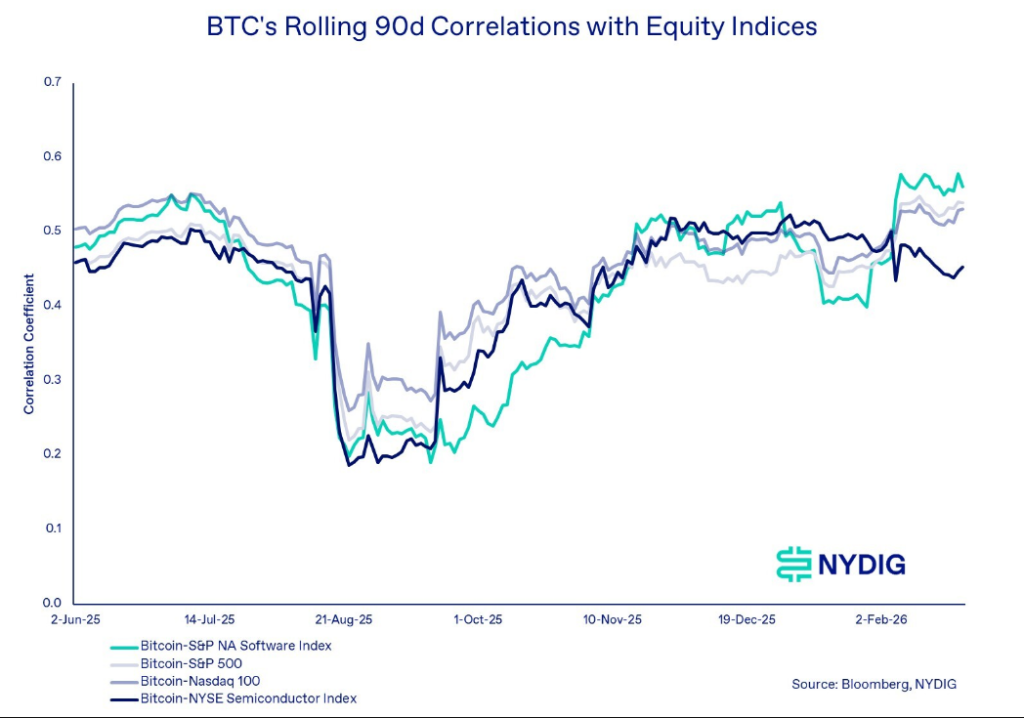
90-Day Rolling Correlation Between Bitcoin and Major Indices. Source: NYDIG

Liquidity Sensitive Assets

That pattern suggests the shift is not specific to software stocks — it is a wider phenomenon tied to investor appetite for risk.

Data shows that both the alpha crypto and software equities are being treated as long-duration, liquidity-sensitive assets. When macro conditions favor risk-taking, both go up. When they don’t, both get hit.

That shared sensitivity to monetary conditions is what has been driving the parallel movement, not any deeper connection between the two.

Image: CoinFlip.tech

The “Bitcoin is a tech stock” narrative has circulated before. It tends to resurface during periods when correlations tick higher and the assets appear to move in lockstep. Cipolaro’s note pushes back on that framing directly.

Crypto’s Distinct Drivers Keep It In A Category Of Its Own

Despite the elevated correlations, NYDIG argues that Bitcoin has a market structure that sets it apart. Network activity, adoption trends, and policy developments all shape its price in ways that do not apply to software companies.

Those factors, Cipolaro said, support Bitcoin’s role as a portfolio diversifier even when cross-asset correlations are climbing.

BTCUSD trading at $67,465 on the 24-hour chart: TradingView

One tension the note acknowledges is Bitcoin’s failure to trade like gold. It has long been called “digital gold,” but reports indicate it is not being bought as a hedge against economic instability.

Traders appear to be allocating to it along a risk curve rather than out of any distinct monetary conviction.

Correlations with equities are elevated right now. But based on NYDIG’s analysis, they are far from the full story of what moves Bitcoin’s price — and far from enough to call it a software stock.

Featured image from ION, chart from TradingView

Related Questions

QAccording to NYDIG, what percentage of Bitcoin's price movement is driven by factors unrelated to equity markets?

AAccording to NYDIG, about 75% of Bitcoin's price movement is driven by forces that have nothing to do with the S&P 500 or the Nasdaq.

QWhat does Greg Cipolaro suggest is the real reason Bitcoin and software stocks sometimes move in the same direction?

AGreg Cipolaro suggests that when Bitcoin and software stocks move together, it is not due to a structural link, but because both are reacting to the same macro pressures that push investors toward or away from risk assets broadly.

QHow does NYDIG describe the nature of both Bitcoin and software equities in the current market?

ANYDIG describes both Bitcoin and software equities as being treated by the market as long-duration, liquidity-sensitive assets.

QDespite higher correlations, what factors does NYDIG say set Bitcoin's market structure apart from software companies?

ANYDIG states that network activity, adoption trends, and policy developments all shape Bitcoin's price in ways that do not apply to software companies, setting its market structure apart.

QWhat does the article say about the common narrative that 'Bitcoin is a tech stock'?

AThe article states that the 'Bitcoin is a tech stock' narrative tends to resurface during periods of high correlation, but NYDIG's analysis directly pushes back on that framing, arguing the correlation is due to shared macro sensitivity, not a structural convergence.

Related Reads

Trading

Spot
Futures

Hot Articles

What is $BITCOIN

DIGITAL GOLD ($BITCOIN): A Comprehensive Analysis Introduction to DIGITAL GOLD ($BITCOIN) DIGITAL GOLD ($BITCOIN) is a blockchain-based project operating on the Solana network, which aims to combine the characteristics of traditional precious metals with the innovation of decentralized technologies. While it shares a name with Bitcoin, often referred to as “digital gold” due to its perception as a store of value, DIGITAL GOLD is a separate token designed to create a unique ecosystem within the Web3 landscape. Its goal is to position itself as a viable alternative digital asset, although specifics regarding its applications and functionalities are still developing. What is DIGITAL GOLD ($BITCOIN)? DIGITAL GOLD ($BITCOIN) is a cryptocurrency token explicitly designed for use on the Solana blockchain. In contrast to Bitcoin, which provides a widely recognized value storage role, this token appears to focus on broader applications and characteristics. Notable aspects include: Blockchain Infrastructure: The token is built on the Solana blockchain, known for its capacity to handle high-speed and low-cost transactions. Supply Dynamics: DIGITAL GOLD has a maximum supply capped at 100 quadrillion tokens (100P $BITCOIN), although details regarding its circulating supply are currently undisclosed. Utility: While precise functionalities are not explicitly outlined, there are indications that the token could be utilized for various applications, potentially involving decentralized applications (dApps) or asset tokenization strategies. Who is the Creator of DIGITAL GOLD ($BITCOIN)? At present, the identity of the creators and development team behind DIGITAL GOLD ($BITCOIN) remains unknown. This situation is typical among many innovative projects within the blockchain space, particularly those aligning with decentralized finance and meme coin phenomena. While such anonymity may foster a community-driven culture, it intensifies concerns about governance and accountability. Who are the Investors of DIGITAL GOLD ($BITCOIN)? The available information indicates that DIGITAL GOLD ($BITCOIN) does not have any known institutional backers or prominent venture capital investments. The project seems to operate on a peer-to-peer model focused on community support and adoption rather than traditional funding routes. Its activity and liquidity are primarily situated on decentralized exchanges (DEXs), such as PumpSwap, rather than established centralized trading platforms, further highlighting its grassroots approach. How DIGITAL GOLD ($BITCOIN) Works The operational mechanics of DIGITAL GOLD ($BITCOIN) can be elaborated on based on its blockchain design and network attributes: Consensus Mechanism: By leveraging Solana’s unique proof-of-history (PoH) combined with a proof-of-stake (PoS) model, the project ensures efficient transaction validation contributing to the network's high performance. Tokenomics: While specific deflationary mechanisms have not been extensively detailed, the vast maximum token supply implies that it may cater to microtransactions or niche use cases that are still to be defined. Interoperability: There exists the potential for integration with Solana’s broader ecosystem, including various decentralized finance (DeFi) platforms. However, the details regarding specific integrations remain unspecified. Timeline of Key Events Here is a timeline that highlights significant milestones concerning DIGITAL GOLD ($BITCOIN): 2023: The initial deployment of the token occurs on the Solana blockchain, marked by its contract address. 2024: DIGITAL GOLD gains visibility as it becomes available for trading on decentralized exchanges like PumpSwap, allowing users to trade it against SOL. 2025: The project witnesses sporadic trading activity and potential interest in community-led engagements, although no noteworthy partnerships or technical advancements have been documented as of yet. Critical Analysis Strengths Scalability: The underlying Solana infrastructure supports high transaction volumes, which could enhance the utility of $BITCOIN in various transaction scenarios. Accessibility: The potential low trading price per token could attract retail investors, facilitating wider participation due to fractional ownership opportunities. Risks Lack of Transparency: The absence of publicly known backers, developers, or an audit process may yield skepticism regarding the project's sustainability and trustworthiness. Market Volatility: The trading activity is heavily reliant on speculative behavior, which can result in significant price volatility and uncertainty for investors. Conclusion DIGITAL GOLD ($BITCOIN) emerges as an intriguing yet ambiguous project within the rapidly evolving Solana ecosystem. While it attempts to leverage the “digital gold” narrative, its departure from Bitcoin's established role as a store of value underscores the need for a clearer differentiation of its intended utility and governance structure. Future acceptance and adoption will likely depend on addressing the current opacity and defining its operational and economic strategies more explicitly. Note: This report encompasses synthesised information available as of October 2023, and developments may have transpired beyond the research period.

363 Total ViewsPublished 2025.05.13Updated 2025.05.13

What is $BITCOIN

Discussions

Welcome to the HTX Community. Here, you can stay informed about the latest platform developments and gain access to professional market insights. Users' opinions on the price of BTC (BTC) are presented below.

活动图片