November Lido Poolside community call was dedicated to the LDO tokenholders update. Vasiliy, Executive Director at the Lido Labs Foundation, provided an update on the Lido protocol’s market position and financials, presented the buyback framework, and gave a strategic outlook for 2026, which will be proposed for a DAO in the ongoing GOOSE cycle.
Read the highlights below or watch the full recording.
Agenda
- Market state
- Financial update
- Buybacks
- Strategic outlook
- Q&A Highlights
Key Points
The Lido Labs Foundation is advancing its product roadmap, with a positive impact on market share expected in late Q4 or early Q1 2026.
- Lido Labs is building a new operational discipline with new product streams being developed, organizational cost efficiency being improved, and the costs of revenue being lowered for the DAO.
- The buyback proposal is live, outlining how Lido DAO can direct surplus revenue into LDO value accrual.
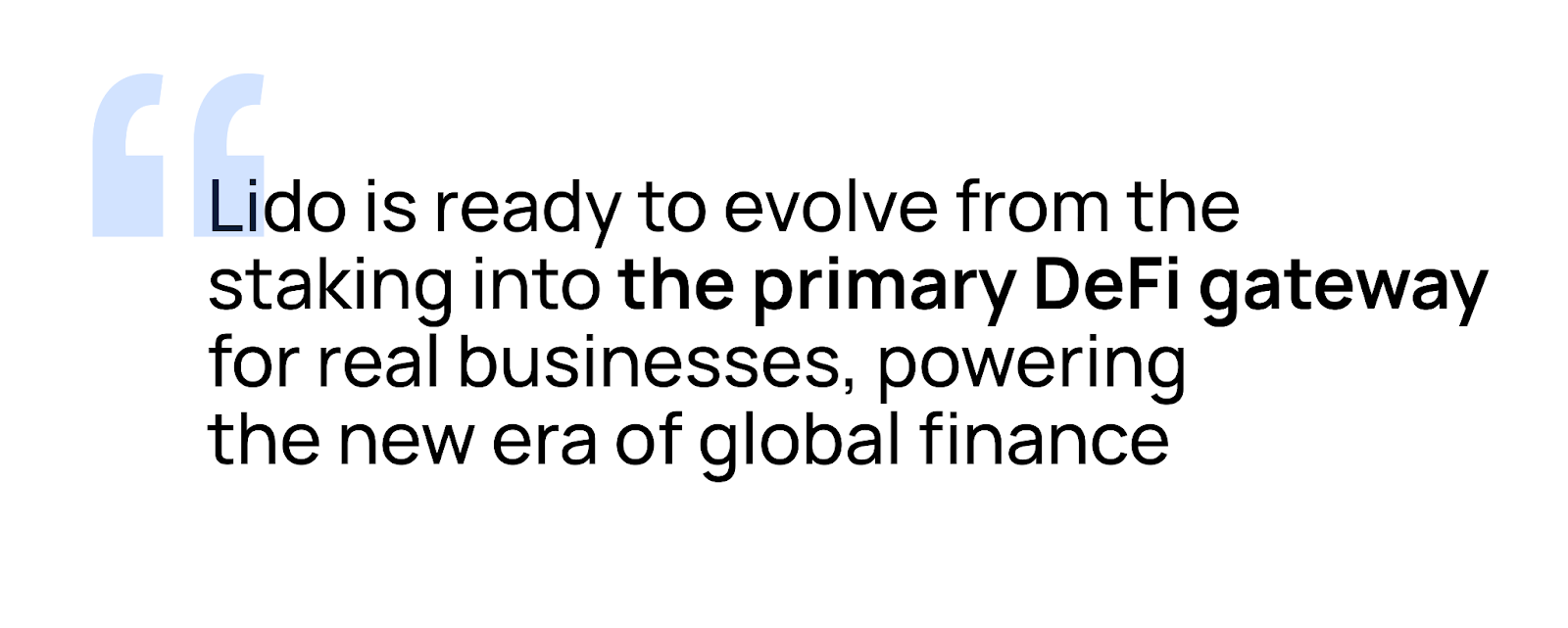
- With GOOSE-3, Lido Labs proposes a shift toward a multi-product model and a move closer to the customer, with a long-term vision of becoming the primary DeFi gateway for real businesses.
Introduction
Lido Protocol Fundamentals
Lido is a liquid staking protocol on Ethereum, providing a simple and secure way to stake ETH.
- It offers capital-efficient functionality with DeFi liquidity integrations throughout the ecosystem.
- The protocol aims to provide participants with fast unstaking, allowing swapping stETH on secondary markets.
Lido protocol is governed by Lido DAO, a decentralized autonomous organisation of LDO tokenholders. Through the governance process, the tokenholders set parameters, approve upgrades to the Lido protocol, manage the Lido DAO Treasury allocations, define goals, and authorize grants for the Lido Labs, Lido Ecosystem, and Lido Alliance Foundations.
Lido Labs Foundation is fully subject to DAO governance decisions and, by its bylaws, required to follow tokenholder-approved directives. It develops and maintains the protocol’s codebase, upgrades, and new features. The current leadership team is led by Executive Director Vasiliy Shapovalov, with Isidoros Passadis as Chief of Staking and Sam Kim as Chief Legal & Operating Officer.
Market State
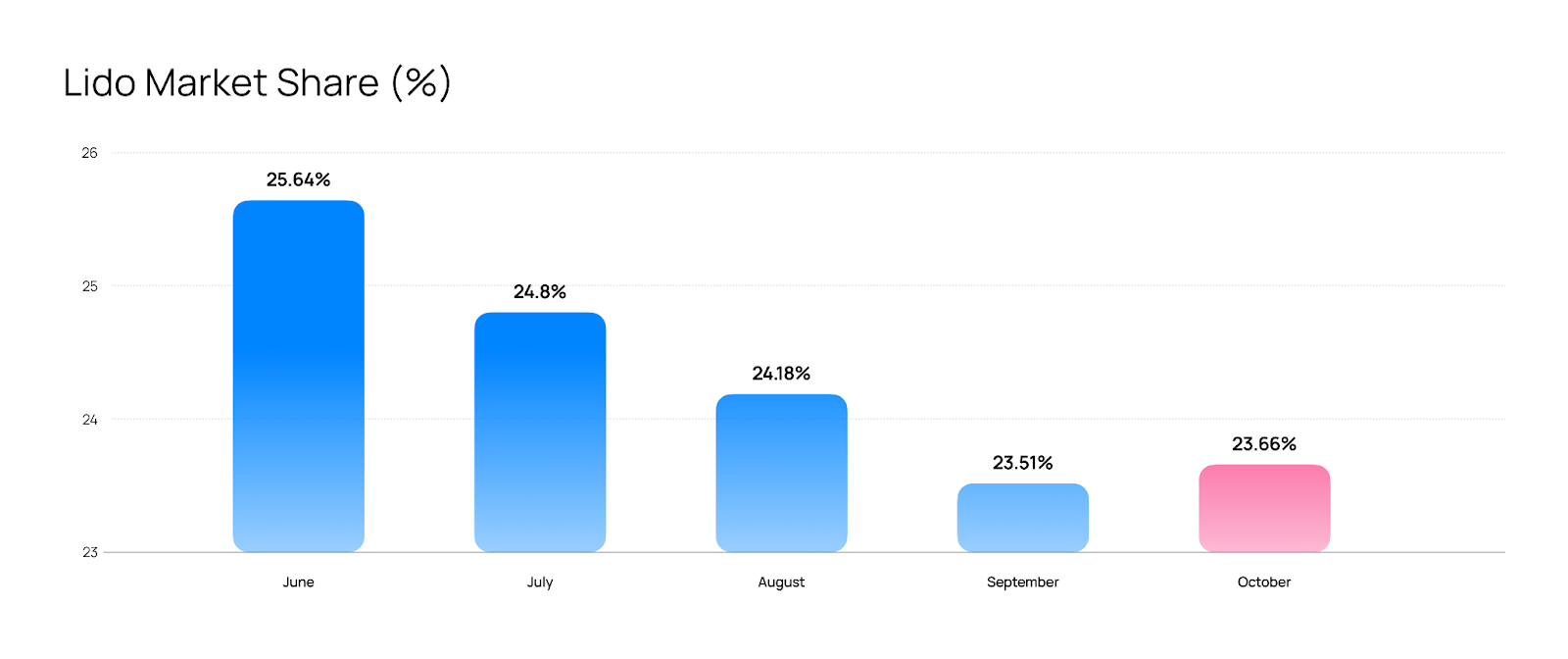
In Q3, Lido protocol’s portion of staked ETH maintained its leading position with 23.7%, despite increased competition from centralized exchanges (Coinbase, Binance, and Kraken) and staking providers servicing large institutional stakers. The rest of the ecosystem saw a contraction: a key driver was deleveraging, when funds running delta‑neutral strategies cut exposure on both the long side (liquid or illiquid staking) and the stablecoin side.

Over the quarter, Lido protocol’s share declined (-1.0pp compared to Q2), but went back onto the growth trajectory at the beginning of Q4.
Lido Protocol: Market Segments
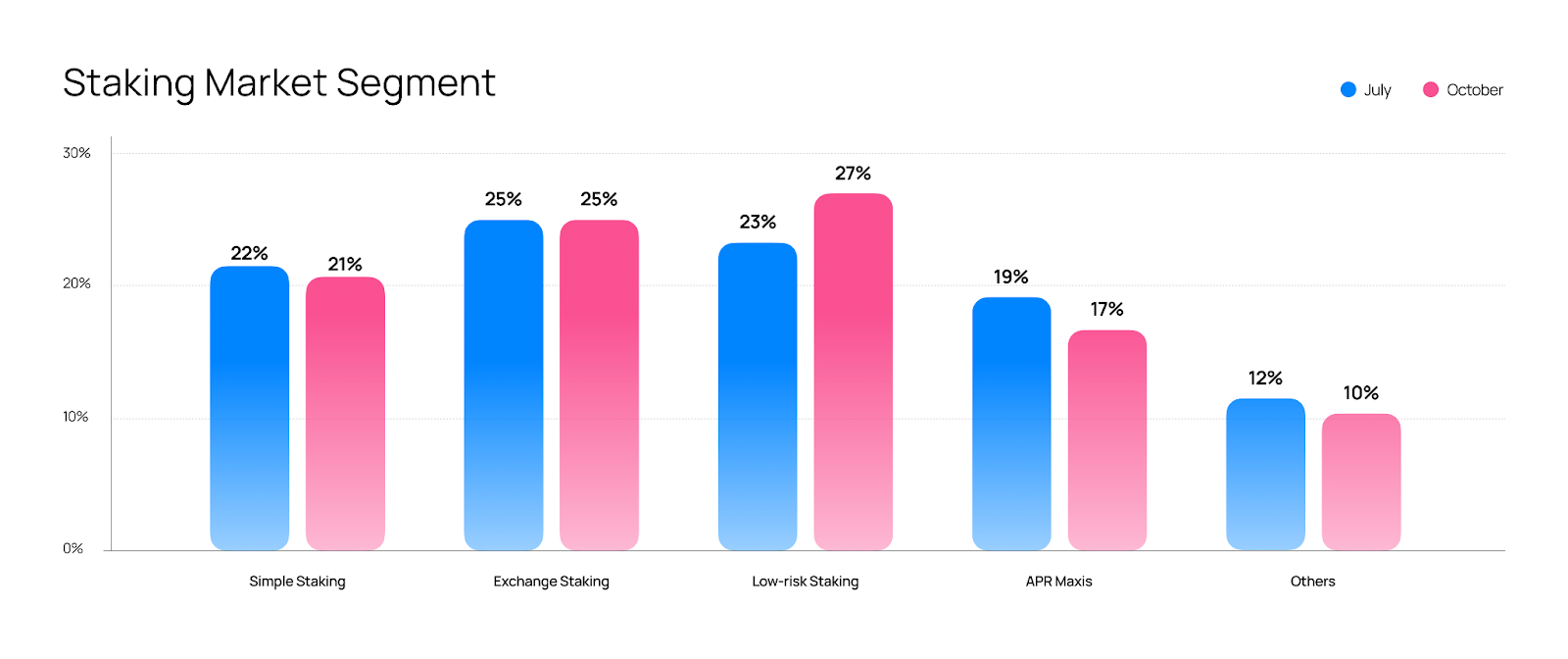
From the Lido protocol’s perspective, the Ethereum staking market can be divided into five main segments:
- Simple liquid staking — traditional liquid staking without added layers or leverage (e.g., stETH by Lido, RETH by Rocket Pool). Users deposit ETH and receive a liquid staking token in return. This segment declined by one percentage point as some funds reduced their delta-neutral strategies and exposure.
- Exchange staking — staking through centralized exchanges such as Binance, Coinbase, or Kraken. These custodial products keep users’ ETH offchain, meaning it generally can’t be utilized in DeFi. The segment’s overall share remained stable through the quarter.
- Low-risk staking — delegated or self-staking, typically preferred by institutional stakers, custodians, and funds. This generally involves larger deposits, lower staking rewards, and illiquidity, as ETH is locked in staking. This segment grew by roughly 4pp, driven by the entry of more institutional players and treasury managers.
- APR Maxis — high-complexity strategies like restaking and leveraged staking, that aim to amplify rewards through additional mechanisms (e.g., Ether.fi, StakeWise). The segment contracted slightly as DeFi deleveraging continued, but Lido protocol’s participation within this segment rose due to the introduction of new products, such as Lido Earn and integrated vault strategies.
- Other/uncategorized — smaller or unidentified setups, such as bespoke institutional products or non-pooled staking.
Lido Protocol: Share by Segment
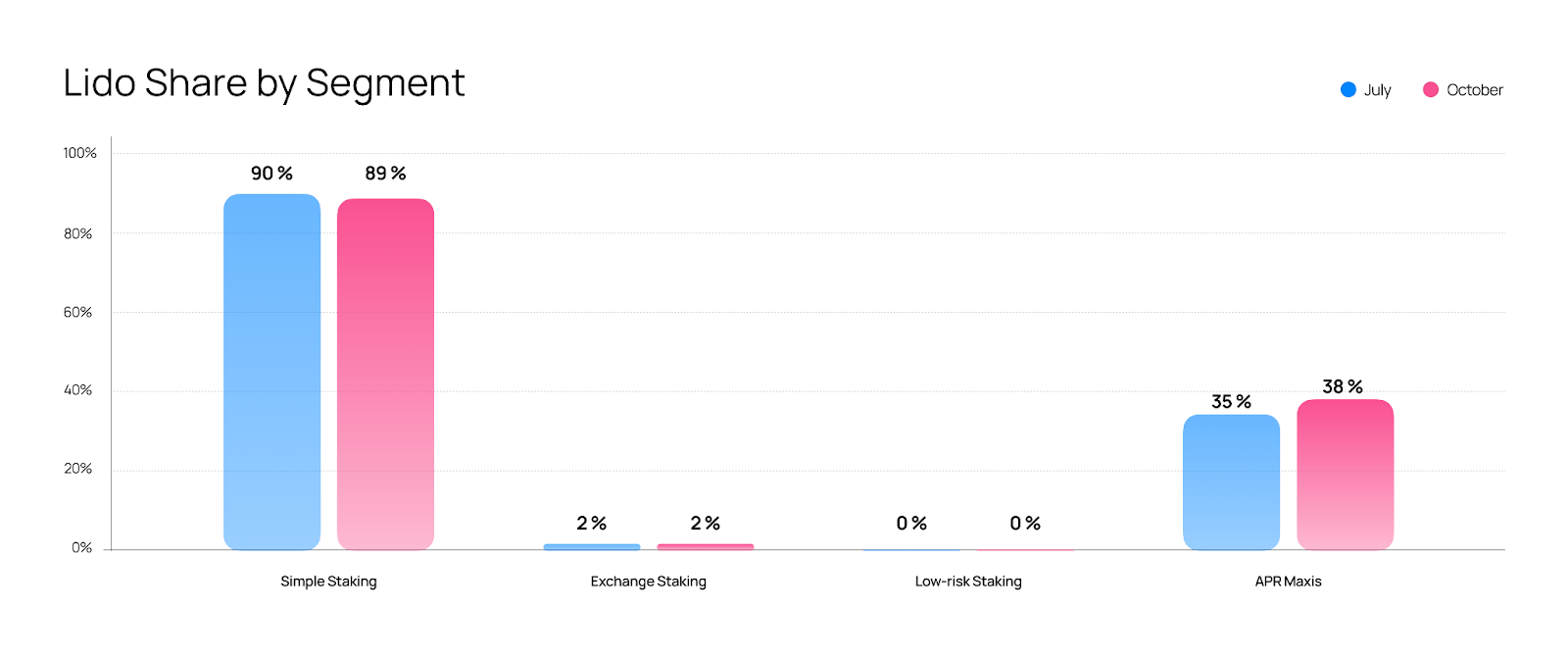
Lido participation across staking segments remained largely stable over Q2–Q3 2025. The protocol continues to have a strong presence in the simple liquid staking category, maintains a limited role in exchange-based staking, has no participation in low-risk staking, and shows a slight increase in activity within higher-complexity strategy segments, influenced partially by recent integrations.
Simple Liquid Staking
This segment represents around 21% of the total Ethereum staking ecosystem. The participation of the Lido protocol within this segment is around 89%, reflecting a stable presence. The recent one-percentage-point reduction in share was primarily driven by withdrawals, rather than by competitive pressure.
Important updates:
- Community Staking Module v2 upgrade launched in October. It enables more independent operators to participate in Ethereum validation through the optional Identified Community Staker (ICS) framework and introduces improvements aimed at enhancing the module’s security, efficiency, and decentralization. The introduction of the new Node Operator reward structure allowed for an increase in the portion of staking rewards flowing to the DAO to ~6%, as only CSM operators with Identified Community Staker status are eligible for the enhanced rewards.
- A proposal to adjust the fee structure for Node Operators in the Curated Module has been published, given increasing competition in the staking market and in light of proposed changes that will be brought by Staking Router v3 and Curated Module v2. The latter should allow transition from a fixed operator fee model to a dynamic, market-based routing system.
- Based on current calculations, the revised structure is anticipated to generate an additional 2,600 ETH yearly in protocol-rewards in 2026*. This actual outcome may vary based on validator performance, overall network and market conditions.
* Please note that the projection above has been updated from the one presented during the Lido Poolside call to reflect refined estimates and current market conditions.
Exchange Staking
This segment accounts for around 25% of the market, with Lido protocol accounting for a modest 2%. It still remains challenging for decentralized protocols to access this segment, primarily due to custodial constraints and regulatory barriers that limit integration with 3rd-party products.
Low-Risk Staking
The Lido protocol currently has no direct participation in this segment, though there is early traction through ongoing discussions with custodians.
Key Enabler for GrowthThe launch of Lido V3 should mark a breakthrough for the Lido protocol's entry into the low-risk staking segment, offering instant liquidity on demand for delegated staking, which is a significant improvement in utility over regular delegated staking. This approach combines liquidity with optional access to DeFi applications and their rewards, as well as participation in certain traditional finance platforms through the ability to use the liquid component of staked ETH within borrowing mechanisms offered by third parties.
Several leading node operators—Solstice, Chorus One, Everstake, and P2P—are already developing solutions utilizing stVaults’ design. On top of that, Linea has integrated stVaults for Native Yield, a new protocol mechanism that enables automatic, directly integrated Ethereum staking rewards.
Another development is in the ETP and ETF space, where VanEck’s stETH ETF filing is currently under review in the U.S.
APR Maxis
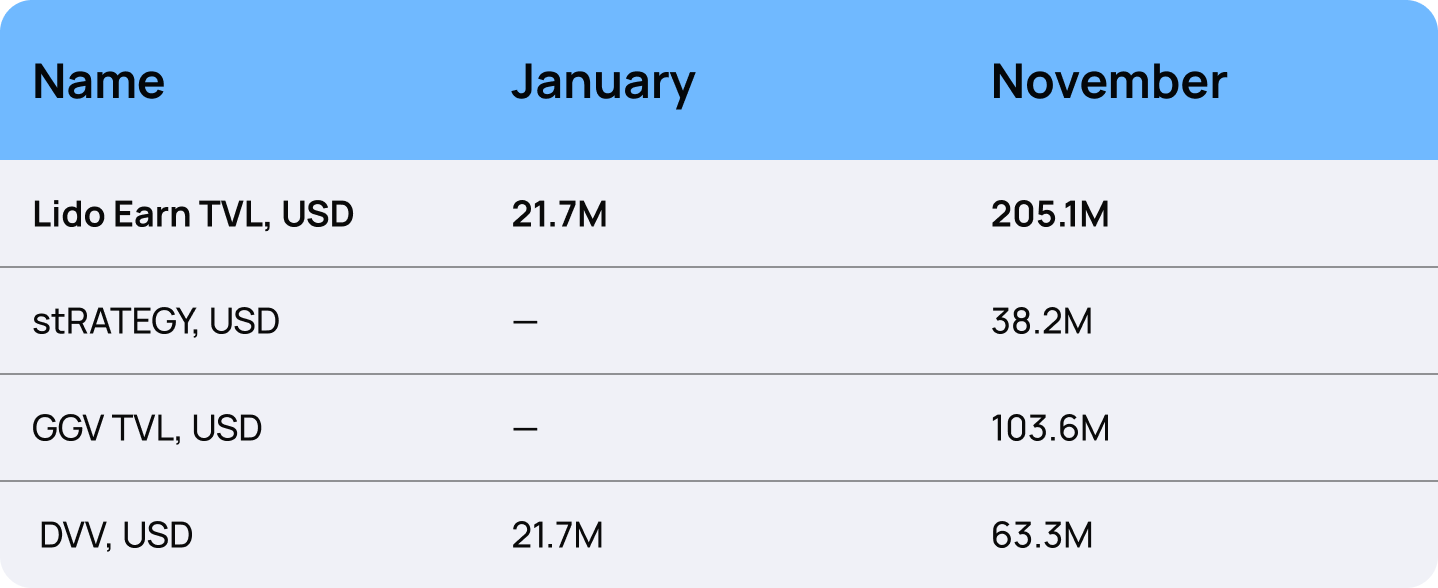
This segment represents approximately 17% of the total market. The participation of the Lido protocol within this segment is about 38%, which includes roughly 22% leveraged staking, 15% restaking collateral, and 1% related to Lido Earn activity, which expanded from $21.7 million in January to $205.1 million in November 2025. For more details, refer to the respective Dune dashboards.
This increase aligned with the launch of GGV and stRATEGY Vaults, reflecting the interest from users in the higher-complexity integrations. Overall, Lido Earn’s activity contributed to an estimated 3–5% increase in the DAO revenue.
Financial Update
Lido Protocol: Operational Model
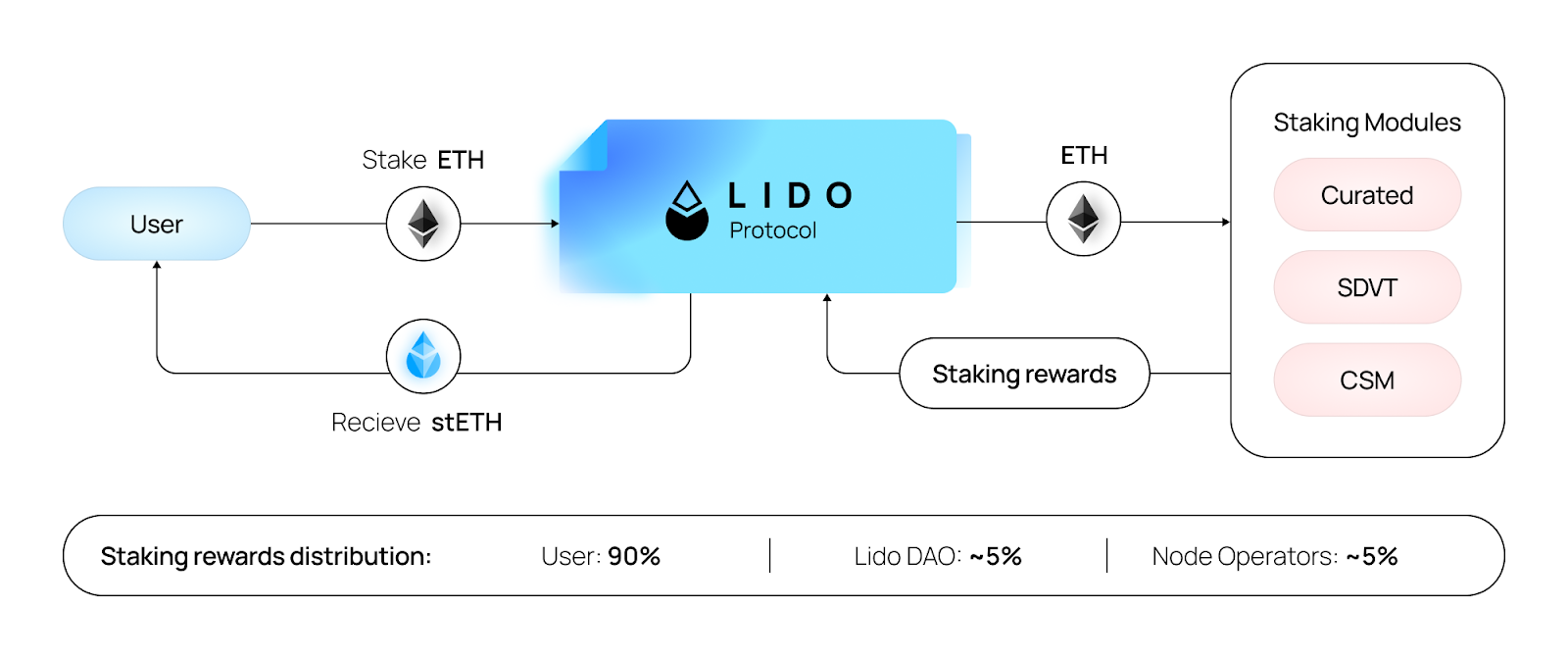
The Lido protocol’s core operational model remains unchanged. Users deposit ETH into the Lido protocol and receive stETH (staked ETH) in return, a liquid token that can be utilized across the broad DeFi ecosystem.
ETH is allocated through the Staking Router into various Staking Modules.
Ethereum staking rewards flow back to the Lido protocol, with 90% distributed to stakers, approximately 5% (depending on the Staking Module) allocated to Node Operators, and the remainder directed to the Lido DAO Treasury.
Financial Position: Q1 - Q3 2025
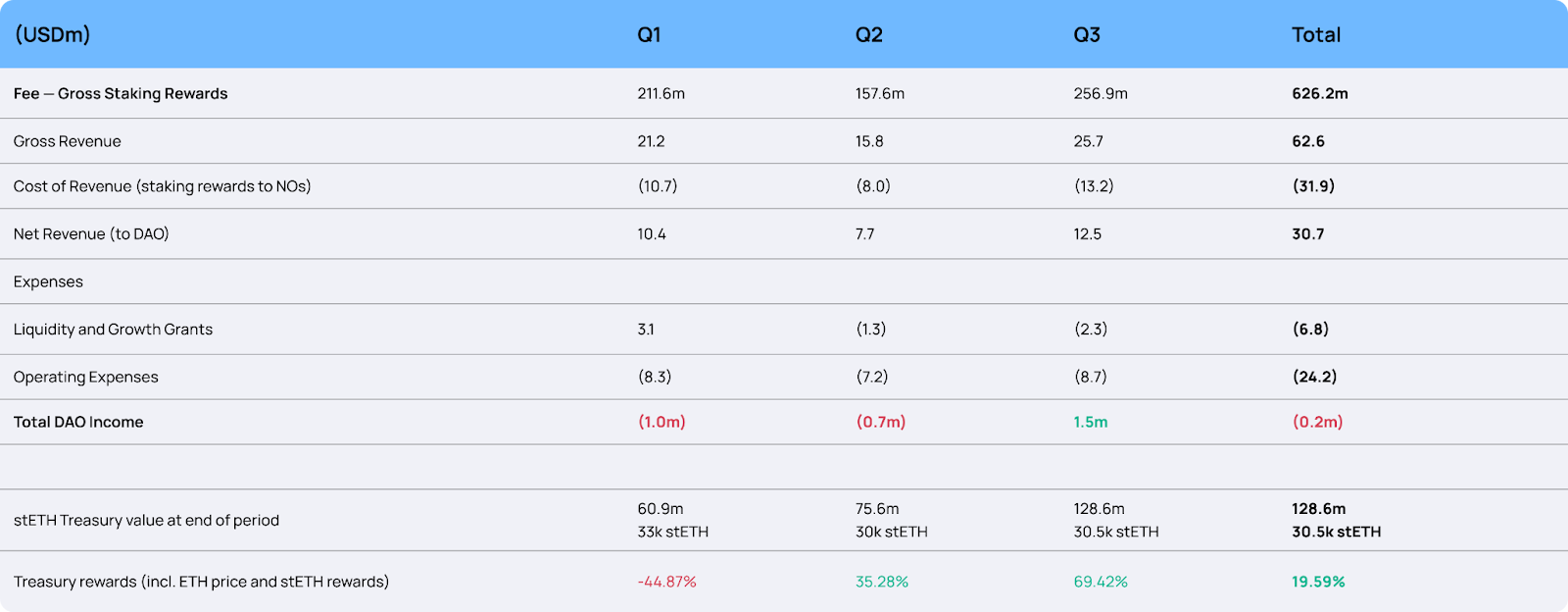
During Q3, the Lido DAO maintained a positive treasury position, with overall Lido Labs, Ecosystem, and Alliance expenses remaining on track with the approved annual target budget:
- Base: $31M
- Growth and liquidity: 10–15% of DAO treasury (~$17M)
For detailed information, refer to the Lido Protocol Economic Reports.
LDO Buybacks
A new buyback framework has been proposed on the Research Forum for community discussion. The framework outlines a mechanism to automate buybacks and pair LDO with wstETH in a liquidity position owned by the Aragon Agent, which should remove LDO from circulation, deepen on-chain liquidity, and generate liquidity fees for the Lido DAO.
The parameters proposed to trigger the buyback mechanism:
- ETH price above $3,000
- DAO revenue >$40M USD
- Distribution: 50% of treasury inflows
- Up to 2% price impact
- $10M on a rolling 12-month basis
If deployed today, and under current conditions (ETH at ~$3,500, annualized DAO revenue ~$45M), this mechanism would meet activation criteria.
This framework proposes a flexible and transparent system that operates only under favorable ecosystem, protocol funds and revenue conditions, and is designed to support Lido DAO sustainability while supporting long-term LDO token value accrual.
The mechanism and parameters are open for community feedback — visit the Research Forum to join the discussion.
Strategic Outlook 2026
Upcoming Goal-Setting Proposal
The Guided Open Objective Setting Exercise (GOOSE) framework sets one- and three-year goals aligned with the DAO’s mission and vision. Anyone can submit a proposal, which is then voted on by tokenholders and executed under DAO mandate.The next GOOSE-3 proposes Lido DAO’s organizational and product priorities for 2026. Coming at the end of November, this proposal focuses on consolidating the Lido protocol’s position within Ethereum’s staking ecosystem while expanding its product scope beyond staking.
Leading With Staking
Lido core product — liquid ETH staking — remains foundational. With major milestones such as Dual Governance and Community Staking Module v2 implemented in 2025, the Lido protocol continues to advance the community’s mission of making staking simple, secure, and decentralized. While maintaining it remains an evergreen priority, there’s not much left to improve it radically.
The next stage of focus lies in broadening the Lido protocol’s reach across staking segments and expanding the ecosystem around liquid staking through adjacent products:
- Lido V3 stVaults: Modular staking infrastructure allowing custodians, L2s, and Node Operators to build custom products on stETH liquidity. Target (subject to market conditions, operational performance, and other factors):
- +1M ETH staked via stVaults by end-2026*
- ~1,000 ETH of additional annual revenue* directed to the DAO, with final outcomes dependent on network conditions and validator performance.
- Lido Staking in ETPs: Initiatives involving the use of stETH within ETP products, which may broaden institutional access to decentralized staking participation by providing additional exposure to stETH.
- Lido Core Upgrades (CMv2, SRv3, ValMart): Turning the protocol stake allocation into a market-responsive system, where stake flows dynamically among Node Operators based on performance, fee curve, decentralization efforts, etc. Target:
- ~2,600 ETH in annual revenue* directed to the DAO, subject to variability based on market and operational conditions.
These initiatives are intended to support the protocol’s leading position in liquid staking while extending its reach to institutional and custodial integrations.
* Please note that the projections above have been updated from the ones presented during the Lido Poolside call to reflect refined estimates and current market conditions.
Expanding Beyond Staking
Today, the Lido protocol has one major product, stETH, supported by the expansion through Lido V3 and stVaults, and the early activity of Lido Earn. In 2026, the protocol is expected to evolve beyond that by developing new products and continuously innovating not just in staking, but across DeFi and real-world integrations, moving from “staking only” to a wider range of use cases.
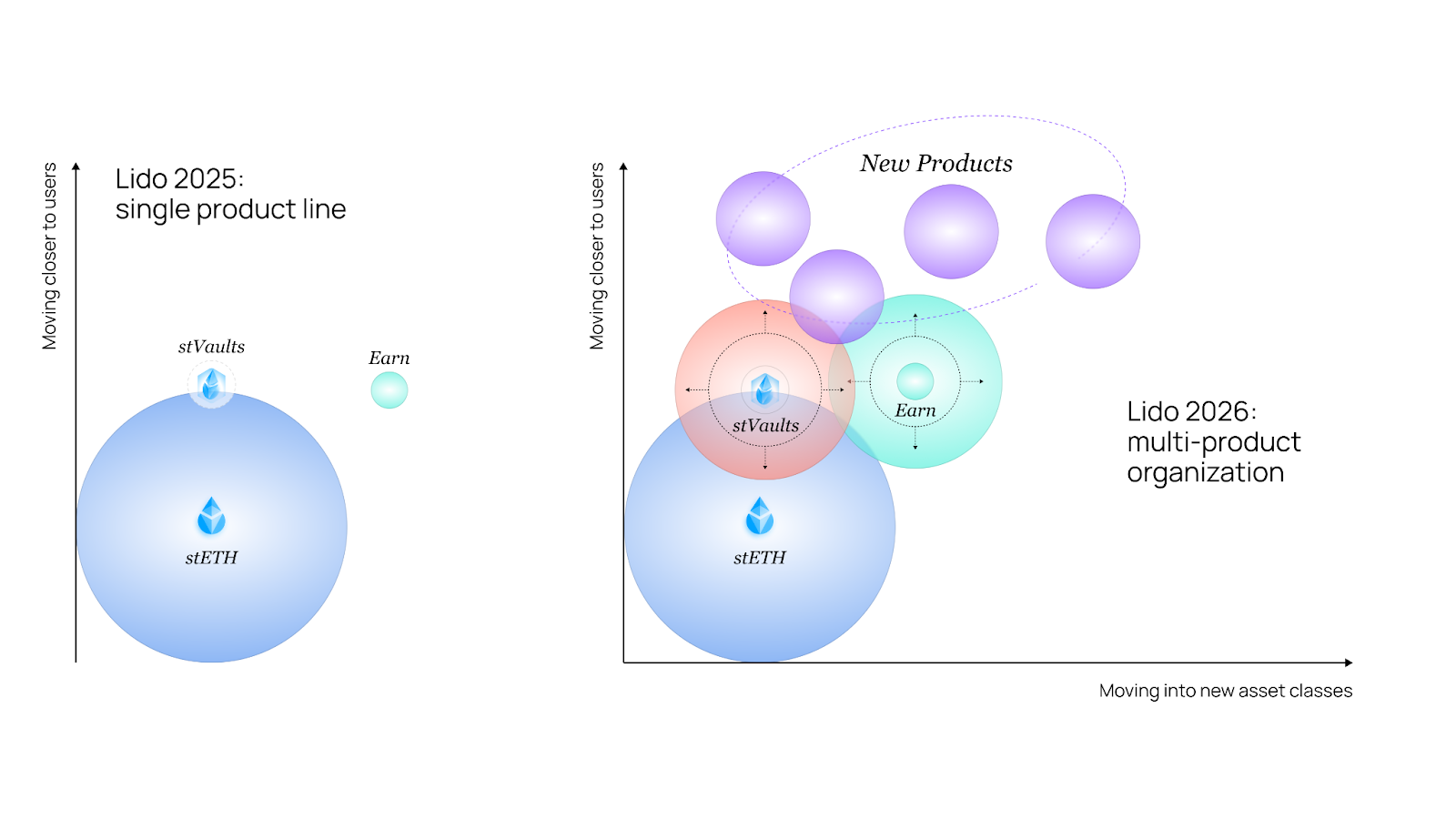
Lido protocol is evolving from a single-product protocol into a multi-product one, leveraging its stETH liquidity, strong presence, and DeFi integrations to move closer to users and businesses.
Web3 is entering a pivotal phase of crypto adoption — moving from the early adopters to the early majority. Today, countless businesses and individuals use blockchains primarily for stablecoin transfers, often without engaging directly in the underlying technical details.
As this trend accelerates, decentralized intermediaries are likely to intersect with a wider range of users, such as businesses, professionals, individuals, and funds. To meet the needs of this expanding user base, the Lido protocol needs to offer more than staking alone.
Q&A Highlights
Given recent issues with unbacked vaults on permissionless platforms like Morpho and Euler, how can Lido V3 ensure stETH remains secure when vaults are issuing tokens against ETH collateral?
- stVaults are designed with conservative reserve ratios — stETH is always overcollateralized, with minting capped at less than 1:1 against ETH collateral.
- The protocol distinguishes permissioned and permissionless vaults, with stricter limits for the latter. Aggregate minting cap from all permissionless vaults is below a protocol safety threshold, that will start small and scale gradually.
- Multiple layers of due diligence are applied to Node Operators, including performance and slashing-risk assessments.
- Security comes first: Lido V3 is undergoing five independent audits conducted by three different auditors, as well as thorough internal reviews and the Bug Bounty competition.
More on stVaults' design is covered in the proposal.
Will Lido contributors expand liquid staking to other chains (e.g., Solana, Hyperliquid)?
- No immediate plans at this time. Past experiments on Solana, Polygon, Kusama, and Polkadot were discontinued due to fragmented markets and strong chain-specific incumbents.
- Competing effectively across multiple ecosystems requires chain-specific tokens and incentives, which can dilute current focus.
- Ethereum remains the primary market for institutional and DeFi staking, and Lido contributors intend to consolidate its leading position there before re-evaluating other cross-chain options.
If CSM v2 is more profitable and better for decentralization, how will Lido Labs increase its share?
- CSM v2 staking rewards are split ~6.5% to the DAO and ~3.5% to Node Operators, resulting in a higher portion of rewards allocated to the DAO compared to the Curated Module Node Operators. However, CSM’s design targets home and community stakers, limiting its scalability relative to professional staking providers.
- The Curated Module v2 will adopt market-driven stake allocation (planned for mid-2026), allowing parameter-based competition among Node Operators with the goal to match or exceed CSM cost efficiency.
- Both staking modules will co-exist to balance decentralization and scalability.
How could ETP/ETFs benefit Lido?
- ETFs and ETPs provide regulated avenues to stake ETH for entities unable to hold digital assets directly.
- Using stETH as the underlying asset allows issuers to provide higher returns on top of liquid staking products for their customers.
- This could lead to dual exposure — traditional treasuries holding both onchain stETH and ETF-wrapped versions — expanding total market reach.
How will Lido Labs compete with custodial staking providers, such as Coinbase or ETF issuers?
- Custodial staking is the immediate next step for institutions, but it operates with some constraints. In contrast, the Lido core product enables the following:
- More of the underlying ETH can be staked;
- Redemptions can use onchain liquidity (stETH) instead of relying solely on withdrawal queues.
- stETH’s onchain liquidity can allow redemptions through secondary market mechanisms to accrue higher rewards and to enable faster redemption flexibility than natively staked custodial ETFs.
- In the long term, DeFi-native composability enables the Lido protocol’s capabilities that ETF structures generally cannot replicate.
What are the highest impact growth items, their expected growth results, and the allocated resources for each?
- Two primary growth vectors:
- stVaults / Lido v3: expanding into the low-risk institutional segment via custodian and L2 integrations.
- Lido Earn: capturing APR Maxis and DeFi-native users through other structured reward-generating products.
- In the short term, most resources are allocated to Lido V3 security and launch; over time, more will shift toward product diversification.
- The DAO plans to incubate smaller, complementary products that expand Lido role across DeFi.
What new products will bring Lido closer to users?
- Lido Earn will expand to include stablecoin-based strategies.
- stVaults will power white-label staking solutions for custodians and institutions.
- Work is also underway on integrated DeFi interfaces and APIs for banks and custodians, improving accessibility for non-crypto-native customers.
How will the success of Lido Earn be measured next year?
- DAO revenue contribution (primary metric).
- Cost efficiency (maintaining sustainable margins).
- Risk-adjusted rewards (prioritizing safe, high-quality strategies).
The goal is to increase the funds flowing to the Lido DAO, without incurring excessive costs or risks.
Further reading
- GOOSE-3 proposal
- GOOSE-2 (year 2025) progress report
- Buyback proposals: framework and technical rails
- Delegate your LDO to always keep your voting power active
For more insights, watch the full session that covers detailed market share analysis, financials, and an extended Q&A session.
▶️ Tokenholder Update call – Full Recording
The next Tokenholder Update will be held at the beginning of 2026. Lido Poolside community calls continue monthly.Subscribe to Luma for updates on upcoming events.
Disclaimer
This material is for informational purposes only and does not constitute investment, legal, tax advice, or any other kind of advice.
No representation or warranty, express or implied, is made as to its accuracy, completeness, or timeliness. Nothing herein should be interpreted as a recommendation or relied upon as a guarantee of any specific outcome, and past performance is not indicative of future results.
Any opinions or forward-looking statements reflect the current judgment of the presenter as of the date of this presentation and are subject to change without notice. Users should conduct their own independent evaluation before making any decisions based on this material.



















