Avail Unveils Nexus Mainnet: A New Era of Seamless Cross-Chain Liquidity Across Ethereum, Solana, EVMs
zycryptoPublished on 2025-11-29Last updated on 2025-11-29

Avail Unveils Nexus Mainnet: A New Era of Seamless Cross-Chain Liquidity Across Ethereum, Solana, EVMs

5
Avail Unveils Nexus Mainnet: A New Era of Seamless Cross-Chain Liquidity Across Ethereum, Solana, EVMs
Advertisement
   

Disclaimer: The below article is sponsored, and the views in it do not represent those of ZyCrypto. Readers should conduct independent research before taking any actions related to the project mentioned in this piece. This article should not be regarded as investment advice.

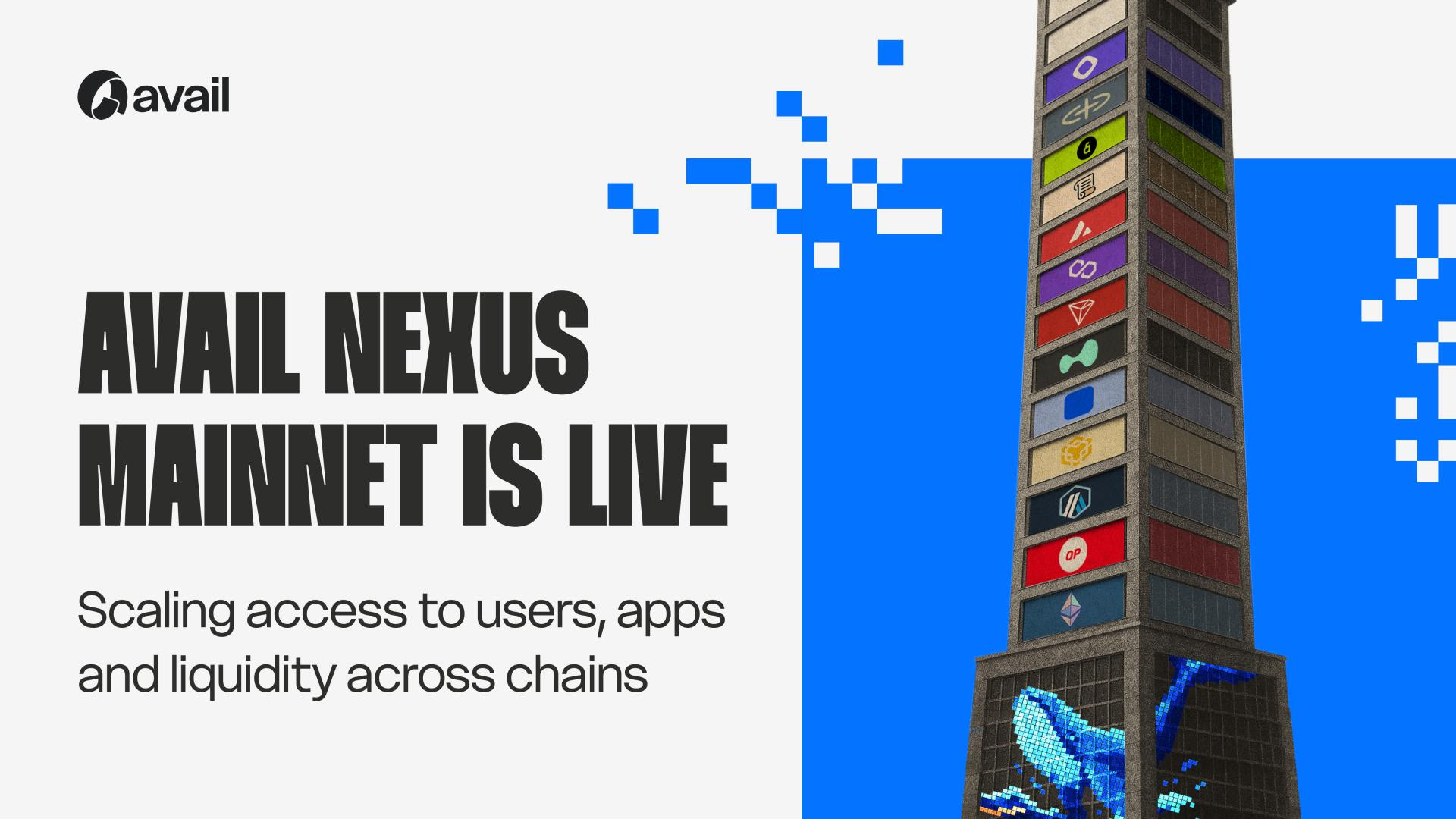
Avail, a pioneering provider of modular blockchain infrastructure, has officially launched the Avail Nexus Mainnet, introducing a new cross-chain coordination layer that seamlessly connects applications, users, and liquidity across leading blockchain networks.

The launch of Nexus Mainnet introduces a large-scale cross-chain system designed to intelligently coordinate liquidity, allowing leading networks such as Ethereum, TRON, Polygon, Base, Arbitrum, Optimism, BNB Chain, Scroll, HyperEVM, Monad, and Kaia to operate together as one unified environment. With this milestone, Avail brings its vision of a connected on-chain world to life, where ecosystems no longer operate in isolation.

Commenting on the launch, Anurag Arjun, Co-Founder of Avail, stated: 

“The current blockchain fragmentation and siloed interactions across ecosystems have limited both the builder and user experience. At Avail, we are transforming how blockchains interact. They can no longer be separate networks passing messages to each other; rather, they should function as integral parts of a unified, verifiable system where assets, users, and intended actions move freely. This fundamental shift, in how apps scale and modular stacks connect to the broader multichain world, is the future.”

AdvertisementFollow ZyCrypto On Google News  

For developers, Nexus provides a unified entry point into the entire on-chain ecosystem. Through a single integration using lightweight SDKs and APIs, builders gain access to real-time shared collateral pools, intent-driven execution, and scalable infrastructure without managing bridges, routers, or costly custom workflows. Combined with Avail’s industry-leading Data Availability (DA) network, currently advancing toward its Infinity Blocks roadmap with targeted block capacities of up to 10 GB, the system delivers a secure, verifiable, and scalable foundation for appchains and applications to grow. The native $AVAIL token operates as the network’s coordination asset and economic driver.

Co-Founder Prabal Banerjee emphasizes that simplifying cross-chain execution will ultimately lead to a more capital-efficient, user-centric ecosystem. By placing complexity at the infrastructure layer, builders are free to focus on innovation and product delivery while liquidity and execution extend seamlessly across all connected chains.

The launch of Nexus arrives with robust ecosystem support across decentralized finance, SocialFi, AI innovation, infrastructure, and cross-chain services. Early partners—including Lens Protocol, Sophon, TRON, Space & Time, Lumia, Validium Network, Vanna Finance, Mace, Clober, Station X, Nexus AI, Bitte.ai, Gummee, Neova, and Symbiotic—are already building or integrating solutions to unlock new, highly composable use cases. These developments include unified collateral management for DeFi, intelligent cross-chain automation, and multi-chain trading strategies that leverage liquidity wherever it resides.

With Mainnet now live, developers can begin integrating directly through the Nexus SDK. At the same time, users will soon gain access to the first “Liquid Apps” designed to showcase the full potential of unified liquidity and cross-chain-enabled execution. Additional chain integrations and ecosystem expansions are planned to roll out steadily in the months ahead.

Avail continues to redefine how users and builders interact with the on-chain world, ensuring accessibility to assets and applications regardless of their network of origin. By connecting the decentralized economy into one cohesive system, Avail is setting the foundation for the next generation of Web3 growth.

About Avail

Avail is a modular blockchain infrastructure provider committed to creating a unified and scalable future for the on-chain economy. By enabling frictionless movement across chains, Avail empowers both users and developers to access the entire decentralized ecosystem from any network.

Founded by early contributors to Polygon and supported by leading global investors, including Founders Fund, Dragonfly, and Cyber Fund, Avail delivers the core technology necessary to overcome fragmentation and accelerate Web3 adoption.




Related Reads

Uncovering the Truth About Agent Commerce, Payments, and Infrastructure

Decoding Agent Commerce, Payments, and Infrastructure: The Reality Over the past year, I've been building infrastructure for the Agent economy, engaging with major players like Stripe, Visa, Coinbase, Google, and dozens of startups. A clear conclusion emerges: true, large-scale demand does not yet exist. Startups face structural challenges. Data points illustrate this gap. Stripe's Agent commerce platform has over 1,000 merchants but only single-digit transacting agents. Visa's Agent payment token requires 9-month KYC and a $250M revenue threshold, accessible only to giants like Amazon. On-chain analysis reveals actual daily Agent transaction volume is around $17k, half of which are test transactions. The article analyzes four potential markets: **1. Agent-to-Merchant (A2M):** Current AI shopping UX is often inferior to traditional e-commerce for visual, comparison-heavy purchases (clothing, electronics). Chat interfaces are a step back. Real merchant interest is defensive "Agent Engine Optimization," fearing future obsolescence, not current demand. Potential exists in high-frequency, low-decision purchases (e.g., food delivery) or simplifying terrible UX (complex checkouts, non-native shoppers), but these require massive consumer distribution channels dominated by giants like DoorDash and Amazon. **2. Agent-to-API (A2A):** Developers already have subscriptions and billing for core APIs (compute, data). The argument for micro-payments via crypto for sub-dollar API calls is addressed by pre-paid balances today. The deeper issue is supplier resistance; major SaaS firms rely on enterprise contracts, not fractional cent pricing. Opportunity lies in the long tail of niche services, but this is a smaller market catering to developers, a historically low-paying group. **3. Agent-to-Agent (A2A):** This remains a theoretical long-term vision with near-zero current transaction volume. It involves unique challenges: discovery, trust, negotiation, dispute resolution. When it materializes, it will require a fundamentally new settlement infrastructure for high-speed, variable-value, multi-party transactions. It's a real long-term bet, but not the current market. **4. Agent-to-Finance (A2F):** This is the only category with existing, paying demand. Integrating AI into financial workflows (trading, portfolio management) is a natural evolution and enables new capabilities like autonomous rebalancing. However, competition favors incumbents with regulatory licenses, compliance infrastructure, and existing client relationships. **The Real Issue:** Why is infrastructure still being built? Incumbents can afford long-term bets, and payment companies see every problem as a nail for their payment hammer. However, payment is just one piece. The core challenge is *coordination*—orchestrating work between Agents and humans, verifying outcomes, and settling results. Payment is part of settlement, which is part of coordination. Companies that solve the coordination problem will subsume payments, not the other way around. Startups lack the infinite runway of giants and must find today's real market, which, after a year of exploration, lies outside these four categories—in an area with real, growing, and underserved activity.

marsbit1h ago

Uncovering the Truth About Agent Commerce, Payments, and Infrastructure

marsbit1h ago

Kalshi, MTS, and a16z's Ambition

The article "Kalshi, MTS, and a16z's Ambition" explores prediction markets as a focal point of excitement in 2025 for investors, crypto enthusiasts, and media. It traces their intellectual lineage from Friedrich Hayek's ideas on dispersed knowledge and market coordination to Robin Hanson's Logarithmic Market Scoring Rule (LMSR), which incentivizes truthful information sharing. The piece argues that a16z's significant investment in prediction market platform Kalshi (valued at $220B) transcends mere financial speculation. a16z frames prediction markets as a new form of "media" that provides "presence"—a way for individuals to actively engage with and influence world events through financial stakes, countering postmodern detachment. By wagering on outcomes, users become "super observers," and the market's aggregated probabilities gain authoritative power to define event truth and importance. The article uses media company MTS ("Monitoring The Situation") as a case study of a16z's "new media" strategy: rapidly producing high-intensity, multi-format content to "take over the timeline." However, prediction markets like Kalshi are presented as the ultimate piece in this media empire. Their real-money, crowd-sourced probabilities possess a unique "reality distortion field" and perceived objectivity, potentially swaying public opinion and granting a private company unprecedented interpretive power over reality. Ultimately, Kalshi's immense valuation is attributed not just to its exchange model, but to its role as a foundational component in a16z's envisioned new media landscape, where prediction markets define narrative and truth.

链捕手1h ago

Kalshi, MTS, and a16z's Ambition

链捕手1h ago

Trading

Spot
Futures

Hot Articles

How to Buy AVAIL

Welcome to HTX.com! We've made purchasing Avail (AVAIL) simple and convenient. Follow our step-by-step guide to embark on your crypto journey.Step 1: Create Your HTX AccountUse your email or phone number to sign up for a free account on HTX. Experience a hassle-free registration journey and unlock all features.Get My AccountStep 2: Go to Buy Crypto and Choose Your Payment MethodCredit/Debit Card: Use your Visa or Mastercard to buy Avail (AVAIL) instantly.Balance: Use funds from your HTX account balance to trade seamlessly.Third Parties: We've added popular payment methods such as Google Pay and Apple Pay to enhance convenience.P2P: Trade directly with other users on HTX.Over-the-Counter (OTC): We offer tailor-made services and competitive exchange rates for traders.Step 3: Store Your Avail (AVAIL)After purchasing your Avail (AVAIL), store it in your HTX account. Alternatively, you can send it elsewhere via blockchain transfer or use it to trade other cryptocurrencies.Step 4: Trade Avail (AVAIL)Easily trade Avail (AVAIL) on HTX's spot market. Simply access your account, select your trading pair, execute your trades, and monitor in real-time. We offer a user-friendly experience for both beginners and seasoned traders.

1.9k Total ViewsPublished 2024.07.23Updated 2026.06.02

How to Buy AVAIL

Discussions

Welcome to the HTX Community. Here, you can stay informed about the latest platform developments and gain access to professional market insights. Users' opinions on the price of AVAIL (AVAIL) are presented below.

活动图片