Wall Street Steps Into Stellar: U.S. Bancorp Partnership Sparks Fresh Momentum for XLM

bitcoinistPublished on 2025-11-27Last updated on 2025-11-27

Abstract

U.S. Bancorp’s entry into the stablecoin arena has injected fresh excitement into the Stellar ecosystem, marking a significant shift as...

Trusted Editorial content, reviewed by leading industry experts and seasoned editors. Ad Disclosure

U.S. Bancorp’s entry into the stablecoin arena has injected fresh excitement into the Stellar ecosystem, marking a significant shift as major financial institutions begin leveraging public blockchains for real-world money movement.

Related Reading: Hoskinson Claims Cardano Revival Starts Now: Here’s What’s Coming

The fifth-largest U.S. bank is piloting a dollar-backed stablecoin on Stellar, an initiative that could accelerate institutional adoption and strengthen market confidence in XLM heading into year-end.
Stellar XLM XLMUSD XLM price

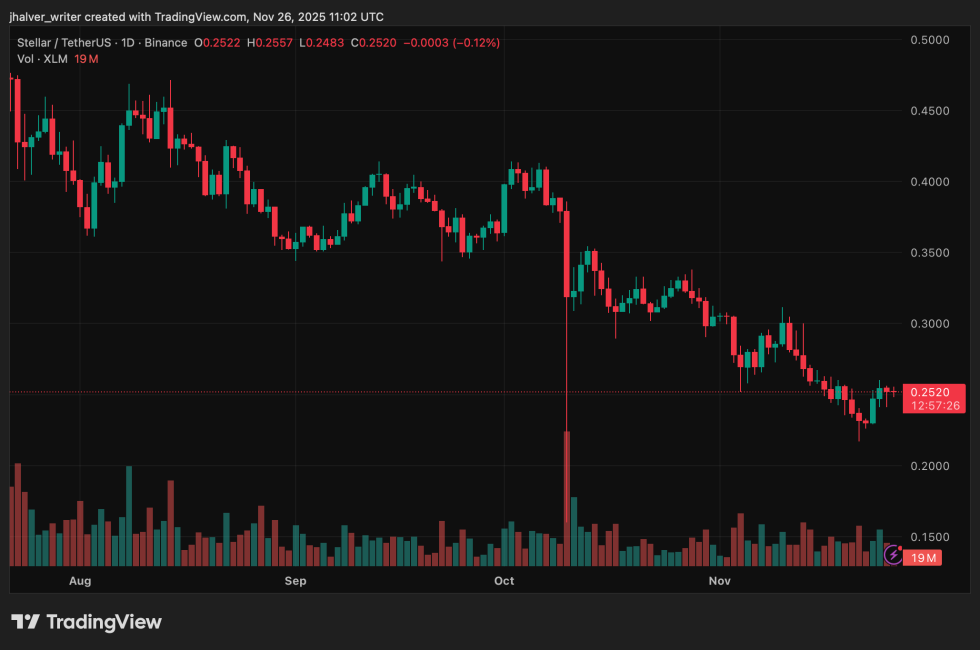
XLM's price trends to the downside on the daily chart. Source: XLMUSD on Tradingview

U.S. Bancorp Selects Stellar for Bank-Grade Stablecoin Infrastructure

The Minneapolis-based banking giant has partnered with PwC and the Stellar Development Foundation (SDF) to test programmable deposits and stablecoin payments on Stellar’s public blockchain.

What sets Stellar apart, according to U.S. Bank’s digital assets head Mike Villano, is its built-in ability to freeze assets, unwind transactions, and enforce compliance at the protocol level.

These capabilities are essential for regulated banks that must adhere to KYC, AML, and consumer protection standards. Unlike traditional “business logic” solutions, Stellar offers these controls directly at the blockchain layer, giving banks the confidence needed to explore tokenized finance.

The pilot arrives amid a resurgence of institutional interest. Banks, including Citi, Goldman Sachs, and Bank of America, have begun designing stablecoin frameworks. U.S. Bank recently relaunched its digital assets division to tap into opportunities in custody, tokenisation, and blockchain-based payments.

Institutional Momentum Could Drive Mainstream Stablecoin Adoption

If successful, U.S. Bancorp’s trial could pave the way for fully regulated, deposit-backed stablecoins issued directly by banks, unlocking new efficiencies for cross-border transfers, treasury operations, and global settlements.

With projections suggesting that stablecoin payments could reach $1 trillion annually by 2030, banks are racing to claim their share of the digital payments market.

Stellar’s high uptime, low-cost settlement, and remittance-focused architecture make it an appealing choice for real-world financial applications. As institutions embrace public blockchains, Stellar stands positioned as one of the few networks offering both decentralization and the regulatory controls banks require.

XLM Price Outlook: Analyst Targets Signal 24–36% Upside

The U.S. Bancorp announcement has arrived at a pivotal time for Stellar’s native token, XLM. Trading near $0.25, the asset is showing early signs of bullish momentum, supported by:

  • MACD bullish divergence
  • Neutral RSI at 42, offering room to climb
  • Price sitting on 20-EMA support
  • Breakout potential above $0.28–$0.31

Analysts expect XLM to target the $0.31–$0.34 range within the next 2–4 weeks, a potential 24–36% upside, if volume expands and the broader crypto market remains stable. A break below $0.22 would invalidate the bullish thesis.

Related Reading: South Korea Risks Stablecoin Legislation Delay As Financial Authorities Clash With BOK

As Wall Street experiments with Stellar’s blockchain, institutional utility could become a significant driver for XLM’s long-term valuation. With new banking-grade use cases emerging, Stellar’s relevance in the digital-asset ecosystem continues to grow, positioning XLM for potential year-end strength.

Cover image from ChatGPT, XLMUSD chart from Tradingview

Editorial Process for bitcoinist is centered on delivering thoroughly researched, accurate, and unbiased content. We uphold strict sourcing standards, and each page undergoes diligent review by our team of top technology experts and seasoned editors. This process ensures the integrity, relevance, and value of our content for our readers.

Trending Cryptos

Related Reads

Robert Kiyosaki Shares His Mentor's Predictions About the Emergence of Bitcoin and AI

American entrepreneur and author of "Rich Dad Poor Dad," Robert Kiyosaki, discussed the influence of futurist R. Buckminster Fuller on his worldview, linking Fuller's past technological predictions to the emergence of Bitcoin and the development of artificial intelligence. In an X post, Kiyosaki also reflected on personal purpose, sharing his journey from the music business—where he worked with bands like The Police and Iron Maiden—to creating the "Cashflow" board game and writing his famous book. He described feeling an inner emptiness despite his success, a turning point that came after meeting Fuller, whom he studied with for three summers. Kiyosaki described Fuller as a "friendly genius" who foresaw world-changing developments like Bitcoin and AI. However, the core of his post focused on Fuller's philosophical impact, particularly a quote about belonging to the universe and finding purpose by dedicating one's life to the maximum benefit of others. The entrepreneur remains a vocal advocate for cryptocurrencies. He regularly advises buying Bitcoin during market panics, viewing it and assets like Ethereum, gold, and silver as hedges against traditional financial system failures. Kiyosaki has predicted a major market crash by 2026, seeing it as an opportunity for prepared investors, with long-term price targets including $750,000 for Bitcoin and $95,000 for Ethereum.

cryptonews.ru23m ago

Robert Kiyosaki Shares His Mentor's Predictions About the Emergence of Bitcoin and AI

cryptonews.ru23m ago

Etherealize CEO Calls Wall Street's Private Blockchains a 'Race to the Bottom'

Etherealize co-founder and CEO Vivek Raman criticized Wall Street's growing interest in private, permissioned blockchains, calling them a "race to the bottom." In an interview with CoinDesk, Raman argued that consortium networks fragment liquidity and return the industry to the siloed systems that blockchain technology was meant to overcome. He stated that closed networks do not interoperate, undermining two key advantages of the technology: system compatibility and liquidity concentration. Etherealize promotes Ethereum as an open, foundational layer for institutional players. Raman insists that privacy and access restrictions should be built on top of public infrastructure—at the application or L2 level—rather than creating separate, closed networks. He compared Ethereum to HTTP as a base layer, with additional permissioned and private layers akin to HTTPS. Examples of this new wave of "closed" solutions mentioned include Canton Network from Digital Asset, Circle's Arc project, and Stripe's Tempo. Raman termed this trend "consortium chains 2.0," recalling earlier initiatives like the R3 interbank consortium and the Hyperledger corporate ecosystem from 2016 that failed to gain significant traction. He reiterated his firm belief that a global, open, permissionless infrastructure is necessary as a foundational base layer. Raman previously noted in June that traditional financial institutions had begun implementing Ethereum-based solutions into real business processes.

cryptonews.ru25m ago

Etherealize CEO Calls Wall Street's Private Blockchains a 'Race to the Bottom'

cryptonews.ru25m ago

Trading

Spot

Hot Articles

Discussions

Welcome to the HTX Community. Here, you can stay informed about the latest platform developments and gain access to professional market insights. Users' opinions on the price of S (S) are presented below.

活动图片