Артур Хэйес допустил падение биткоина к $80 000–$85 000 из-за признаков кредитного кризиса

cryptonews.ruPublished on 2025-04-17Last updated on 2025-11-18

Биткоин вполне может упасть до $80 000–85 000, а в случае синхронного обвала рынков взлететь до $200 000 или даже до $250 000, если власти США «ускорят свои махинации». Об этом заявил соучредитель BitMEX Артур Хэйес.

В новом эссе эксперт объяснил падение биткоина (BTC) со $125 000 до $90 000 на фоне умеренной слабости индексов S&P 500 и Nasdaq 100 вблизи исторических максимумов формированием кредитного кризиса. Он сослался на снижение индекса долларовой ликвидности с июля на $1 трлн.
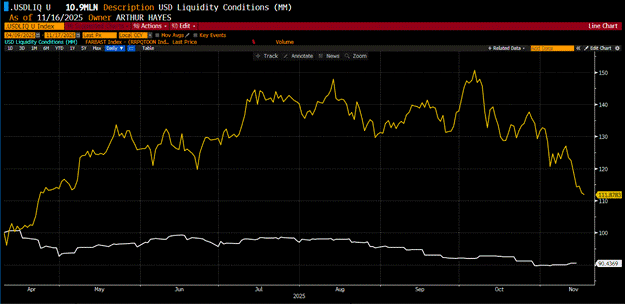
Источник: Артур Хэйес.

По теме: Артур Хэйес назвал дефицит бюджета во Франции драйвером роста биткоина

Когда разворот?

По мнению Хэйеса, коррекции на 10–20% в сочетании с подъемом доходности 10-летних гособлигаций к 5% станут основанием для срочной реализации схемы «печатания денег» Федрезервом, Казначейством или другим государственным агентством США.

Пока к этому в Вашингтоне не готовы. Сигналом изменения позиции могут стать «инсайды» на страницах The Wall Street Journal колумниста Ника Тимираоса, который освещает вопросы монетарной политики.

«Быки правы: со временем денежный сделает brrr. Но сначала активы должны отыграть апрельский рост, чтобы лучше соответствовать фундаментальным индикаторам ликвидности. Биткоин и некоторые шиткоины обновят рекорды только после того, как рынки достаточно „стошнит“, чтобы ускорить темпы печатания денег», — пояснил Хэйес.

Специалист напомнил, что с 1 декабря американский ЦБ прекратит продажу гособлигаций с баланса, а Казначейство США после прекращения шатдауна вскоре достигнет целевого показателя своего счета в Федрезерве в $850 млрд, что нормализует объем ликвидности в системе.

По теме: Артур Хэйес связал экономические меры нового премьера Японии с ростом биткоина до $1 млн

Помощь со стороны Китая

Эксперт также ожидает поддержки со стороны Китая, власти которой «нажмут на курок» после аналогичных действий геополитического оппонента. В настоящий момент препятствием этому выступают опасения укрепления юаня, если Пекин решится на стимулирование в одностороннем порядке.

Сооснователь BitMEX отметил реакцию в КНР на «кражу» правоохранительными органами США первой криптовалюты у гражданина Китая. По мнению Хэйеса, очевидно, что лидер страны Си Цзиньпин считает цифровое золото ценным активом.

«Если и Трамп, и Си Цзиньпин, лидеры двух крупнейших экономик мира, верят в ценность биткоина, почему вы не настроены оптимистично в долгосрочной перспективе?», — заключил специалист.

По теме: шатдаун позади. Что реанимирует рынок криптовалют?

Related Reads

Deep Insight: Decentralized Inference is Not Hype, but a Key Track for AI to Break Through Centralized Monopoly

Decentralized Reasoning: Beyond the Hype, a Key to Breaking AI's Centralized Monopoly A future scenario where a powerful AI model is banned by a major government illustrates the core value proposition of decentralized AI: resistance to censorship. The core bet of decentralized inference networks is mitigating this risk, with other benefits like cost being secondary. The path is extremely difficult, involving four key challenges: 1. **Running Massive Models:** Distributing a single model across a decentralized GPU swarm requires sophisticated techniques like pipeline and speculative decoding to overcome crippling network latency, aiming for usable speeds (e.g., 30-40 tokens/second). 2. **Proving Model Integrity:** Verifying that a node runs the correct model is critical. Solutions range from cryptographically secure but slow ZKML to faster, economically-secure methods like statistical fingerprints, deterministic re-execution, or live-weight proofs, each involving trade-offs between integrity, latency, and cost. 3. **Ensuring Prompt Privacy:** Simply sharding a model does not protect user inputs from nodes. Robust solutions currently require trusted hardware (TEEs) or advanced cryptography (FHE), which are not yet widely deployed in consumer swarms. 4. **Building a Real Market:** Identifying the ideal customer is tough. Beyond speculative AI agents, the viable market currently consists of startups embedding AI and projects needing batch processing (e.g., synthetic data generation), where decentralized aggregation can be an advantage over low-latency needs. The article analyzes several projects tackling these problems, such as Dolphin Network (live-weight proofs), Inference.net (statistical verification), Morpheus (TEE-based), and Darkbloom (Apple Secure Enclave). It provides a framework: decentralization is a "tax" for latency-sensitive applications (e.g., chat) but a potential supply-side advantage for throughput-oriented tasks (e.g., batch processing). The long-term vision is a closed data loop where decentralized inference generates valuable data (traces, preferences) to feed decentralized training networks, which in turn produce better open-weight models for the inference networks. A due diligence checklist advises focusing on projects that: are truly decentralized at specific layers; have a credible integrity method; offer real cost benefits; ensure genuine privacy; handle node reliability; have paying users; and are built by teams with deep AI expertise. The ultimate goal should be products that appeal beyond the crypto-native audience, using crypto mechanisms invisibly to deliver better cost, performance, or privacy.

Foresight News28m ago

Deep Insight: Decentralized Inference is Not Hype, but a Key Track for AI to Break Through Centralized Monopoly

Foresight News28m ago

The Final Piece of Franklin Templeton's Crypto Ambition

Franklin Templeton Completes Crypto Ambition with Acquisition of 250 Digital On June 22, Franklin Templeton announced the acquisition of 250 Digital and established Franklin Crypto, a new division focused on actively managed cryptocurrency strategies for institutional investors. The unit is led by Christopher Perkins and Seth Ginns. This acquisition marks a key piece in Franklin Templeton's multi-year crypto strategy, which began in 2018 with a digital assets team. The firm's crypto product suite now spans three layers: tokenized funds like the blockchain-based money market fund BENJI (~$831M AUM); a series of passive ETFs including Bitcoin (EZBC, ~$368M), Ethereum (EZET), XRP (XRPZ, ~$252M), Solana (SOEZ), and a multi-crypto index fund (EZPZ); and the newly added active management strategies from Franklin Crypto. The company has also expanded its crypto ecosystem through investments in projects like Ethena and Crossmint, and collaborations with blockchains such as Aptos and Sui. With approximately $18B in digital asset AUM and a total firm AUM of ~$1.78T, Franklin Templeton is positioning itself as a comprehensive crypto asset manager for pensions and sovereign wealth funds. In contrast, competitor Fidelity Investments has taken a different path, focusing early on building its own custody and trading infrastructure. Fidelity's Bitcoin ETF (FBTC) holds over $11B, significantly larger than Franklin Templeton's equivalent offering. Both giants' moves underscore the deepening trend of traditional finance entering the crypto space.

Foresight News52m ago

The Final Piece of Franklin Templeton's Crypto Ambition

Foresight News52m ago

Trading

Spot
Futures
活动图片