Solana Foundation Exec Slams XRP Hype: ‘Show Me the Data’

bitcoinistPublished on 2025-11-03Last updated on 2025-11-03

Abstract

Solana Foundation executive Vibhu Norby ignited a fresh round of cross-ecosystem debate this weekend, challenging XRP supporters to ground their...

Trusted Editorial content, reviewed by leading industry experts and seasoned editors. Ad Disclosure

Solana Foundation executive Vibhu Norby ignited a fresh round of cross-ecosystem debate this weekend, challenging XRP supporters to ground their bullish narratives in verifiable network metrics rather than aspiration. In a series of posts on X, Norby said he “want[s] Ripple and XRP to succeed at an insane degree,” but argued that “the community does not argue with facts, even though the data is readily available.” He added: “as a longtime engineer and truth seeker, that bothers me.”

Norby Says XRP Growth Stalled

The core claim is that—measured by on-chain activity—the XRP Ledger’s growth has been “extremely mediocre” relative to faster-growing chains, most notably Solana. Citing XRPScan, he said the “active daily accounts shows no 3-year improvement, hovering around 25,000 daily active accounts,” while “this year, Solana is averaging over 2.5 million daily active accounts. That’s 100x.” Short of debating sentiment or distant roadmaps, he framed the discussion as empirical: “The fiction is very far ahead of the facts.”
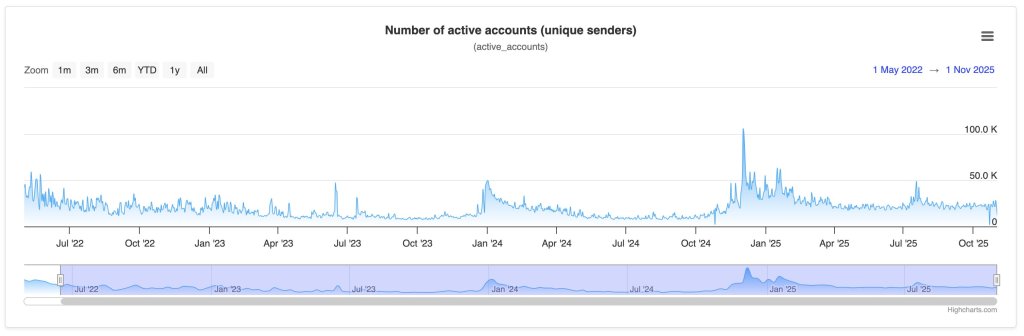
Number of active XRP Ledger accounts
Number of active accounts | Source: X @vibhu

The activity gap was a through-line in Norby’s posts. On throughput, he pointed to XRP’s roughly 1–1.5 million daily transactions and contrasted that with Solana’s order-of-magnitude higher traffic: “the total daily transactions, around 1.5 million per day, is outclassed by Solana which is handling about 100 million per day.”
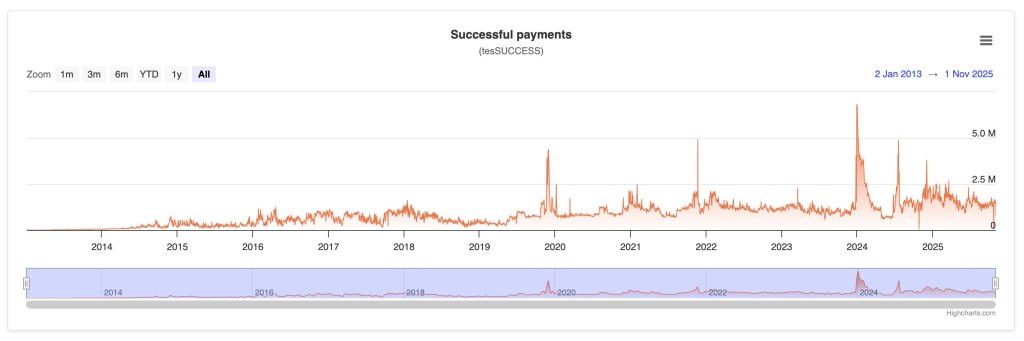
XRP successful payments
Successful payments | Source: X @vibhu

While exact daily figures vary with market conditions and data providers, independent dashboards corroborate the broad picture: XRP’s transactions typically sit in the low-single-digit millions per day, while Solana’s effective user-facing throughput has been documented near the ~1,000 TPS range with peaks far higher under stress; counting all transaction types, Solana’s raw transaction count regularly dwarfs legacy chains. “Currently, XRPL is handling about 17 TPS, according to XRPScan. Solana executes 1000 non-vote TPS on mainnet, and often more,” Norby said.

Norby also trained attention on value transfer rather than just message count. “XRP’s transfer volume today is about $50–60 billion per month. However, Solana’s October stablecoin transfer volume alone, which is a small subset of all network assets, was almost $2 trillion,” he wrote.

Anticipating the most common rejoinder—“oh it’s all fake, bots, etc.”—Norby argued that the Solana-side data excludes wash behavior in the stablecoin tallies he referenced and that fee structures are not a sufficient explanation for alleged bot asymmetry. “Given both XRPL and Solana have similarly low transaction fees, there’s no reason why Solana would uniquely attract bots that XRPL wouldn’t,” he wrote, adding that the on-chain payments edge in Solana remains “a huge measurable margin” even after obvious noise filters.

The exchange quickly broadened beyond raw counters to product-market fit. One defender asserted that “XRP isn’t for retail and memecoins. Financial institutions are heavily regulated and slow to adopt.” Norby rebutted that premise bluntly: “They haven’t been slow to adopt – lol. They’re just adopting stablecoins, not XRP.”

In a separate reply to a question about what’s driving Solana’s relative outperformance, Norby’s answer was a one-word thesis: “Technology.” He later summarized the posture of the XRP army he believes the data supports with a pointed quip: “Solana is a bridge currency.”

Norby also dismissed the idea that RippleNet’s progress should be conflated with on-chain traction: “One cannot have a view on RippleNet because it appears to be simply a private business. Therefore it’s hard to argue it has any bearing on XRP.”

That distinction echoes long-standing commentary that RippleNet, as an enterprise messaging and settlement network, can operate independently of XRP unless specific corridors use On-Demand Liquidity mechanisms. “Offchain connections are entirely commoditized,” Norby added, casting political or banking relationships as insufficient substitutes for measurable on-chain usage.

As the thread grew, community pushback coalesced around two counterclaims: that XRP’s design goal is institutional settlement rather than retail-heavy app ecosystems, and that a “HODL-heavy” holder base naturally depresses daily active address counts. Norby responded that Solana, too, is held by large numbers of passive investors—“Believe it or not, many people also just buy SOL and hold”—but “the difference is that people also actually use Solana.”

He concluded with a challenge: “Open offer to any community member or Ripple executive: let’s do a livestream debate right here on X. You bring facts, I bring facts. Facts are important. Let the internet decide who wins.” He also hosted a public X Space to continue the discussion.

None of the above makes Ripple’s endgame impossible. Norby repeatedly allows that “it is very possible that XRPL wins,” framing his argument as a present-tense snapshot rather than a terminal verdict. But his counsel to investors is unsparing: “If you hold XRP as an investment, you need to seriously consider how much longer it’s worth waiting around.”

At press time, XRP traded at $2.40.
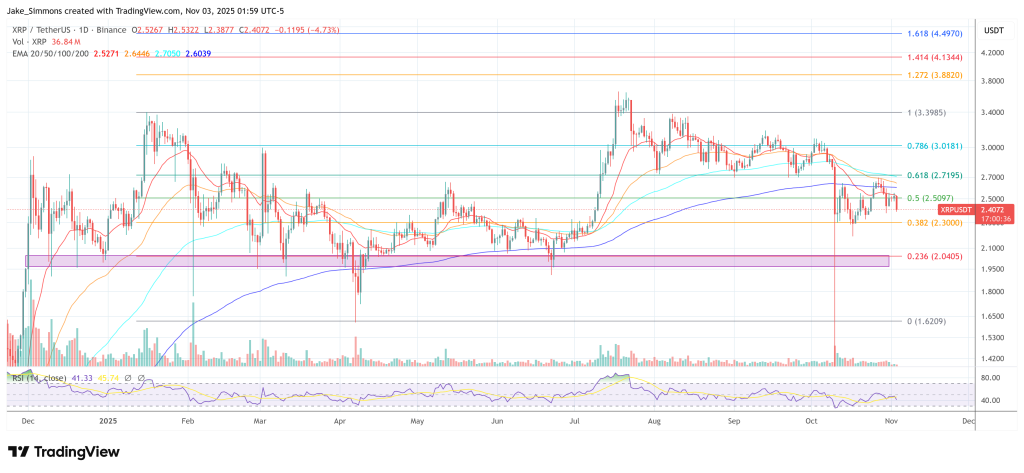
XRP price
XRP falls below the 0.5 Fib, 1-day chart | Source: XRPUSDT on TradingView.com
Featured image created with DALL.E, chart from TradingView.com
Editorial Process for bitcoinist is centered on delivering thoroughly researched, accurate, and unbiased content. We uphold strict sourcing standards, and each page undergoes diligent review by our team of top technology experts and seasoned editors. This process ensures the integrity, relevance, and value of our content for our readers.

Jake Simmons has been a Bitcoin enthusiast since 2016. Ever since he heard about Bitcoin, he has been studying the topic every day and trying to share his knowledge with others. His goal is to contribute to Bitcoin's financial revolution, which will replace the fiat money system. Besides BTC and crypto, Jake studied Business Informatics at a university. After graduation in 2017, he has been working in the blockchain and crypto sector. You can follow Jake on Twitter at @realJakeSimmons.

Related Reads

DeepSeek Announces Permanent Price Cut, But Liang Wenfeng Is Not Trying to Be a "Cyber Bodhisattva"

DeepSeek has announced a permanent 75% discount on its V4-Pro API, significantly reducing its token prices. This move stands out as a major industry-wide price cut while competitors like Anthropic, OpenAI, and Google have been quietly raising theirs. The article contrasts this strategy with the broader trend of AI becoming more expensive, citing examples of companies like Microsoft and Uber struggling with high token costs as usage soars. While CEO Liang Wenfeng is hailed by some as a "Cyber Bodhisattva" for this普惠 approach, the article argues this is a strategic business choice, not mere altruism. DeepSeek's ability to maintain low prices is attributed to several structural advantages: lower-cost AI talent in China, the impending use of domestic昇腾 hardware for further cost reductions, and, most critically, access to China's cheaper and more abundant energy infrastructure, which drastically reduces the electricity costs dominating AI operations. The analysis suggests that for many commercial applications, a "good enough" model that is radically cheaper (e.g., 1% to 11% of GPT-5.5's cost) is more valuable than the absolute top-tier model. This allows for vastly more experimentation and iteration within a budget. Therefore, as AI generally becomes more expensive, DeepSeek's cost-competitiveness—rooted in China's energy and talent advantages—becomes its core strategic value and differentiator in the global market.

marsbit10h ago

DeepSeek Announces Permanent Price Cut, But Liang Wenfeng Is Not Trying to Be a "Cyber Bodhisattva"

marsbit10h ago

The Veil of Mythos Becomes Anthropic's Lever to Move Trillions

The article discusses Anthropic's reported upcoming $30 billion funding round, which would value the company at over $900 billion. It analyzes how the company has leveraged strategic narratives around its unreleased "Mythos" model, rather than just its publicly available products, to drive this massive valuation. Key points include Google's surprising $40 billion investment in a competitor, suggesting it is buying strategic positioning. Anthropic's "Glasswing" cybersecurity project and the unreleased Mythos model are portrayed not through direct proof, but through carefully crafted narratives of being "too powerful for public release," creating an aura of exclusive, high-level capability. This is bolstered by reports of the White House and NSA seeking access to Claude/Mythos despite previous security concerns, implying indispensable technology. Furthermore, Anthropic's reported rapid revenue growth—from a $1 billion annual run-rate in late 2024 to over $30 billion by April 2026, largely driven by enterprise API and Claude Code—provides a financial story for investors. The article concludes that Anthropic's core business model is effectively converting unverifiable technical potential, government interest, and future revenue projections into a compelling narrative that secures immense capital, using the actions of wealthy investors and powerful institutions as the ultimate validation of its worth.

marsbit12h ago

The Veil of Mythos Becomes Anthropic's Lever to Move Trillions

marsbit12h ago

Trading

Spot
Futures

Hot Articles

What is XRP 2.0

XRP 2.0: A New Frontier in the Cryptocurrency Landscape Introduction to XRP 2.0 In the ever-evolving realm of cryptocurrency, new projects continuously emerge, vying for attention and adoption. One such promising initiative is XRP 2.0, a novel cryptocurrency project designed to leverage advanced blockchain technology and robust encryption methodologies. While the name draws parallels with Ripple’s XRP, it’s crucial to note that XRP 2.0 operates independently, focusing on enhancing transaction security, privacy, and scalability. As the digital financial landscape increasingly embraces decentralized solutions, XRP 2.0 aims to contribute meaningfully to web3 and the overall expansion of crypto projects. What is XRP 2.0? At its core, XRP 2.0 is a cryptocurrency project that aims to create a secure and decentralized digital currency ecosystem. Its foundational technology integrates sophisticated blockchain principles with cutting-edge encryption techniques. The overarching goal of XRP 2.0 is to establish itself as a reliable and efficient platform enabling swift transaction execution while prioritizing enhanced privacy protections for its users. The project is promoted as a solution to many limitations faced by existing cryptocurrencies, proposing a system that can handle a higher volume of transactions with improved speed and privacy. This versatility positions XRP 2.0 as a significant contender in a marketplace riddled with various digital currencies. Who is the Creator of XRP 2.0? The identity of the creator behind XRP 2.0 has been flagged as ‘Wilbur.’ However, comprehensive details regarding Wilbur or their associated entity remain elusive. The anonymity of many cryptocurrency creators is not an uncommon phenomenon in the industry, often designed to maintain a degree of privacy and security. Who are the Investors of XRP 2.0? As of now, specific information related to the investment foundations or organizations supporting XRP 2.0 is not publicly available. In the cryptocurrency sector, the backing by reputed investors can significantly influence a project's credibility and success, yet the transparency regarding the financial supporters of XRP 2.0 has not been established. How Does XRP 2.0 Work? XRP 2.0 stands out by employing a combination of blockchain technology and advanced encryption algorithms that ensures secure and decentralized transactions. Its innovative structure includes unique features designed to foster user engagement and broaden functionalities beyond conventional cryptocurrency transactions. Among these features, XRP 2.0 incorporates AI-powered capabilities, such as text-to-image and text-to-speech functionalities. These additions are designed to enhance the interactive experience for users, promoting broader applicability across various sectors. By bridging technological advancements with user-centered design, XRP 2.0 aims to capture the attention of a diverse range of individuals and enterprises looking to integrate cryptocurrency solutions into their operational frameworks. Timeline of XRP 2.0 Understanding XRP 2.0 requires examining the milestones that have defined its journey thus far: July 23, 2023: XRP 2.0 is introduced as a novel cryptocurrency project, aiming to revolutionize secure and decentralized transaction capabilities in the blockchain domain. September 8, 2023: The launching of another project, XRP20, occurs, marking the emergence of an ERC-20 token on the Ethereum blockchain that remains unrelated to XRP 2.0. November 13, 2023: The XRP Ledger undergoes a significant update with the release of rippled server software version 2.0.0. It is essential to note that this development is disconnected from the XRP 2.0 cryptocurrency project. Key Points About XRP 2.0 To distill the essence of XRP 2.0, several critical factors emerge: Unique Features: The inclusion of features like AI-powered text-to-image and text-to-speech further diversifies the potential applications of XRP 2.0. Blockchain Technology: The framework utilizes advanced blockchain mechanisms and encryption protocols, ensuring a secure and decentralized environment for transactions. Scalability and Privacy: XRP 2.0 prioritizes enhanced privacy protections in transaction processes and the scalability necessary to accommodate a growing user base. No Affiliation with Ripple: Importantly, despite its name, XRP 2.0 does not have any allegiance or collaboration with Ripple’s XRP, distinguishing its operational framework and objectives within the cryptocurrency ecosystem. Conclusion XRP 2.0 represents an ambitious venture into the cryptocurrency sphere, aiming to offer a combination of security, privacy, and efficiency in digital transactions. By integrating sophisticated technologies and user-friendly features, the project sets out to broaden the horizons of what cryptocurrency can achieve in today's digital economy. While the anonymity of its creator and lack of disclosed investors might raise questions for some, XRP 2.0's focus on advanced functionalities and decentralisation enhances its appeal amidst an increasingly crowded crypto market. As the cryptocurrency landscape continues to evolve, XRP 2.0 may yet emerge as a pivotal player in the expansion of secure and scalable blockchain solutions.

942 Total ViewsPublished 2024.04.01Updated 2024.12.03

What is XRP 2.0

Discussions

Welcome to the HTX Community. Here, you can stay informed about the latest platform developments and gain access to professional market insights. Users' opinions on the price of XRP (XRP) are presented below.

活动图片