Индекс S&P 500 достигает 6,900 что будет с крипторынком?

cryptonews.ruPublished on 2025-05-28Last updated on 2025-10-29

28 октября 2025 года индекс S&P 500 впервые преодолел отметку в 6900 пунктов, однако почти 80% входящих в него акций в тот день упали. Это зафиксировало самое слабое рыночное «дыхание» за всю историю роста индекса — уникальный случай, когда рекордный день оказался одновременно одним из наиболее узких по охвату.

Этот феномен показывает, насколько концентрированным стал рост и насколько хрупким может быть рынок, несмотря на оптимизм, который демонстрируют прогнозные площадки.

Ралли, управляемое несколькими акциями

На момент публикации индекс S&P 500 (SPX) торговался на уровне около 6890 пунктов после лёгкой коррекции с максимума 6911, достигнутого во вторник.
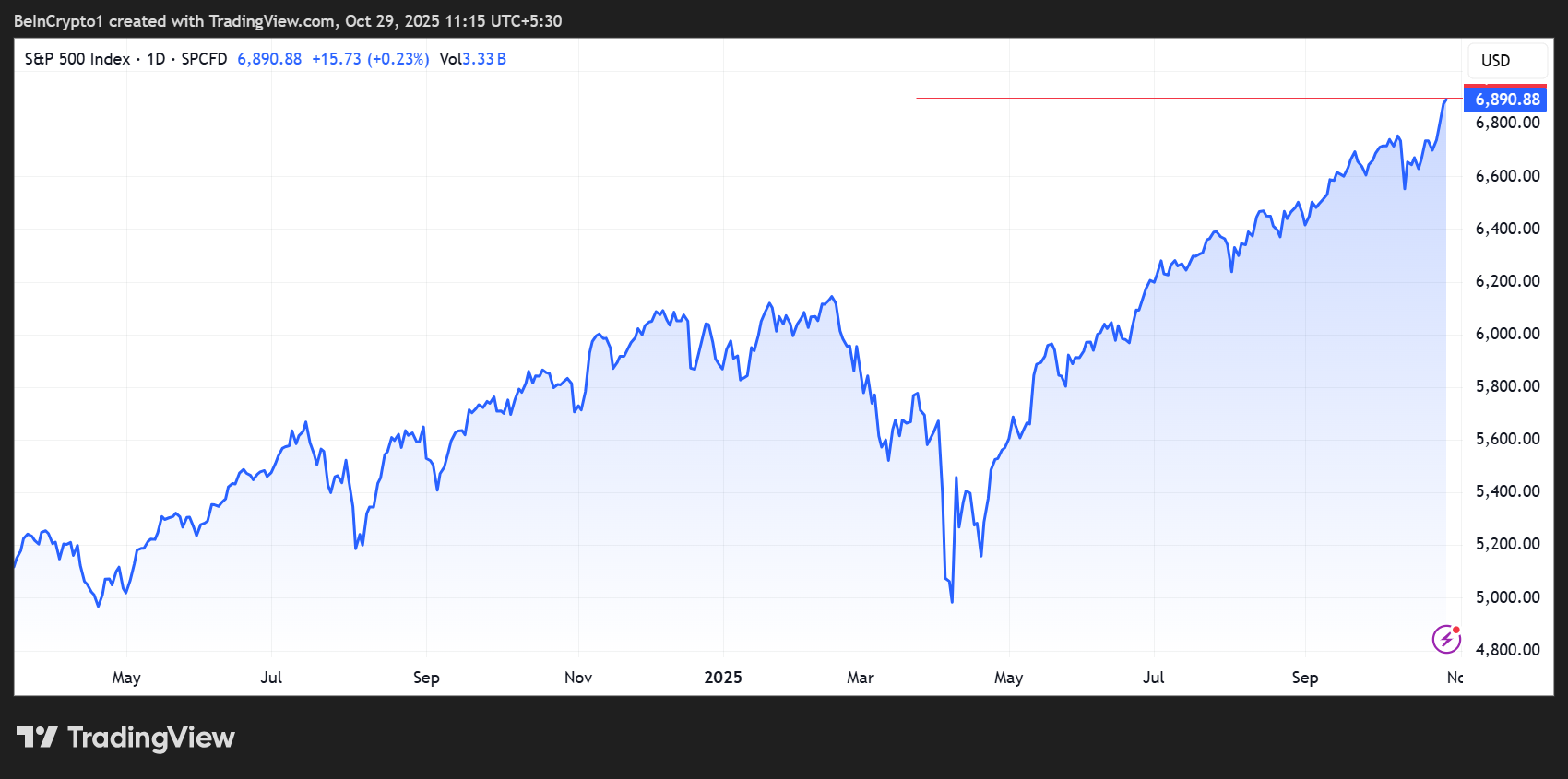
Динамика цен S&P 500 (SPX)
Динамика цен S&P 500 (SPX). Источник: TradingView

Аналитики называют происходящее одним из самых необычных ралли в современной истории. По данным Barchart, почти 80% акций из состава индекса снизились в цене, что стало антирекордом для позитивного торгового дня. В то же время сам SPX обновлял исторические максимумы.
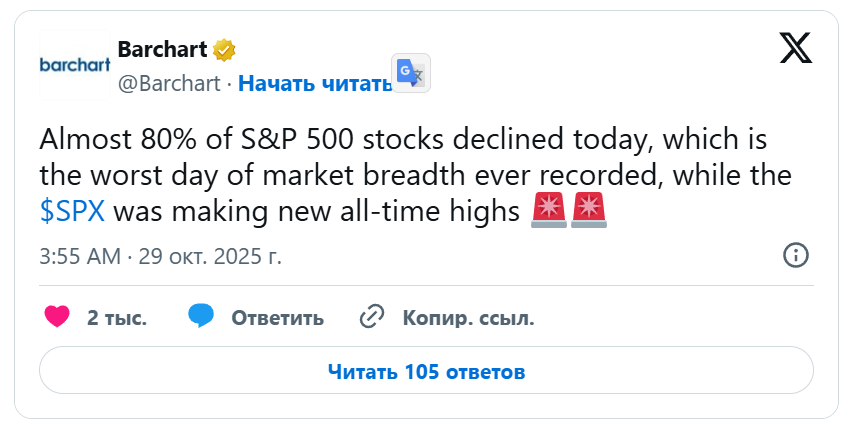
Компания Bespoke Investment Group подтвердила эти цифры, отметив, что это худший день рыночной широты для «плюсовой» сессии за всю историю S&P 500. Платформа ZeroHedge добавила, что этот случай войдёт в учебники как день с наиболее отрицательной широтой на рекордном максимуме.

Рост индекса практически целиком обеспечивается гигантскими компаниями из сектора искусственного интеллекта. Как отметили в The Kobeissi Letter, рынок переживает уникальный исторический момент — на пересечении технологической революции, дерегулирования и триллионных инвестиций.

Тем не менее аналитики Kobeissi предупреждают, что волатильность остаётся ключевой чертой текущей эпохи: «За последние десять лет индекс S&P 500 пережил четыре коррекции минимум на −20% — это рекорд. Используйте эту волатильность», — говорится в их обзоре.

Текущая суженность ралли подчёркивает, насколько сосредоточенным стало лидерство на американском фондовом рынке. Несколько технологических гигантов из сектора AI тянут весь индекс вверх, скрывая слабость большинства остальных бумаг. Обычно такая динамика характерна для поздней стадии бычьего рынка и может сигнализировать о приближении разворота.

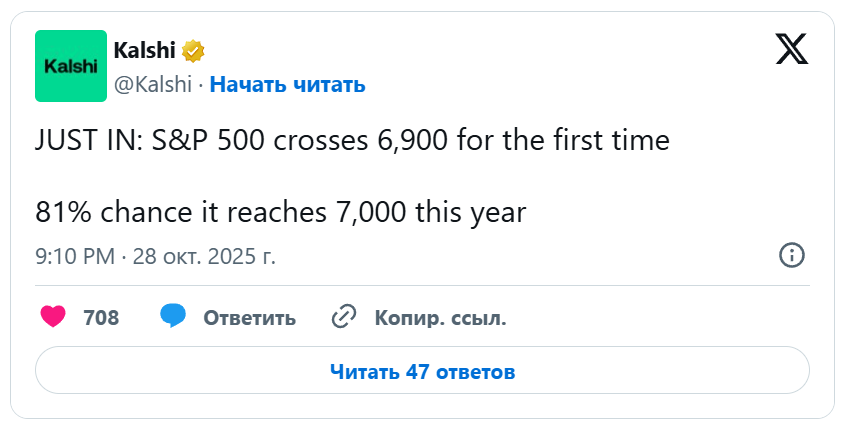
Однако трейдеры не спешат уходить с рынка. Платформа прогнозов Kalshi оценивает вероятность достижения отметки 7000 пунктов по S&P 500 к концу года в 81%. Это отражает уверенность инвесторов в поддержке ликвидности и благоприятной политике ФРС.
Рынок крипты отстаёт от рынка традиционных активов

Сейчас традиционный рынок капитала, по мнению многих аналитиков, находится в состоянии явного пузыря. Оценки крупных технологических компаний взлетели до уровней, не подкрепленных фундаментальными показателями. Растущая зависимость индекса S&P 500 от нескольких гигантов искусственного интеллекта делает всю структуру рынка уязвимой. При малейшем сбое в прибыли или изменении макроэкономического фона резко усилится давление на котировки, а волна паники способна быстро перейти и на рынок цифровых активов.

Пока Уолл-стрит движется за счёт капитала мегакорпораций, аналитики из криптосферы проводят интересные параллели. Так, эксперт Дайана Санчес отметила масштабный разрыв между фондовым и крипторынком: «S&P 500 только что пробил уровень 6900, прибавив ошеломляющие $18 трлн с апреля. А вся капитализация биткоина — всего $2,27 трлн. Когда понимаешь, насколько мала криптоиндустрия по сравнению с традиционными рынками, осознаешь, как рано мы всё ещё находимся», — отметила она.

Что ждёт рынок криптовалют в 2026 году

История показывает, что массовая распродажа ликвидных активов неизбежно задевает и криптовалюты. Инвесторы, стремясь сократить риски, часто выходят из всех рискованных инструментов одновременно. Если пузырь на фондовом рынке лопнет, крипторынок может испытать кратковременный, но резкий спад. Даже такие устойчивые активы, как биткоин и Ethereum, в подобных условиях обычно временно теряют позиции, уступая место «бегству в кэш».

Однако другой сценарий выглядит гораздо привлекательнее. Если экономике удастся пережить плавную коррекцию без обвала, капиталы, накопленные в результате AI-ралли, могут начать искать новые направления роста. И тогда крипторынок станет естественным магнитом для притока этих средств. Его объём всё ещё несоизмерим с традиционным рынком капитала, а потому даже небольшой процент перераспределения способен вызвать значительный рост цен.

В такой ситуации цифровые активы получат второе дыхание. Инвесторы, обогащённые на бумажных прибылях технологических гигантов, могут начать диверсифицировать капитал в блокчейн-проекты, DeFi и токены инфраструктурного назначения. При грамотной регуляторной среде и росте доверия институциональных игроков крипторынок может превратиться в следующую площадку для масштабного капитального цикла — уже не на спекуляциях, а на реальной полезности технологий.

Таким образом, исход текущего пузыря будет определяющим. Резкий обвал способен вызвать временную панику и возврат к консервативным стратегиям, но мягкая посадка и правильное перераспределение средств могут стать толчком к новому витку криптоэволюции. Рынок цифровых активов остаётся относительно малым, но именно это делает его потенциально самым чувствительным и перспективным направлением для капитала, выходящего из перегретого фондового сектора.


Trending Cryptos

Related Reads

Uniswap Founder: When Stocks and Treasuries Are Fully On-Chain, How Will AMMs Restructure the Global Market?

Uniswap founder Hayden Adams argues that as traditional assets like stocks become tokenized, Automated Market Makers (AMMs) could fundamentally restructure global markets. The core insight is that AMMs are most efficient in "correlated pairs"—such as NVDA/SPY—where assets move together. In these pairs, passive liquidity providers (LPs) who are willing to hold the underlying assets face lower inventory risk and minimal hedging costs compared to traditional, delta-neutral market makers. This cost advantage allows AMMs to undercut professional firms. Tokenization enables assets to trade directly against each other on a shared settlement layer, rather than being siloed in dollar-based systems. Adams observes this pattern already emerging in DeFi, where assets naturally pair with correlated benchmarks (e.g., ETH for Ethereum assets). He believes this will extend to tokenized stocks, with liquidity concentrating in low-volatility correlated pairs, while a few high-volume "bridge pairs" (like SPY/USD) handle dollar conversions. The article highlights that early correlated markets for tokenized stocks already exist (e.g., on Robinhood's chain), and Uniswap v4 hooks like DualPool can further boost LP returns. Adams draws a parallel to the rise of passive index funds, suggesting passive AMM liquidity could similarly democratize market-making and capture significant market share from traditional finance. A response from crypto KOL Cody adds practical analysis, noting that while the correlated pair strategy reduces impermanent loss, current on-chain fees may not yet fully compensate for it. He shares his own LP strategy using valuation models, emphasizing that AMMs offer a novel, low-cost market-making avenue for those willing to hold inventory.

marsbit7m ago

Uniswap Founder: When Stocks and Treasuries Are Fully On-Chain, How Will AMMs Restructure the Global Market?

marsbit7m ago

Goldman Sachs Buys Volatility, Turns Bitcoin into a Yield Business

Goldman Sachs acquired NEOS Investments for up to $2.25 billion, gaining a suite of ETFs that generate income by selling options against crypto assets, particularly Bitcoin. This includes the BTCI fund, which sells call options against Bitcoin ETF holdings to capture high premiums from crypto’s volatility, offering investors stable cash flow—around 27% annualized in returns—while capping upside potential and fully exposing them to downside risk. The move highlights Wall Street’s broader push to package crypto-native yield—through staking, lending, and structured products—without taking directional bets on prices. Firms like Fidelity, JPMorgan, and Morgan Stanley now offer staking services or accept crypto as collateral for loans, collecting steady fees regardless of market direction. In contrast, native crypto firms like Bitwise remain vulnerable to market downturns, as their revenue depends entirely on assets under management. This reflects a strategic pivot: large institutions no longer need to “believe” in crypto to profit from it. They monetize volatility and investor activity through fee-based structures, leaving price risk to retail investors. As regulatory shifts like the proposed 401(k) rules unfold, yield-generating crypto products may gain even broader adoption in traditional portfolios, further cementing Wall Street’s role as a neutral intermediary capturing reliable revenue streams from the ecosystem.

marsbit11m ago

Goldman Sachs Buys Volatility, Turns Bitcoin into a Yield Business

marsbit11m ago

AI Launches a Fierce Assault on Cancer, Virtually Tests 4,000 Anti-Cancer Drugs, Google Gemma Downloads Exceed 1 Billion

Google's open-source Gemma AI model family has reached a new milestone, surpassing 10 billion cumulative downloads in two and a half years since its February 2024 launch. This growth has fueled a vast ecosystem, with over 100,000 developer-derived model variants powering diverse applications, from NASA satellites to over 100 million phones. A standout application involves cancer research. In collaboration with Google Research and Yale, a team developed a 27-billion-parameter model called Cell2Sentence-Scale 27B (C2S-Scale). This model innovatively converts complex single-cell sequencing data into a "sentence" of gene names ranked by activity, allowing it to analyze cellular behavior. It was used to conduct a "dual-context virtual screen" of over 4,000 drugs, aiming to find one that specifically boosts antigen presentation—a key process for immune system recognition—only in the presence of low interferon signals (a "cold tumor" context), not in neutral conditions. The model identified silmitasertib (CX-4945), a CK2 kinase inhibitor, as a top candidate. Subsequent live-cell experiments validated this AI-generated hypothesis, showing that the drug combined with low-dose interferon increased antigen presentation by about 50%, whereas neither element alone had a significant effect. This represents a novel, AI-proposed mechanistic pathway for potential cancer therapy. Beyond biomedicine, the Gemma ecosystem is expanding into unique domains. Models have been deployed in space on high-performance GPUs and are being used in projects like DolphinGemma to decipher dolphin communication patterns. The 10-billion-download milestone underscores a key trend: the disruptive potential of AI lies not just in raw model capability but in its widespread, silent integration into diverse hardware and real-world applications, as evidenced by the thriving "Gemmaverse" community.

marsbit12m ago

AI Launches a Fierce Assault on Cancer, Virtually Tests 4,000 Anti-Cancer Drugs, Google Gemma Downloads Exceed 1 Billion

marsbit12m ago

Shocking: OpenAI Fully Open-Sources Codex Harness

OpenAI has open-sourced the core framework of Codex, called "Harness," under an Apache-2.0 license. This move allows developers to deeply integrate AI agents into their own applications and workflows, moving beyond the limitations of generic chat interfaces. The Harness is the underlying execution system that manages an AI agent's complete lifecycle: understanding tasks, maintaining memory, using tools, handling failures, and requesting human approvals. OpenAI demonstrated that optimizations to the Harness alone can dramatically boost a model's performance, tripling scores on a benchmark while using significantly fewer tokens. The release includes three key components: a CLI tool (`codex exec`) for automated tasks, official SDKs (TypeScript/Python) for programmatic control, and the `app-server` for embedding agents directly into products. This enables features like persistent state, real-time event streaming, and human-in-the-loop controls. Early adopters showcase its versatility beyond coding. Examples include a tax preparation system that cut processing time by one-third, Cisco's platform for building apps with natural language, and a demo logistics dashboard where agents analyze data and propose actions within the existing interface. This paradigm shift grants developers full control over the user interface, context, tools, and security boundaries. AI becomes an invisible assistant within specialized software, rather than a separate chatbot. By open-sourcing the engine behind its powerful agents, OpenAI aims to spark a new wave of native, deeply integrated AI applications.

marsbit17m ago

Shocking: OpenAI Fully Open-Sources Codex Harness

marsbit17m ago

Trading

Spot

Hot Articles

Discussions

Welcome to the HTX Community. Here, you can stay informed about the latest platform developments and gain access to professional market insights. Users' opinions on the price of S (S) are presented below.

活动图片