Trump Family’s Crypto Fortune Soars To $1B, Eric Trump Says ‘Probably More’ – Report

bitcoinistPublished on 2025-10-17Last updated on 2025-10-17

Abstract

A recent investigation alleges that since US President Donald Trump’s return to the White House, the Trump family’s crypto fortune...

Trusted Editorial content, reviewed by leading industry experts and seasoned editors. Ad Disclosure

A recent investigation alleges that since US President Donald Trump’s return to the White House, the Trump family’s crypto fortune has surged to over $1 billion from his multiple digital asset ventures.

Trump Family’s Crypto Ventures Reap over $1B

On Thursday, the Financial Times (FT) reported that the Trump crypto empire, built by the US President and his family, has generated more than $1 billion in pre-tax profits over the past year.

The investigation explained that Trump’s crypto ventures have significantly boosted the US President’s net worth on paper by billions of dollars. However, they calculated the potential income only from the realized profits of World Liberty Financial’s WLFI token and USD1 stablecoin, and the official TRUMP and MELANIA memecoins.

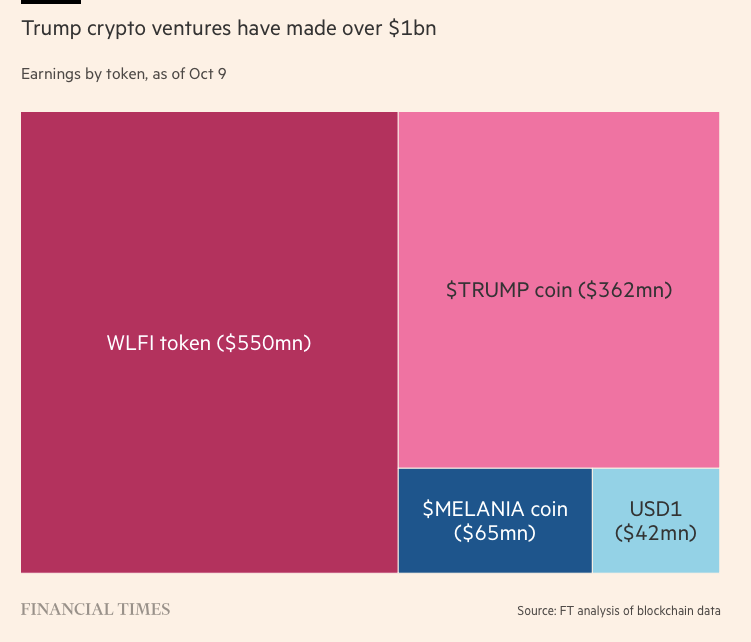
According to FT’s calculations, the TRUMP and MELANIA memecoins, which launched just days before Trump took office in January, have made around $362 million and $65 million, respectively, for a total of $427 million in sales and trading fees.
Crypto

FT's calculations of Trump's realized profits. Source: Financial Times

Meanwhile, the report’s data estimates that the WLFI token has generated approximately $550 million so far, and potentially made $42 million from the USD1 stablecoin, which recorded $2.71 billion in total sales.

To maintain the value of USD1, the company must hold assets in reserve to back the token, so sales of these coins do not immediately become profits. But if the money raised from the sales had been placed into short-term US debt, World Liberty Financial would have made around $40mn in interest and fees from the assets it holds to back its USD1 stablecoin so far.

Moreover, the investigation notes that Trump declared a personal income of $57.3 million from World Liberty Financial in his latest financial report, which covers the 2024 calendar year.

When asked about the accuracy of FT’s calculations, Eric Trump affirmed that the actual figure was “probably more.” He previously explained that his family embraced crypto after several banks cut them off following the January 6, 2021, riot at the US Capitol.

“At that time, I realized how fragile the financial system was and how easily it could be weaponized against you,” he stated in August, claiming that the decisions were likely political, leading him and his family to turn to the industry.

US President Faces Conflict Of Interests Claims

As the report noted, the questions about potential conflicts of interest mount, with many highlighting that, unlike most of his predecessors, President Trump has not put his crypto ventures in a trust managed by an independent party. Instead, most of his businesses are owned by a revocable trust, of which he is the sole beneficiary, and managed by his son Donald Trump Jr.

In June, Democratic lawmakers proposed a bill to prevent crypto-related conflicts of interest. As reported by Bitcoinist, Senator Adam Schiff introduced the Curbing Officials’ Income and Nondisclosure (COIN) Act to ban the president, vice president, and their immediate family from getting into any crypto business while in office.

Similarly, a trio of Senate Democrats pressed the new head of the Office of the Comptroller of the Currency (OCC) in July about the US President’s crypto ventures and a potential conflict of interest related to the Trump family’s stablecoin, USD1.

Richard Painter, former chief White House ethics lawyer to President George W. Bush, told FT that he believes President Trump should divest from all financial interests that potentially pose a conflict with his official responsibilities.

“Every other president since the Civil War has avoided any significant financial conflicts of interest with their official duties,” Painter added. Nonetheless, the White House has argued that in his first term, Trump was the only president to lose money in office and “His sole motivation to leave behind his life of luxury to run for office was to save our country and people.”
crypto, WLFI, WLFIUSDT

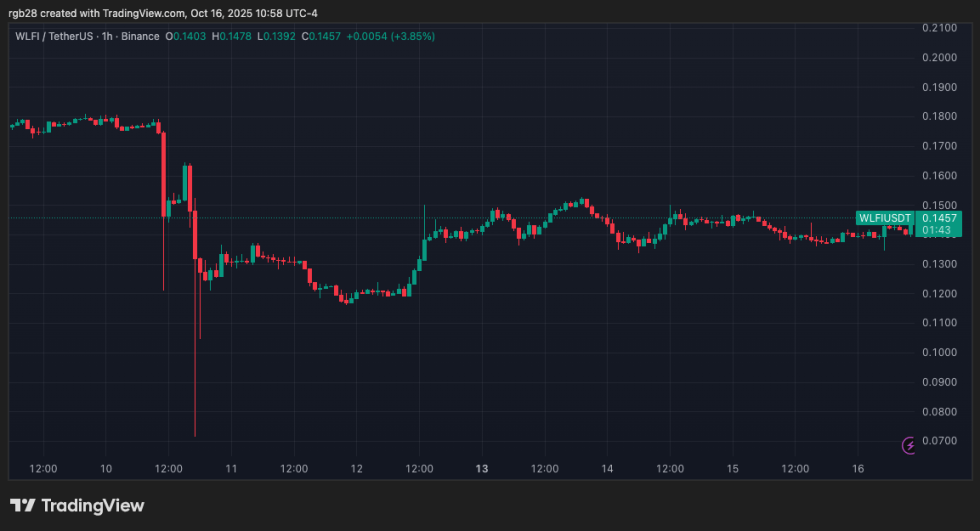
WLFI trades at $0.14 in the one-week chart. Source: WLFIUSDT on TradingView
Featured Image from Unsplash.com, Chart from TradingView.com
Editorial Process for bitcoinist is centered on delivering thoroughly researched, accurate, and unbiased content. We uphold strict sourcing standards, and each page undergoes diligent review by our team of top technology experts and seasoned editors. This process ensures the integrity, relevance, and value of our content for our readers.

Rubmar is a crypto enthusiast who likes learning and improving constantly. She enjoys reporting on the latest news and developments in the crypto industry. Rubmar also enjoys scrapbooking, crafting, simulation games, and watching football.

Trending Cryptos

Related Reads

JPMorgan Research Report Analysis: Moderna's INT Trial Meets Endpoints, but Market Already Priced In

On August 19, J.P. Morgan (JPM) published a research report analyzing Moderna's recent Phase III trial success for its Individualized Neoantigen Therapy (INT), developed in partnership with Merck, in adjuvant melanoma. The trial met its primary endpoint of significantly improved recurrence-free survival and the key secondary endpoint of distant metastasis-free survival. While JPM acknowledged the strong clinical value of these results, particularly the prevention of distant metastasis, the bank stated that this success was widely anticipated, with an 85% prior probability of success, and is already reflected in Moderna's current market valuation. Following the announcement, Moderna's stock rose in pre-market trading. However, JPM maintained its Underweight rating and $40 price target, implying approximately 36% downside from the current price of ~$63. The core rationale is that the success in adjuvant melanoma, a relatively small market in immuno-oncology, is fully priced in. Moderna's future valuation hinges entirely on INT's ability to demonstrate similar efficacy across broader cancer indications. JPM's valuation model incorporates only a modest risk-adjusted value (~$3/share) for the melanoma approval. Approximately $15/share of its target price is attributed to INT's potential in other cancer types. The report identifies upcoming data readouts in non-melanoma cancers (e.g., lung, head & neck, renal) as the critical variable that will determine the platform's ultimate value. Upside risks include better-than-expected data in these new indications, while downside risks involve clinical failures, regulatory delays, or commercial underperformance. In conclusion, JPM views the pre-market stock move as driven by short covering and trading sentiment rather than a fundamental re-rating. The bank remains bearish, arguing that Moderna must now prove INT's efficacy as a platform technology beyond melanoma to justify its current market cap.

marsbit37m ago

JPMorgan Research Report Analysis: Moderna's INT Trial Meets Endpoints, but Market Already Priced In

marsbit37m ago

Treasury Department Directly Intervenes to Suppress Long-Term Interest Rates

The article discusses the U.S. Treasury's recent direct intervention to suppress long-term bond yields through buyback operations. While distinct from traditional Yield Curve Control (YCC), this move is interpreted as direct government intervention in its own financing costs. The author emphasizes the short-term tactical nature of this action and contrasts it with the Federal Reserve's upcoming, potentially divergent, policy stance at Jackson Hole. The core issue is framed as a long-term U.S. strategic dilemma: managing high deficit levels. The analysis argues that deficit reduction cannot realistically come from spending cuts or traditional industries, but must rely on achieving higher economic growth driven by technological breakthroughs. Current monetary tightening, while possibly curbing yields and inflation in the short term, is seen as potentially counterproductive to this necessary long-term investment in technology and supply chain resilience. The piece draws historical parallels, placing the current intervention between the 2000-2002 Treasury buybacks (for liquidity) and larger-scale Fed-led "Operation Twist" maneuvers. The effectiveness of the Treasury's action is deemed limited without Federal Reserve cooperation, which would signify a more significant policy shift. Ultimately, the author views such technical, bureaucratic interventions as treating symptoms rather than the underlying disease of the U.S. economy's structural challenges and "K-shaped" divergence. The conclusion suggests that sustained yield suppression by the Fed, combined with specific geopolitical outcomes, could serve as a catalyst for a more profound discussion on broader U.S. and dollar trajectory.

marsbit38m ago

Treasury Department Directly Intervenes to Suppress Long-Term Interest Rates

marsbit38m ago

Trading

Spot

Hot Articles

Discussions

Welcome to the HTX Community. Here, you can stay informed about the latest platform developments and gain access to professional market insights. Users' opinions on the price of S (S) are presented below.

活动图片