Greatest Bitcoin Threat? Charles Edwards Predicts Quantum Break In 2–8 Years

bitcoinistPublished on 2025-10-15Last updated on 2025-10-15

Abstract

At TOKEN2049 Singapore, Capriole Investments founder Charles Edwards set aside his well-known Bitcoin bullishness to deliver an unambiguous warning: a...

Trusted Editorial content, reviewed by leading industry experts and seasoned editors. Ad Disclosure

At TOKEN2049 Singapore, Capriole Investments founder Charles Edwards set aside his well-known Bitcoin bullishness to deliver an unambiguous warning: a quantum “Q-Day” could arrive far sooner than most of the industry expects, with potentially existential consequences if Bitcoin’s core cryptography is not upgraded in time. “Within two to eight years, a quantum machine will break Bitcoin’s current encryption,” he told the audience, urging developers, companies and holders to treat the issue as urgent engineering, not distant theory.

Edwards framed Q-Day as the moment a sufficiently powerful quantum computer can break widely-used classical cryptography such as RSA—and, by extension, the elliptic-curve cryptography (ECC) underpinning Bitcoin’s public-private key model. “Q-day is the day in which a quantum machine will break classic encryption,” he said, adding that once that threshold is crossed, anything protected by those primitives—from financial networks to “sensitive data” and “of course Bitcoin”—is at risk. He asserted that Bitcoin’s ECC would likely fall sooner than RSA when the industry approaches that breakpoint.

Quantum Computing Could Break Bitcoin Within 8 Years

Pushing back on the common refrain that practical quantum attacks are decades away, Edwards argued the timeline has materially compressed, citing both rapid technical progress and a collective incentive among states and large firms to accelerate. “Even quantum years away. If you ask ChatGPT or Grok, it’ll tell you 10, 20, 30 years away. It’s rubbish,” he said. He pointed to quantum computer access already available via major cloud providers—AWS, Google and Azure—and its use cases in “drug discovery, defense, [and] optimizing bond yields,” presenting these as markers of real-world traction rather than laboratory demos.

Edwards anchored his 2–8 year forecast to a convergence of views he described as independent and sober. He referenced security specialist Jameson Lopp as assigning “50% risk in four to nine years,” a “math PhD doctor specializing in quantum” at “2 to six years for Bitcoin,” and McKinsey’s estimate for RSA-level Q-Day in “2 to 10 years,” reiterating his belief that “Bitcoin breaks years earlier than that.”

He also drew attention to a 2017 “Bitcoin quantum paper” that, in his reading, suggests “you only need 2,300 qubits—logical qubits—to break Bitcoin’s ECC,” noting its authorship by researchers affiliated with Microsoft, IonQ and Meta. While those numbers and affiliations were presented as evidence, his central message was less about any single study and more about the overall direction of travel: a multilateral “quantum arms race” that he said has already attracted “$55 billion” in commitments, with China “spending double the US.”

In Edwards’ telling, technological trendlines are compounding that investment wave. He described qubit growth as “basically a straight line in a log chart,” claiming it is “progressing faster than Moore’s law,” and likened today’s skepticism to the disbelief many held about AI adoption in 2021—right before chatbots went mainstream.

“Imagine 2021 and thinking about AI… You thought it was years away. So ChatGPT happened. I think we’re in a similar moment with quantum. It’s ignored today, but it’s coming.” He also highlighted a perceived shift in sentiment from Nvidia’s Jensen Huang, saying that after downplaying quantum timelines early in the year, Huang later called quantum at “an inflection point” and has been “spending billions buying quantum companies.” For Edwards, the takeaway is simple: “As always, follow the money.”

The operational risks Edwards outlined for Bitcoin were concrete and immediate. If adversaries can derive private keys from public keys exposed on-chain, coins sitting at addresses that have previously revealed public keys become vulnerable to theft. That set includes long-dormant “lost” coins and, potentially, some portion of Satoshi-era holdings.

“Satoshi’s coins will probably be market dumped,” he said starkly, not because their owner would necessarily act, but because the associated keys could be computed and the UTXOs swept once Q-Day arrives.

He contrasted dormant addresses with actively maintained wallets, arguing that modern key management and timely migration would reduce exposure: “We want to keep active wallets… it’s good to maintain security upgrades and relevancy of the tech through time.” He referenced Michael Saylor’s recent remark about doing “something ethically proper and burn[ing] his coins,” using it to underscore an inversion in perceived safety: “Actually burnt—the lost coins—the highest risk because no one has maintained that infrastructure.”

Beyond the cryptographic break itself, Edwards emphasized the logistical constraints of any industry-wide upgrade. Bitcoin can only process so many transactions per day, meaning a migration to quantum-safe addresses cannot be done overnight. “We have long lead times to upgrade Bitcoin,” he said.

“For Bitcoin itself it takes at least a month if you ignore all other transactions on the network to simply move everyone across to new wallets… so we’re looking at at least basically 6 to 12 months to fix this.” On that basis, he argued work on a concrete migration path cannot wait: “We need to be solving this really next year—2026—in order to get a solution before 2027.”

Edwards pointed to ongoing technical efforts as a starting point rather than a finished plan. “There’s solutions to protect crypto… There’s a few BIPs for example like this one… by Jameson Lopp. So there are solutions. We can solve this but there is an urgency to it.”

He called on developers to evaluate proposals for quantum-resistant schemes and on the broader community to “get talking to [the] community, your social media, get involved in the Bitcoin improvement proposals. Review them, give feedback, just get talking.” The subtext was that governance friction—social consensus, client implementation, wallet support, exchange coordination—becomes the gating factor once a candidate scheme is chosen, and that delay is itself a security risk if adversaries are on a clock of their own.

At press time, Bitcoin traded at $111,161.
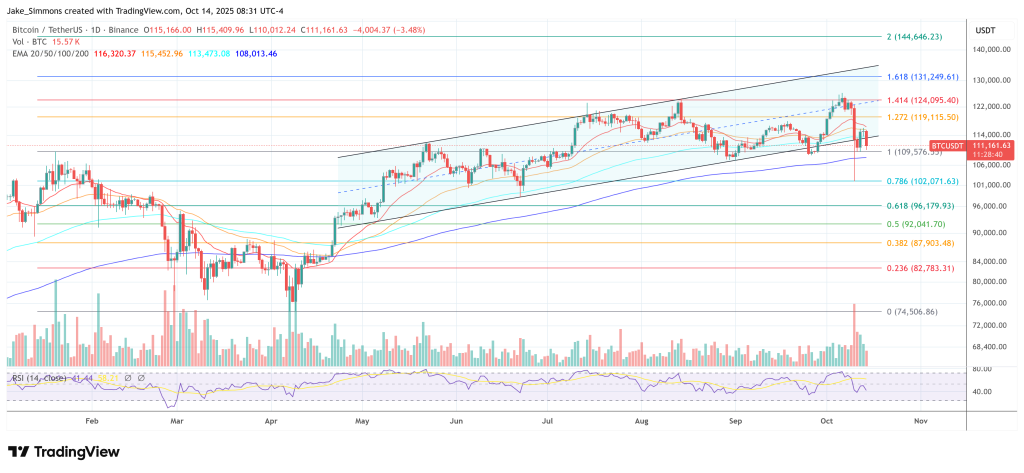
Bitcoin price
Bitcoin drops below the channel again, 1-day chart | Source: BTCUSDT on TradingView.com
Featured image created with DALL.E, chart from TradingView.com
Editorial Process for bitcoinist is centered on delivering thoroughly researched, accurate, and unbiased content. We uphold strict sourcing standards, and each page undergoes diligent review by our team of top technology experts and seasoned editors. This process ensures the integrity, relevance, and value of our content for our readers.

Jake Simmons has been a Bitcoin enthusiast since 2016. Ever since he heard about Bitcoin, he has been studying the topic every day and trying to share his knowledge with others. His goal is to contribute to Bitcoin's financial revolution, which will replace the fiat money system. Besides BTC and crypto, Jake studied Business Informatics at a university. After graduation in 2017, he has been working in the blockchain and crypto sector. You can follow Jake on Twitter at @realJakeSimmons.

Related Reads

Trading

Spot
Futures

Hot Articles

What is $BITCOIN

DIGITAL GOLD ($BITCOIN): A Comprehensive Analysis Introduction to DIGITAL GOLD ($BITCOIN) DIGITAL GOLD ($BITCOIN) is a blockchain-based project operating on the Solana network, which aims to combine the characteristics of traditional precious metals with the innovation of decentralized technologies. While it shares a name with Bitcoin, often referred to as “digital gold” due to its perception as a store of value, DIGITAL GOLD is a separate token designed to create a unique ecosystem within the Web3 landscape. Its goal is to position itself as a viable alternative digital asset, although specifics regarding its applications and functionalities are still developing. What is DIGITAL GOLD ($BITCOIN)? DIGITAL GOLD ($BITCOIN) is a cryptocurrency token explicitly designed for use on the Solana blockchain. In contrast to Bitcoin, which provides a widely recognized value storage role, this token appears to focus on broader applications and characteristics. Notable aspects include: Blockchain Infrastructure: The token is built on the Solana blockchain, known for its capacity to handle high-speed and low-cost transactions. Supply Dynamics: DIGITAL GOLD has a maximum supply capped at 100 quadrillion tokens (100P $BITCOIN), although details regarding its circulating supply are currently undisclosed. Utility: While precise functionalities are not explicitly outlined, there are indications that the token could be utilized for various applications, potentially involving decentralized applications (dApps) or asset tokenization strategies. Who is the Creator of DIGITAL GOLD ($BITCOIN)? At present, the identity of the creators and development team behind DIGITAL GOLD ($BITCOIN) remains unknown. This situation is typical among many innovative projects within the blockchain space, particularly those aligning with decentralized finance and meme coin phenomena. While such anonymity may foster a community-driven culture, it intensifies concerns about governance and accountability. Who are the Investors of DIGITAL GOLD ($BITCOIN)? The available information indicates that DIGITAL GOLD ($BITCOIN) does not have any known institutional backers or prominent venture capital investments. The project seems to operate on a peer-to-peer model focused on community support and adoption rather than traditional funding routes. Its activity and liquidity are primarily situated on decentralized exchanges (DEXs), such as PumpSwap, rather than established centralized trading platforms, further highlighting its grassroots approach. How DIGITAL GOLD ($BITCOIN) Works The operational mechanics of DIGITAL GOLD ($BITCOIN) can be elaborated on based on its blockchain design and network attributes: Consensus Mechanism: By leveraging Solana’s unique proof-of-history (PoH) combined with a proof-of-stake (PoS) model, the project ensures efficient transaction validation contributing to the network's high performance. Tokenomics: While specific deflationary mechanisms have not been extensively detailed, the vast maximum token supply implies that it may cater to microtransactions or niche use cases that are still to be defined. Interoperability: There exists the potential for integration with Solana’s broader ecosystem, including various decentralized finance (DeFi) platforms. However, the details regarding specific integrations remain unspecified. Timeline of Key Events Here is a timeline that highlights significant milestones concerning DIGITAL GOLD ($BITCOIN): 2023: The initial deployment of the token occurs on the Solana blockchain, marked by its contract address. 2024: DIGITAL GOLD gains visibility as it becomes available for trading on decentralized exchanges like PumpSwap, allowing users to trade it against SOL. 2025: The project witnesses sporadic trading activity and potential interest in community-led engagements, although no noteworthy partnerships or technical advancements have been documented as of yet. Critical Analysis Strengths Scalability: The underlying Solana infrastructure supports high transaction volumes, which could enhance the utility of $BITCOIN in various transaction scenarios. Accessibility: The potential low trading price per token could attract retail investors, facilitating wider participation due to fractional ownership opportunities. Risks Lack of Transparency: The absence of publicly known backers, developers, or an audit process may yield skepticism regarding the project's sustainability and trustworthiness. Market Volatility: The trading activity is heavily reliant on speculative behavior, which can result in significant price volatility and uncertainty for investors. Conclusion DIGITAL GOLD ($BITCOIN) emerges as an intriguing yet ambiguous project within the rapidly evolving Solana ecosystem. While it attempts to leverage the “digital gold” narrative, its departure from Bitcoin's established role as a store of value underscores the need for a clearer differentiation of its intended utility and governance structure. Future acceptance and adoption will likely depend on addressing the current opacity and defining its operational and economic strategies more explicitly. Note: This report encompasses synthesised information available as of October 2023, and developments may have transpired beyond the research period.

363 Total ViewsPublished 2025.05.13Updated 2025.05.13

What is $BITCOIN

Discussions

Welcome to the HTX Community. Here, you can stay informed about the latest platform developments and gain access to professional market insights. Users' opinions on the price of BTC (BTC) are presented below.

活动图片