Ethereum на грани: какова вероятность падения цены ETH ниже $4 000

cryptonews.ruPublished on 2025-10-13Last updated on 2025-10-13

На фоне охлаждения интереса на крипторынке Ethereum упал ниже важного уровня поддержки в $4 426

С ослаблением бычьего импульса ETH может опуститься ниже $4 000, что еще больше подорвет уверенность трейдеров.

Инвесторы теряют интерес к Ethereum

Снижение цены ETH с начала недели вызвало вялое отношение инвесторов, что отразилось в падении его социальной доминантности. По данным Santiment, этот показатель сейчас составляет 6,48%, что на 5% ниже, чем пять дней назад.

Когда цена падает и сопровождается снижением интереса трейдеров, это сигнализирует о переключении внимания на другие активы. Уменьшение видимости часто ведет к снижению спроса, что еще больше давит на цену ETH.
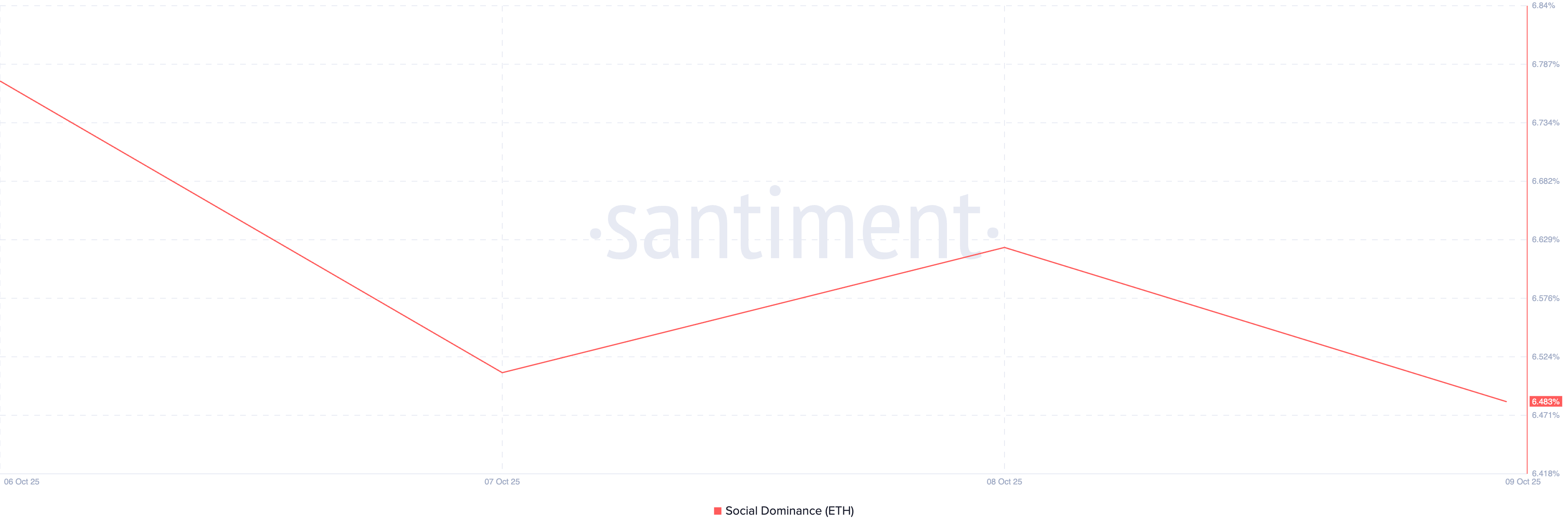
Социальная доминантность ETH.
Социальная доминантность ETH. Источник: Santiment

Данные с дневного графика ETH/USD показывают снижение индекса Smart Money (SMI) с понедельника. На момент публикации этот показатель составляет 4 359 после снижения на 6%.

Когда цена падает, ключевые инвесторы могут фиксировать прибыль, ожидая краткосрочной коррекции. Если эта тенденция продолжится, это грозит усилить медвежье давление на ETH, особенно на фоне снижения розничных настроений и социальной активности.
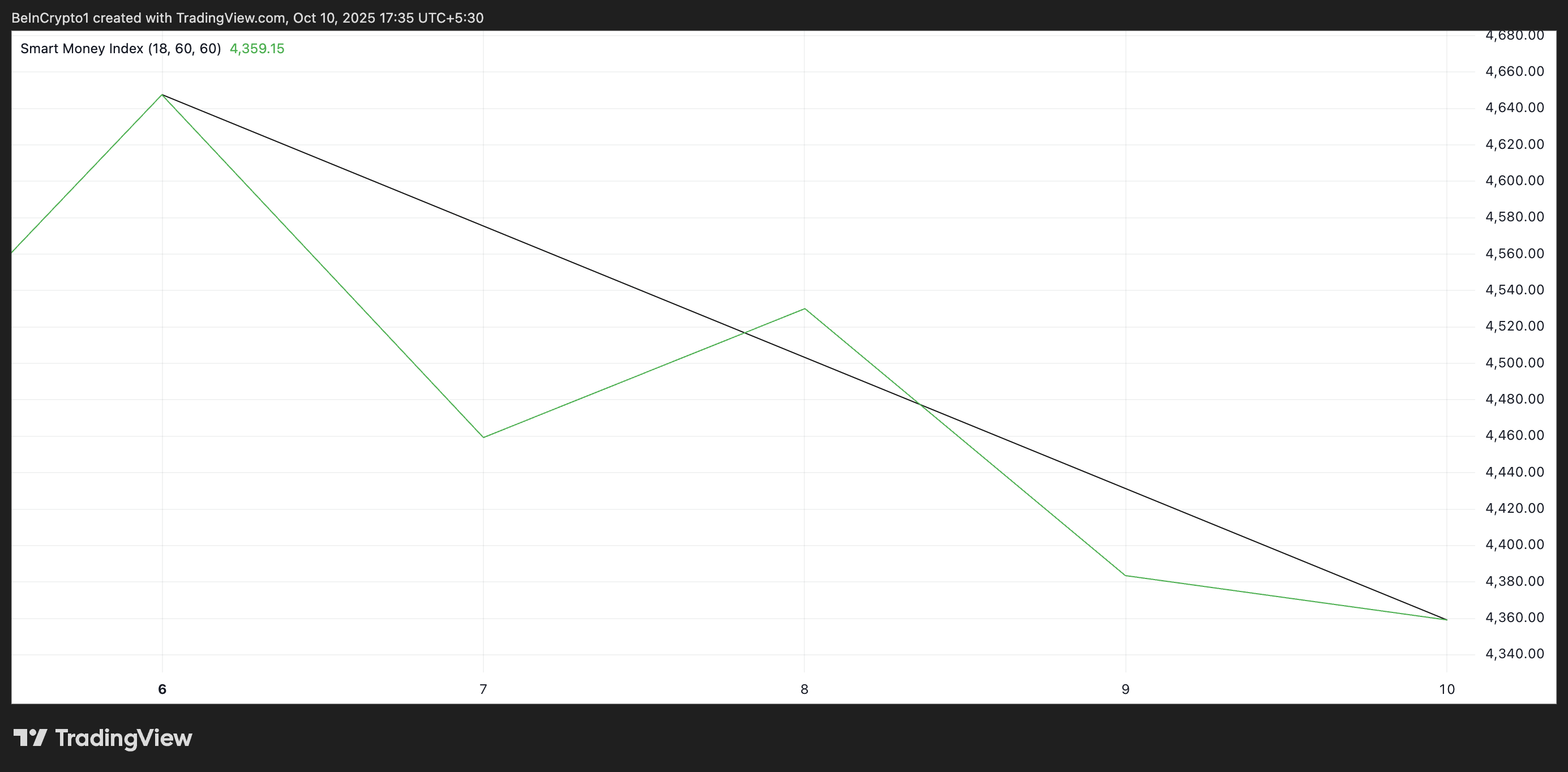
Индекс Smart Money ETH.
Индекс Smart Money ETH. Источник: TradingView

Прогноз ETH

Когда и «умные деньги» выходят с рынка, и общий спрос на монеты падает, это обычно предвещает период консолидации или снижения. Это может означать, что ETH установит боковой тренд или упадет к $4 211.

Если уровень поддержки не удержится, альткоин рискует упасть ниже $4 000 и достичь $3 875.
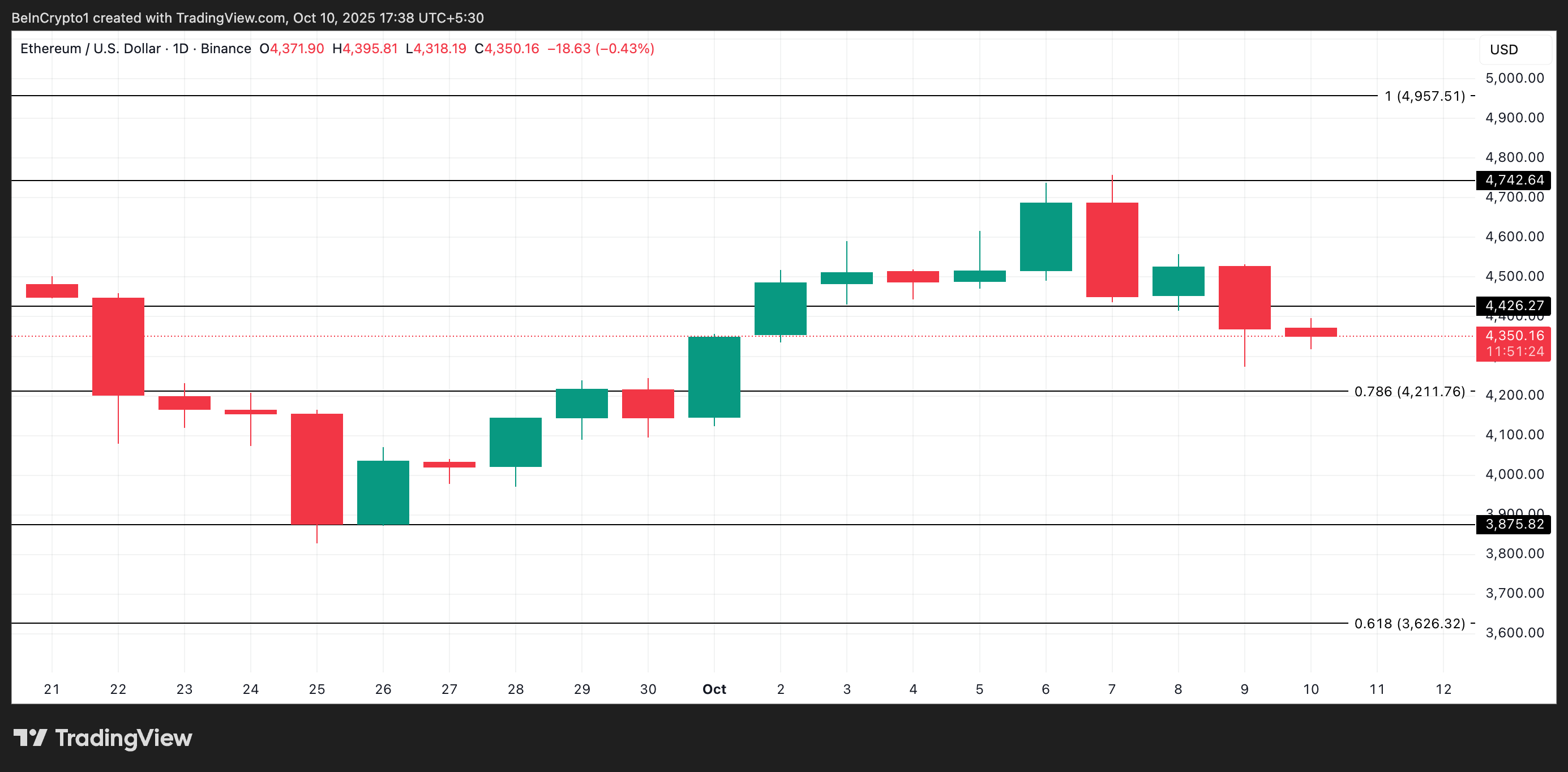
Анализ цены ETH
Анализ цены ETH. Источник: TradingView

Если спрос на рынке возрастет, цена ETH получит шанс подняться выше $4 426 и достичь $4 742.

Trending Cryptos

Related Reads

Pantera Capital: As Perpetual Contracts Move Towards the Financial Center, Hyperliquid Aims to Be All-Encompassing

Perpetual futures ("perps"), once a crypto-native phenomenon, are becoming a dominant global financial instrument, evolving into a fundamental market structure shift that traditional finance can no longer ignore. This article outlines the advantages of perpetual contracts over traditional futures, highlighting their simplicity (no expiry/rollover), easier risk management, and native 24/7 operation. While the concept is not new, digital assets provided the ideal environment for its explosive growth. Initially dominated by centralized exchanges (CEX), perps have recently migrated significantly to decentralized exchanges (DEX), with Hyperliquid emerging as the leading DEX for perps, capturing ~40% of the on-chain volume. Hyperliquid, built on its own purpose-built L1 blockchain, has successfully expanded beyond crypto into traditional assets like stocks, commodities, and indices, driven by its permissionless listing framework (HIP-3) and 24/7 availability. It has become a crucial price discovery venue during off-hours and for pre-IPO companies, attracting attention from traditional hedge funds and major exchanges like ICE, which now views it as serious competition. The investment thesis for Hyperliquid's token, HYPE, rests on its large and growing total addressable market (TAM) across all finance, strong execution, superior user experience, and direct value accrual via aggressive token buybacks using 99% of protocol revenue. Key risks remain, primarily regulatory uncertainty in the U.S., though recent CFTC actions approving certain regulated crypto perp contracts signal a potential shift toward broader acceptance. The core question is no longer if perpetuals matter beyond crypto, but whether blockchain-based infrastructure like Hyperliquid can become the primary venue for pricing, trading, and discovering risk across all financial domains.

marsbit41m ago

Pantera Capital: As Perpetual Contracts Move Towards the Financial Center, Hyperliquid Aims to Be All-Encompassing

marsbit41m ago

Tiger Research: Zuckerberg Begins Betting on Prediction Markets, While Asian Nations Still View Them as Gambling

This article examines the rise of prediction markets, contrasting their growing institutional acceptance in the West with their restrictive regulation in Asia. It details how prediction markets, which originated from informal political betting and academic experiments like the Iowa Electronic Market, aggregate crowd wisdom into probabilistic prices through binary contracts. Their growth accelerated around 2020, reaching over $14 billion in monthly volume. A key driver is the "skin in the game" principle, where users risk their own capital, leading to high accuracy in predicting events like Fed rate decisions and elections, as demonstrated by platforms like Polymarket. Meta's entry, with Mark Zuckerberg reportedly leading the development of the Arena app, signals the market's maturation. In the U.S., court rulings have distinguished prediction markets from gambling, facilitating entry by traditional financial institutions. However, most Asian jurisdictions still classify them as gambling, focusing on social control rather than financial innovation. The article argues this stance creates three problems for Asia: 1) regulatory arbitrage pushes users to riskier offshore platforms, 2) loss of sovereign information infrastructure as valuable social sentiment data accumulates abroad, and 3) abandonment of user protection. It concludes that Asia needs a policy shift from prohibition to constructive regulation, integrating these markets into the formal system to harness their data as a national asset, as initiatives like Limitless Research are beginning to do.

marsbit3h ago

Tiger Research: Zuckerberg Begins Betting on Prediction Markets, While Asian Nations Still View Them as Gambling

marsbit3h ago

Ethereum's Next Decade in the Eyes of Vitalik

"Lean Ethereum" Long-Term Roadmap Unveiled by Vitalik Buterin On July 5, 2026, Vitalik Buterin published the "Lean Ethereum" roadmap, positioning it as Ethereum's third major evolution following the Merge. This multi-year, multi-phase upgrade aims to fundamentally transform Ethereum's core protocol through staged network upgrades extending to 2029. Key goals include achieving 1 gigagas per second L1 throughput (a massive increase from the current ~32 TPS), near-instant finality, and quantum-resistant cryptography. The plan involves transitioning Ethereum's security model from full transaction re-execution by all nodes to native verification via recursive STARK proofs. A major proposed change is replacing the EVM with a proof-friendly architecture like RISC-V or leanISA, though this remains a point of contention, especially with L2s like Arbitrum favoring alternatives like WASM. Other planned upgrades include a restructured state model with a large, cheap "warehouse" storage layer to drastically reduce fees for migrated applications, multi-dimensional gas pricing, and a new focus on making privacy a first-class, native protocol feature. While the roadmap significantly raises Ethereum's long-term technical ceiling, analysts note it does not directly address ETH's mid-term token economics or value capture. The plan's multi-year timeline means near-term price impact will likely depend on observable progress milestones, such as the successful deployment of the upcoming Glamsterdam gas limit increase, growth in L2 activity and blob usage, and trends in L1 fee revenue and ETH burn.

链捕手4h ago

Ethereum's Next Decade in the Eyes of Vitalik

链捕手4h ago

Trading

Spot

Hot Articles

Discussions

Welcome to the HTX Community. Here, you can stay informed about the latest platform developments and gain access to professional market insights. Users' opinions on the price of ETH (ETH) are presented below.

活动图片