От $180 до $60 000: ралли Zcash (ZEC) только начинается

cryptonews.ruPublished on 2025-10-15Last updated on 2025-10-15

Zcash (ZEC) продолжает расти, преодолев отметку $180 в октябре после кратковременного спада. Несмотря на рост более чем на 400% с августа, многие аналитики считают, что это только начало ралли

ZEC возвращается к $180: почему это может быть только началом

Позитивный сценарий для Zcash (ZEC) начался, когда Grayscale, одна из крупнейших инвестиционных компаний в криптовалюты, активно продвигала свой Zcash Trust (ZCSH). Фонд отметил, что ZEC предлагает безопасность, схожую с биткоином, с улучшенной приватностью.

Однако в октябре обсуждения вокруг ZEC стали еще более активными. Инвесторы не удовлетворены недавним ралли и ожидают более высоких целей.

Позитивные аргументы в пользу ZEC основаны на убеждении, что приватность — это не просто тренд, а основа криптодвижения. Рост цены Zcash рассматривается как следствие возвращения к основным ценностям криптовалют. Это возвращение может привлечь значительные инвестиции в Zcash, что приведет к росту цен на ZEC.

Тор Торренс, советник проекта Zcash и бывший сотрудник администрации президента США, поделился амбициозным сценарием: если 10% офшорного капитала перейдет в Zcash, каждый ZEC может стоить $62 893.
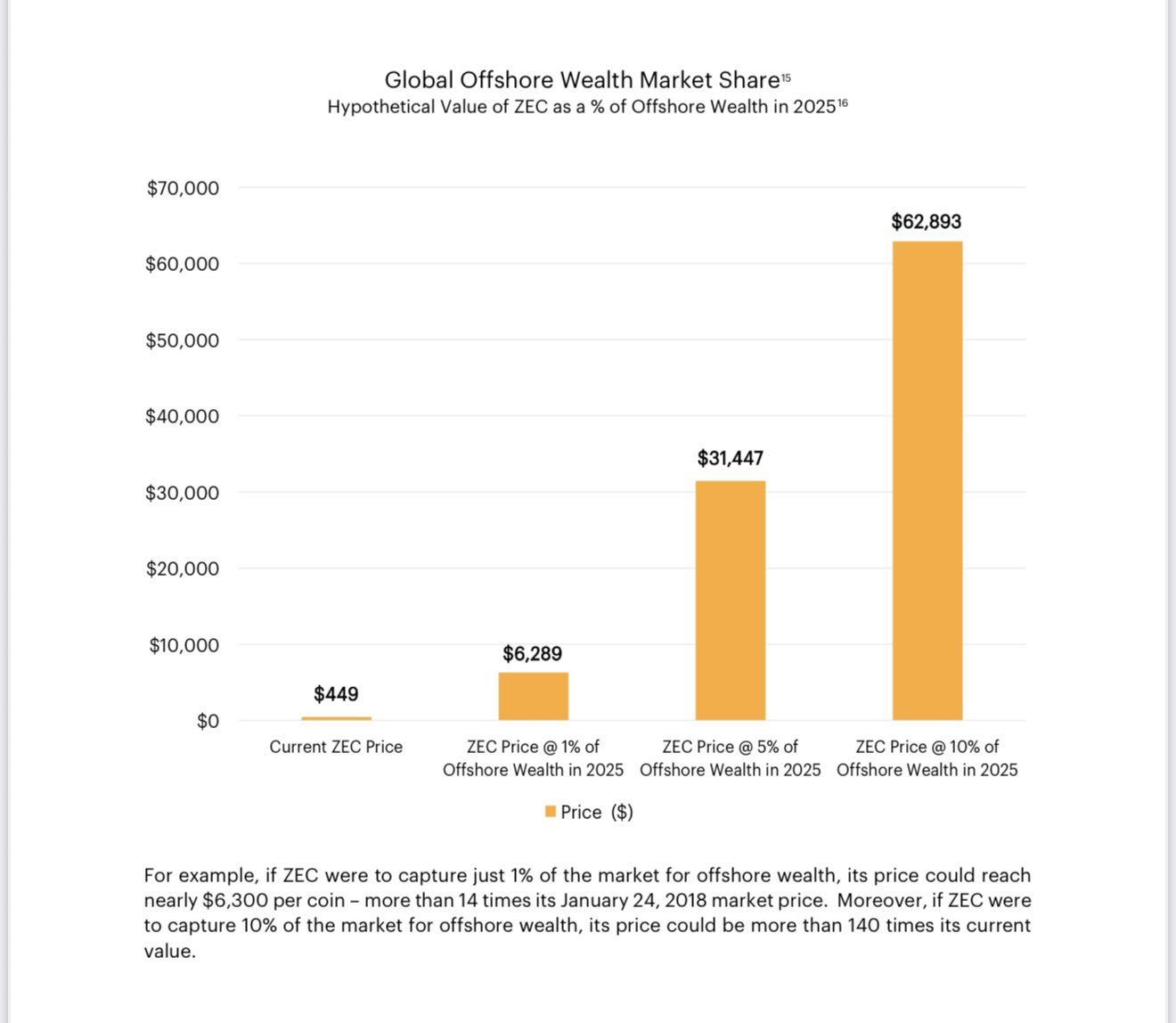
Прогноз цены Zcash (ZEC)
Прогноз цены Zcash (ZEC). Источник: Тор Торренс

«Напоминаю, что тезис Grayscale остается актуальным. Если 10% офшорного капитала перейдет в Zcash, один ZEC может стоить $62 893», — заявил Тор Торренс.

Кроме темы приватности, аналитики отмечают долгосрочный потенциал Zcash благодаря технологии zk-SNARKs, которая обеспечивает полную анонимность транзакций.

Некоторые сравнивают ZEC с биткоином, особенно в контексте их халвингов. В ноябре прошлого года Zcash прошел второй халвинг и с тех пор находится в фазе ценового открытия. Некоторые аналитики прогнозируют, что ZEC может достичь $20 000, повторяя путь биткоина.

«Биткоин и Zcash имеют одинаковую справедливую кривую эмиссии, где первые восемь лет майнеры просто сбрасывают монеты. Даже биткоин не удержался выше $1 000 до второго халвинга — после чего он взлетел до $20 000», — отметил аналитик Арджун Хемани.

Даже самые осторожные прогнозы значительно превышают текущую цену ZEC около $178.

«Кстати, Zcash теперь идет к $1 000», — заявил рыночный аналитик Тайлер в своем прогнозе.

Достигнет ли ZEC $1 000, $20 000 или $60 000, пока неясно. Однако ZEC уже много лет остается одним из наиболее активно накапливаемых альткоинов Grayscale. Приватность в блокчейне по-прежнему актуальна, и многие инвесторы считают Zcash второй возможностью для биткоина.

Как инвесторы Zcash упускают риски

Не все разделяют этот оптимизм. Рыночный аналитик Маартунн отметил, что каждый крупный рост ZEC часто совпадает с пиками рынка.
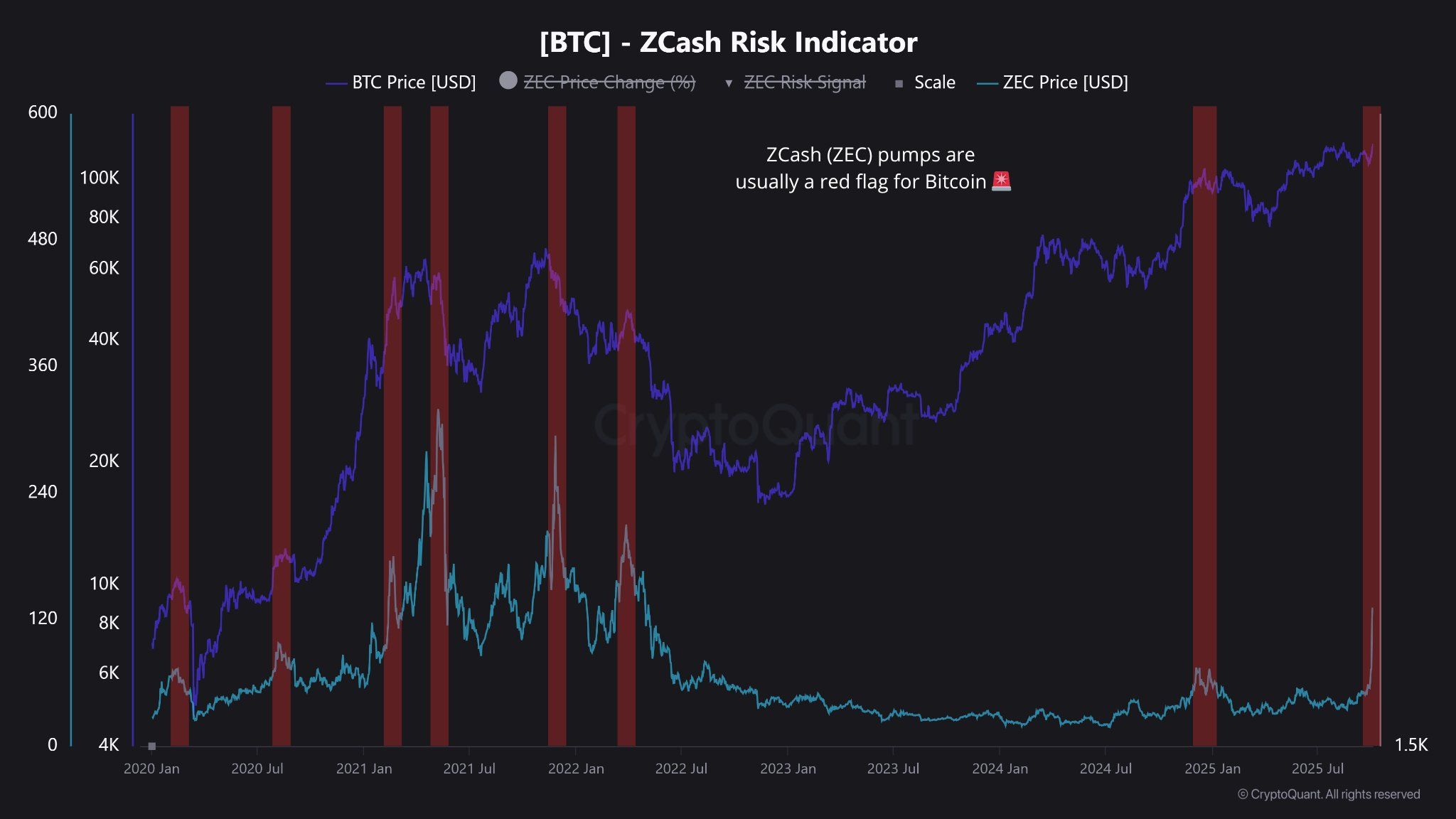
Индикатор риска Zcash. Источник: Маартунн

«Рост ZCash (ZEC) обычно является тревожным сигналом для биткоина. Исторически, такие всплески альткоинов происходят вблизи локальных и циклических пиков», — отметил Маартун.

Пока вокруг Zcash царит позитивный ажиотаж, серьезные регуляторные опасения по поводу приватных монет остаются в тени. Эти опасения уже привели к тому, что Monero (XMR) исключили с нескольких бирж и подвергли сильному давлению продаж.

В мае Европейский Союз ввел новые правила по борьбе с отмыванием денег (AML). Политика предусматривает запрет приватных токенов и анонимных криптоаккаунтов с 2027 года, который коснется финансовых учреждений и поставщиков услуг цифровых активов.

Другие регионы приняли аналогичные меры. В 2023 году правительство Дубая запретило выпуск криптовалют, ориентированных на приватность, таких как Zcash (ZEC) и Monero (XMR). Япония запретила приватные монеты в 2018 году, а Южная Корея — в 2021 году.

Инвесторам стоит учитывать ключевые риски. Ужесточат ли другие правительства регулирование ZEC? Может ли анонимность ZEC использоваться для незаконной деятельности? Пока эти вопросы остаются без внимания на фоне октябрьского оптимизма. Однако любое регуляторное объявление или действие может быстро изменить рыночный тренд ZEC и настроения трейдеров.

Trending Cryptos

Related Reads

In Just 11 Days, Claude Rewrote Millions of Lines of Code, an Epic AI Engineering Feat Sparks Fury

In just 11 days, Bun's founder Jarred Sumner used Anthropic's Claude AI models to rewrite its million lines of code from Zig to Rust. This move sparked significant controversy, particularly from Zig's creator, Andrew Kelley, who publicly criticized Sumner's engineering practices and the decision to use AI for such a massive rewrite. Bun, a high-performance JavaScript/TypeScript runtime and rival to Node.js, was originally written in Zig. After Anthropic acquired Bun, the team encountered persistent stability and memory safety bugs in the Zig codebase. These issues, combined with Zig's strict policy against LLM-generated code, led to the decision to rewrite in Rust. The rewrite was executed using Claude AI tools at an estimated API cost of $165,000, dramatically reducing the expected time and financial cost. Andrew Kelley's response was scathing. He blamed the original bugs on poor engineering habits, calling Bun's Zig code a collection of "hacks on top of hacks." He expressed relief that Bun was no longer associated with Zig, fearing it would misrepresent the language and attract low-quality, AI-generated contributions. The tech community is divided; some view Kelley's critique as unprofessional, while others see it as a defense of engineering integrity. A major concern about the AI-driven rewrite is the resulting code quality. The translation from Zig left approximately 27,000 lines of unsafe Rust code, raising fears about long-term maintainability and technical debt. The debate centers on whether this project is a milestone in AI-assisted development or a future maintenance nightmare.

marsbit28m ago

In Just 11 Days, Claude Rewrote Millions of Lines of Code, an Epic AI Engineering Feat Sparks Fury

marsbit28m ago

From Auto Finance to Bitcoin to AI Engines: An Analysis of Cango's 'What Not to Do' Strategy

From Auto Finance to Bitcoin and Now AI: Cango's "What Not to Do" Strategy Cango, a Chinese auto finance platform that went public on the NYSE in 2018, is undergoing its third major transformation. After selling its entire auto business in 2024, it pivoted to become a large-scale Bitcoin miner, acquiring 50 exahash of mining rigs from Bitmain. However, its true goal was never Bitcoin, but owning and controlling energy infrastructure. Now, Cango is pivoting again. While most listed Bitcoin miners are leasing power to giant hyperscalers for AI training clusters, Cango is taking the opposite path. It has launched an AI inference subsidiary called EcoHash, focusing not on training but on distributed inference. The company's strategy hinges on the insight that over 70% of mining industry power is controlled by small, independent sites (10-50 MW), which are too small for hyperscalers but ideal for low-latency AI inference. Cango aims to partner with these small operators, providing the AI technology, customers, and financing through its EcoLink software layer, which can distribute workloads across sites for reliability. Cango maintains a hybrid model, running roughly 31.7 EH/s of Bitcoin mining for cash flow while aggressively cleaning its balance sheet—slashing long-term debt by 94.5% to $30.6 million and raising $75 million for its AI venture. Its first AI deployment will be at a 50 MW site in Georgia. The strategy faces skepticism, given the high costs of converting mining sites and the potential for an AI bubble. However, Cango's leadership believes discipline around "what not to do"—avoiding direct competition with hyperscalers in training—positions it to capture the long-tail demand for distributed AI inference power.

Foresight News45m ago

From Auto Finance to Bitcoin to AI Engines: An Analysis of Cango's 'What Not to Do' Strategy

Foresight News45m ago

Strategy's Bitcoin Sales Cap Far Exceeds $1.25 Billion: A Detail the Market Overlooked

The article discusses how MicroStrategy's potential Bitcoin sales go far beyond the announced $1.25 billion "reserve-building capacity." It clarifies a key distinction in the company's "BTC Monetization Program": selling Bitcoin to *build* a new dollar reserve (the $1.25B cap) versus selling to *replenish* the existing USD Reserve after it's used for expenses like preferred share dividends. The recent $216M BTC sale for dividend payments was a "replenishment," leaving the headline $1.25B building quota untouched. The plan actually outlines three potential funding pools from BTC sales: 1) Building the reserve ($1.25B cap), 2) Covering preferred share/ debt costs (no specified cap), and 3) Funding buyback programs (up to $20B). This means the structured sales potential exceeds $30 billion, not including uncapped replenishment sales. The piece argues this marks MicroStrategy's shift from a passive "buy-and-hold" Bitcoin proxy to an actively managed entity using BTC as a balance-sheet tool to manage its complex capital structure (common stock, preferred shares, debt, reserve). This creates new dynamics and potential conflicts, as actions benefiting one part (e.g., selling BTC to pay dividends) may pressure another (e.g., undermining the "never sell" narrative). Investors must now parse the company's specific terminology ("build" vs. "replenish") to understand the true scope of future BTC sales, which is significantly larger than the market initially perceived.

marsbit51m ago

Strategy's Bitcoin Sales Cap Far Exceeds $1.25 Billion: A Detail the Market Overlooked

marsbit51m ago

Goldman Sachs Report Deconstructs the Competitive Landscape of China's AI Large Models: Who Will Be the Long-Term Winner?

Goldman Sachs analyzes China's AI large language model (LLM) landscape, identifying key players and a strategic shift towards efficiency and global expansion. The report highlights that Chinese open-source/open-weight models are closing the performance gap with top global proprietary models at significantly lower cost, driven by architectural innovations like MoE. This enables a "two-tier" market: a high-end segment (e.g., GLM5.2, Qwen3.7 Max) with pricing at ~$1 per million tokens, and a low-end, price-sensitive global segment. Open-source strategies aid adoption but limit monetization, as deployments via third-party platforms (e.g., AWS Bedrock, Alibaba Cloud) may not generate direct revenue for model creators. The industry is thus moving towards "open-weight + community license" models with revenue-sharing to improve unit economics. Internationally, the focus is shifting from "token maximization" to ROI-driven enterprise adoption, particularly in non-U.S. markets. Major cloud platforms are integrating Chinese models (e.g., DeepSeek, MiniMax). Using a competitive framework based on pricing power, cost advantage, and financial strength, Goldman Sachs identifies **Zhipu AI** and **DeepSeek** as leaders in foundational text models, and **ByteDance** (with Seedance) leading in multimodal/video generation. **MiniMax** and **Kuaishou** are also rated favorably. The firm forecasts China's AI model API/subscription revenue growing from ~RMB 35bn (2026E) to RMB 879bn by 2030.

marsbit51m ago

Goldman Sachs Report Deconstructs the Competitive Landscape of China's AI Large Models: Who Will Be the Long-Term Winner?

marsbit51m ago

Trading

Spot

Hot Articles

How to Buy ZEC

Welcome to HTX.com! We've made purchasing Zcash (ZEC) simple and convenient. Follow our step-by-step guide to embark on your crypto journey.Step 1: Create Your HTX AccountUse your email or phone number to sign up for a free account on HTX. Experience a hassle-free registration journey and unlock all features.Get My AccountStep 2: Go to Buy Crypto and Choose Your Payment MethodCredit/Debit Card: Use your Visa or Mastercard to buy Zcash (ZEC) instantly.Balance: Use funds from your HTX account balance to trade seamlessly.Third Parties: We've added popular payment methods such as Google Pay and Apple Pay to enhance convenience.P2P: Trade directly with other users on HTX.Over-the-Counter (OTC): We offer tailor-made services and competitive exchange rates for traders.Step 3: Store Your Zcash (ZEC)After purchasing your Zcash (ZEC), store it in your HTX account. Alternatively, you can send it elsewhere via blockchain transfer or use it to trade other cryptocurrencies.Step 4: Trade Zcash (ZEC)Easily trade Zcash (ZEC) on HTX's spot market. Simply access your account, select your trading pair, execute your trades, and monitor in real-time. We offer a user-friendly experience for both beginners and seasoned traders.

3.7k Total ViewsPublished 2024.03.29Updated 2026.06.02

How to Buy ZEC

Discussions

Welcome to the HTX Community. Here, you can stay informed about the latest platform developments and gain access to professional market insights. Users' opinions on the price of ZEC (ZEC) are presented below.

活动图片