Bitcoin All-Time High At $125,700 Was A Trap, Warns Analyst

bitcoinistPublished on 2025-10-06Last updated on 2025-10-07

Abstract

Bitcoin’s dramatic weekend spike to a fresh all-time high of $125,700 lacked real spot demand and was largely the product...

Trusted Editorial content, reviewed by leading industry experts and seasoned editors. Ad Disclosure

Bitcoin’s dramatic weekend spike to a fresh all-time high of $125,700 lacked real spot demand and was largely the product of leveraged speculation in thin conditions, according to crypto analyst Maartun, who characterized the move as a classic fakeout rather than a durable breakout. “Bitcoin prints a brand new all-time high, $125,700… But hold on a second. The price almost immediately reversed,” he said, framing the question that followed: “Was that move for real?”

The Truth Behind Bitcoin’s Weekend Surge

Maartun argues the answer sits in the futures market. Open interest—capital tied up in outstanding derivatives positions—“didn’t just go up, it absolutely exploded,” rising by more than $2.1 billion during the rally. In his telling, that surge came “over a weekend, which is a time when there are way fewer buyers and sellers around,” amplifying the impact of leveraged positioning in a low-liquidity window. “This whole move was driven by futures, by bets,” he said, adding that the jump in open interest, roughly 5%, turned the market into “a house of cards ready to fall over at the slightest touch.”

Equally important, Maartun says, is what did not happen: an influx of committed spot buyers to underpin the advance. Earlier in the week, he notes, Coinbase showed aggressive spot demand, trading about $110 above other venues—evidence of “real buyers… snapping up Bitcoin.” During the weekend push, that premium vanished. “The gamblers were placing their bets,” Maartun said, “but the investors, the people actually buying Bitcoin, they were sitting this one out.”

With those two “clues”—a derivatives-led surge and the absence of spot confirmation—Maartun’s verdict is unambiguous. “You can call it a fake out, you can call it a swing failure pattern, or you can even call it the head of a head and shoulders pattern… It was a trap. A move that was designed to look like the real deal, but had absolutely no substance behind it.” After the brief print at $125,700, price swiftly retraced “right back down to where the whole move started,” he added.

From here, Maartun identifies a single inflection point: $123,000. “This is the level… that is going to tell us whether the bulls or the bears take control from here,” he said. On confirmation criteria, he is explicit: “What we need to see is a strong, confident close above that $123K mark. That would signal acceptance… and a true breakout is probably coming.”

Failure to reclaim and hold that area, in his view, likely hands momentum back to sellers with an initial drawdown target around $117,500. He also cautions against expecting a repeat head-fake at the same level: “Fakeouts don’t usually happen twice in a row. The second attempt to break a level like this is very often the real deal one way or the other.”

The broader context to Maartun’s assessment is the unusual timing and texture of the move. Weekends in crypto “are normally kind of sleepy,” he said, yet this one delivered “the best weekend performance we’ve seen in four whole months”—a signal, in his analysis, not of rekindled spot enthusiasm but of how quickly leverage can dominate price in quiet order books. Without renewed spot leadership—such as a return of the Coinbase premium or other evidence of net spot accumulation—he sees the market “on a knife’s edge” at the $123,000 line in the sand: “Break out or pull back?”

At press time, Bitcoin held above $124,216.
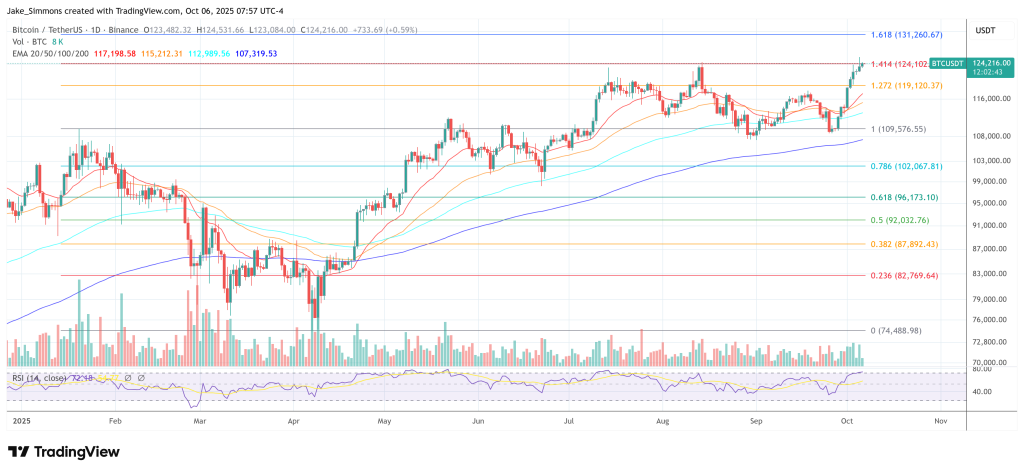
Bitcoin price
BTC remains above $124,000, 1-day chart | Source: BTCUSDT on TradingView.com
Featured image created with DALL.E, chart from TradingView.com
Editorial Process for bitcoinist is centered on delivering thoroughly researched, accurate, and unbiased content. We uphold strict sourcing standards, and each page undergoes diligent review by our team of top technology experts and seasoned editors. This process ensures the integrity, relevance, and value of our content for our readers.

Jake Simmons has been a Bitcoin enthusiast since 2016. Ever since he heard about Bitcoin, he has been studying the topic every day and trying to share his knowledge with others. His goal is to contribute to Bitcoin's financial revolution, which will replace the fiat money system. Besides BTC and crypto, Jake studied Business Informatics at a university. After graduation in 2017, he has been working in the blockchain and crypto sector. You can follow Jake on Twitter at @realJakeSimmons.

Related Reads

Hyperliquid "Invades" Wall Street: A Playground for On-Chain Whales, Facing Compliance Pressure Head-On

Hyperliquid, a leading decentralized exchange (Perp DEX) for perpetual futures, is gaining significant traction by expanding into traditional asset trading through its HIP-3 market, which includes commodities like WTI crude oil and stock indices. With a monthly trading volume of $173.4 billion and over 4.11 trillion in total volume—81% of which comes from the top 100 addresses—it has become a hub for institutional and professional traders rather than retail users. Recent geopolitical tensions, such as the U.S.-Iran conflict, have accelerated adoption, as Hyperliquid offers 24/7 price discovery even when traditional markets are closed. This growth occurs amid a broader shift of liquidity from centralized exchanges (CEX) to DEXs, with Perp DEX volumes surging 346% in 2025. However, Hyperliquid faces mounting regulatory challenges. The CFTC is expected to introduce policies for crypto perpetual futures in the U.S. within a month, which may force platforms like Hyperliquid to adopt stricter compliance measures, including KYC—potentially undermining their permissionless appeal. To navigate these issues, Hyperliquid established a policy center in Washington D.C., led by crypto lawyer Jake Chervinsky, aiming to shape DeFi regulation and ensure long-term legitimacy. The platform’s founders emphasize building a sustainable, financially neutral infrastructure, recognizing that compliance is essential for broader adoption in traditional finance.

marsbit33m ago

Hyperliquid "Invades" Wall Street: A Playground for On-Chain Whales, Facing Compliance Pressure Head-On

marsbit33m ago

Only xxx Can Save the Crypto World? Let 'Lobster' Play Prediction Markets

This article discusses recent hot topics in the crypto community, as shared by influencers on X (formerly Twitter). Key points include: - Debate around an AI arbitrage bot allegedly earning $98K on Polymarket using Claude. Skeptics point to potential survivorship bias, liquidity constraints, and the rapid decay of alpha once strategies are public. - A resource sharing over 11,000 high-quality image generation prompts for Nano Banana Pro. - Commentary on Venus Protocol, highlighting its vulnerability to repeated exploits, with a linked analysis of how to profit from a recent attack. - A controversial opinion piece by influencer @BTCdayu arguing that only Sam Bankman-Fried (SBF) can "save crypto." The author claims that despite SBF's crimes and 25-year sentence, his genius is needed to address current industry crises: VC-backed altcoins scamming users, Bitcoin miners pivoting to AI, broken tokenomics, and a lack of new narratives. SBF's background at Jane Street, his innovative FTX trading system, and his early bets on AI (like Anthropic) are cited as reasons he could drive integration between AI and crypto, potentially pushing BTC to $1 million. This sparked heated discussion, with replies noting the improbability of a pardon, SBF's likely shift to AI, and that this nostalgia reflects a bygone era of "capital, narrative, and runaway imagination." The article concludes with links to the news outlet's social channels. All content is presented as personal opinion and not investment advice.

比推1h ago

Only xxx Can Save the Crypto World? Let 'Lobster' Play Prediction Markets

比推1h ago

Trading

Spot
Futures
活动图片