Bitcoin At Risk? Simon Dixon Alleges BlackRock’s Hidden Takeover Plan

bitcoinistPublished on 2025-10-06Last updated on 2025-10-06

Abstract

In an interview with Bitcoin Archive’s Archie, early Bitcoiner and Bank to the Future co-founder Simon Dixon characterized the current...

Trusted Editorial content, reviewed by leading industry experts and seasoned editors. Ad Disclosure

In an interview with Bitcoin Archive’s Archie, early Bitcoiner and Bank to the Future co-founder Simon Dixon characterized the current moment as nothing less than “the Wall Street attack phase,” arguing that institutional finance is assembling the plumbing and incentives to pull customer coins into custodial wrappers—and, in crisis, separate investors from their bitcoin. “People underestimate what Wall Street is willing to do to take your Bitcoin,” he said. The essential defense, in his view, is unambiguous: “Bitcoin is money you can own, money you can spend, and money that has a fixed supply with a monetary policy that nobody can change.”

How BlackRock Is Allegedly Trying To Control Bitcoin

Dixon framed the last 14 years of Bitcoin’s history as a series of counter-attacks, from exchange failures to regulatory squeezes, culminating now in what he described as a two-tier system: bitcoin held in Wall Street custody—via ETFs, pensions, corporate treasuries and bitcoin-backed loans—and bitcoin held in self-custody. The danger, he argued, is not price manipulation forever, but engineered liquidity events designed to vacuum up coins from leveraged or custodial holders. “They can’t change the long-term price. The fixed supply is the fixed supply,” he said. “But they can do elaborate schemes to steal your Bitcoin.”

At the core of his thesis is the scale and reach of the modern asset-management complex. Dixon pointed to BlackRock’s centrality—its index weight across “20,000 companies,” its Aladdin risk platform used by large asset managers, and its proximity to policymaking—as symptomatic of a broader “financial-industrial complex.”

In Dixon’s telling, that complex has already rebuilt the crypto industry in its own image: first by presiding over (or benefiting from) a parade of high-profile implosions and banking disruptions like FTX and Celsius, then by shepherding a pro-ETF, pro-tokenization framework that channels retirement savings, insurance float and corporate balance sheets into custodial bitcoin exposure. “Through this tax efficiency plus individuals thinking about inheritance, we have essentially given the asset managers full control,” he claimed. The net effect, he warned, is the consolidation of coins into a few systemically important pools.

Archie challenged the causal chain between the 2022–2023 enforcement wave and spot ETF approvals, noting that Grayscale had to sue to win its conversion. Dixon acknowledged that “you have to take a few leaps” when reconstructing opaque policy sequences, but insisted the net result is plain: the industry was discredited and de-banked, only for a tightly regulated, Wall-Street-led version to emerge. He cited his inside view as a major creditor in the Celsius Chapter 11 as formative, saying that bankruptcy taught him how quickly “Bitcoin IOUs” become indistinguishable from the legacy system’s risks. “Anybody that’s left Bitcoin on an exchange and received a Bitcoin IOU… realizes the importance of the ability to self-custody,” he said.

The conversation repeatedly returned to leverage. Archie drew a distinction between the margin chains and rehypothecation that blew up in 2021–2022 and the long-duration, corporate-finance tools used by publicly listed “bitcoin operating companies,” arguing these are “night and day” in terms of systemic fragility. Dixon’s reply was that the real risk emerges when individually sensible structures are linked into a pipeline—ETFs and index funds directing flows, corporate debt and dividend commitments denominated in fiat, stablecoin credit interlacing with bitcoin-backed loans, distressed buyouts rolling assets into the largest public vehicles, and mining equities sitting inside the same index-fund complex.

“When you combine all of these different products together… you can then do this margin process,” he said. He sketched a scenario in which a severe drawdown triggers margin cascades and bankruptcy proceedings that deliver even more coins into a few custodial honeypots. “All you need to do to protect yourself when that event happens is own bitcoin in self-custody,” he said.

Beyond market structure, Dixon placed Bitcoin in a wider macro and geopolitical frame. He argued the United States is pursuing “fiscal dominance”—debt-financed spending that inflates away obligations—while a multipolar currency order accelerates. In that transition, he expects both gold and bitcoin to be instrumentalized. “Bitcoin is going to be placed at the very, very center of a future and upcoming currency war,” he said, asserting that the same financial-industrial network that shapes rates and credit will not hesitate to “engineer some kind of pump and dump cycle that resets the chessboard.” Whether or not readers accept that framing, his prescription does not waver: self-custody first.

Dixon also laid out a personal rule set forged across cycles: buy on a fixed cadence, hold coins in self-custody, and think in multi-year horizons. “Most people come in for number-go-ups,” he said, “but until they go through a disaster, then they realize that the money you can own and money you can spend is the real utility.” He urged viewers to build the operational competence of self-custody now—keys, inheritance planning, and disciplined accumulation—rather than outsourcing it to product wrappers that trade convenience for counterparty risk. “Everybody has to do it,” he said. “The skill of self-custody is something everyone has to do.”

Archie added two caveats for balance: allocate only capital you can leave untouched for at least four years, and remember to upgrade quality of life rather than “bask in the warmth of your UTXOs” indefinitely. Dixon agreed, stressing that the point of reducing financial anxiety is to live better, not to hoard at all costs. Still, he closed with urgency: “There will never be another five years like the five years ahead… In the next five years, you need to accumulate as much bitcoin as is humanly possible,” he said, adding his standard disclaimer—“not financial advice.”

At press time, BTC traded at $123,896.
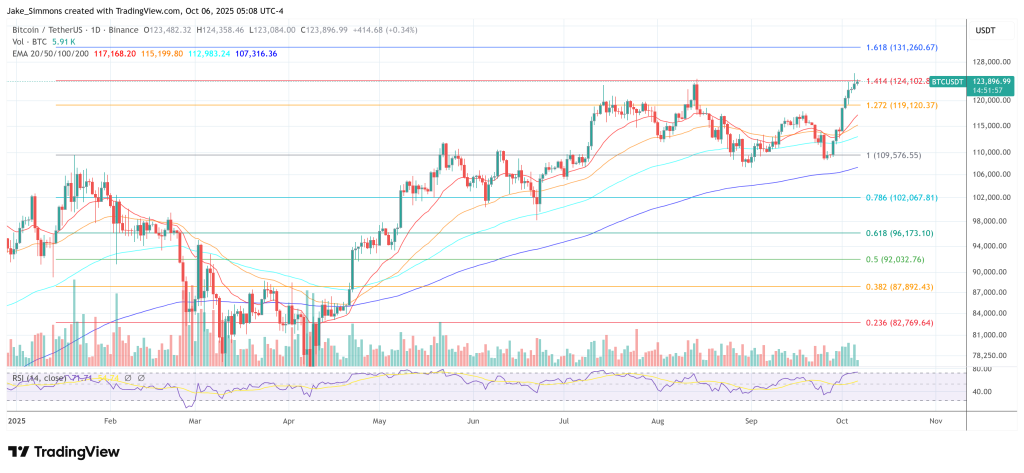
Bitcoin price
BTC hovers below $124,000, 1-day chart | Source: BTCUSDT on TradingView.com
Featured image created with DALL.E, chart from TradingView.com
Editorial Process for bitcoinist is centered on delivering thoroughly researched, accurate, and unbiased content. We uphold strict sourcing standards, and each page undergoes diligent review by our team of top technology experts and seasoned editors. This process ensures the integrity, relevance, and value of our content for our readers.

Jake Simmons has been a Bitcoin enthusiast since 2016. Ever since he heard about Bitcoin, he has been studying the topic every day and trying to share his knowledge with others. His goal is to contribute to Bitcoin's financial revolution, which will replace the fiat money system. Besides BTC and crypto, Jake studied Business Informatics at a university. After graduation in 2017, he has been working in the blockchain and crypto sector. You can follow Jake on Twitter at @realJakeSimmons.

Trending Cryptos

Related Reads

Shanghai's $10 Billion Unicorn Is About to Go Public

Shanghai-based automotive-grade millimeter-wave radar chip unicorn Calterah Microelectronics Technology (Shanghai) Co., Ltd. has filed for an IPO on Shanghai's STAR Market, aiming to raise 3.49 billion yuan. Founded in 2014 by Chen Jiashu, a UC Berkeley PhD graduate, and his professor Ali Niknejad, Calterah pioneered CMOS technology for 77GHz radar chips, breaking the decades-long monopoly of international giants like Texas Instruments. Its low-cost, highly integrated solutions enabled millimeter-wave radar to move from luxury to mass-market vehicles. By 2025, Calterah captured a 31.1% share in China's automotive millimeter-wave radar chip market (second domestically, fourth globally), with cumulative shipments exceeding 30 million units. Its client list includes BYD, Geely, Nio, and Volvo. The company has undergone 11 funding rounds, attracting high-profile investors such as the National Integrated Circuit Industry Investment Fund Phase II, China Capital Management, and GD Capital. Its valuation has reached tens of billions of yuan, with a projected post-IPO valuation of approximately 14 billion yuan. Despite rapid revenue growth—increasing from 206 million yuan in 2023 to 632 million yuan in 2025 with a 75.28% CAGR—Calterah remains unprofitable. It reported net losses of 323 million yuan, 334 million yuan, and 193 million yuan from 2023 to 2025, accumulating over 900 million yuan in losses over three and a half years. These losses are primarily attributed to heavy R&D investment, which totaled over 1.039 billion yuan in the reporting period, often exceeding annual revenue. The company faces significant risks, including high customer concentration (its top five customers accounted for over 99% of revenue from 2023-2025, with BYD alone representing over 50% in 2025) and supply chain concentration. Revenue pressure from key customers and dependencies on overseas suppliers for EDA tools and IP pose challenges to sustainable growth. The IPO is seen as crucial for securing capital to expand production, diversify its customer base, and reduce supply chain dependencies.

marsbit21m ago

Shanghai's $10 Billion Unicorn Is About to Go Public

marsbit21m ago

Ray Dalio's Latest Macro Analysis Full Text: Buy More Gold, Add Some Bitcoin

In his latest macro analysis, Ray Dalio applies his framework from "How Countries Go Broke: The Big Cycle" to the current global debt environment. He highlights recent events like Japan selling U.S. Treasuries and rising U.S. long-term yields as signs of an unsustainable debt dynamic. Dalio explains that excessive government debt leads to either unacceptably high interest rates, severe economic downturns, or significant currency debasement through central bank money printing. He summarizes the U.S. fiscal situation: with $5.5 trillion in revenue, $7.5 trillion in spending, a $2 trillion deficit, and total debt at six times annual revenue, debt servicing costs are immense. Without correction, U.S. debt could reach $55-$60 trillion in a decade. Dalio proposes a "3% Three-Way" solution: reducing the budget deficit to 3% of GDP through balanced spending cuts, tax increases, and interest rate reductions to avoid a traumatic adjustment. In response to FAQs, he argues that the risk of a U.S. debt crisis is high and could materialize within a few years if the current path continues. He dismisses the notion that the dollar's reserve status makes the U.S. immune, citing historical precedents of reserve currency declines. He is also unconvinced by Japan's high-debt stability, noting poor returns for yen-denominated assets. For investors, Dalio recommends diversifying globally, underweighting bonds, and overweighting assets like gold and a small allocation to Bitcoin (around 10-15% to gold) to hedge against currency debasement and poor debt returns.

marsbit1h ago

Ray Dalio's Latest Macro Analysis Full Text: Buy More Gold, Add Some Bitcoin

marsbit1h ago

Stripe’s 16-Year Chronicle: From 7 Lines of Code to a $100 Billion Valuation

Stripe's 16-year journey began with a simple promise: "7 lines of code to accept payments." Founded by Patrick and John Collison, the company started by hiding the complexity of bank integrations and merchant accounts behind a clean API, initially targeting developers at startups. This early focus on user experience and technical simplicity fueled rapid adoption. A key early milestone was establishing vital bank partnerships, a challenge overcome by hiring Billy Alvarado, who brought crucial institutional relationship skills. From this foundation, Stripe systematically expanded its product boundaries. It launched Connect for platform payments, Atlas for company formation, Radar for fraud prevention, and Billing for subscriptions. This transformed Stripe from a payment processor into a broader financial infrastructure suite for internet businesses. The COVID-19 pandemic accelerated growth but also led to over-hiring. A 14% layoff in 2022 marked a period of organizational correction. Subsequently, Stripe shifted its growth strategy towards strategic acquisitions to enter new domains quickly. It acquired Bridge (stablecoin infrastructure), Privy (wallet infrastructure), Metronome (usage-based billing), and agreed to buy OpenRouter (AI model routing). These moves signal Stripe's ambition to build a "programmable money system" for the emerging AI and agent-based economy, managing not just currency flows but also the measurement and pricing of computational resources like AI tokens. Internally, Stripe leverages AI agents (like "Minions") to boost engineering productivity. Despite scaling to nearly 8,000 employees and processing $1.9 trillion in payment volume annually, the company remains private. A recent employee tender offer valued it at $159 billion. The core question for Stripe's future is whether it can successfully integrate its expanding product matrix—spanning payments, crypto, and AI infrastructure—into a cohesive platform, positioning itself as the foundational economic layer for autonomous software agents.

marsbit1h ago

Stripe’s 16-Year Chronicle: From 7 Lines of Code to a $100 Billion Valuation

marsbit1h ago

Treasury Secretary's Move to Suppress Treasury Yields Ignites 'Currency Debasement Trade'! Gold Hits Three-Month High, Bitcoin Surges Over 25% in a Single Week

US Treasury Secretary Besant's efforts to lower long-term Treasury yields by announcing expanded buybacks had only a brief market impact. However, this move fueled a "currency devaluation trade," weakening the US dollar while boosting both gold (to a three-month high) and Bitcoin (up over 25% for the week). Analysts attribute this reaction to deepening market concerns over the massive US fiscal deficit and structural pressures keeping long-term rates elevated, including fierce competition for capital from global government borrowing and massive AI sector financing. Despite the Treasury's actions, fundamental forces like growth, inflation, and capital demand are seen as limiting its ability to sustainably suppress yields. Bitcoin's strong positive correlation with gold has reinforced its narrative as a hedge against devaluation. While equity markets have shown resilience, some strategists warn that Treasury yields nearing 5% increase pressure on the dollar and high-leverage assets. Figures like Ray Dalio have advised reducing bond exposure in favor of gold and some Bitcoin, citing US debt risks. Market opinions are divided on the sustainability of the devaluation trade, with some noting the lack of a near-term catalyst for its next leg higher. The underlying tension between the Treasury's desire for lower borrowing costs and the Federal Reserve's focus on inflation and reducing market intervention remains a key theme. Upcoming events like Nvidia's earnings and the Jackson Hole symposium will test whether AI profits can continue supporting stocks and if the Fed aligns more with Washington's preference for easier financial conditions.

华尔街日报3h ago

Treasury Secretary's Move to Suppress Treasury Yields Ignites 'Currency Debasement Trade'! Gold Hits Three-Month High, Bitcoin Surges Over 25% in a Single Week

华尔街日报3h ago

Trading

Spot

Hot Articles

What is $BITCOIN

DIGITAL GOLD ($BITCOIN): A Comprehensive Analysis Introduction to DIGITAL GOLD ($BITCOIN) DIGITAL GOLD ($BITCOIN) is a blockchain-based project operating on the Solana network, which aims to combine the characteristics of traditional precious metals with the innovation of decentralized technologies. While it shares a name with Bitcoin, often referred to as “digital gold” due to its perception as a store of value, DIGITAL GOLD is a separate token designed to create a unique ecosystem within the Web3 landscape. Its goal is to position itself as a viable alternative digital asset, although specifics regarding its applications and functionalities are still developing. What is DIGITAL GOLD ($BITCOIN)? DIGITAL GOLD ($BITCOIN) is a cryptocurrency token explicitly designed for use on the Solana blockchain. In contrast to Bitcoin, which provides a widely recognized value storage role, this token appears to focus on broader applications and characteristics. Notable aspects include: Blockchain Infrastructure: The token is built on the Solana blockchain, known for its capacity to handle high-speed and low-cost transactions. Supply Dynamics: DIGITAL GOLD has a maximum supply capped at 100 quadrillion tokens (100P $BITCOIN), although details regarding its circulating supply are currently undisclosed. Utility: While precise functionalities are not explicitly outlined, there are indications that the token could be utilized for various applications, potentially involving decentralized applications (dApps) or asset tokenization strategies. Who is the Creator of DIGITAL GOLD ($BITCOIN)? At present, the identity of the creators and development team behind DIGITAL GOLD ($BITCOIN) remains unknown. This situation is typical among many innovative projects within the blockchain space, particularly those aligning with decentralized finance and meme coin phenomena. While such anonymity may foster a community-driven culture, it intensifies concerns about governance and accountability. Who are the Investors of DIGITAL GOLD ($BITCOIN)? The available information indicates that DIGITAL GOLD ($BITCOIN) does not have any known institutional backers or prominent venture capital investments. The project seems to operate on a peer-to-peer model focused on community support and adoption rather than traditional funding routes. Its activity and liquidity are primarily situated on decentralized exchanges (DEXs), such as PumpSwap, rather than established centralized trading platforms, further highlighting its grassroots approach. How DIGITAL GOLD ($BITCOIN) Works The operational mechanics of DIGITAL GOLD ($BITCOIN) can be elaborated on based on its blockchain design and network attributes: Consensus Mechanism: By leveraging Solana’s unique proof-of-history (PoH) combined with a proof-of-stake (PoS) model, the project ensures efficient transaction validation contributing to the network's high performance. Tokenomics: While specific deflationary mechanisms have not been extensively detailed, the vast maximum token supply implies that it may cater to microtransactions or niche use cases that are still to be defined. Interoperability: There exists the potential for integration with Solana’s broader ecosystem, including various decentralized finance (DeFi) platforms. However, the details regarding specific integrations remain unspecified. Timeline of Key Events Here is a timeline that highlights significant milestones concerning DIGITAL GOLD ($BITCOIN): 2023: The initial deployment of the token occurs on the Solana blockchain, marked by its contract address. 2024: DIGITAL GOLD gains visibility as it becomes available for trading on decentralized exchanges like PumpSwap, allowing users to trade it against SOL. 2025: The project witnesses sporadic trading activity and potential interest in community-led engagements, although no noteworthy partnerships or technical advancements have been documented as of yet. Critical Analysis Strengths Scalability: The underlying Solana infrastructure supports high transaction volumes, which could enhance the utility of $BITCOIN in various transaction scenarios. Accessibility: The potential low trading price per token could attract retail investors, facilitating wider participation due to fractional ownership opportunities. Risks Lack of Transparency: The absence of publicly known backers, developers, or an audit process may yield skepticism regarding the project's sustainability and trustworthiness. Market Volatility: The trading activity is heavily reliant on speculative behavior, which can result in significant price volatility and uncertainty for investors. Conclusion DIGITAL GOLD ($BITCOIN) emerges as an intriguing yet ambiguous project within the rapidly evolving Solana ecosystem. While it attempts to leverage the “digital gold” narrative, its departure from Bitcoin's established role as a store of value underscores the need for a clearer differentiation of its intended utility and governance structure. Future acceptance and adoption will likely depend on addressing the current opacity and defining its operational and economic strategies more explicitly. Note: This report encompasses synthesised information available as of October 2023, and developments may have transpired beyond the research period.

2.0k Total ViewsPublished 2025.05.13Updated 2025.05.13

What is $BITCOIN

Discussions

Welcome to the HTX Community. Here, you can stay informed about the latest platform developments and gain access to professional market insights. Users' opinions on the price of BTC (BTC) are presented below.

活动图片















