Helius Takes First Step In Solana Treasury With $175 Million Purchase

bitcoinistPublished on 2025-09-24Last updated on 2025-09-24

Abstract

Helius Medical Technologies has officially kick-started its Solana (SOL) treasury strategy with an initial acquisition of 760,190 tokens. Helius Has...

Trusted Editorial content, reviewed by leading industry experts and seasoned editors. Ad Disclosure

Helius Medical Technologies has officially kick-started its Solana (SOL) treasury strategy with an initial acquisition of 760,190 tokens.

Helius Has Started Buying Solana With Its $500 Million Raise

As announced in a press release, Helius Medical Technologies has completed its first Solana purchase for its digital asset treasury strategy. In total, the company has acquired 760,190 SOL at an average price of $231 per token, spending about $175 million.

Originally a neurotech company, Helius Medical Technologies adopted a strategy focused on accumulating SOL earlier this month. Just a few days ago, the firm revealed that it had raised over $500 million for its digital asset treasury through a private placement offering.

Among the key backers were Pantera Capital, an American venture capital and hedge fund specializing in blockchain and digital assets, and Summer Capital, a Hong Kong-headquartered investment firm.

Joseph Chee, Executive Chairman at Helius, said:

It has been gratifying to receive shows of support from multiple stakeholders across the Solana ecosystem, including staking providers, DeFi protocols and others. We take our responsibility to maximize shareholder value seriously and are eager to execute against our plan.

With the latest purchase, Helius has begun deploying the raised capital into Solana. The company still has $335 million sitting in cash reserves for further treasury expansions, along with the potential to raise another $750 million if the stapled warrants from its private placement are exercised.

The press release noted that, besides SOL being among the top coins in on-chain activity-related metrics, it’s also financially productive by design, thanks to its 7% native staking yield.

Helius added:

As an independent treasury company, HSDT’s mission is to support the growth and security of tokenized networks by serving as a long-term holder of $SOL, in addition to continuing the development of its neurotech and medical device operations

The NASDAQ-listed neurotech firm isn’t the only one to pivot to a Solana treasury this month. Forward Industries, a company focused on design and manufacturing, also adopted a SOL strategy and closed a private investment in public equity (PIPE) earlier in September, raising $1.65 billion.

The financing was led by three key players in Galaxy Digital, Multicoin Capital, and Jump Crypto. Last Monday, the firm executed its first purchase worth $1.58 billion, instantly becoming the largest SOL treasury holder in the world.

In some other news, analytics firm Santiment has shared an update on how projects in the Solana ecosystem compare against each other in terms of the Development Activity metric.
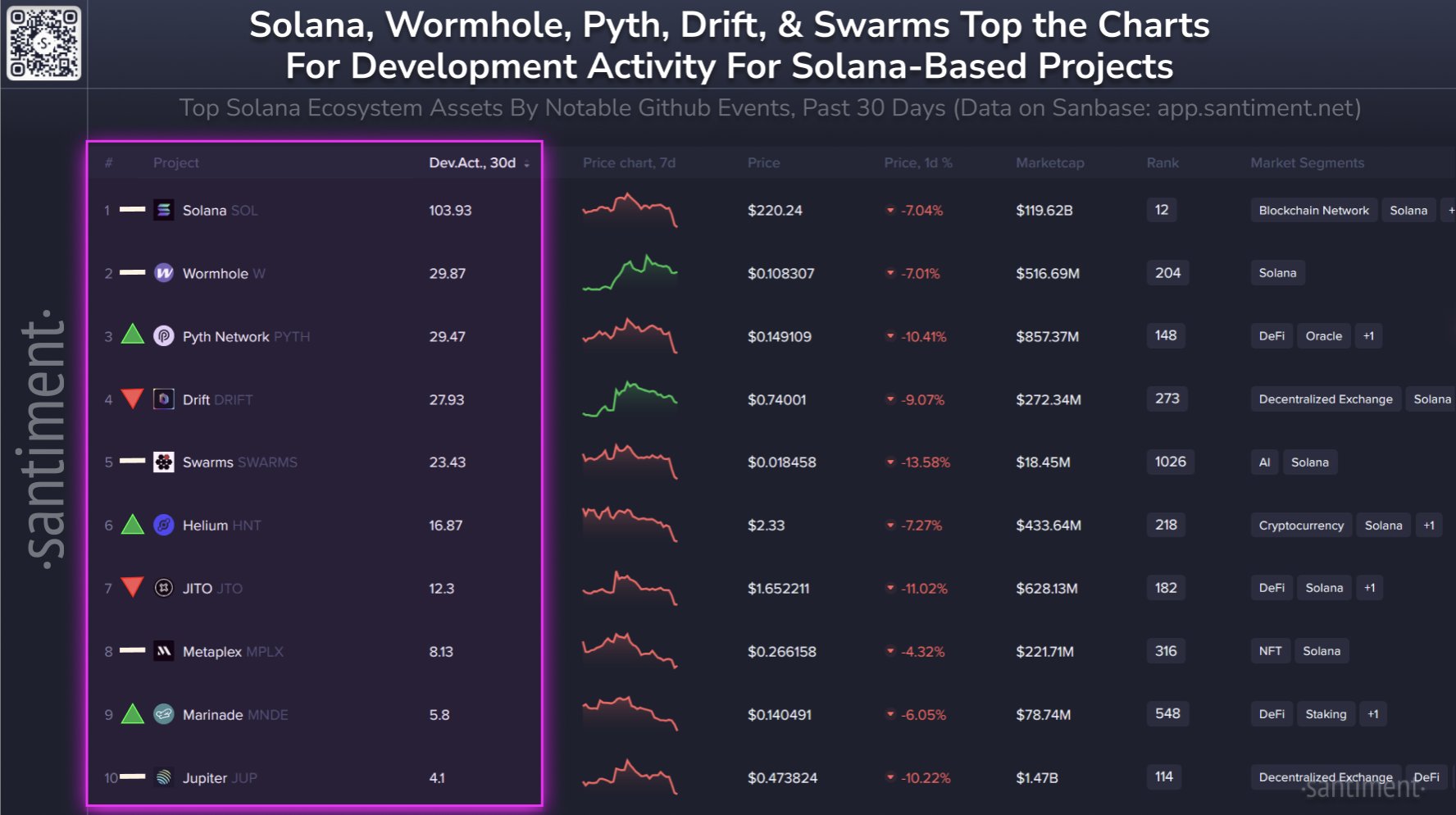
Solana Development Activity

The ranking of the SOL ecosystem projects on the basis of 30-day Development Activity | Source: Santiment on X

From the table, it’s visible that SOL continues to be the top-ranked coin with its developers putting in the most work on the project’s public GitHub repositories. Wormhole (W) and Pyth Network (PYTH) follow in second and third, respectively.

SOL Price

At the time of writing, Solana is trading around $218, down over 7% in the last week.

Solana Price Chart

Looks like the price of the coin has slipped down over the last few days | Source: SOLUSDT on TradingView
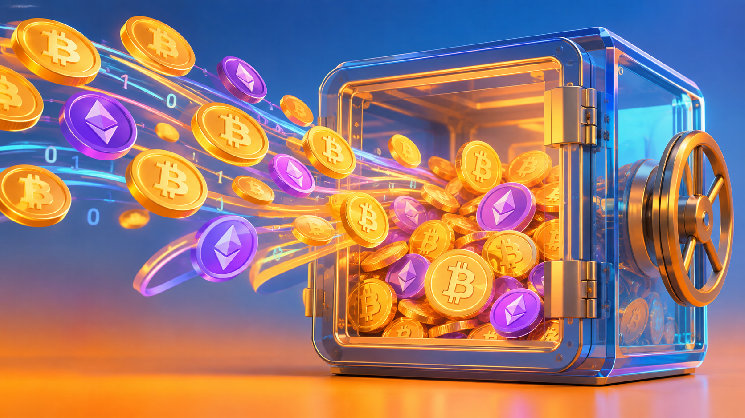
Featured image from Dall-E, Santiment.net, chart from TradingView.com
Editorial Process for bitcoinist is centered on delivering thoroughly researched, accurate, and unbiased content. We uphold strict sourcing standards, and each page undergoes diligent review by our team of top technology experts and seasoned editors. This process ensures the integrity, relevance, and value of our content for our readers.

Keshav is a Physics graduate who has been employed as a writer with Bitcoinist since June 2021. He is passionate about writing and through the years, he has gained experience working in a variety of niches. Keshav holds an active interest in the cryptocurrency market, with on-chain analysis being an area he particularly likes to research and write about.

Related Reads

Jensen Huang's Daughter: From Chef to an $8 Million Annual Salary

Madison Huang, daughter of NVIDIA founder Jensen Huang, recently made a rare public appearance in Beijing during the 2026 World Robot Conference. As the Senior Director of Product and Technology Marketing for NVIDIA's Physical AI Platform, with an annual salary of approximately $1.2 million, her visit focused on evaluating leading Chinese robotics companies like UBTech, Unitree, and others. This highlights NVIDIA's strategic interest in the burgeoning Chinese robotics ecosystem, a key battleground for the development of Physical AI—technology that enables machines to understand and interact with the physical world. Huang's career path is unconventional. Initially pursuing her passion, she studied culinary arts, worked as a chef, and later held a marketing role at LVMH. She joined NVIDIA as an intern in 2020 after completing an MBA, quickly rising through the ranks. Her brother, Spencer Huang, followed a similar path, closing a cocktail bar he co-founded to also join NVIDIA, where he now works on robotics software. Jensen Huang has publicly addressed nepotism concerns, humorously noting that some "second-generation" employees outperform their parents. The conference itself underscored China's vibrant robotics sector, marked by Unitree's recent blockbuster IPO and a pipeline of companies preparing to go public. While hardware development and manufacturing are advancing rapidly, industry leaders like Wang Xingxing of Unitree point to the next critical challenge: developing the "brain" or AI that allows robots to perform diverse, unseen tasks based on simple instructions. With massive manufacturing scale and diverse real-world testing scenarios, China is positioned as a central player in the global race to define the future of robotics.

marsbit13m ago

Jensen Huang's Daughter: From Chef to an $8 Million Annual Salary

marsbit13m ago

He Gave Wang Xingxing the First 2 Million, Now Serves as Chairman for the Next 'Unitree'

On August 19, 2024, Unitree Robotics, China's "first humanoid robotics stock," went public. Its founder, Wang Xingxing, started a decade ago with his self-developed XDog. In 2016, at a critical funding juncture, he received his first angel investment of 2 million RMB from Yin Fangming. This bet has since yielded a return of over 140 times. Yin Fangming is more than just a key investor. He was a co-founder of the AI robotics company ROOBO, whose own venture ultimately struggled. This firsthand experience with the hardware challenges in robotics gave him unique insight when backing Unitree, a company renowned for its hardware R&D and cost control. While his own company faltered, Yin continued investing shrewdly. He partially cashed out some Unitree shares early, reinvesting the proceeds into sectors like energy (e.g., solid-state battery firm TaiLan) and commercial aerospace (e.g., small launch vehicle developer XianDeng Aerospace). However, his most significant move after Unitree is his deep involvement with Galaxy General, a leading embodied AI unicorn. In July 2024, Yin stepped from behind the scenes to officially become its Chairman, indicating a role far beyond a typical investor. This comes as Galaxy General is viewed as preparing for future capital moves. Yin's career has consistently been ahead of the curve—from mobile internet to AI and robotics. Known for his foresight and low profile, he declined an interview for this story, offering only a statement encouraging support for visionary entrepreneurs like Wang Xingxing.

marsbit28m ago

He Gave Wang Xingxing the First 2 Million, Now Serves as Chairman for the Next 'Unitree'

marsbit28m ago

Coldcard Theft Reflection: Source Code Visibility Does Not Equal Security

The article examines the open-source vs. closed-source debate in crypto, prompted by a theft of over $100M in Bitcoin from Coldcard hardware wallets. It clarifies key terminology: true "Free and Open Source Software" (FOSS) grants four essential freedoms (use, study, share, modify), while "source available" code, like Coldcard's firmware, may have usage restrictions. The piece argues that visible source code alone does not guarantee security; actual safety depends on the economic incentives for thorough, ongoing review by skilled individuals. Using Bitcoin Core as a model, the article describes a successful, transparent open-source development culture built on public review and consensus. It contrasts this with the Coldcard case, where a critical bug in a lightly-reviewed, source-available library went undetected for years, highlighting a "tragedy of the commons" scenario where assumed but absent scrutiny creates vulnerability. The economics of licensing are crucial: restrictive licenses can limit the pool of motivated commercial reviewers. Finally, the article explores AI's impact. It cites the Bitcoin Red Team's use of AI to rapidly audit codebases and find vulnerabilities at scale, demonstrating a powerful new tool for security. However, AI also floods projects with low-quality code, straining maintainers. The piece concludes that in high-stakes crypto, only well-audited projects—whether open or closed-source—can withstand evolving threats, with AI both challenging and aiding security practices.

marsbit38m ago

Coldcard Theft Reflection: Source Code Visibility Does Not Equal Security

marsbit38m ago

Trading

Spot
活动图片