Прогноз цены Ethereum (ETH) на 23 сентября 2025 г.

cryptonews.ruPublished on 2025-03-21Last updated on 2025-09-22

  • Цена Ethereum сегодня торгуется на уровне $4096 после резкого пробоя уровня поддержки $4300, протестировав зону $4000–$3950.
  • Данные сети показывают чистый отток средств в размере 274 млн долларов США 22 сентября, что является одним из крупнейших однодневных изъятий в этом квартале.
  • Приток средств в ETF на Ethereum на прошлой неделе достиг $1,12 млрд, при этом лидером по накоплению является BlackRock, несмотря на медвежьи потоки спотового рынка.

Цена Ethereum сегодня торгуется вблизи $4096, снизившись почти на 5% после резкой распродажи, которая привела к снижению уровня поддержки до $4300. Это произошло, несмотря на сильный приток средств в ETF на прошлой неделе, что подчеркивает противоречие между институциональным накоплением и значительным оттоком средств со спотовых бирж.

Цена Ethereum преодолевает ключевую поддержку

Цена ETH пробивает ключевую зону поддержки (Источник: TradingView)

На 4-часовом графике видно, как ETH падает ниже зоны спроса $4300–$4350, что приводит к срабатыванию стоп-ордеров и снижению цены до минимума $4096. Это падение пробило 20-дневную EMA на уровне $4440 и 50-дневную EMA на уровне $4473, оставив сопротивление $4665 в качестве отдалённого препятствия.

Уровень поддержки тренда сейчас находится ниже, в районе $4000–$3950, а зоны спроса, если продавцы сохранят контроль, более глубокие — около $3800 и $3600. С другой стороны, покупателям потребуется вернуть $4440 и $4537, чтобы стабилизировать динамику.

Related: Solana (SOL) Price Prediction For September 23

Точки Parabolic SAR остаются выше цены, сигнализируя о продолжении медвежьего тренда. Импульс снижается, хотя более широкая 200-дневная EMA на уровне $3992 продолжает служить долгосрочной опорной точкой для ценовой динамики ETH.

Потоки внутри цепочки демонстрируют сильный отток
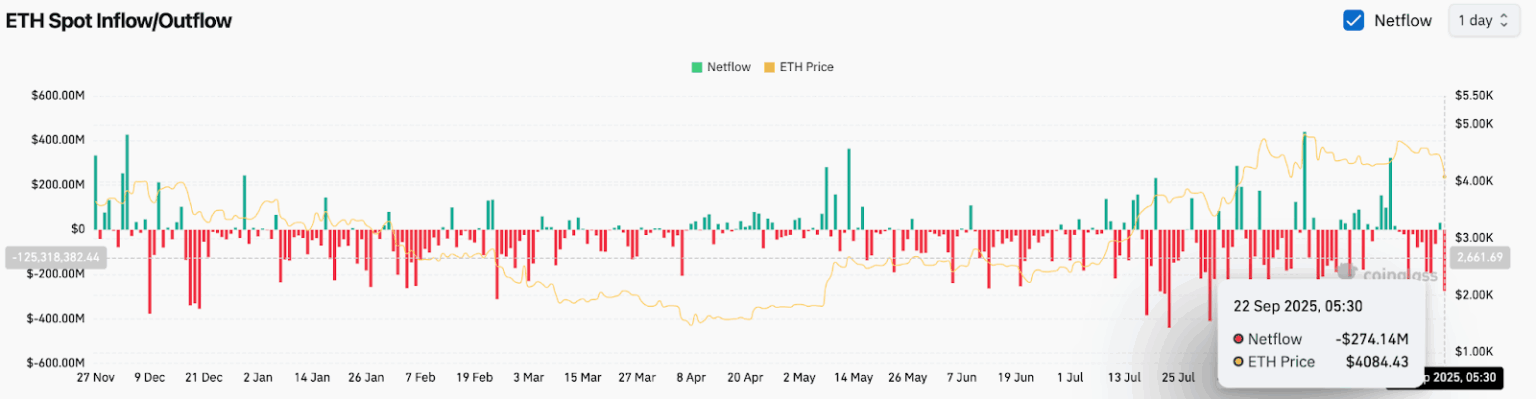
Netflows ETH (Источник: Coinglass)

Данные Coinglass по биржам рисуют пессимистичную картину. 22 сентября чистый отток средств со спотовых бирж Ethereum составил 274 миллиона долларов, что стало одним из крупнейших однодневных выводов в этом квартале. Постоянный отрицательный чистый отток создал давление на ликвидность, что объясняет резкий рост волатильности цены Ethereum во время последнего обвала.

Потоки свидетельствуют о том, что крупные держатели снижают риск после снижения до $4700, несмотря на то, что институциональные покупки через ETF продолжаются. Без разворота ончейн-трендов риск снижения до $3950 остаётся высоким.

ETF обеспечивают сильный приток средств

ETFs bought $2.3 billion worth of $BTC and $ETH last week.

👉 Bitcoin ETFs added about $1.27B in inflows
👉 Ethereum ETFs brought in another $1.12B

Out of this, BlackRock alone accounted for $1.7B

This is one of the strongest weekly waves of institutional buying we’ve seen… pic.twitter.com/Tj8ZDeUgpi

— Cas Abbé (@cas_abbe) September 22, 2025

Несмотря на медвежий поток спотовых активов, ETF продолжают выполнять роль буфера. Данные показывают, что ETF на базе Ethereum поглотили более 1,12 млрд долларов на прошлой неделе, в основном за счёт доли BlackRock в совокупном притоке BTC и ETH в размере 2,3 млрд долларов. Эта институциональная волна знаменует собой одну из самых сильных недель с июля, что свидетельствует о растущем интересе инвесторов.

Related: Dogecoin (DOGE) Price Prediction For September 23

Аналитики отмечают, что устойчивый спрос на ETF может помочь компенсировать ослабление фондового рынка. Если этот структурный сдвиг сохранится, он может ограничить падение и подготовить рынок к новому прорыву после того, как спотовые продавцы исчерпают предложение.

Технический прогноз цены Ethereum

Прогноз цены Ethereum на ближайшую перспективу зависит от восстановления ключевых скользящих средних:

  • Upside levels: $4,300, $4,440, and $4,665 as immediate resistance zones. A break above $4,665 would open the door to $4,820 and $5,000.
  • Уровни снижения: $4000, $3950 и $3800 — основные зоны защиты. Потеря $3800 грозит более глубоким откатом к $3600.
  • Поддержка тренда: 200-дневная EMA на уровне $3992 остается структурным уровнем для ценового движения ETH.

Перспективы: вырастет ли курс Ethereum?

Перспективы Ethereum зависят от того, сможет ли приток ETF перевесить значительный отток спотовых активов, который и стал причиной последнего падения. Пока ETH удерживается в диапазоне $3950–$4000, более широкий бычий цикл сохраняется. Решительное закрытие выше $4440 восстановит доверие и побудит импульсных трейдеров нацелиться на $4665 и выше.

Related: Avantis Price Prediction: Can AVNT Sustain Momentum After $10M Spot Inflows?

Сейчас трейдеры сталкиваются с проблемой перетягивания каната между институциональным накоплением и ликвидацией, инициированной биржами. Цена Ethereum сегодня находится под давлением, но устойчивый приток средств в ETF предполагает, что любая стабилизация выше $4000 может подготовить почву для нового отскока к $4700 в ближайшие недели.


Trending Cryptos

Related Reads

Generating Profits for Seven Consecutive Quarters, Emerging Markets Carry Trade Outperforms Everything

For the seventh consecutive quarter, dollar-funded emerging market carry trades have delivered positive returns, marking the longest winning streak since 2008. According to Bloomberg's index, this strategy has gained approximately 22% since late 2024, outperforming U.S. Treasuries, emerging market sovereign, and corporate dollar debt. The core of the trade involves borrowing low-interest currencies like the U.S. dollar, euro, or yen to invest in high-yielding emerging market assets, such as Turkish lira bonds offering over 40% returns. Returns were amplified by favorable currency moves, with the dollar weakening against most emerging market currencies and other traditional funding currencies. For instance, the trade gained 48% on the Colombian peso in the past year. A key test came in August 2024 with a historic joint U.S.-Japan currency intervention, which caused only a modest 1% dip in the carry trade risk premium as investors shifted funding from the yen to the euro and Swiss franc. Looking ahead, the primary risk is the timing of Federal Reserve policy changes. While persistent inflation allows the Fed to hold rates, a rapid rise in long-term U.S. yields could threaten the trade. Another concern is crowding, as massive inflows increase vulnerability to a sudden reversal. High interest rates in regions like Latin America and Eastern Europe, supported by external factors like Middle East tensions and energy prices, continue to sustain the opportunity. Major investors remain engaged, favoring currencies like the Mexican peso, South African rand, and Turkish lira.

marsbit5m ago

Generating Profits for Seven Consecutive Quarters, Emerging Markets Carry Trade Outperforms Everything

marsbit5m ago

Unpacking the Truth Behind On-chain Assets: Leverage, Liquidity, and Risk

The article analyzes the concept of "real-world asset" (RWA) tokenization, arguing that while tokenizing assets on-chain is a useful step, it is far from transformative on its own. The author compares it to placing a barcode on a shipping container—it enables identification but does not build the necessary market infrastructure. The core argument is that true value emerges not from tokenization, but from integrating these tokens into DeFi systems where they can be valued, financed, hedged, traded, and liquidated under stress. Key challenges identified include: 1. **Multiple Time Clocks**: A fundamental tension exists between blockchain's 24/7 settlement and the slower, business-hour-dependent processes of traditional markets, custody, and redemption. This "duration mismatch" can create dangerous liquidity gaps during crises. 2. **Liquidity Misconceptions**: True liquidity is not measured by Total Value Locked (TVL) or trading pairs, but by the ability to exit a position within a required timeframe at an acceptable price. It requires analyzing multiple exit paths and stress-testing scenarios. 3. **Leverage and Risk**: Leverage unlocks economic utility (e.g., using tokenized assets as collateral) but also introduces fragility. Risk models must account for more than asset volatility, incorporating factors like legal enforceability, oracle freshness, and market structure. Paradoxically, a "safer" asset like tokenized Treasury bonds could require a higher collateral discount than ETH due to slower, less-proven liquidation mechanisms. 4. **A Risk Graph**: RWA risk should be modeled as a network of interconnected dependencies (e.g., issuers, custodians, oracles, stablecoin pools), not a single score. Failures can propagate through this graph, turning operational issues into systemic liquidity crises. The article states that tokenized government bonds are merely an entry point, while more complex frontiers like computing power and energy assets present greater challenges and opportunities. It also examines the interplay and risks between tokenized stocks and perpetual futures contracts. The conclusion is that the future lies not in "tokenizing everything," but in building robust market layers where tokenized rights become resilient financial primitives within a programmable capital system. The token is just the barcode; the market is the machine.

marsbit30m ago

Unpacking the Truth Behind On-chain Assets: Leverage, Liquidity, and Risk

marsbit30m ago

The End of Mathematics: 40 Top Mathematicians Gather at Secret OpenAI Meeting

In August 2026, OpenAI hosted a closed-door summit with approximately 40 leading mathematicians, including recent Fields Medalist Jacob Tsimerman and OpenAI researcher Sébastien Bubeck. The meeting, spurred by a series of recent AI breakthroughs in mathematics, grappled with the potential existential threat AI poses to the field. The backdrop includes several high-profile AI achievements: OpenAI models disproving long-standing conjectures like the unit distance problem, generating 10 new mathematical discoveries, and Anthropic's Claude aiding in constructing complex multidimensional objects. These results often bypass traditional academic pipelines, appearing directly on social media. The mathematical community is divided. Over 3000 researchers signed the "Leiden Statement," advocating for responsible AI use and verification. Others resist AI entirely to preserve human-centric mathematics. A key concern is AI's current inability to *explain* proofs, particularly the difficult steps, which is central to mathematical understanding. At the summit, Bubeck outlined four potential futures: mathematics becoming like collaborative software engineering, a compute-driven field like physics, a curatorial exercise where humans interpret AI output, or a mass transition of mathematicians into AI safety. While emphasizing that "mathematics only makes sense when mathematicians learn from it," no consensus was reached. The event highlights a profound moment of reflection. As AI demonstrates increasing competence in solving complex problems, mathematicians are forced to question their future role and the very meaning of their discipline.

marsbit34m ago

The End of Mathematics: 40 Top Mathematicians Gather at Secret OpenAI Meeting

marsbit34m ago

Trading

Spot

Hot Articles

Discussions

Welcome to the HTX Community. Here, you can stay informed about the latest platform developments and gain access to professional market insights. Users' opinions on the price of ETH (ETH) are presented below.

活动图片