The $10 Million Bitcoin Roadmap: Eric Yakes Explains The Path

bitcoinistPublished on 2025-09-12Last updated on 2025-09-12

Abstract

On the latest episode of What Bitcoin Did, Eric Yakes, co-founder of Epoch, a Bitcoin Venture Capital firm, laid out...

Trusted Editorial content, reviewed by leading industry experts and seasoned editors. Ad Disclosure

On the latest episode of What Bitcoin Did, Eric Yakes, co-founder of Epoch, a Bitcoin Venture Capital firm, laid out a sweeping—if controversial—thesis for how Bitcoin could reach $10 million per coin, arguing the asset is powered by a unique mass movement, a shifting geopolitical reserve regime, and an institutional bid that is still in its early innings. “Bitcoin is going to be at $10 million in probably like seven years,” Yakes said, adding that the market is “always and everywhere like one major press release away from a huge change in the perception of it.”

The Path To $10 Million For Bitcoin

Yakes’ starting point is qualitative, not quantitative. In his view, Bitcoin’s defining edge is sociological: “No other asset has a mass movement or a revolution backing it.” He likens the phenomenon to a secular “perennial bid” that shows up whenever prices weaken—“our own ‘Fed put,’” as he put it—rooted in conviction buyers who treat the asset as a political and monetary hedge rather than a mere trade. To explain the durability of such movements, he reached for Eric Hoffer’s classic The True Believer, arguing Bitcoin has already progressed from “men of words” (the cypherpunks) through the “fanatics” who evangelized in the early years and is now entering a phase dominated by “men of action”—operators and executives consolidating and scaling the movement’s gains.

That cultural shift, he said, is colliding with a new adoption curve. Where the 2017 cycle skewed retail, the current regime is being shaped by corporates, asset managers and, increasingly, states. Yakes framed Wall Street’s embrace as a narrative unlock as much as a flow story. He cited BlackRock’s research popularized during the ETF push and said the firm’s Bitcoin fund became “one of the most profitable products” in short order.

More broadly, he argued that many wealth managers are moving from dismissive to neutral-positive, experimenting with 1–2% allocations while watching for signs that Bitcoin’s correlation profile durably decouples from risk assets. “The second we do really get gold-like characteristics in the correlation,” he said, “that’s when that 1–2% turns to 30% pretty quickly”—a shift he believes would rapidly cannibalize gold’s investable market.

Politics, in his telling, is now tailwind rather than headwind. Talking about US President Donald Trump and the strategic Bitcoin reserve, Yakes said that the explicit presidential support is more important than whether the government actually buys coins. “What’s the most powerful thing that he’s done? The signaling,” Yakes said, arguing that once backing Bitcoin ceases to be reputationally costly, institutional adoption compounds. He acknowledged criticisms that symbolic gestures are not policy, but stressed that markets run on narratives: elite endorsement shrinks career risk, expands the buyer set and reduces volatility through systematic, rules-based inflows.

The Post-2022 Macro Shift

Yakes’ macro scaffolding is built around the post-2022 shift in global reserves. Sanctions risk, he argued, has accelerated a move from holding other nations’ liabilities toward holding commodities. He expects official sectors to keep accumulating gold and, over time, to add Bitcoin as a “synthetic commodity” with superior portability and seizure resistance—albeit only after market depth grows. The constraint, he emphasized, is liquidity: sovereigns need to move tens or hundreds of billions without intolerable slippage, which means Bitcoin’s market structure must continue to thicken before state balance sheets can own it in size.

Corporate treasuries are, in his view, a necessary bridge. Yakes noted that a modest shift of cash from the largest US corporates—“put 15% of the top ten’s cash into Bitcoin”—could match or exceed spot-ETF demand, with potentially outsized price impact because Bitcoin’s supply “doesn’t respond to demand.” The price, he reminded, is set at the margin where incremental buying meets a base of increasingly inelastic holders, and “narrative determines” how willing those holders are to sell at any given level.

The roadmap also runs through banks and stablecoins. Yakes argued that stablecoins have already disintermediated major parts of the traditional “two-tier” money system by translating short-duration government debt into on-chain dollars. He criticized US rules that forbid stablecoin issuers from paying interest as a ring-fence to protect banks, but predicted a bifurcation between onshore, bank-integrated “tokenized deposits” and offshore stablecoins that compete on yield and reserve composition.

In that competitive landscape, he expects Bitcoin to penetrate reserve baskets over time—citing Tether’s reported allocation to BTC—because issuers will seek “superior risk-adjusted collateral” to out-yield rivals. If users notice their stablecoin provider is capturing the Bitcoin upside while paying them a lower yield, he argued, that becomes the Trojan-horse moment when people “flip the switch” and hold more native BTC.

Yakes tied this to a nascent, Bitcoin-native “term structure of interest rates”—a concept popularized by Nick Batia—emerging from Lightning routing fees, liquidity leases and other on-chain funding primitives. He pointed to early datapoints, from single-digit routing yields to higher returns reported by large nodes in siloed environments, as evidence of a developing capital market that treasury companies and banks will eventually tap. The direction of travel, he said, is clear: “The margins are better in Bitcoin.” Repealing roadblocks like SAB 121 and green-lighting bank custody would accelerate that migration.

What Could Go Wrong For Bitcoin?

The interview did not dodge risks. Host Danny Knowles pressed on the prospect that Bitcoin’s monetary freedoms get corralled into a KYC-only, surveillance-heavy regime, leaving a neutered “store-of-value product” managed by a handful of custodians. Yakes conceded the danger—calling ETF custody concentration a “real thing to monitor”—but argued that incentives and game theory cut against long-run cartelization.

Institutions, he said, face a prisoner’s-dilemma: defecting in favor of the network’s neutrality and the goodwill of node-running users will often be more profitable than coordinating to capture it. He returned repeatedly to first principles: if permissionless global money is in fact the highest-value use case, the largest profit pools will accrue to those who preserve that property, not those who smother it.

On the oft-debated sequence—store of value, medium of exchange, unit of account—Yakes rejects the idea that advocates must “make” people spend Bitcoin today. Money, he said, emerges because everyone already holds it. As ownership diffuses, sellers will begin to demand it, and usage will follow. “It’s becoming this thing where everybody’s like, ‘I should probably have a little bit of money in Bitcoin.’ And that’s how it becomes something everybody has,” he said. At that point, Gresham-like dynamics take over: people hoard the harder money and spend the softer one until counterparties increasingly require payment in the harder form.

Yakes’ $10 million call rests less on a single trigger than on cumulative, compounding unlocks. He expects correlation shifts to draw larger portfolio weights from asset managers; corporate treasuries to widen the buyer base and thicken two-way markets; stablecoins and bank rails to normalize cryptographic settlement while quietly seeding Bitcoin into reserves; and geopolitics to push sovereigns toward assets that are both neutral and portable.

The timetable is deliberately bold. But the mechanism, he insisted, is straightforward: fixed supply, rising legitimacy, broadening distribution and a movement that does not go away. “Everything’s in our favor and nothing’s going to be able to stop this,” he said, adding “Bitcoin is something that could get to $10 million easily within the next 10 years. If I were to put my money on it, I’d say Bitcoin is going to be at $10 million in probably like seven years. I think it’s going to happen relatively rapidly.”

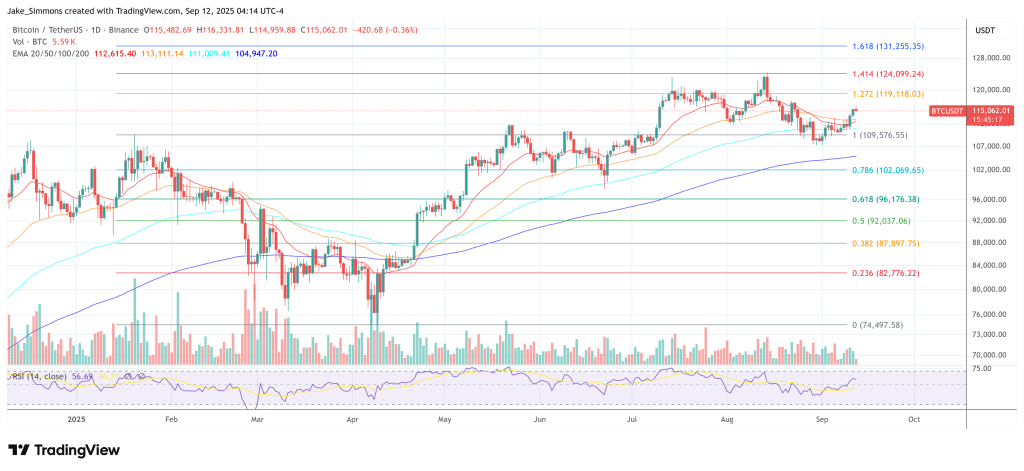
At press time, Bitcoin traded at $115,062.
Bitcoin price
BTC rises back above $115,000, 1-day chart | Source: BTCUSDT on TradingView.com
Featured image created with DALL.E, chart from TradingView.com
Editorial Process for bitcoinist is centered on delivering thoroughly researched, accurate, and unbiased content. We uphold strict sourcing standards, and each page undergoes diligent review by our team of top technology experts and seasoned editors. This process ensures the integrity, relevance, and value of our content for our readers.

Jake Simmons has been a Bitcoin enthusiast since 2016. Ever since he heard about Bitcoin, he has been studying the topic every day and trying to share his knowledge with others. His goal is to contribute to Bitcoin's financial revolution, which will replace the fiat money system. Besides BTC and crypto, Jake studied Business Informatics at a university. After graduation in 2017, he has been working in the blockchain and crypto sector. You can follow Jake on Twitter at @realJakeSimmons.

Trending Cryptos

Related Reads

Aave Founder Dismisses Reports Of Payward’s ‘70% Discount’ Stake Purchase

Aave founder Stani Kulechov has dismissed reports claiming that Kraken's parent company, Payward, was negotiating to purchase a 15% stake in Aave Group at a steep 70% discount. The reported deal proposed a $71 million investment at a $385 million valuation, which was framed as a significant discount compared to AAVE's fully diluted token valuation. Kulechov rejected this narrative, stating AAVE would not be sold at such a discount, and highlighted Aave's protocol revenue. The article clarifies the distinction between different entities within the Aave ecosystem—Aave Group, Aave Labs, Aave DAO, and AAVE token holders—noting that an equity discussion in a related company does not equate to selling the protocol or transferring DAO control. It underscores the sensitivity of major DeFi protocols to strategic investment rumors and the importance of accurate terminology to avoid misleading readers. While strategic discussions are common in the crypto sector, Kulechov specifically denied the discounted sale framing. The situation highlights that future developments should be monitored via official Aave channels, and market reactions may depend on whether token holders view the denial as value-supportive or focus on potential future distributions. The key takeaway is the founder's rejection of the 70% discount story, while leaving room for strategic partnerships under different terms.

bitcoinist1h ago

Aave Founder Dismisses Reports Of Payward’s ‘70% Discount’ Stake Purchase

bitcoinist1h ago

Trading

Spot

Hot Articles

What is $BITCOIN

DIGITAL GOLD ($BITCOIN): A Comprehensive Analysis Introduction to DIGITAL GOLD ($BITCOIN) DIGITAL GOLD ($BITCOIN) is a blockchain-based project operating on the Solana network, which aims to combine the characteristics of traditional precious metals with the innovation of decentralized technologies. While it shares a name with Bitcoin, often referred to as “digital gold” due to its perception as a store of value, DIGITAL GOLD is a separate token designed to create a unique ecosystem within the Web3 landscape. Its goal is to position itself as a viable alternative digital asset, although specifics regarding its applications and functionalities are still developing. What is DIGITAL GOLD ($BITCOIN)? DIGITAL GOLD ($BITCOIN) is a cryptocurrency token explicitly designed for use on the Solana blockchain. In contrast to Bitcoin, which provides a widely recognized value storage role, this token appears to focus on broader applications and characteristics. Notable aspects include: Blockchain Infrastructure: The token is built on the Solana blockchain, known for its capacity to handle high-speed and low-cost transactions. Supply Dynamics: DIGITAL GOLD has a maximum supply capped at 100 quadrillion tokens (100P $BITCOIN), although details regarding its circulating supply are currently undisclosed. Utility: While precise functionalities are not explicitly outlined, there are indications that the token could be utilized for various applications, potentially involving decentralized applications (dApps) or asset tokenization strategies. Who is the Creator of DIGITAL GOLD ($BITCOIN)? At present, the identity of the creators and development team behind DIGITAL GOLD ($BITCOIN) remains unknown. This situation is typical among many innovative projects within the blockchain space, particularly those aligning with decentralized finance and meme coin phenomena. While such anonymity may foster a community-driven culture, it intensifies concerns about governance and accountability. Who are the Investors of DIGITAL GOLD ($BITCOIN)? The available information indicates that DIGITAL GOLD ($BITCOIN) does not have any known institutional backers or prominent venture capital investments. The project seems to operate on a peer-to-peer model focused on community support and adoption rather than traditional funding routes. Its activity and liquidity are primarily situated on decentralized exchanges (DEXs), such as PumpSwap, rather than established centralized trading platforms, further highlighting its grassroots approach. How DIGITAL GOLD ($BITCOIN) Works The operational mechanics of DIGITAL GOLD ($BITCOIN) can be elaborated on based on its blockchain design and network attributes: Consensus Mechanism: By leveraging Solana’s unique proof-of-history (PoH) combined with a proof-of-stake (PoS) model, the project ensures efficient transaction validation contributing to the network's high performance. Tokenomics: While specific deflationary mechanisms have not been extensively detailed, the vast maximum token supply implies that it may cater to microtransactions or niche use cases that are still to be defined. Interoperability: There exists the potential for integration with Solana’s broader ecosystem, including various decentralized finance (DeFi) platforms. However, the details regarding specific integrations remain unspecified. Timeline of Key Events Here is a timeline that highlights significant milestones concerning DIGITAL GOLD ($BITCOIN): 2023: The initial deployment of the token occurs on the Solana blockchain, marked by its contract address. 2024: DIGITAL GOLD gains visibility as it becomes available for trading on decentralized exchanges like PumpSwap, allowing users to trade it against SOL. 2025: The project witnesses sporadic trading activity and potential interest in community-led engagements, although no noteworthy partnerships or technical advancements have been documented as of yet. Critical Analysis Strengths Scalability: The underlying Solana infrastructure supports high transaction volumes, which could enhance the utility of $BITCOIN in various transaction scenarios. Accessibility: The potential low trading price per token could attract retail investors, facilitating wider participation due to fractional ownership opportunities. Risks Lack of Transparency: The absence of publicly known backers, developers, or an audit process may yield skepticism regarding the project's sustainability and trustworthiness. Market Volatility: The trading activity is heavily reliant on speculative behavior, which can result in significant price volatility and uncertainty for investors. Conclusion DIGITAL GOLD ($BITCOIN) emerges as an intriguing yet ambiguous project within the rapidly evolving Solana ecosystem. While it attempts to leverage the “digital gold” narrative, its departure from Bitcoin's established role as a store of value underscores the need for a clearer differentiation of its intended utility and governance structure. Future acceptance and adoption will likely depend on addressing the current opacity and defining its operational and economic strategies more explicitly. Note: This report encompasses synthesised information available as of October 2023, and developments may have transpired beyond the research period.

467 Total ViewsPublished 2025.05.13Updated 2025.05.13

What is $BITCOIN

Discussions

Welcome to the HTX Community. Here, you can stay informed about the latest platform developments and gain access to professional market insights. Users' opinions on the price of BTC (BTC) are presented below.

活动图片