Spot Dogecoin ETF Delayed Again As SEC Stalls Bitwise’s Bid

bitcoinistPublished on 2025-09-10Last updated on 2025-09-10

Abstract

The US Securities and Exchange Commission (SEC) has pushed back its decision on whether NYSE Arca can list the Bitwise...

Trusted Editorial content, reviewed by leading industry experts and seasoned editors. Ad Disclosure

The US Securities and Exchange Commission (SEC) has pushed back its decision on whether NYSE Arca can list the Bitwise Dogecoin ETF, designating a “longer period” to complete its review of the exchange’s proposed rule change under Rule 19b-4.

In a notice dated Sept. 9, the agency said it is extending the deadline to Nov. 12, 2025, to either approve or disapprove the application to list Bitwise’s DOGE trust as Commodity-Based Trust Shares under NYSE Arca Rule 8.201-E. “The Commission… designates November 12, 2025, as the date by which the Commission shall either approve or disapprove the proposed rule change,” the order states.

Spot Dogecoin ETF—Nah, But DOJE Is Coming

The delay keeps Bitwise in the growing queue of spot altcoin ETFs waiting on the traditional pathway used by the spot bitcoin and ether products: an exchange rule change under the Securities Exchange Act of 1934 paired with a Securities Act registration statement. Bitwise’s DOGE product is structured as a commodity-based trust that would hold Dogecoin in custody, with Coinbase Custody listed as the Dogecoin custodian in its S-1 filing.

Even as the spot DOGE application slips to November, a Dogecoin ETF from REX Shares and Osprey Funds is slated to begin trading this Thursday via a different regulatory route. The product will list under the ticker DOJE and is distributed by Foreside Fund Services, with launch timing confirmed for Thursday. This fund leverages the Investment Company Act of 1940—rather than the ’33/’34 Act spot-commodity-trust pathway—to offer DOGE exposure, a structure the issuers previously used for their Solana product.

Bloomberg’s Eric Balchunas framed the moment succinctly, posting on X: “Meme coin ETF era about to kick off it looks like with DOJE slated for a Thursday launch, albeit under the 40 Act a la SSK. There’s a big group of ‘33 Act-ers waiting for SEC approval still. Pretty sure this is first-ever US ETF to hold something that has no utility on purpose.”

REX-Osprey’s use of the ’40 Act route echoes the playbook behind SSK, the REX-Osprey SOL + Staking ETF, which lists on Cboe and holds SOL exposure while seeking to pass through staking rewards within the constraints of a registered fund. That earlier launch established a template for crypto-exposure ETFs that do not rely on an exchange’s 19b-4 rule change to list a spot commodity trust.

The SEC’s latest Bitwise order leaves the market with two parallel tracks for Dogecoin exposure in US ETFs. On one side is the Bitwise proposal, proceeding through the familiar spot-trust approval gauntlet that culminates on Nov. 12 absent another procedural shift. On the other is DOJE, which—if it begins trading Thursday—would represent a first-of-its-kind US DOGE ETF launched as a ’40 Act fund, a structure industry analysts say can reach the market without the same exchange rule-change approval required for commodity-based trusts.

For investors and issuers, the split underscores how crypto ETFs are evolving beyond the binary of “approved or denied” for spot commodity trusts. Bitwise is pursuing a product that would hold DOGE directly in a trust structure consistent with NYSE Arca’s Rule 8.201-E framework, while REX-Osprey appear set to offer DOGE exposure inside a registered investment company—akin to SSK’s approach—highlighting the growing role of ’40 Act mechanics in bringing non-bitcoin assets to the exchange-traded market.

At press time, DOGE traded at $0.24.
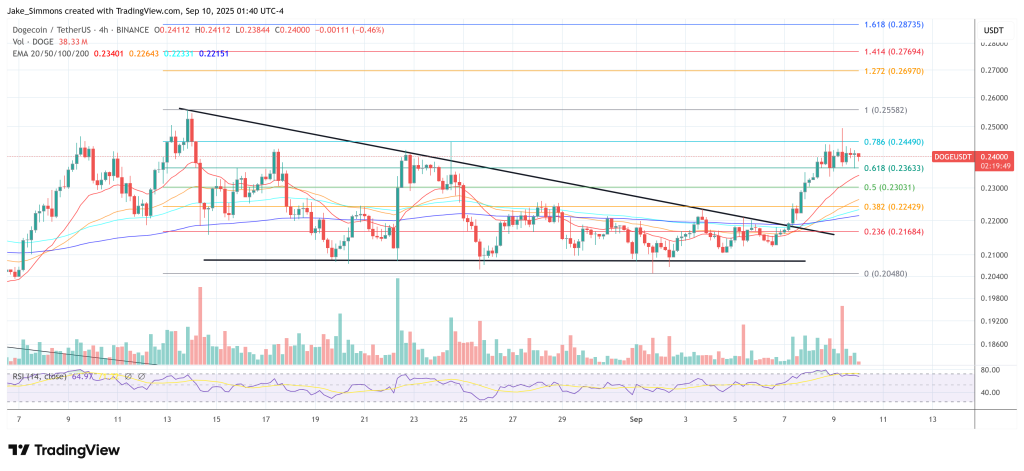
Dogecoin price
DOGE price, 4-hour chart | Source: DOGEUSDT on TradingView.com
Featured image created with DALL.E, chart from TradingView.com
Editorial Process for bitcoinist is centered on delivering thoroughly researched, accurate, and unbiased content. We uphold strict sourcing standards, and each page undergoes diligent review by our team of top technology experts and seasoned editors. This process ensures the integrity, relevance, and value of our content for our readers.

Jake Simmons has been a Bitcoin enthusiast since 2016. Ever since he heard about Bitcoin, he has been studying the topic every day and trying to share his knowledge with others. His goal is to contribute to Bitcoin's financial revolution, which will replace the fiat money system. Besides BTC and crypto, Jake studied Business Informatics at a university. After graduation in 2017, he has been working in the blockchain and crypto sector. You can follow Jake on Twitter at @realJakeSimmons.

Trending Cryptos

Related Reads

Why Is No One Buying DeFi Insurance?

"Why DeFi Insurance Remains Unpurchased" explores the paradox of decentralized finance insurance. While DeFi insurance promises automatic, unbiased payouts via smart contracts—eliminating traditional insurers' denial practices—it struggles to attract users. The core issue is economic viability. Premiums are prohibitively high relative to the yields from DeFi protocols. For example, insuring a deposit on Aave or Maple Finance can consume most or even all of the annual yield, leaving returns comparable to or worse than traditional savings. Only the safest protocols, like MakerDAO, offer affordable premiums. Furthermore, the DeFi insurance model is structurally fragile. Unlike traditional insurance where risks are uncorrelated, DeFi risks are highly interconnected (e.g., oracle failures, bridge hacks). A single major exploit can simultaneously threaten multiple protocols, potentially bankrupting the entire insurance pool, which holds only millions against billions in total value locked. The governance model also creates a conflict of interest. In platforms like Nexus Mutual, token holders who vote on claims risk their own capital if payouts are approved, incentivizing denials. Consequently, the market is tiny and shrinking. Nexus Mutual dominates with $81.56 million in assets, but the industry lacks the capacity to cover a catastrophic event like the $292M Kelp DAO hack. Other providers have dwindled or shut down. The article concludes that DeFi insurance faces a "tragedy of the commons": its stability requires widespread adoption, but individual users have no incentive to pay for it, as premiums destroy their yields. Current solutions involve preventative measures like bug bounties and seeking external capital from traditional reinsurance, acknowledging that on-chain capital alone is insufficient to cover on-chain risks.

marsbit1h ago

Why Is No One Buying DeFi Insurance?

marsbit1h ago

Trading

Spot

Hot Articles

Discussions

Welcome to the HTX Community. Here, you can stay informed about the latest platform developments and gain access to professional market insights. Users' opinions on the price of S (S) are presented below.

活动图片