Digital Asset Treasuries (DATs), public companies formed primarily to buy crypto, are facing a sharp reality check. After months of parabolic stock gains and grand promises, the sector is now navigating declining share prices, reduced Bitcoin purchases, and mounting skepticism about the sustainability of the entire model.
DAT stocks slide despite crypto rally
While major indices like the S&P 500 continue pushing higher, shares of token-holding companies are heading in the opposite direction. According to Architect Partners, a group of 15 DATs dropped an average of 15% last week alone.
Names like ALT5 Sigma, tied to Trump-linked World Liberty Financial’s WLFI token, have fallen nearly 50%. Meanwhile, Kindly MD, which holds Bitcoin via subsidiary Nakamoto Holdings, is down over 80% from its May peak. Even companies exposed to ETH and SOL haven’t been spared, with token values and corresponding equities sinking in tandem.
“There are way too many of them and very little differentiation,” said Ed Chin, co-founder of Parataxis Capital, a firm that recently backed a Bitcoin treasury company in South Korea.
A flood of token buyers, from nail salons to meal kits
More than 100 companies have jumped into the DAT space this year, often through overnight pivots, think cannabis brands, nail salons, and ad agencies suddenly rebranding as Bitcoin holders. Most of these firms hold little more than volatile tokens and a pitch deck.
And yet, speculation still finds a way. On Monday, Eightco Holdings surged 3,000% after announcing plans to buy Worldcoin and bringing on Wall Street analyst Dan Ives as a board member.
The Bitcoin-buying engine is sputtering
Despite occasional outliers, the broader trend is cooling. CryptoQuant reports that DATs acquired just 14,800 BTC in August—down from 66,000 BTC in June. Average purchase sizes have shrunk nearly 86% from 2025 highs. More tellingly, accumulation rates have plummeted from 163% in March to just 8% last month, revealing a dramatic slowdown in net buying behavior.
Exotic financing: high risk, low clarity
In an attempt to extract more leverage, DATs have turned to bespoke financial tools: Bitcoin-backed loans, token-linked convertibles, and structured payouts that often blur the line between strategy and speculation.
Smarter Web Co., a UK-based web firm, issued a bond tied to BTC’s price, meaning its debt burden rises as Bitcoin does. CEO Andrew Webley insisted only 5% of their treasury is exposed. “If Bitcoin goes down, we repay the debt,” he said. “If it goes up, our shares should rise faster.”
DDC Enterprise, formerly a struggling meal company, now claims access to over $1 billion in capital through a maze of debt lines and equity facilities. Its stock, too, has crashed after an earlier vertical rally.
Nasdaq tightens rules amid dilution concerns
The Nasdaq has reportedly begun asking some DATs to obtain shareholder approval before issuing new shares to fund token purchases—a direct hit to the dilution-heavy model that many of these companies rely on.

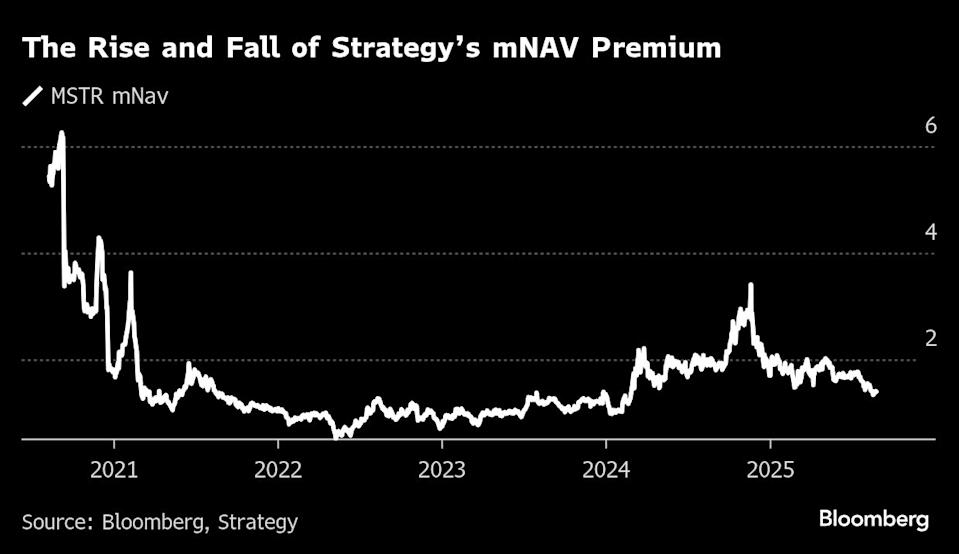
Even heavyweights like Strategy and Metaplanet Inc., once poster children for the DAT boom, have seen their valuations stumble. Strategy was left out of the S&P 500 rebalance last Friday despite qualifying on paper. Its Bitcoin-to-market-cap ratio (mNAV) now sits around 1.5, and its stock has barely moved since April, even as Bitcoin rallied. Earlier this week, the firm bought another $217 million in BTC, but investor response was muted.
Crypto lenders step in—but for how long?
Firms like Two Prime, a provider of BTC-collateralized loans, are seeing increased demand from DATs. CEO Alexander Blume noted the firm has $1.25 billion in active open loans, with individual deals ranging from $10 million to $500 million. New structures like fixed-term bullet loans are being marketed as “breathing room” for firms under pressure.
But critics argue the strategy may be less about growth and more about survival.
As enthusiasm fades, the DAT model looks less like a bridge between crypto and capital markets—and more like a short-term trade built on low float and high hope. With Bitcoin ETFs now offering exposure without the baggage of equity dilution or operational risk, investors are beginning to ask: why buy a company for its coins when you can just buy the coins?
As Travis Kling, CIO of Ikigai Asset Management, bluntly put it:
“I’ve been trying to convince myself to buy some of these DATs. Haven’t gotten there. May never get there.”