Bitcoin Hyper Unveils High-Throughput Bitcoin Layer-2 as Presale See Whales Buy $150K in One Week

bitcoinistPublished on 2025-08-20Last updated on 2025-08-20

Abstract

Bitcoin Hyper ($HYPER) took a leap forward this week with its plan to bring high-speed, low-cost transactions and smart-contract functionality...

Trusted Editorial content, reviewed by leading industry experts and seasoned editors. Ad Disclosure

Bitcoin Hyper ($HYPER) took a leap forward this week with its plan to bring high-speed, low-cost transactions and smart-contract functionality to Bitcoin via a Solana Virtual Machine (SVM) rollup architecture.

The project will position the world’s largest crypto asset for everyday payments and scalable on-chain apps while preserving Bitcoin’s settlement assurances.

The $HYPER presale has cleared the $10.8M mark amid heightened market interest.

Crucially, this week saw whales swimming into the presale; over $150K was added to the total in a series of whale buys.

Why Bitcoin Hyper, and what’s drawing the whales in? Time for a closer look.

Bitcoin’s Throughput and Fees Don’t Match 2025 Demand

Despite its dominance, Bitcoin’s base layer was optimized for security and decentralization. By enabling capability only for simple smart contracts, Bitcoin’s designer kept vulnerabilities low and autonomy high.

That’s not always great for high-frequency consumer transactions or complex applications.

In peak periods, Bitcoin users face unpredictable fees and slow settlement times, making point-of-sale payments, gaming, and high-volume micro-transactions impractical on Layer 1 alone.

To become more than just a store of value, Bitcoin requires a solution that doesn’t spoil Bitcoin’s appeal – but can address the very real problems that face the networks.

Concrete pain points today include:

  • Consumer payments: A coffee, concert ticket, or cross-border payment needs seconds-level confirmation and minimal fees. Base-layer Bitcoin can’t deliver that at scale with an average of only 7 transactions per second.
  • On-chain apps: DeFi, gaming, and creator tools require complex smart contracts and high TPS, capabilities Bitcoin doesn’t natively provide.
  • Merchant UX: Businesses require predictable costs and reliable finality on the level of current credit card rails to finally adopt crypto at scale.

Bitcoin set fresh all-time highs last month and remains a strong asset with deep institutional flows. But it lags behind when it comes to the everyday, low-latency utility required for speed and programmability.

Bitcoin Hyper’s SVM Rollup on Bitcoin

Bitcoin Hyper proposes a rollup-style Layer-2 that uses the Solana Virtual Machine (SVM) for high throughput and low latency, while anchoring security and finality to Bitcoin Layer 1.

It’s a hybrid model that seeks to combine core strengths from both blockchains:

  1. Canonical Bridge and Minting: Users deposit $BTC to a monitored L1 address. An SVM smart contract – Bitcoin Relay Program – verifies the Bitcoin block headers and proofs. Valid deposits are trustlessly reflected (minted) one-for-one on Bitcoin Hyper L2.
  2. Fast L2 Execution: Transactions and smart contracts run natively on the SVM, delivering near-instant finality and high throughput with thousands of transactions per second. Wrapped Bitcoin on Bitcoin Hyper will be suitable for dApps from payments and DEXs to gaming and social dApps.
  3. Proofs and Settlement: Batched L2 state updates are compressed and posted back to Bitcoin, with ZK proofs ensuring validity. Users can always withdraw wrapped $BTC back to L1, preserving Bitcoin’s assurances.
  4. Why SVM (not EVM): SVM’s parallel execution and performance characteristics make it a better fit for payments-first use cases and low-latency apps.
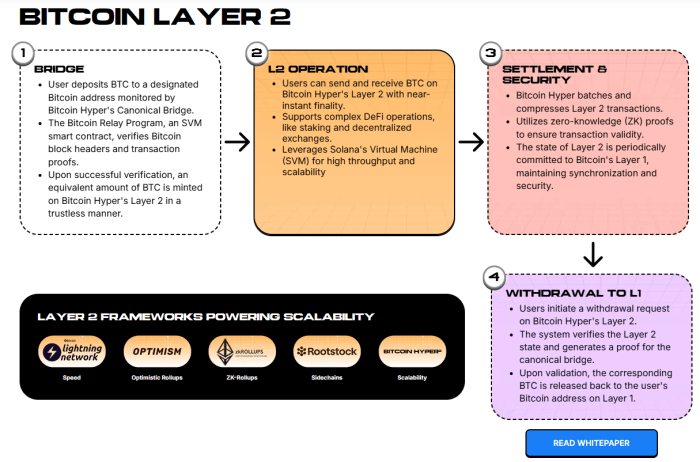
Bitocin Hyper architecture behind the Layer 2.

Using $HYPER, you can unlock everyday $BTC payments, with seconds-level processing and low-fee checkouts – and L1 settlement behind the scenes.

You can also power Bitcoin-based DeFi. Swaps, lending markets, and yield strategies, executed at Layer 2 speed. If you’re more into memes than ETFs, you can launch and trade red-hot meme assets without congesting the L1.

Why $HYPER Matters for Bitcoin’s Standing

Bitcoin leads by market cap and brand. Extending speed and programmability on top of Bitcoin’s settlement credibility could expand its addressable market from ‘store-of-value and ETFs’ to ‘daily money and apps.’
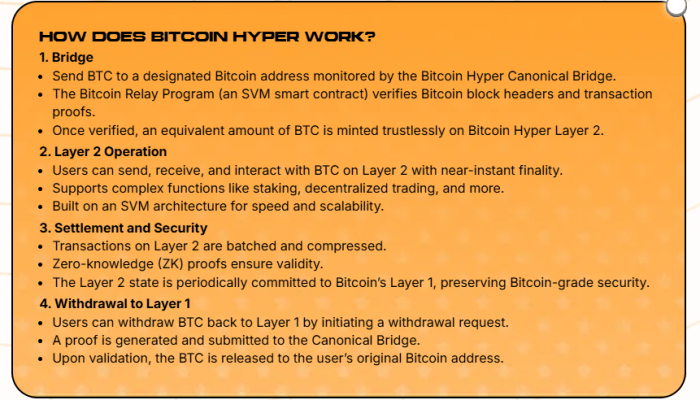
how does bitcoin hyper work?

The smart money is already catching on. In the past week, a series of hefty transactions in the Bitcoin Hyper presale reveal that whale investors spent $150K amassing $HYPER tokens:

So far, the Bitcoin Hyper presale has raised over $10.8M, demonstrating investor interest in the project’s ambitions for a lightning-fast Bitcoin Layer 2.

$HYPER Token: Utility and Economics for Layer 2

$HYPER is the native token for transaction fees, staking, and governance on the Bitcoin Hyper network. Tokens are allocated across development, listings, marketing, rewards, and treasury.

Investors in the ongoing presale can stake $HYPER tokens for dynamic 102% returns. Learn how to buy $HYPER in our guide and stake your tokens right away for max gains; rewards will be disbursed over two years.

Our price prediction shows real potential for $HYPER: from its current price of $0.012765, we think the project could reach $0.32 by the end of 2025, representing a 2,683% increase from its final presale price.

What is Bitcoin Hyper? It’s the first Bitcoin Layer 2 to take a truly unique approach to resolving Bitcoin’s scalability issues – with the potential to materially benefit not just the Hyper Layer 2, but the original Bitcoin, too.

Bitcoin Continues Growth, Sets Stage for $HYPER’s Launch

Bitcoin printed a new record around $124.5K on Aug. 14, before consolidating in the $113-118K range. U.S. spot Bitcoin ETFs continue to channel institutional demand.

$HYPER’s launch at a time of continued growth for Bitcoin, could set the stage for monster gains for both protocols. If Bitcoin becomes both the base collateral of crypto and a high-throughput transactional network via an L2, its dominance could become even more entrenched.

Corporate treasuries remain a significant structural underpinning for Bitcoin. (Micro)Strategy reports holdings exceeding 629K $BTC as of Aug. 18, exerting steady, long-duration capital pressure that can amplify the impact of new demand entering.
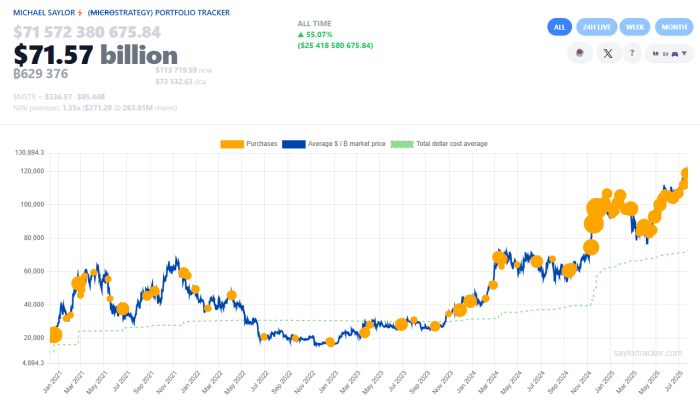
Saylor Tracker

In other words, if the Bitcoin Hyper layer creates buying pressure for $BTC – for new, L2-powered use cases, perhaps – then $BTC’s price could spike even further.

Bitcoin Hyper: Launching the Future of Bitcoin

With its Bitcoin Layer-2 that combines an SVM execution layer with rollup-style settlement on Bitcoin, Bitcoin Hyper could change the game.

The goal is to provide Bitcoin-grade security with near-instant, low-fee transactions, enabling payments, DeFi, and high-throughput apps to run at scale, but remain settled on Bitcoin.

Visit the Bitcoin Hyper presale page to get a glimpse of Bitcoin’s future.

And always do your own research – this isn’t financial advice.

Editorial Process for bitcoinist is centered on delivering thoroughly researched, accurate, and unbiased content. We uphold strict sourcing standards, and each page undergoes diligent review by our team of top technology experts and seasoned editors. This process ensures the integrity, relevance, and value of our content for our readers.

Aaron covers all things crypto, with an eye towards simple, easy-to-understand explanations for complicated topics. In his spare time, he writes fantasy stories for fun and enjoys working out and boxing.

Trending Cryptos

Related Reads

Dialogue with IOTA Foundation's Jens: From Kenya to the UK, TWIN Propels Global Trade into the '5-Minute' Era

**Summary: IOTA's TWIN Project is Speeding Up Global Trade** Jens Munch Lund-Nielsen, Head of Global Trade & Supply Chain at the IOTA Foundation, discusses how the TWIN (Trade and Logistics Information Network) project is addressing long-standing inefficiencies in global trade. Traditionally, cross-border trade involves numerous parties, extensive paperwork, and delays spanning weeks. TWIN, built on IOTA's decentralized, scalable, and low-cost infrastructure, aims to replace this fragmented, paper-based system with a real-time, trusted, and interconnected digital collaboration layer. As a neutral digital public infrastructure, TWIN allows governments, businesses, and ports to exchange verifiable data and documents without ceding control to a single entity. This solves a core coordination problem that previous, proprietary platforms failed to address due to a lack of trust and neutrality. Key real-world implementations include: * **TLIP in East Africa:** Reduced document retrieval times for flower, coffee, and tea exports from 6-7 hours to ~30 minutes, cutting administrative work by 50-60%. * **UK Ecosystem of Trust Trials:** Provided border agencies with much earlier visibility (up to 20+ hours) of incoming chilled poultry shipments from Poland, enabling better resource planning. * Other pilots focus on supply chain traceability for fruits/vegetables, port efficiency, and critical mineral sourcing. TWIN ensures interoperability across jurisdictions by adopting global standards (e.g., UN/CEFACT data models), leveraging decentralized identity systems (DIDs), and supporting legal frameworks like MLETR. Looking ahead, Jens is optimistic that a trusted "connective layer" like TWIN will scale in the coming years. Its success could fundamentally transform global trade, most notably by helping to close the current $2.5 trillion trade finance gap. By providing lenders with access to verifiable, real-time supply chain data, TWIN could unlock capital and reshape how businesses discover partners and secure financing.

marsbit19m ago

Dialogue with IOTA Foundation's Jens: From Kenya to the UK, TWIN Propels Global Trade into the '5-Minute' Era

marsbit19m ago

Trading

Spot

Hot Articles

What is $BITCOIN

DIGITAL GOLD ($BITCOIN): A Comprehensive Analysis Introduction to DIGITAL GOLD ($BITCOIN) DIGITAL GOLD ($BITCOIN) is a blockchain-based project operating on the Solana network, which aims to combine the characteristics of traditional precious metals with the innovation of decentralized technologies. While it shares a name with Bitcoin, often referred to as “digital gold” due to its perception as a store of value, DIGITAL GOLD is a separate token designed to create a unique ecosystem within the Web3 landscape. Its goal is to position itself as a viable alternative digital asset, although specifics regarding its applications and functionalities are still developing. What is DIGITAL GOLD ($BITCOIN)? DIGITAL GOLD ($BITCOIN) is a cryptocurrency token explicitly designed for use on the Solana blockchain. In contrast to Bitcoin, which provides a widely recognized value storage role, this token appears to focus on broader applications and characteristics. Notable aspects include: Blockchain Infrastructure: The token is built on the Solana blockchain, known for its capacity to handle high-speed and low-cost transactions. Supply Dynamics: DIGITAL GOLD has a maximum supply capped at 100 quadrillion tokens (100P $BITCOIN), although details regarding its circulating supply are currently undisclosed. Utility: While precise functionalities are not explicitly outlined, there are indications that the token could be utilized for various applications, potentially involving decentralized applications (dApps) or asset tokenization strategies. Who is the Creator of DIGITAL GOLD ($BITCOIN)? At present, the identity of the creators and development team behind DIGITAL GOLD ($BITCOIN) remains unknown. This situation is typical among many innovative projects within the blockchain space, particularly those aligning with decentralized finance and meme coin phenomena. While such anonymity may foster a community-driven culture, it intensifies concerns about governance and accountability. Who are the Investors of DIGITAL GOLD ($BITCOIN)? The available information indicates that DIGITAL GOLD ($BITCOIN) does not have any known institutional backers or prominent venture capital investments. The project seems to operate on a peer-to-peer model focused on community support and adoption rather than traditional funding routes. Its activity and liquidity are primarily situated on decentralized exchanges (DEXs), such as PumpSwap, rather than established centralized trading platforms, further highlighting its grassroots approach. How DIGITAL GOLD ($BITCOIN) Works The operational mechanics of DIGITAL GOLD ($BITCOIN) can be elaborated on based on its blockchain design and network attributes: Consensus Mechanism: By leveraging Solana’s unique proof-of-history (PoH) combined with a proof-of-stake (PoS) model, the project ensures efficient transaction validation contributing to the network's high performance. Tokenomics: While specific deflationary mechanisms have not been extensively detailed, the vast maximum token supply implies that it may cater to microtransactions or niche use cases that are still to be defined. Interoperability: There exists the potential for integration with Solana’s broader ecosystem, including various decentralized finance (DeFi) platforms. However, the details regarding specific integrations remain unspecified. Timeline of Key Events Here is a timeline that highlights significant milestones concerning DIGITAL GOLD ($BITCOIN): 2023: The initial deployment of the token occurs on the Solana blockchain, marked by its contract address. 2024: DIGITAL GOLD gains visibility as it becomes available for trading on decentralized exchanges like PumpSwap, allowing users to trade it against SOL. 2025: The project witnesses sporadic trading activity and potential interest in community-led engagements, although no noteworthy partnerships or technical advancements have been documented as of yet. Critical Analysis Strengths Scalability: The underlying Solana infrastructure supports high transaction volumes, which could enhance the utility of $BITCOIN in various transaction scenarios. Accessibility: The potential low trading price per token could attract retail investors, facilitating wider participation due to fractional ownership opportunities. Risks Lack of Transparency: The absence of publicly known backers, developers, or an audit process may yield skepticism regarding the project's sustainability and trustworthiness. Market Volatility: The trading activity is heavily reliant on speculative behavior, which can result in significant price volatility and uncertainty for investors. Conclusion DIGITAL GOLD ($BITCOIN) emerges as an intriguing yet ambiguous project within the rapidly evolving Solana ecosystem. While it attempts to leverage the “digital gold” narrative, its departure from Bitcoin's established role as a store of value underscores the need for a clearer differentiation of its intended utility and governance structure. Future acceptance and adoption will likely depend on addressing the current opacity and defining its operational and economic strategies more explicitly. Note: This report encompasses synthesised information available as of October 2023, and developments may have transpired beyond the research period.

519 Total ViewsPublished 2025.05.13Updated 2025.05.13

What is $BITCOIN

Discussions

Welcome to the HTX Community. Here, you can stay informed about the latest platform developments and gain access to professional market insights. Users' opinions on the price of BTC (BTC) are presented below.

活动图片