3 'Hello's and You're Out of Quota: Where Did Your Claude Code Allowance Go? A 28-Day Cache Bug and an Official Response Telling You to 'Use It Sparingly'

marsbitPublished on 2026-04-03Last updated on 2026-04-03

Abstract

Over the past month, Claude Code experienced a critical caching bug that caused prompt cache read rates to drop to 4–17%, far below the typical 97–99%. This meant users were charged 10–20 times more than normal when resuming conversations, as the system reprocessed entire contexts instead of reusing cached content. The bug persisted across 20 versions from March 4 to April 1. User complaints surged after a promotional period ended, revealing the severity of the issue. Anthropic responded by tightening usage limits and offering user advice—such as downgrading models or reducing context windows—but did not issue refunds or reset quotas. Despite confirming and fixing a caching regression bug, the company maintained that no overcharging occurred. The response contrasts with OpenAI’s approach of compensating users during similar incidents. Subscribers reported extreme consumption rates, with some exhausting their monthly quotas in minutes.

4-17%. This was the prompt cache read rate for Claude Code over the past month. The normal level is 97-99%.

This means that when you resumed a previous session, Claude Code did not reuse the context that had already been processed, but instead processed the entire content from scratch each time, consuming 10 to 20 times the normal amount of allowance. You thought you were continuing a conversation, but in reality, you were starting a brand new, full-price conversation every time.

This number comes from independent developer ArkNill's proxy monitoring tests. By setting up a transparent proxy, he recorded every request between Claude Code and the Anthropic API, discovering at least two client-side cache bugs that prevented the API server from matching cached conversation prefixes, forcing a full token rebuild every round.
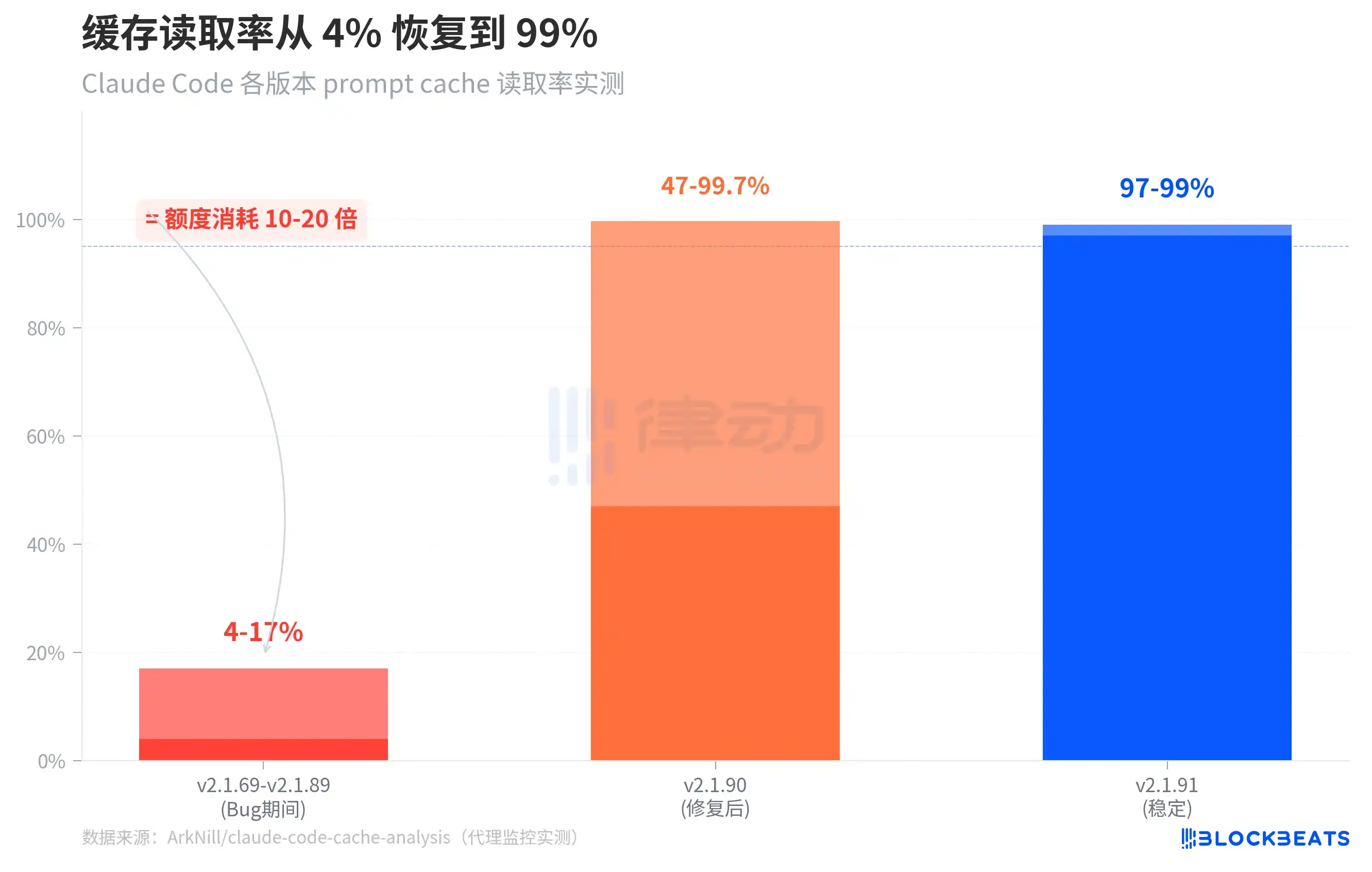
The chart above shows a comparison of cache read rates across three phases. During the period from v2.1.69 to v2.1.89 (i.e., the bug period), the cache read rate for the standalone version was only 4-17%. After v2.1.90 fixed one of the critical bugs, the cold-start cache read rate returned to 47-99.7%. By v2.1.91, the stable running cache read rate recovered to 97-99%.

Notably, a detail in the chart: the range for v2.1.90 is very wide (47% to 99.7%). This is because when a session is first resumed, it still needs to "warm up" the cache; the hit rate for the first few rounds is relatively low but quickly returns to normal levels. In the buggy version, this warm-up never happened—the cache read permanently stalled at the 14,500 tokens of the system prompt, and the entire conversation history was billed at full price every time.

28 Days, 20 Versions

This bug wasn't the kind introduced in one update and fixed in the next. According to npm registry release records, the bug-introducing v2.1.69 was released on March 4th, and the bug-fixing v2.1.90 was released on April 1st. This spans 28 days and 20 versions.
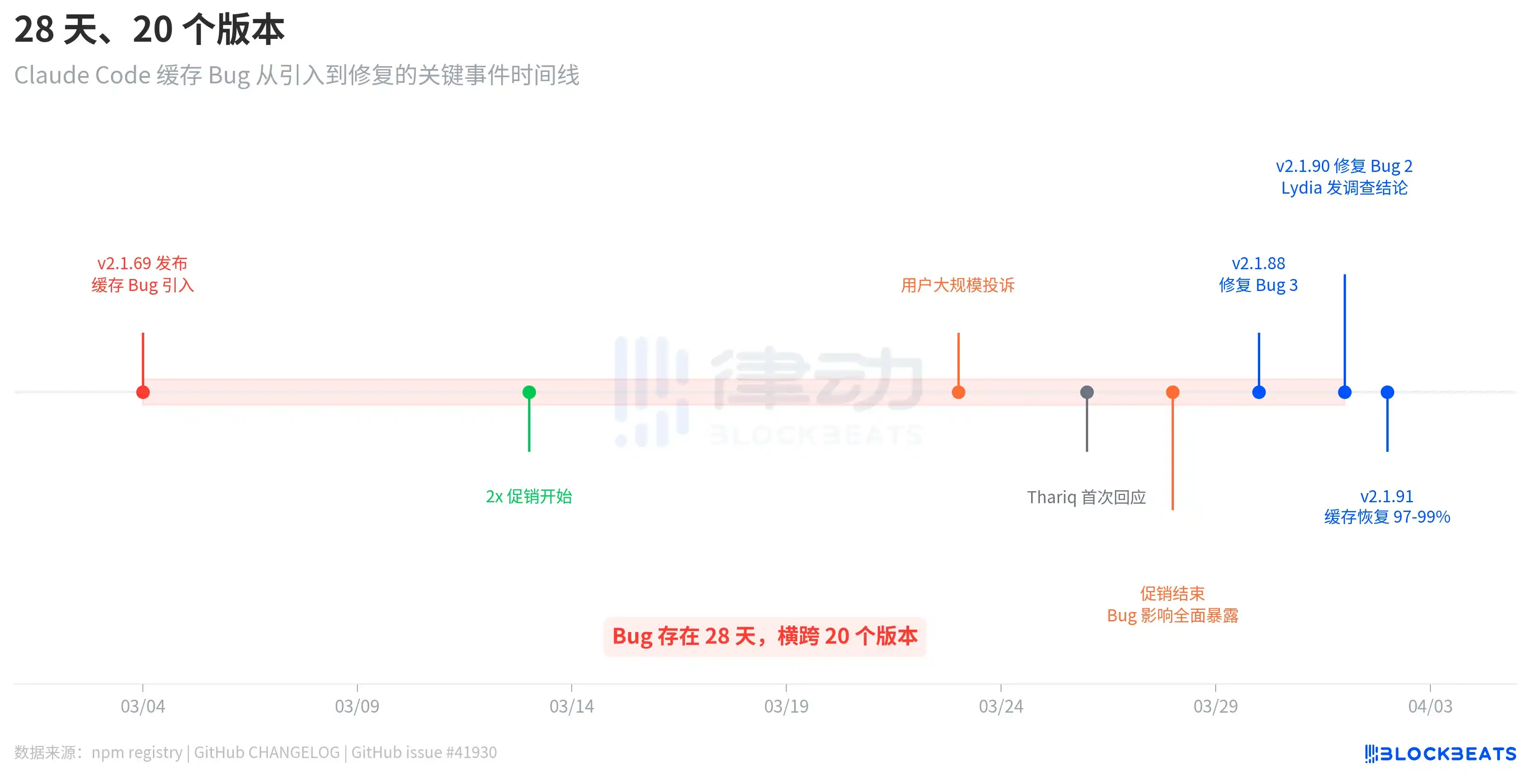
The timeline reveals an intriguing detail. After the bug was introduced on March 4th, users did not immediately complain on a large scale. Complaints only exploded around March 23rd, nearly three weeks later. The reason, as梳理ed in GitHub issue #41930, is that Anthropic ran a 2x allowance promotion (doubling during off-peak hours) from March 13th to 28th, which objectively masked the bug's impact. After the promotion ended, the consumption from the cache bug returned to the normal billing baseline, and users' allowances instantly "evaporated".

Anthropic's response was not swift. On March 26th, three days after user complaints exploded, engineer Thariq Shihipar announced on his personal X account that peak hour (weekdays 5am-11am PT) limits had been tightened. On March 30th, Anthropic acknowledged on Reddit that "users are hitting their limits much faster than expected," calling it the team's highest priority. It wasn't until April 1st that team member Lydia Hallie published the formal investigation conclusion.

Throughout this process, Anthropic did not publish any blog posts, send email notifications, or update their status page. All official communication was done solely through engineers' personal social media posts and a few Reddit comments.

How Much Did You Pay, How Long Could You Use It?

GitHub issue #41930 gathered hundreds of user reports. The most extreme case was a Max 20x subscriber ($200/month) whose 5-hour rolling window was completely exhausted in 19 minutes. Max 5x users ($100/month) reported their 5-hour window being used up within 90 minutes. According to The Letter Two, some users claimed a simple "hello" consumed 13% of their session quota. A Pro user ($20/month) said on Discord their allowance was "used up by Monday, reset on Saturday," meaning they could only use it normally for 12 out of 30 days.
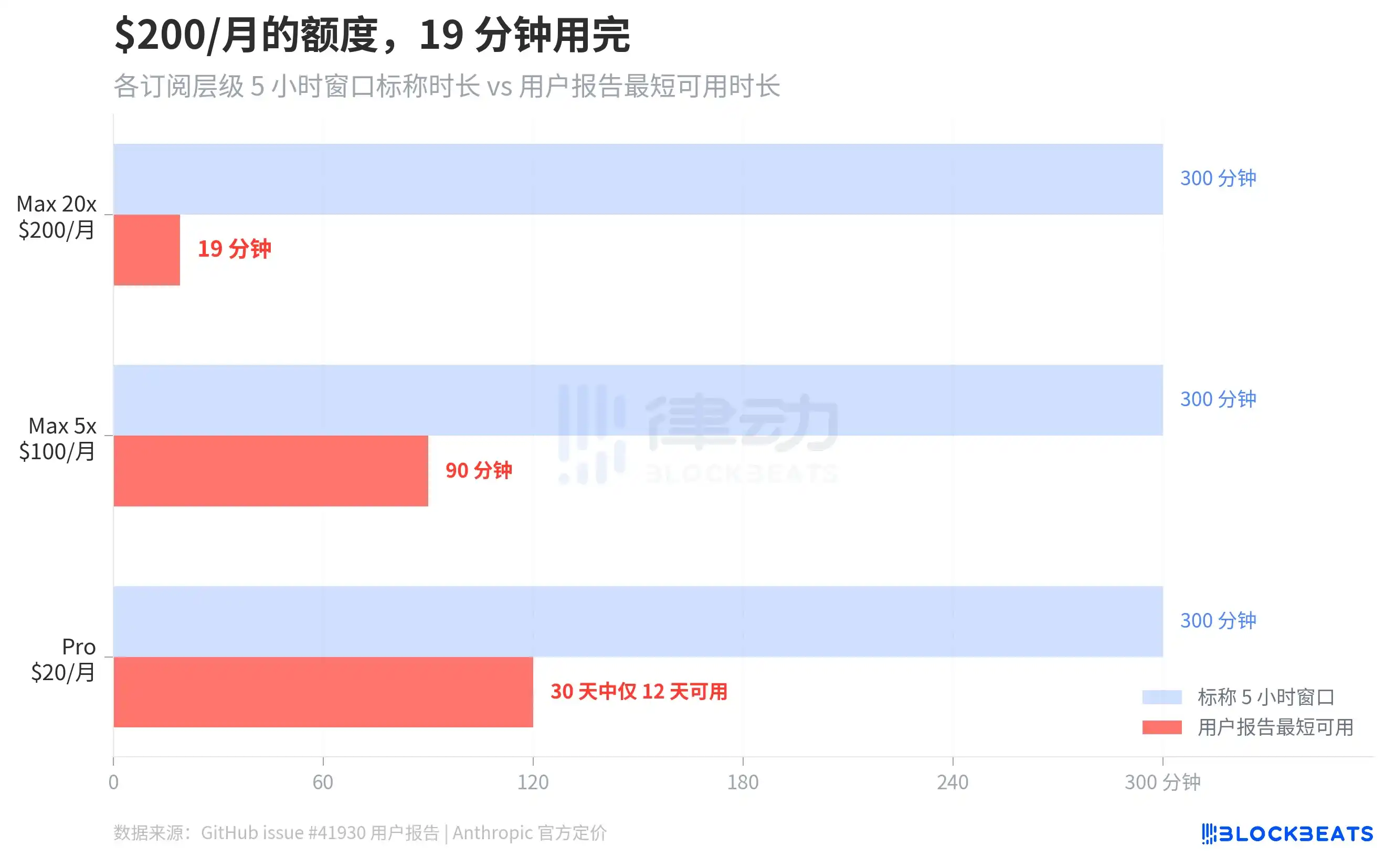
Based on ArkNill's benchmark tests, on the buggy version v2.1.89, the 100% quota of the Max 20x plan would be exhausted in about 70 minutes. He also calculated the allowance cost of a single --resume operation on a 500K token context session to be approximately $0.15, because the system would fully replay the entire context.

"You're Holding It Wrong"

Lydia Hallie's investigation conclusion confirmed two things: first, peak hour limits had indeed been tightened, and second, sessions with 1 million token contexts consumed more. She stated the team had fixed some bugs but emphasized that "none of these bugs resulted in overcharging."

She then offered four suggestions for saving usage:
1. Use Sonnet 4.6 instead of Opus (Opus consumes about twice as much);

2. Reduce reasoning strength or turn off extended thinking when deep reasoning isn't needed;

3. Don't resume long sessions idle for over an hour, start a new one instead;

4. Set the environment variable CLAUDE_CODE_AUTO_COMPACT_WINDOW=200000 to limit the context window size.

There was no mention of any form of quota reset or compensation.

AI podcast host Alex Volkov summarized this response as "You're holding it wrong," pointing out that Anthropic itself set the 1 million token context as the default, promoted Opus as the flagship model, and marketed extended thinking as a selling point, but is now advising paying users not to use these features.

The claim of "no overcharging" also creates tension with Claude Code's own update records. Just the day before Lydia's response, v2.1.90 fixed a cache regression bug that had existed since v2.1.69: when using --resume to restore a session, requests that should have hit the cache triggered a full prompt cache miss, billed at full price. Lydia's response did not mention this confirmed billing anomaly.
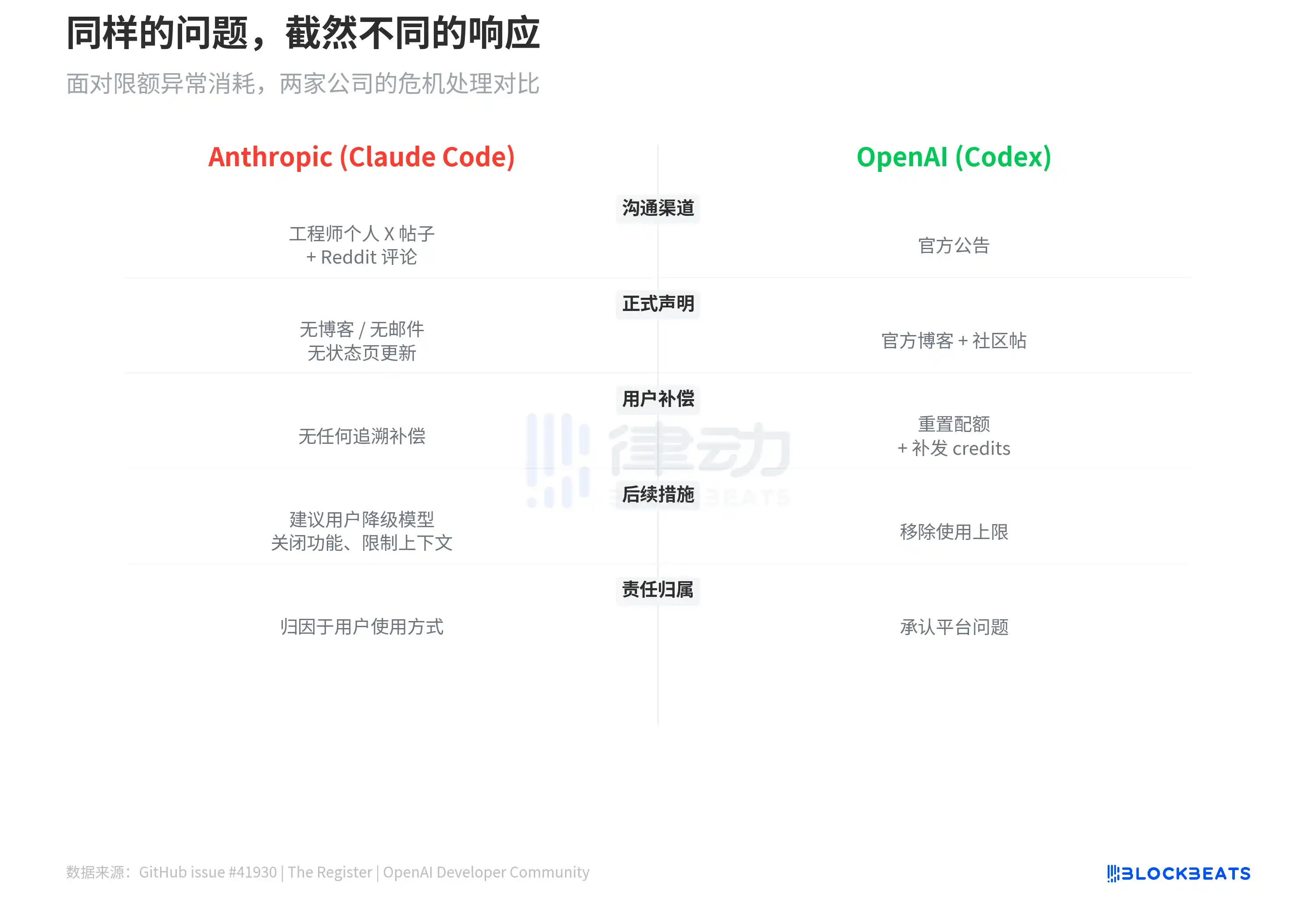
As a comparison, OpenAI's Codex previously had a similar issue of abnormal quota consumption. OpenAI's approach was to reset user quotas, issue credit补偿, and in March announce the removal of Codex usage caps. Anthropic's approach was to advise users to downgrade models, turn off features, limit context, and attribute responsibility to user usage patterns.

Anthropic sells subscriptions for the "strongest model + largest context + highest reasoning ability" and charges $20 to $200 per month. A 28-day cache bug caused paying users' allowances to evaporate at 10-20 times the normal rate, and the official response is to tell you to use it sparingly.


Trending Cryptos

Related Questions

QWhat was the prompt cache read rate for Claude Code during the bug period, and what is the normal range?

AThe prompt cache read rate was 4-17% during the bug period, while the normal range is 97-99%.

QHow long did the caching bug persist across versions, and which versions were affected?

AThe bug persisted for 28 days, from version v2.1.69 (released March 4) to v2.1.90 (released April 1), spanning 20 versions.

QWhat was the response from Anthropic regarding the bug and its impact on user quotas?

AAnthropic acknowledged the issue on Reddit, stated it was their highest priority, and later provided user recommendations to conserve usage. They claimed 'no overcharging occurred' and did not offer quota resets or compensation.

QWhat were some of the extreme user reports regarding quota consumption during the bug?

AExtreme reports included a Max 20x user exhausting their 5-hour rolling window in 19 minutes, a Pro user depleting their weekly quota by Monday with a reset on Saturday, and a user claiming a simple 'hello' message consumed 13% of their session quota.

QWhat recommendations did Anthropic engineer Lydia Hallie give to users to reduce their token consumption?

AThe recommendations were: 1) Use Sonnet 4.6 instead of Opus, 2) Reduce reasoning strength or turn off extended thinking, 3) Start a new session instead of resuming one idle for over an hour, and 4) Set an environment variable to limit context window size.

Related Reads

STRC Major De-pegging's First Financial Report, How Will Strategy Repair Its Capital Flywheel?

Bitcoin treasury company Strategy released its Q2 2026 earnings report on July 31. Despite a 6.9% year-over-year revenue increase to $122 million, the company recorded a net loss of $8.22 billion, largely due to $8.32 billion in unrealized losses from Bitcoin price fluctuations. As of quarter-end, Strategy holds 843,775 BTC with an average cost of $75,000 per coin, and Bitcoin per share increased. The report highlights a critical shift in Strategy's capital model following the de-pegging of its key financing tool, STRC (Strategic Coin), which fell below its $100 target. Management's top priority is restoring STRC to its target value, aiming for a recovery by September 8. They rule out discounted STRC issuances and plan to maintain its dividend yield at 12%, instead focusing on bolstering its $3.75 billion cash reserve. Strategy has moved from a one-way "buy-and-hold" Bitcoin strategy to active capital management. This new approach, part of its "Digital Credit Capital Framework," involves flexibly managing its balance sheet across four elements: BTC, USD cash, common stock (MSTR), and digital credit securities like STRC. This allows for BTC monetization (having sold $218.4 million in BTC so far), strategic repurchases of discounted securities, and debt optimization, as seen with a $1.5 billion convertible bond buyback. The company's future hinges on two key tests: successfully re-pegging STRC to restore market confidence in its digital credit system, and a long-term recovery in Bitcoin's price to ultimately support its growth thesis.

marsbit37m ago

STRC Major De-pegging's First Financial Report, How Will Strategy Repair Its Capital Flywheel?

marsbit37m ago

STRC's First Financial Report Post-Depegging, How is Strategy Restoring the Capital Flywheel?

On July 31, 2026, Bitcoin treasury company Strategy released its Q2 financial report. Despite a 6.9% year-over-year increase in revenue to $122 million, the company recorded a substantial net loss of $8.22 billion, primarily due to $8.32 billion in unrealized losses from Bitcoin holdings. While Strategy's core Bitcoin strategy remains intact—its holdings grew 11% to 843,775 BTC—the company is undergoing a fundamental shift in its capital model. Following the de-pegging of its key financing tool, the STRCoin (STRC), from its $100 target in May, Strategy has pivoted from a one-directional "raise funds, buy Bitcoin" cycle to a more dynamic, multi-asset capital management approach. A key part of this new framework is the "Monetization Program," through which Strategy has sold approximately $218.4 million worth of BTC to bolster liquidity. The company's top priority is repairing STRC's peg, committing not to issue discounted shares until it returns to its target range. It has initiated a $1 billion buyback program for discounted digital credit securities, having repurchased $28.9 million face value of STRC so far. Management aims to restore the peg around September 8, 2026. Strategy now actively manages a matrix of assets: Bitcoin (for accumulation or strategic sales), USD cash reserves (now at $3.75 billion), common stock (MSTR), and digital credit securities like STRC. This allows for tactical moves like repurchasing discounted debt or equity to capture value. The future success of Strategy's "capital flywheel" hinges on two factors: the short-term ability to successfully re-peg STRC to restore market confidence in its digital credit system, and the long-term price trajectory of Bitcoin, upon which its entire investment thesis ultimately depends.

Odaily星球日报43m ago

STRC's First Financial Report Post-Depegging, How is Strategy Restoring the Capital Flywheel?

Odaily星球日报43m ago

With Two Consecutive Quarters of Losses, Coinbase Must Rely on Paths Beyond Trading

Coinbase posted its second consecutive quarterly net loss of $359 million on $1.22 billion in revenue for Q2, highlighting its vulnerability to crypto market cycles where weaker prices and lower volatility reduce user trading. However, the report also reveals a strategic shift in its business model. Despite a 25% quarter-over-quarter decline in global spot trading volume, Coinbase increased its market share to a company-record 10.3%. This suggests its position as a compliant U.S. on-ramp is strengthening even in a cooler market. A key development is the diversification of revenue streams. Transaction revenue fell to $599 million, nearly equaling subscription and services revenue of $555 million. Stablecoin services, generating $292 million, are becoming a crucial revenue "floor." This income, derived from interest on the $20 billion average USDC balance held on its platform, is less tied to daily trading activity. Furthermore, while spot trading volume dropped significantly, derivatives volume held steady at $1.03 trillion. Coinbase is pushing to integrate spot, stablecoin, and derivatives liquidity to create a more interconnected and sticky ecosystem for users. The GAAP net loss includes non-cash expenses like stock-based compensation and crypto asset valuation changes. Its adjusted EBITDA remained positive at $208 million for the 14th straight quarter, indicating core operations can cover ongoing costs. The company is also reducing expenses to manage the downturn. The central question moving forward is whether Coinbase's growing market share, stablecoin revenues, and expanding product integration can sufficiently offset the inherent cyclicality of its core trading business during future market contractions.

marsbit58m ago

With Two Consecutive Quarters of Losses, Coinbase Must Rely on Paths Beyond Trading

marsbit58m ago

Trading

Spot

Hot Articles

Discussions

Welcome to the HTX Community. Here, you can stay informed about the latest platform developments and gain access to professional market insights. Users' opinions on the price of S (S) are presented below.

活动图片