Trump Appoints Pro-Bitcoin Fed Economist, Boosts Crypto & Bitcoin Hyper Sentiment

bitcoinistPublicado a 2025-08-08Actualizado a 2025-08-08

Resumen

Bitcoin’s back on the up, bouncing near $117K after the US President Donald Trump gave crypto lovers something to cheer...

Trusted Editorial content, reviewed by leading industry experts and seasoned editors. Ad Disclosure

Bitcoin’s back on the up, bouncing near $117K after the US President Donald Trump gave crypto lovers something to cheer about: the appointment of Stephen Miran to the Federal Reserve Board.

Miran, a former Treasury official and vocal Bitcoin supporter, is expected to push for looser monetary policy, including fewer rate hikes and a more growth-friendly economic stance.

This could be great news for $BTC. As the #1 crypto with a hefty $2.32T market cap, it tends to perform well when inflation rises and the dollar loses strength.

But as $BTC gains more attention, the same old issues often resurface. The Bitcoin network still struggles with slow speeds and costly fees, especially during periods of peak demand.

Fortunately, Bitcoin Hyper – a Bitcoin Layer 2 solution – is getting set to launch this quarter to help address such woes.

Miran Joins Fed, Boosts Crypto Market Outlook

In a Truth Social post yesterday, Trump announced that Miran, the current Chairman of the Council of Economic Advisors, would fill the recently vacated Fed seat until January 31, 2026.

Trump announced hiring Stephen Miran to Fed on Truth Social.
Source: Truth Social (Donald J. Trump)

Interestingly, before his appointment, Miran questioned the accuracy of current inflation models and hinted at a more cautious approach to rate hikes – an outlook that could favor $BTC.
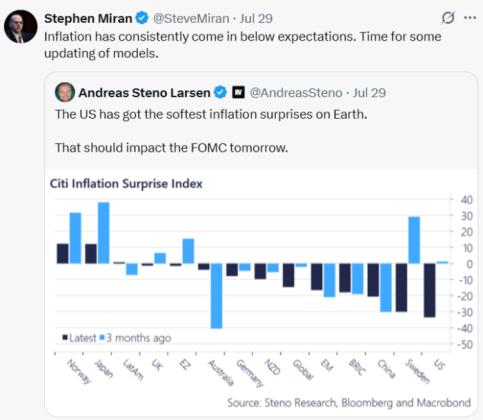
Stephen Miran discussed current inflation models on X.
Source: X (Stephen Miran)

With Miran now serving on the Fed Board, the crypto market has perked up. Since the news broke, $BTC has spiked by around 3%, from a $114K low to a $117.5K – though it has since stabilized to $117K.

Bitcoin ETFs are also on the rise, with all top 10 funds in the green. ProShares’ BITO, the only futures ETF in the top 10, posted the highest turnover rate at 9.31%.
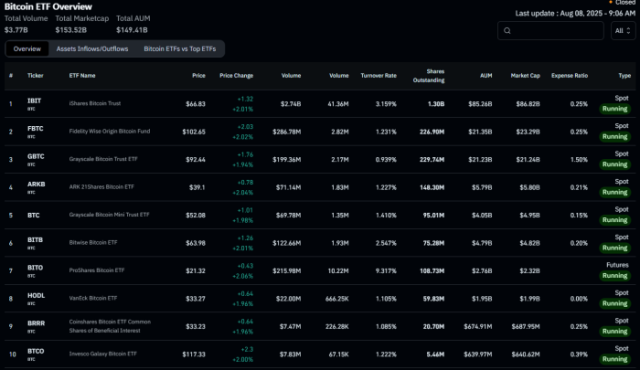
This signals that long-term investors and active traders are re-entering the market as $BTC shows renewed strength.
Bitcoin ETF overview on Coinglass.
Source: Coinglass

But while $BTC’s price hike is promising, the network on which it’s held still faces scalability issues. This makes Bitcoin Hyper’s upcoming launch all the more important.

Bitcoin Hyper to Solve Bitcoin’s Biggest Issues This Quarter

Once launched this quarter, Bitcoin Hyper promises to make Bitcoin more scalable, faster, and cost-friendly – all without compromising the Layer 1 version’s security or core principles.

As $BTC adoption grows, the network often becomes congested. Fees spike and transactions slow down, especially during bull runs. Bitcoin Hyper is under development to fix precisely this.

For instance, during the April 2024 halving event, fees on the Bitcoin network spiked above $128. This was also partly due to the launch of the Runes protocol, causing a sharp increase in transaction demand.

But with Bitcoin Hyper, instead of every transaction competing for space on the base layer, it batches transactions off-chain and settles them efficiently.

By doing so, it can facilitate lower fees, faster transactions, and more practical real-world use for DeFi protocols and dApps built on Bitcoin.

Bitcoin Hyper aims to achieve this by leveraging the Solana Virtual Machine (SVM), which brings smart contract capabilities to the Bitcoin ecosystem.

A Canonical Bridge is also at the core of the Layer 2’s infrastructure. Once a transaction is verified through an SVM smart contract, the system mints an equivalent wrapped $BTC on the Layer 2. This wrapped $BTC can then be used across DeFi platforms.
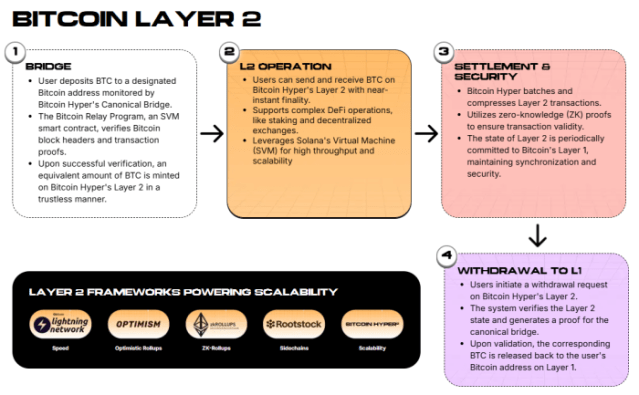
How the Bitcoin Hyper Layer 2 will operate.
Source: Bitcoin Hyper

If you want to retrieve your Bitcoins, fear not. The bridge will validate the Layer 2 activity and securely release the original $BTC back to the base layer.

Moreover, to ensure security while scaling, Bitcoin Hyper uses Zero-Knowledge Proofs (ZKPs). This allows for fast, trustless transaction verification with minimal impact on Bitcoin’s main chain.

To get the most out of the ecosystem, you’ll want to purchase $HYPER. As the project’s native currency, it grants access to lower gas fees, governance rights, and staking rewards up to a 139% APY.

It’s no wonder $HYPER has already attracted over $7.7M since its presale launch on May 16, 2025.

Verdict – Bitcoin Hyper to Gear Up at the Right Time

Miran joining the Federal Reserve Board signals a shift toward looser policy, a setup that often benefits $BTC.

While this is excellent news for the crypto leader and thus the entire market as a whole, the Bitcoin network will likely struggle to keep up with the surge in demand.

Good thing Bitcoin Hyper is getting set to launch shortly. To get the most out of the ecosystem, you can purchase $HYPER on presale for just $0.012575.

Once the Layer 2 launches its mainnet, it’s anticipated to reach $0.32, making now a prime time to join for possible gains surpassing 2,445%.

This isn’t investment advice. Always do your due diligence and never invest more than you’d be sad to lose.

Editorial Process for bitcoinist is centered on delivering thoroughly researched, accurate, and unbiased content. We uphold strict sourcing standards, and each page undergoes diligent review by our team of top technology experts and seasoned editors. This process ensures the integrity, relevance, and value of our content for our readers.

Leah is a British journalist with a BA in Journalism, Media, and Communications and nearly a decade of content writing experience. Over the last four years, her focus has primarily been on Web3 technologies, driven by her genuine enthusiasm for decentralization and the latest technological advancements. She has contributed to leading crypto and NFT publications – Cointelegraph, Coinbound, Crypto News, NFT Plazas, Bitcolumnist, Techreport, and NFT Lately – which has elevated her to a senior role in crypto journalism. Whether crafting breaking news or in-depth reviews, she strives to engage her readers with the latest insights and information. Her articles often span the hottest cryptos, exchanges, and evolving regulations. As part of her ploy to attract crypto newbies into Web3, she explains even the most complex topics in an easily understandable and engaging way. Further underscoring her dynamic journalism background, she has written for various sectors, including software testing (TEST Magazine), travel (Travel Off Path), and music (Mixmag). When she's not deep into a crypto rabbit hole, she's probably island-hopping (with the Galapagos and Hainan being her go-to's). Or perhaps sketching chalk pencil drawings while listening to the Pixies, her all-time favorite band.

Lecturas Relacionadas

Director de Inversiones de Bitwise: la fuerte caída de STRC es una señal de fondo, el mercado alcista comenzará en otoño

**Bitwise CIO: La fuerte caída de STRC es señal de fondo, el mercado alcista comenzará en otoño** La semana pasada, Bitcoin cayó por debajo de los $60k, marcando un mínimo en 2024. La causa principal fue la caída en picado de las acciones preferentes perpetuas STRC de MicroStrategy. STRC, un producto que ofrecía alto rendimiento y estabilidad de precio, atrajo $10.5 mil millones. Los inversores temieron que MicroStrategy suspendiera los dividendos ante la debilidad del precio de Bitcoin, haciendo que STRC cayera a $75. MicroStrategy anunció un nuevo marco: venderá algunos Bitcoin para pagar dividendos y permitirá que STRC cotice libremente, abandonando el objetivo de $100. Esto marca un cambio: ya no será solo un comprador neto constante de Bitcoin, sino que operará de manera más dinámica. El CIO de Bitwise argumenta que la volatilidad de STRC es un signo clásico del final de un ciclo, donde el exceso de apalancamiento (dinero que buscaba bajo riesgo ingresó a un activo volátil) se elimina del mercado. Este proceso de "limpieza" es necesario para encontrar un fondo sólido. El próximo motor principal para Bitcoin, según él, será la adopción institucional (bancos, fondos de pensiones, etc.), que ya está en marcha. Para identificar un fondo de mercado, sugiere observar: 1) MSTR cotizando con descuento sobre su valor neto, 2) el Índice de Miedo y Codicia en extremos de "miedo", y 3) tasas de financiación de futuros persistentemente negativas. Concluye que, aunque es imposible predecir el momento exacto, el proceso de desapalancamiento actual acerca al mercado al fondo, y anticipa que un nuevo mercado alcista podría comenzar en el otoño de este año.

Foresight NewsHace 12 min(s)

Director de Inversiones de Bitwise: la fuerte caída de STRC es una señal de fondo, el mercado alcista comenzará en otoño

Foresight NewsHace 12 min(s)

El fundador de ENS quiere «recuperar el poder» de manos del DAO

El 29 de junio, Nick Johnson, fundador de ENS, ejerció una gran cantidad de sus tokens ENS para votar en contra de una propuesta que buscaba renovar por dos años el poder de veto del Comité de Seguridad del ENS DAO. Aunque inicialmente la propuesta contaba con amplio apoyo, su intervención cambió el resultado. Johnson justificó su voto argumentando preocupaciones sobre la falta de contrapesos adecuados para el comité y el posible uso político de su poder de veto. Este evento es parte de un contexto más amplio de tensiones en la gobernanza del ENS DAO. Desde finales de 2025, Johnson y otros han expresado su descontento con la ineficiencia y las luchas políticas internas dentro del DAO, donde consideran que el liderazgo ha sido asumido por personas con intereses no alineados o falta de experiencia. Paralelamente, la COO de ENS, Katherine Wu, presentó una controvertida propuesta para transferir gran parte de las operaciones diarias y la gestión del tesoro (que supera los 350 millones de dólares) a una Fundación ENS reorganizada, mientras el DAO conservaría ciertos poderes clave. Esto ha generado un debate entre quienes defienden un control más descentralizado por parte de los holders de tokens y quienes creen que una estructura más centralizada es necesaria para una gestión eficiente, especialmente en un contexto de caída de los ingresos del protocolo. La votación de Johnson es vista como el primer paso en un esfuerzo más amplio para reformar la gobernanza de ENS, moviendo el proyecto hacia un modelo que priorice la eficiencia operativa y la responsabilidad, aunque ello implique cierta recentralización del poder de decisión.

Foresight NewsHace 42 min(s)

El fundador de ENS quiere «recuperar el poder» de manos del DAO

Foresight NewsHace 42 min(s)

VELVET se estanca en $2—¿Qué tan profunda podría ser la actual corrección?

VELVET se ha mantenido en una tendencia alcista, impulsado por la noticia de su asociación con Aerodrome Finance, llegando a superar brevemente la resistencia psicológica de los 2 dólares el 29 de junio. Sin embargo, su impulso ha disminuido, con una corrección del 11.5% en las últimas 24 horas y un volumen de trading diario reducido en un 27.1%. El análisis técnico muestra señales mixtas. La estructura diaria sigue siendo bajista a pesar de la corrección anterior, y mientras el Indicador de Balance de Volumen (OBV) muestra presión compradora, el Índice de Flujo de Capital (CMF) indica salidas significativas de capital. Esto sugiere una presión distributiva a corto plazo, aunque el volumen comprador general se mantiene alto. Para los traders, el ratio riesgo-recompensa no es favorable para posiciones largas en este momento. No hay garantía de que la tendencia alcista haya concluido, pero los indicadores de futuros (Open Interest en descenso, CVD spot estable y tasa de funding neutral) apuntan a un momentum bajista a corto plazo. Los alcistas podrían intentar recuperar el soporte de 2 dólares, mientras que la media móvil de 20 días en 0.75 dólares se perfila como un nivel de soporte dinámico clave en caso de una mayor corrección. En resumen, VELVET no logró consolidar los 2 dólares como soporte y se encuentra en un retroceso. La evidencia sugiere que esta es una distribución controlada a corto plazo, no una toma de ganancias masiva, pero la profundidad de la corrección actual sigue siendo incierta.

ambcryptoHace 1 hora(s)

VELVET se estanca en $2—¿Qué tan profunda podría ser la actual corrección?

ambcryptoHace 1 hora(s)

Trading

Spot
活动图片