Could Wall Street 51% Attack Ethereum? Bitcoin Firm CEO Sparks Debate

bitcoinistPublished on 2025-07-24Last updated on 2025-07-24

Abstract

A speculative thread led by Bitcoin Magazine CEO David Bailey on July 23 ignited a fresh dispute between Bitcoin advocates...

Trusted Editorial content, reviewed by leading industry experts and seasoned editors. Ad Disclosure

A speculative thread led by Bitcoin Magazine CEO David Bailey on July 23 ignited a fresh dispute between Bitcoin advocates and Ethereum supporters over how the proof‑of‑stake (PoS) security model might interact with traditional capital markets. The exchange unfolded against a backdrop of publicly listed Ethereum treasury companies steadily accumulating and staking Ether—an emerging trend.

Wall Street 51% Attack on Ethereum?

Bailey’s scenario hinges on that concentration: if a cluster of corporate balance sheets holds a material share of staked ETH, equity‑market tactics could, in his view, substitute for direct token purchases in assembling validator control. Bailey opened: “If enough eth validators were owned by public ethereum treasury companies (~20% of total eth supply), you could 51% attack the public equities (ie take majority control, many ways to achieve that via capital markets) – and you’d have governance control over ethereum. In other words securities law would become eth’s consensus mechanism.”

Extending the idea, he claimed the strategy “opens quite an interesting investment strategy,” adding: “since Ethereum is not a security then ethereum holders have no legal rights… You could reorg the chain, slash other users, screw up all assets and L2s issued on top eth… legally pillage.”

The core of Bailey’s hypothesis rests on two linked assumptions: first, that publicly listed Ethereum treasury companies accumulate a sufficiently large percentage of staked Ether; second, that hostile actors could obtain board or managerial control of those corporations—via hostile takeovers, activist campaigns, or other capital markets tactics—without directly purchasing ETH on‑chain.

Responding to a counterargument that an attacker would have to buy vast quantities of Ether and thereby enrich existing holders, Bailey wrote: “You don’t need to buy any eth, you just buy stock in companies that already own it.”

Critics quickly challenged both the technical premises and the real‑world feasibility. Pseudonymous commentator Birdnals framed the scenario as requiring simultaneous, secret collusion among several boards overseeing “5+ publicly traded companies” and “the 100’s of others of employees/agents it would take to perform that collusion… many of which are ETH maxis.”

They warned such conduct could invite “fraud, anti-trust violations, RICO” and other liabilities, making the proposition legally and operationally brittle. Bailey replied that “hostile takeovers is a whole world unto itself in capital markets” and questioned how “social slashing” would be applied “without screwing the other 49% of shareholders who are innocent.”

Technical members of the Ethereum community rejected the framing that validator ownership equals governance authority. Former federal agent Tigran Gambaryan responded: “Block production and mev maybe, but not governance. That’s not how eth works. ETH governance is off-chain.” Ethereum user nicholasb.eth likewise stated: “While there are many PoS blockchains that use on-chain governance, Ethereum does not. It’s important to distinguish this. It’s not just whoever owns the most ETH (or a coordinated group of holders) can control the network,” calling Bailey’s earlier claim “factually incorrect.”

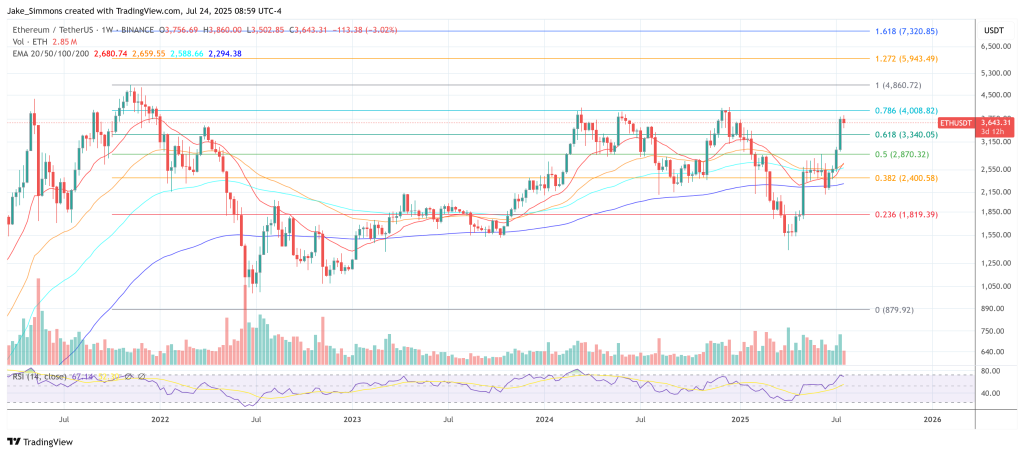
At press time, ETH traded at $
Ethereum price
ETH price stalls below key resistance, 1-week chart | Source: ETHUSDT on TradingView.com
Featured image created with DALL.E, chart from TradingView.com
Editorial Process for bitcoinist is centered on delivering thoroughly researched, accurate, and unbiased content. We uphold strict sourcing standards, and each page undergoes diligent review by our team of top technology experts and seasoned editors. This process ensures the integrity, relevance, and value of our content for our readers.

Jake Simmons has been a Bitcoin enthusiast since 2016. Ever since he heard about Bitcoin, he has been studying the topic every day and trying to share his knowledge with others. His goal is to contribute to Bitcoin's financial revolution, which will replace the fiat money system. Besides BTC and crypto, Jake studied Business Informatics at a university. After graduation in 2017, he has been working in the blockchain and crypto sector. You can follow Jake on Twitter at @realJakeSimmons.

Trending Cryptos

Related Reads

Doubao and Qwen Will Discontinue Agent Functionality on July 15

On July 4th, Doubao and Tongyi Qianwen announced the impending shutdown of their user-created "AI Agent" features. Doubao confirmed its agent feature will be taken offline on July 15, directing users to ByteDance's CatBox app for similar needs. On the same day, Tongyi Qianwen notified users, specifying that personalized interactive agents and user-built agent functions will cease on July 10, with all agent features and services completely deactivated by July 15. After this date, access to agent configurations and historical chat records will be lost. This adjustment impacts core user scenarios like role-playing, personal assistants, and vertical tool agents. The shutdown date coincides with the official implementation of China's "Interim Measures for the Administration of Artificial Intelligence Human-like Interactive Services" on July 15. The new regulations impose strict rules on "human-like emotional interaction services," requiring platforms to implement measures like anti-addiction systems, minor verification, and content moderation. This move is widely seen as a proactive step by the platforms to align with regulatory timelines and mitigate compliance risks. Additionally, commercial challenges are a key driver. Analysis suggests that casual, human-like chat agents generate high-frequency, low-value interactions, leading to high computational costs with poor monetization. As the AI application market shifts from user growth to proving value, sustaining such "high-cost, low-efficiency" user-generated content becomes difficult. Both platforms have outlined transition plans. Doubao will allow data viewing and self-backup for a period after shutdown, with data scheduled for permanent deletion by October 15. Tongyi Qianwen similarly advised users to save important content via copying or screenshots before the deadline. This strategic retreat from C-end agent features signals a broader market shift. Compliance capability and sustainable business models are replacing user scale and feature richness as the new core competitive dimensions. Tongyi Qianwen's recent move to fully open its Agent and Skill platforms to third-party enterprises and developers further underscores a strategic pivot from low-value C-end services to high-value B-end enterprise scenarios.

marsbit1h ago

Doubao and Qwen Will Discontinue Agent Functionality on July 15

marsbit1h ago

Why Did Codex and ChatGPT Merge? What's Next for Codex? OpenAI Core Leader Answers Everything

In 2026, OpenAI's Codex saw explosive growth, with weekly active users surging over 5x to 5 million since January, driven largely by the February launch of its desktop app. Codex desktop lead Andrew Ambrosino explains key shifts behind its evolution. A core change is the inversion of development costs: implementation is now cheap, while curation and taste—judging which of many AI-generated prototypes is valuable—have become the new scarcities. Ambrosino defines taste as a blend of aesthetics, systems thinking, direction, and semantic coherence in interaction. He notes AI still struggles with design because evaluating it requires human cultural context and abstract reasoning about how components relate—capabilities beyond current models. Timing is critical: the same Codex app would have failed months earlier; success hinges on the model's capabilities at launch. Roles are blurring within his team, with engineers, designers, and PMs overlapping significantly. However, Ambrosino cautions against eliminating specialized roles entirely, as each field retains deep expertise. On AI-assisted development, the focus has shifted from measuring code written by AI to distinguishing between supervised and unsupervised generation. A current challenge is teaching models to simplify code, not just add complexity. The merger of Codex and ChatGPT stems from observed user behavior: non-developers adopted Codex for general knowledge work despite its developer-centric interface. This revealed a collapsing boundary between specialized tools and universal assistants. The vision is a "home base" that orchestrates tasks across external professional tools (like Excel or Premiere Pro) via connectors, rather than rebuilding everything internally. An internal example showed Codex helping edit video by interacting with Premiere Pro's files and even writing a plugin for it. The future direction is a unified, extensible platform that serves as a central hub for automating and managing work across any specialized tool the user employs.

marsbit2h ago

Why Did Codex and ChatGPT Merge? What's Next for Codex? OpenAI Core Leader Answers Everything

marsbit2h ago

Trading

Spot

Hot Articles

Discussions

Welcome to the HTX Community. Here, you can stay informed about the latest platform developments and gain access to professional market insights. Users' opinions on the price of ETH (ETH) are presented below.

活动图片