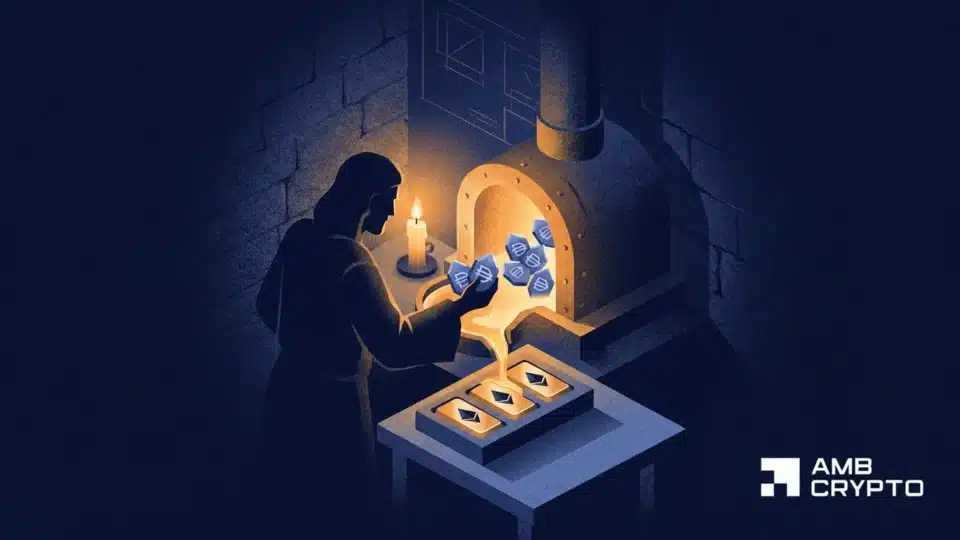
Crypto Graveyard Grows: Coinbase Says $3.4B In ETH Is Irrecoverable

bitcoinistPublished on 2025-07-22Last updated on 2025-07-22

Abstract

Ethereum is seeing a growing chunk of its coins slip out of reach. According to Coinbase head of product, Conor...

Trusted Editorial content, reviewed by leading industry experts and seasoned editors. Ad Disclosure

Ethereum is seeing a growing chunk of its coins slip out of reach. According to Coinbase head of product, Conor Grogan, 913,111 ETH—about 0.76 % of the nearly 121 million coins in circulation—are now locked away by user blunder or software bugs.

Coinbase disclosed that the stash alone is worth more than $3.43 billion at today’s prices. When you add the 5.3 million ETH burned under the network’s fee‑burn rule, the total “gone forever” pile swells to roughly 6.2 million ETH, or 5 % of all issued tokens, representing about $23.4 billion in value.

Coinbase: Lost Ether Climbs Sharply

Based on reports from March 2023, the lost‑to‑error bucket has jumped 44 % from 636,000 ETH to today’s 913,111 ETH. The rise is driven almost entirely by routine transfers to burn addresses and a handful of historical mishaps.

Grogan notes this figure still underestimates the real total, since forgotten private keys and unused genesis wallets aren’t counted.

Investors watching these numbers are getting a clearer view of Ethereum’s true scarcity. Unlike Bitcoin, capped at 21 million coins, ETH’s supply isn’t fixed.

Yet these burns and losses carve out a shrinking pocket of tokens you can actually move. That dynamic can feed into market sentiment—and prices—if demand holds or grows.

ETHUSD currently trading at $3,799. Chart: TradingView

Major Incidents Still Dominate

According to Coinbase, three big blunders account for most of the missing ETH. A faulty Parity multisig wallet swallowed 306,000 ETH. Quadriga’s broken contract ate 60,000 ETH, and the Akutars NFT mint bug locked away 11,500 ETH.

Since Grogan’s last update, only about 1,000 ETH more has wandered into a burn address by mistake. No new megabullets have been shot, but every error still adds up.

For every person who is developing on Ethereum, the risk of lost burns or unclaimed funds is not eliminated. Smart contract audits and easy-to-use key management tools attempt to mitigate these losses, but human error will never be fully eradicated.

That is why keeping up with the rate of lost tokens is as crucial as keeping up with trading volume or price movements.

Elastic Supply And Burn Impact

Ethereum’s switch to proof‑of‑stake in September 2022 and the London hard fork in August 2021 reconfigured its issuance.

Between a high of around 121 million ETH at the Merge, supply fell approximately 0.4 % up until April 2024 due to decreased validator rewards and the fee burn. Net issuance inched back up again afterward, pushing overall supply to 121 million ETH.

Featured image from Unsplash, chart from TradingView

Editorial Process for bitcoinist is centered on delivering thoroughly researched, accurate, and unbiased content. We uphold strict sourcing standards, and each page undergoes diligent review by our team of top technology experts and seasoned editors. This process ensures the integrity, relevance, and value of our content for our readers.

Christian, a journalist and editor with leadership roles in Philippine and Canadian media, is fueled by his love for writing and cryptocurrency. Off-screen, he's a cook and cinephile who's constantly intrigued by the size of the universe.

Trending Cryptos

Related Reads

Li Fei-Fei's Latest Long-Form Article: When Video Generation, Robotics, and NVIDIA All Call Themselves World Models, We Need a Taxonomy

In a new article, Dr. Fei-Fei Li addresses the widespread and often inconsistent use of the term "world model" in AI. She proposes a clear, functional taxonomy rooted in the classic Partially Observable Markov Decision Process (POMDP) loop (agent → action → state → observation → agent). According to this framework, current systems called "world models" are different projections of this loop, categorized by their primary output: 1. **Renderers**: Output observations (pixels). Their goal is visual fidelity for human consumption (e.g., video generation models like Sora). They are the most commercially mature but are limited by a focus on appearance over physical accuracy. 2. **Simulators**: Output states (geometric, physical, dynamic representations). They provide a structurally accurate world for both human professionals (e.g., architects) and computational agents (e.g., robots for training). Li argues simulators are the crucial, underappreciated bridge, as they can underpin both rendering and planning. 3. **Planners**: Output actions. Given an observation and a goal, they decide what an agent should do next (e.g., robotic action models). This area is highly promising but remains the least mature for real-world deployment. Li highlights a key trend: the boundaries between these three categories are beginning to blur, as they all rely on a shared underlying understanding of geometry, physics, and dynamics. The logical endpoint is a unified world foundation model capable of switching between rendering, simulation, and planning based on downstream needs. This convergence, she concludes, is central to advancing spatial intelligence—enabling machines not just to talk about the world, but to truly understand, imagine, and interact with it.

marsbit4h ago

Li Fei-Fei's Latest Long-Form Article: When Video Generation, Robotics, and NVIDIA All Call Themselves World Models, We Need a Taxonomy

marsbit4h ago

Forbes Feature: Stablecoin Cross-Border Payments Are Faster, But Not Yet Cheaper

A Forbes feature delves into the state of stablecoin-based cross-border payments, noting rapid growth but a key shortfall: while faster and more accessible, they are not yet cheaper. At a recent industry conference in Mexico City, optimism about technology, regulation, and volume was tempered by discussions with practitioners. The core issue is liquidity. Traditional FX brokers charge 60-70 basis points, and stablecoins promise to slash this to 2-5 basis points. However, this theoretical cost advantage cannot be realized until deep liquidity pools are established at scale, requiring significant institutional capital inflow. A major adoption barrier is trust. Businesses often rely on long-standing relationships with traditional brokers, valuing reliability over marginal cost savings. This shift will be gradual. Furthermore, successful companies in the space are not positioning themselves as replacements for legacy systems like SWIFT, but as complements. They leverage stablecoins for speed while using traditional rails for their standardization and reliability in ensuring accurate payment details—a critical factor for supplier payments to avoid customs issues. Companies like Caliza, experiencing high monthly growth, exemplify this hybrid approach. The industry anticipates consolidation, as long-term viability will depend on securing the essential trifecta: proper licensing, robust fiat on/off-ramps, and deep liquidity. Without these, firms risk being mere intermediaries rather than building sustainable businesses.

marsbit4h ago

Forbes Feature: Stablecoin Cross-Border Payments Are Faster, But Not Yet Cheaper

marsbit4h ago

Trading

Spot

Hot Articles

Discussions

Welcome to the HTX Community. Here, you can stay informed about the latest platform developments and gain access to professional market insights. Users' opinions on the price of ETH (ETH) are presented below.

活动图片