Насколько безопасно владеть криптовалютами. Какие риски учитывать при инвестировании в криптовалюты

cryptonews.ruPublished on 2025-02-16Last updated on 2025-07-17

Аналитический отчет по безопасности за первое полугодие 2025 года выявил появление новой тревожной тенденции на крипторынке

Компания Сhainalysis опубликовала полугодовой отчет по преступности в сфере криптовалют. Одной из наиболее тревожных тенденций 2025 года аналитики назвали рост числа так называемых «wrench attacks» (букв. «атак гаечным ключом»), то есть преступлений с применением физического насилия. Число таких инцидентов за первые шесть месяцев уже приблизилось к значениям прошлого года. Анализ также показал взаимосвязь между числом нападений и ростом цены биткоина.

«Судя по графику, в 2025 году число таких атак может вдвое превысить рекорд предыдущих лет. Многие случаи не сообщаются, так что реальное число инцидентов может быть выше», — отметили эксперты.
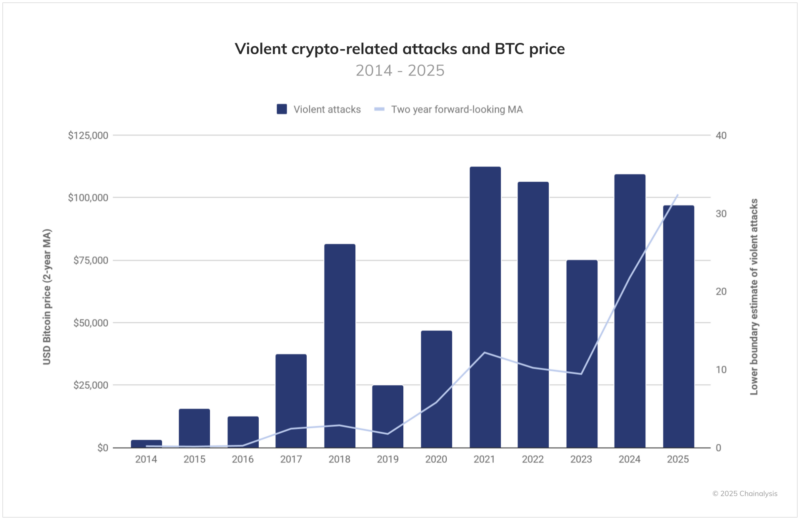
Физические атаки на криптопользователей и цена биткоина. Источник: График с сервиса Github, статистику предоставил биткоин-разработчик Джеймсон Лопп
rbc.group

В 2025 году действительно участились случаи насилия, связанного с криптовалютами. Только во Франции в этом году зафиксировано три громких инцидента, связанных с похищением людей, относящихся к криптобизнесу.

В середине мая жителя Белоруссии приговорили к 13 годам лишения свободы за разбой и попытку вымогательства криптовалюты на сумму более 1 млрд белорусских рублей (₽26 млрд). А в Екатеринбурге будут судить участников банды, обвиняемых в похищении человека, разбойном нападении и краже криптовалюты на 5,6 млн руб.

Данные Chainalysis показали также географическое распределение кражи криптовалют с личных кошельков держателей. В 2025 году США, Германия, Россия, Канада, Япония, Индонезия и Южная Корея возглавили список стран с наибольшим числом жертв, в то время как в странах Восточной Европы, странах Ближнего Востока и Северной Африки и странах Центральной и Восточной Азии наблюдался самый быстрый рост общего числа жертв в период с первой половины 2024 года по первую половину 2025 года.

Уверенность преступников

Характер использования преступниками украденных средств также отличается от большинства других видов краж. Аналитики отметили, что не все украденные средства сразу же отмывают. Средства с личных кошельков все чаще остаются на контролируемых злоумышленниками адресах без конвертации в фиатные валюты.

«Такое «ходлинговое» [от криптотермина Hodl — удерживать монеты] поведение преступников может отражать уверенность в своей операционной безопасности или общую инвестиционную стратегию», — говорится в отчете.

Эксперты отмечают растущую важность сохранения конфиденциальности личных данных, что «требует от частных лиц фундаментального переосмысления мер безопасности».

«Корреляция между насильственными атаками и динамикой цены биткоина свидетельствует о том, что операционная безопасность, такая как сохранение конфиденциальности криптовалютных активов, может быть столь же важна, как и технические меры безопасности», — предостерегают в Chainalysis, добавив, что следует проявлять особую бдительность в отношении своего цифрового следа и физической безопасности.

Нацелены на биткоин

С точки зрения активов украденных преступниками, владельцы биткоинов реже становятся жертвами целенаправленной кражи, чем владельцы других криптоактивов. Но держатели главной криптовалюты несут гораздо большие потери по стоимости украденного. Эксперты предположили, что злоумышленники намеренно нацеливаются на более ценные активы отдельных лиц.

В качестве причин, из-за которых преступники чаще выбирают кражу с личных кошельков, а не сервисов выделяются четыре следующих фактора:

  1. Улучшение мер безопасности сервисов, что подталкивает злоумышленников к выбору лиц, считающихся более легкой добычей.

  2. Растущее число индивидуальных держателей криптовалют.

  3. Рост стоимости криптовалюты, хранящейся в личных кошельках, с течением времени.

  4. Разработка более сложных методов индивидуального таргетинга, включая развитие ИИ-технологий.

Related Reads

Lao Huang: Prompt is Dead, the Entire AI Community is Frenziedly Chasing Loops

The article "Prompt is Dead: The AI Industry is Obsessively Chasing Loops" discusses a major shift in AI development, where "Loop Engineering" is replacing traditional prompt engineering. Industry leaders like NVIDIA's Jensen Huang, Andrew Ng, and engineers from Anthropic and OpenAI argue that manually crafting prompts is becoming obsolete. Instead, the new focus is on designing autonomous, self-improving AI systems (loops) that can operate 24/7. A loop system typically involves five key phases: Discovery (finding tasks), Handoff (assigning to agents), Validation (critical independent review), Persistence (saving progress), and Scheduling (automated operation). The core idea is to move humans from being the operational "engine" to being the system "architects" who design the loop, define goals, and set up verification mechanisms. A major challenge and necessity is implementing robust, independent validation to prevent AI from uncritically approving its own work. The trend is seen as part of a move towards "inference-time compute," where allocating computational budget effectively becomes a key engineering skill. While loops can produce higher-quality outputs, they are more expensive and time-consuming than simple prompting. The article warns of risks like "verification debt," "comprehension corrosion," and "cognitive surrender," where engineers might stop understanding the code their systems generate. Ultimately, the article concludes that in an era of automated loops, human judgment and oversight remain the most critical and scarce resources.

marsbit6m ago

Lao Huang: Prompt is Dead, the Entire AI Community is Frenziedly Chasing Loops

marsbit6m ago

Anthropic's Latest Report Reveals Global Workers' Patterns: Seeking Sleep at 5 AM, Asking for Recipes at 6 PM

A new report from Anthropic analyzes millions of hourly user interactions with Claude AI, revealing detailed patterns in daily life and work. The data shows distinct rhythms: people most frequently ask about sleep help around 5 AM, seek news at 7 AM, and search for dinner recipes at 6 PM—the day's single largest query spike. Usage sharply diverges between weekdays and weekends. Workdays are dominated by professional tasks like business emails and coding (backend, APIs). Weekends see a surge in personal use—nearly 50% of conversations—focused on emotional support, creative writing (especially fan fiction), medical advice, and side projects like AI agent design or game development. Weekend "entrepreneurial" queries peak globally, while job-hunting activity drops. The report introduces "artifact" analysis, finding 93% of conversations produce a tangible output (explanation, document, code, etc.). Blog posts are 81% work-related, while creative writing is over 80% personal. High-wage professionals (e.g., marketing managers, programmers) use Claude more intensively outside work hours, with longer conversations, more tokens consumed, and greater use of deep thinking features compared to lower-wage roles. Interestingly, Claude's responses typically register at a higher reading level than user prompts (by about one educational year on average), except for audience-focused writing like emails or blogs where the gap nearly disappears. The data also captures specific cultural moments, like an 8x spike in tax-related queries on the U.S. filing deadline. Precise hourly data transforms fragmented queries into a collective diary of modern life—mapping not just economic activity, but also cycles of anxiety, creativity, and daily rhythm, with AI acting as both a productivity tool and an intimate, always-available confidant.

marsbit23m ago

Anthropic's Latest Report Reveals Global Workers' Patterns: Seeking Sleep at 5 AM, Asking for Recipes at 6 PM

marsbit23m ago

Margin Exhausted, "Brother Huang Li Cheng" Begins Selling Monkeys at a Loss

Taiwanese crypto whale "Machi Big Brother" Jeffrey Huang has been forced to sell his prized Bored Ape Yacht Club (BAYC) NFTs at significant losses to cover mounting losses from a highly leveraged ETH long position on Hyperliquid. Over the past month, Huang sold 34 BAYC NFTs for 326 ETH (approx. $514,000), realizing a loss of 399 ETH (approx. $631,000). The proceeds were transferred to Hyperliquid to replenish margin for his perpetual contract trades. One ape, BAYC #6057, bought for 76.84 ETH four years ago, was sold for just 7.65 ETH, a 90% loss in ETH terms. Huang began his high-leverage (25-40x) ETH long strategy in September 2025 when ETH was around $4,700. While his account once showed over $45 million in unrealized profit, the subsequent crash of ETH to the $1,600 range erased all gains. As of June 26, his cumulative losses on Hyperliquid reached $33.85 million, with over 335 liquidations earning him the community nickname "King of Liquidations." With conventional funds depleted, Huang's once-valuable NFT collection, which at its peak included around 200 BAYCs and was worth tens of millions, has become a lifeline. His remaining ~150 BAYCs, valued at roughly $1.6 million at current floor prices, provide only limited runway for his persistent high-stakes trading. Huang rose to prominence in crypto as a key figure in popularizing BAYC NFTs in Asia during the 2021 bull market. His pivot to perpetual contracts has now led to a cycle where his iconic "monkeys" are being sold to fund a failing trading strategy.

Foresight News1h ago

Margin Exhausted, "Brother Huang Li Cheng" Begins Selling Monkeys at a Loss

Foresight News1h ago

Trading

Spot
活动图片