Blockchains Solutions like JPMorgan’s JPMD Could Make tGlobal Economy 100x Better: Start with Best Wallet

bitcoinistPublished on 2025-06-24Last updated on 2025-06-24

Abstract

The dated COBOL (Common Business Oriented Language) system may become a thing of the past thanks to increasing blockchain innovation...

Trusted Editorial content, reviewed by leading industry experts and seasoned editors. Ad Disclosure

The dated COBOL (Common Business Oriented Language) system may become a thing of the past thanks to increasing blockchain innovation and adoption by the world’s banking system.

At least this is what Jesse Pollak, the creator of Base and Head of Protocol at Coinbase, told Unchained in a recent interview:

‘The global economy is going to work 100 times better because it’s using this new technology that lets us move money in a permissionless, programmable way.’

Jesse Pollak, Unchained Podcast

What is COBOL?

COBOL is one of the oldest high-level programming languages, developed in the late 1950s for business applications and administrative systems in business, finance, and other areas.

Despite being in use in most banking systems, it faces issues related to its inefficiency, reliance on a niche language, limited libraries, and lack of support for multimedia processing, machine learning, and graphical UI.

JPMorgan’s JPMD Changes the Game

JPMorgan just announced its JPMD (J.P. Morgan Deposit Token), which essentially incorporates blockchain technology into its payment system. As stated in the press release:

‘JPMD – and Deposit Tokens in general – match the novel and distinctive properties of stablecoins, most notably the ability to conduct peer-to-peer transactions with programmability. As such, Deposit Tokens and stablecoins can be applied to similar use cases.’

JPMorgan, Deposit Tokens

This could signal the first step towards the abolition of COBOL, which, according to a Reuters report, is still in use in over 43% of the world’s banks.
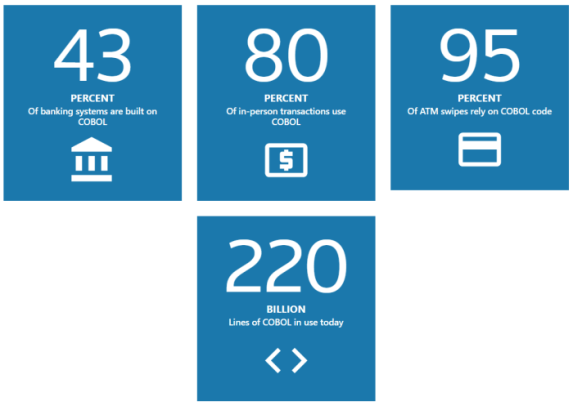
Reuters report on COBOL use.
Source: Reuters

According to John Duigenan, General Manager of Financial Services at IBM Technology, the dinosaur systems the banks are still using highlight the lack of innovation in the banking industry.

‘In order for banks to offer new services … they have to be able to modernise and transform — and many are struggling with the fact that they have hyper-integrated monolithic systems from 50 years ago.’

John Duigenan, Interview

In contrast, the JPMD system lets whitelisted customers transfer their JPMorgan deposits to Coinbase’s BASE and move money far more efficiently than COBOL ever could.

This is what Jesse Pollak meant when he said that blockchain integration will help the economy work 100x better.

US’s GDP growth according to Trade EconomicsIn this evolving financial context, the adoption of new tools like Best Wallet is another step in the right direction.

How Best Wallet Contributes to a More User-Friendly Financial System

Best Wallet is a non-custodial, no-KYC, and free-to-use crypto wallet with a user-friendly interface, live charts, and a Token Launchpad. The latter alerts you to hot new tokens, so you can buy early and potentially maximize your ROI.

Best Wallet is available to use right now, but it’s also under continuous development, intending to expand its reach and implement new services across four phases.

Best Wallet’s roadmapAn NFT gallery, support for over 60 chains, market intel analytics, and MEV protection are all in the pipeline, as the project gains traction and sees wider adoption.

Best Wallet’s native token, $BEST is now in presale and has already accumulated over $13.5M, with a current token price of $0.025225.

The token supports Best Wallet’s development cycle while offering holders exclusive perks within Best Wallet’s ecosystem. These include governance rights, reduced on-chain transaction fees, and early access to new features and projects.
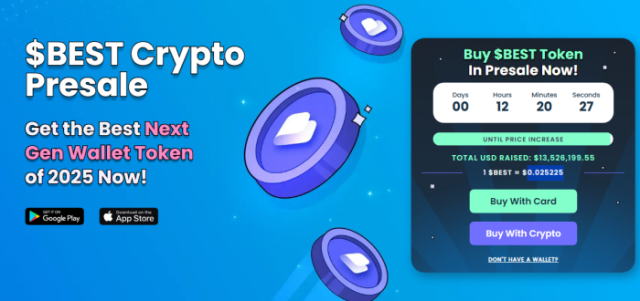
$BEST presale pageBased on Best Wallet’s utility, ease-of-use, and ambitious roadmap, our analysts predict that $BEST will steam up the charts post-release.

We’re looking at a potential price point of $0.072 by the end of the year, which represents a growth of 185% from today’s price of $0.025225.

With a projected 1B users by 2030, $BEST could reach $0.82 or higher, for an ROI of 3,150% if you invest today. This makes $BEST one of the best crypto presales of 2025.

If you want to join the presale to take advantage of the $BEST pre-launch price and the staking APY of 103%, go to the presale page and buy your stack of $BEST today.

The Future of Banking is Blockchain

With finance giants like JPMorgan already making the transition to digital assets and blockchain services, the signs are clear: the world’s banking system is heading straight to tokenization.

In this ever-changing financial context, innovative, user-focused services like Best Wallet will drive the transition from the classical banking system to blockchain-based ones.

Remember, this isn’t financial advice. Do your own research (DYOR) and only invest money that you can afford to lose.

Editorial Process for bitcoinist is centered on delivering thoroughly researched, accurate, and unbiased content. We uphold strict sourcing standards, and each page undergoes diligent review by our team of top technology experts and seasoned editors. This process ensures the integrity, relevance, and value of our content for our readers.

As a crypto writer, Bogdan’s responsibilities are split between researching and writing articles and entertaining the team with his humor bordering on the politically incorrect, an aspiring Bill Burr, if you will. Thanks to his 12+ years of writing experience in just as many fields, including tech, cybersecurity, modelling, fitness, crypto, and other topics-that-shall-not-be-named, he's become a genuine asset to the team. While his position as a senior writer at PrivacyAffairs thought him valuable lessons about the power of self-management, his entire writing career was and is an exercise in self-improvement. Now, he's ready to sink his teeth into crypto and teach people how to take control of their own money on the blockchain. With fiat as an eternally devaluing currency, Bitcoin and altcoins seem like the best-fitting alternative for Bogdan. Bogdan’s biggest professional accomplishment, aside from securing a position as a main writer for Bitcoinist, was his 5-year run as a writing manager at Blackwood Productions, where he coordinated a team of four writers. During that time, he learned the value of teamwork and that of creating a working environment that breeds efficiency, positivity, and friendship.

Trending Cryptos

Related Reads

Bitcoin’s path to $80K may hinge on THIS hidden trend

Bitcoin's potential path toward $80,000 is influenced by conflicting market signals. Data shows the Coinbase Bitcoin Premium Index has recorded its longest-ever streak of consecutive negative premiums, indicating muted institutional demand or net selling from U.S. institutions. While such a trend often signals short-term weakness, it doesn't necessarily forecast a long-term bear market. Additionally, a bearish crossover occurred in Bitcoin's Net Unrealized Profit/Loss (NUPL), with its short-term average falling below the longer-term average, suggesting declining investor profitability and waning market momentum. Historically, major bear market bottoms saw the 100-day NUPL drop below zero, but this cycle it remains positive, implying either an unprecedented bottom or a further decline is needed. Currently trading around $63,148, Bitcoin has seen weekly gains but remains below its May peak. Technical indicators present a mixed picture: the MACD shows bullish momentum, while the RSI signals bearish pressure. A positive development is the return of inflows to Bitcoin ETFs after eight weeks of outflows. Analysts hold divergent views; some highlight a key liquidity zone between $48,000-$50,000 where a market bottom could form, while others maintain a more optimistic long-term outlook. Ultimately, while some bullish signs exist, a strong push from institutional investors appears crucial for Bitcoin to challenge the $80,000 level.

ambcrypto9m ago

Bitcoin’s path to $80K may hinge on THIS hidden trend

ambcrypto9m ago

Unexpected Weak Non-Farm Payrolls Data Pushes BTC to Rebound 11%, FOMC Minutes to Test the Narrative of This Rally

Bitcoin has rebounded 11% from its 21-month low, but the sustainability of this rally hinges entirely on the Federal Reserve's release of the June FOMC meeting minutes. The bounce was triggered by a weaker-than-expected US jobs report, which showed only 57,000 jobs added in June—about half of economists' forecasts. This data prompted traders to scale back bets on further Fed rate hikes, fueling a rally in Bitcoin alongside gold and stocks. The upcoming minutes are critical. They will reveal whether Fed officials, in their mid-June meeting, were already expressing concerns about a weakening labor market, tight credit conditions, or the risks of overtightening—factors that would support the market's recent dovish shift. Conversely, if the discussion focused on persistent inflation and the conditions for more rate hikes, the rally's foundational narrative would crumble. Market indicators show the rebound's fragility. While US spot Bitcoin ETFs saw a significant single-day inflow, it followed a prolonged period of outflows. On-chain data indicates a substantial increase in Bitcoin being moved to exchanges, creating potential sell pressure. Options market positioning suggests key price levels around $60,000 and $62,000 that could either stabilize or accelerate price movement. In essence, Bitcoin's 11% gain is built on speculation about the Fed's private deliberations three weeks ago. The FOMC minutes will replace that speculation with concrete details, and the discrepancy between market expectations and the actual record will determine whether Bitcoin holds above $64,000 or falls back toward $58,000.

marsbit20m ago

Unexpected Weak Non-Farm Payrolls Data Pushes BTC to Rebound 11%, FOMC Minutes to Test the Narrative of This Rally

marsbit20m ago

Just Now, The World's First Ultra-High-Frame World Model Was Born, Nvidia Content 0, Racing to 50 FPS

Just Now, Global First Ultra-High-Frame World Model Born, 0% NVIDIA, Speeds to 50 FPS A Chinese team has developed MoWorld, the world's first Flash World Model, achieving real-time interactive inference exceeding 50 FPS. Crucially, it is entirely built on domestic NPUs (National Processing Units), bypassing NVIDIA GPUs. Developed by Moxin Technology in collaboration with Zhejiang University's Pan Yunhe academician team, MoWorld represents a complete, closed-loop system from training and distillation to deployment on domestic computing power. The model tackles the critical industry bottleneck of real-time performance, essential for applications like robotics, gaming, and digital worlds. MoWorld achieves this through a full-stack redesign for NPUs, including a proprietary 3D-annotated data pipeline, system-level optimizations for long-sequence training (up to 2000 frames), and inference optimizations like dynamic mixed-precision quantization. On a Huawei Ascend 910C platform, a 14B MoE parameter model achieves over 50 FPS, reducing typical inference costs by 70% compared to equivalent GPU solutions. This breakthrough lowers the deployment barrier, potentially accelerating the industrialization of world models. Key application areas include gaming/entertainment (offering 6-DoF camera control for immersive exploration), embodied AI/autonomous driving (providing a high-fidelity digital training ground), film pre-visualization, and 3D reconstruction/digital twins due to its strong geometric consistency. MoWorld demonstrates that a full-stack domestic compute ecosystem can support cutting-edge, real-time world models, positioning China at a competitive starting line in defining next-generation spatial intelligence standards. The project underscores a shift in competition from model scale to real-world usability and cost-effective deployment.

marsbit57m ago

Just Now, The World's First Ultra-High-Frame World Model Was Born, Nvidia Content 0, Racing to 50 FPS

marsbit57m ago

Pacific 'Fever': How Extreme Weather Becomes Wall Street's Cash Machine?

"Pacific Fever": How Extreme Weather Becomes Wall Street's ATM? The summer of 2026 sees unusually fierce weather across China and globally. The common driver behind this global pattern is a powerful El Niño event, potentially the strongest since 1950, as declared by NOAA. This phenomenon, characterized by warming central/eastern Pacific waters, disrupts global atmospheric circulation, raising risks of floods, droughts, and heatwaves, further intensified by climate change. For financial markets, especially commodities, El Niño is not just weather but a major trading theme. History shows its price impact is profound. In the 1970s, El Niño-driven anchovy collapse in Peru fueled a soybean boom, giving Richard Dennis his first million. Anthony Ward's cocoa empire was built on superior weather intelligence. Most recently in 2024, West African droughts caused cocoa prices to soar over 400%, delivering huge gains for trend-following hedge funds. In 2026, markets are again pricing in future El Niño-induced supply shocks. Despite high current inventories, prices for palm oil, rubber, and sugar have rallied on anticipation of upcoming Southeast Asian droughts and weak Indian monsoons. Analysts identify key indicators to watch: the Niño3.4 index, Indian monsoon rainfall, Malaysian palm oil stocks, and the fundraising scale of specialized weather funds like Moreton Capital. Beyond trading opportunities, a concerning narrative is gaining traction online, linking El Niño with fertilizer shortages and energy supply disruptions to warn of potential global food crises within months. While alarmist, it highlights a deeper truth: the cascading effects of climate-driven weather extremes ultimately translate into higher costs of living for everyone, far beyond the trading floor.

marsbit1h ago

Pacific 'Fever': How Extreme Weather Becomes Wall Street's Cash Machine?

marsbit1h ago

Pacific 'Fever': How Extreme Weather Becomes Wall Street's ATM?

"Pacific 'Fever': How Extreme Weather Becomes Wall Street's Piggy Bank" The article examines how the 2026-2027 El Niño, potentially the strongest since 1950, is not only disrupting global weather but also creating major financial opportunities. It links recent extreme events in China and worldwide to this climate phenomenon, which alters atmospheric patterns, increasing risks of floods, droughts, and heatwaves. The core narrative explores how financial markets capitalize on these disruptions. A hedge fund is raising $500 million specifically to bet on El Niño-affected crops like South African corn and Malaysian palm oil. Historically, such strategies have yielded massive profits. Examples include Richard Dennis ("Turtle Trader") making his first fortune in the 1970s soy boom triggered by El Niño's impact on Peruvian anchovies (a key fishmeal source), and Anthony Ward's cocoa empire built on superior weather intelligence. The 2024 cocoa price surge, driven by West African drought, enriched quantitative trend-following funds. Currently, markets are preemptively bidding up palm oil, rubber, and sugar futures based on anticipated future supply shocks, despite high current inventories. The article details El Niño's asymmetric global impacts: causing drought in Southeast Asia (hurting palm oil/rubber) and India (affecting sugar/cotton), but bringing beneficial rains to South American soy and sugarcane. Key metrics to watch include the Niño3.4 index, Indian monsoon data, and Malaysian palm oil stocks. The true price effects often materialize *after* the El Niño peaks, suggesting 2027 may see the real volatility. The conclusion warns that beyond trading gains, the convergence of El Niño, energy shortages, and fertilizer scarcity poses a systemic risk, potentially raising the cost of living for everyone, turning a climate event into a global economic story.

链捕手1h ago

Pacific 'Fever': How Extreme Weather Becomes Wall Street's ATM?

链捕手1h ago

Trading

Spot

Hot Articles

Discussions

Welcome to the HTX Community. Here, you can stay informed about the latest platform developments and gain access to professional market insights. Users' opinions on the price of S (S) are presented below.

活动图片