Malaysia’s Crypto Mining Boom Threatened By $100 Million Power Theft

bitcoinistPublished on 2025-06-10Last updated on 2025-06-10

Abstract

Malaysia’s crypto miners are at a crossroads. A new study by the ACCESS Blockchain Association of Malaysia points to big...

Trusted Editorial content, reviewed by leading industry experts and seasoned editors. Ad Disclosure

Malaysia’s crypto miners are at a crossroads. A new study by the ACCESS Blockchain Association of Malaysia points to big gains ahead. But it also warns that illegal outfits are draining more than RM441 million from the power grid between 2020 and 2024. That $100 million loss has hit both public safety and investor trust.

Malaysia Mining Faces Power Theft Crisis

According to national utility Tenaga Nasional Berhad (TNB), hidden rigs in homes and offices have been tapping into the grid without permission. Over the last five years, TNB logged power losses worth RM441 million. That’s more than $100 million in stolen electricity.

Now, grid instability is rising. Local communities risk outages. And real miners worry their bills could spike to cover the shortfall.

Legal Mining Growth Could Bring RM700 Million

Based on reports from ACCESS, formalizing crypto mining could unlock RM700 million in hardware and infrastructure this year alone. It could also create 4,000 new jobs and boost annual tax revenues by around RM150 million.

Malaysia already ranks among the top 10 countries worldwide by bitcoin hash rate share. Cheap industrial tariffs in places like East Sarawak help explain the hike. Yet many legal players stay under the radar. They fear unclear rules and sudden policy shifts.
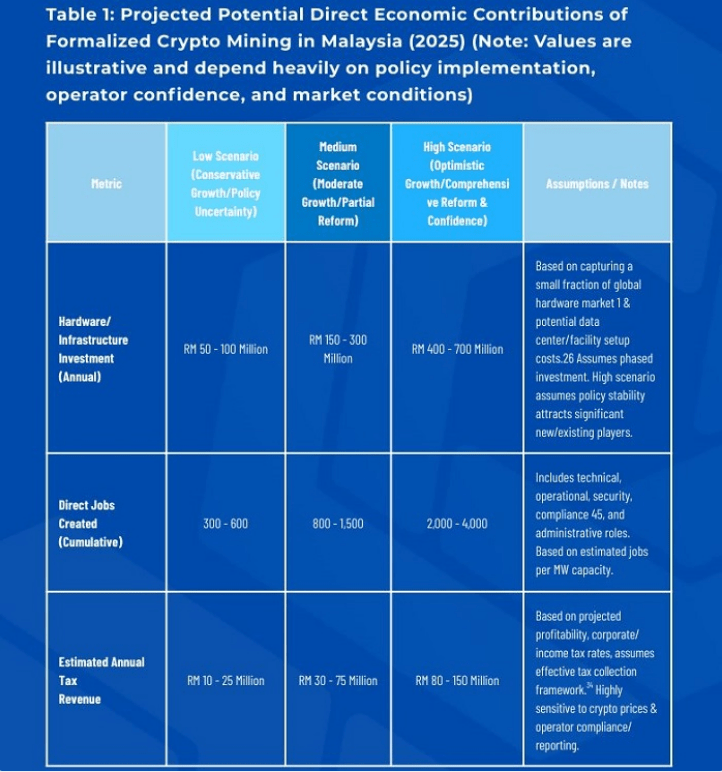
Source: ACCESS Blockchain Association

Regulators Urged To Act

The study points out that no agency specifically licenses mining. The Securities Commission looks after asset trading and custody, but it stops there. Miners have no dedicated permit. They face vague electricity tariffs and murky environmental rules.

That confusion deters investors who want stability. ACCESS calls for a clear mining license, fair pricing, and defined environmental checks.

In neighboring Thailand and Indonesia, illegal mining has also spiked. Between 2018 and 2024, power-theft incidents tied to crypto rigs jumped nearly 300%, totaling nearly 2,400 cases. That regional trend underlines a shared headache. If Malaysia doesn’t tighten laws, it risks losing credibility in the fast-growing digital asset arena.
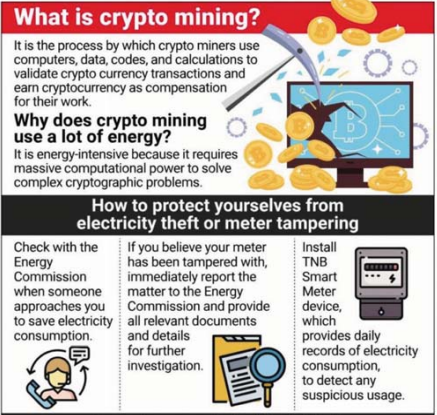
Source: TNB

TNB has started using smart meters and data analytics to spot theft early. But enforcement remains patchy. Multiple government bodies share responsibility, which means cases often slip through the cracks. Without a unified team on this, illegal operators keep hitting the grid—and the public.

ACCESS suggests updating landlord liability laws so building owners can’t turn a blind eye to unauthorized rigs. It also recommends energy pricing tied to sustainability, nudging miners toward greener power.

Featured image from LinkedIn, chart from TradingView

Editorial Process for bitcoinist is centered on delivering thoroughly researched, accurate, and unbiased content. We uphold strict sourcing standards, and each page undergoes diligent review by our team of top technology experts and seasoned editors. This process ensures the integrity, relevance, and value of our content for our readers.

Christian, a journalist and editor with leadership roles in Philippine and Canadian media, is fueled by his love for writing and cryptocurrency. Off-screen, he's a cook and cinephile who's constantly intrigued by the size of the universe.

Trending Cryptos

Related Reads

Pantera Capital: As Perpetual Contracts Move Towards the Financial Center, Hyperliquid Aims to Be All-Encompassing

Perpetual futures ("perps"), once a crypto-native phenomenon, are becoming a dominant global financial instrument, evolving into a fundamental market structure shift that traditional finance can no longer ignore. This article outlines the advantages of perpetual contracts over traditional futures, highlighting their simplicity (no expiry/rollover), easier risk management, and native 24/7 operation. While the concept is not new, digital assets provided the ideal environment for its explosive growth. Initially dominated by centralized exchanges (CEX), perps have recently migrated significantly to decentralized exchanges (DEX), with Hyperliquid emerging as the leading DEX for perps, capturing ~40% of the on-chain volume. Hyperliquid, built on its own purpose-built L1 blockchain, has successfully expanded beyond crypto into traditional assets like stocks, commodities, and indices, driven by its permissionless listing framework (HIP-3) and 24/7 availability. It has become a crucial price discovery venue during off-hours and for pre-IPO companies, attracting attention from traditional hedge funds and major exchanges like ICE, which now views it as serious competition. The investment thesis for Hyperliquid's token, HYPE, rests on its large and growing total addressable market (TAM) across all finance, strong execution, superior user experience, and direct value accrual via aggressive token buybacks using 99% of protocol revenue. Key risks remain, primarily regulatory uncertainty in the U.S., though recent CFTC actions approving certain regulated crypto perp contracts signal a potential shift toward broader acceptance. The core question is no longer if perpetuals matter beyond crypto, but whether blockchain-based infrastructure like Hyperliquid can become the primary venue for pricing, trading, and discovering risk across all financial domains.

marsbit12m ago

Pantera Capital: As Perpetual Contracts Move Towards the Financial Center, Hyperliquid Aims to Be All-Encompassing

marsbit12m ago

Tiger Research: Zuckerberg Begins Betting on Prediction Markets, While Asian Nations Still View Them as Gambling

This article examines the rise of prediction markets, contrasting their growing institutional acceptance in the West with their restrictive regulation in Asia. It details how prediction markets, which originated from informal political betting and academic experiments like the Iowa Electronic Market, aggregate crowd wisdom into probabilistic prices through binary contracts. Their growth accelerated around 2020, reaching over $14 billion in monthly volume. A key driver is the "skin in the game" principle, where users risk their own capital, leading to high accuracy in predicting events like Fed rate decisions and elections, as demonstrated by platforms like Polymarket. Meta's entry, with Mark Zuckerberg reportedly leading the development of the Arena app, signals the market's maturation. In the U.S., court rulings have distinguished prediction markets from gambling, facilitating entry by traditional financial institutions. However, most Asian jurisdictions still classify them as gambling, focusing on social control rather than financial innovation. The article argues this stance creates three problems for Asia: 1) regulatory arbitrage pushes users to riskier offshore platforms, 2) loss of sovereign information infrastructure as valuable social sentiment data accumulates abroad, and 3) abandonment of user protection. It concludes that Asia needs a policy shift from prohibition to constructive regulation, integrating these markets into the formal system to harness their data as a national asset, as initiatives like Limitless Research are beginning to do.

marsbit2h ago

Tiger Research: Zuckerberg Begins Betting on Prediction Markets, While Asian Nations Still View Them as Gambling

marsbit2h ago

Ethereum's Next Decade in the Eyes of Vitalik

"Lean Ethereum" Long-Term Roadmap Unveiled by Vitalik Buterin On July 5, 2026, Vitalik Buterin published the "Lean Ethereum" roadmap, positioning it as Ethereum's third major evolution following the Merge. This multi-year, multi-phase upgrade aims to fundamentally transform Ethereum's core protocol through staged network upgrades extending to 2029. Key goals include achieving 1 gigagas per second L1 throughput (a massive increase from the current ~32 TPS), near-instant finality, and quantum-resistant cryptography. The plan involves transitioning Ethereum's security model from full transaction re-execution by all nodes to native verification via recursive STARK proofs. A major proposed change is replacing the EVM with a proof-friendly architecture like RISC-V or leanISA, though this remains a point of contention, especially with L2s like Arbitrum favoring alternatives like WASM. Other planned upgrades include a restructured state model with a large, cheap "warehouse" storage layer to drastically reduce fees for migrated applications, multi-dimensional gas pricing, and a new focus on making privacy a first-class, native protocol feature. While the roadmap significantly raises Ethereum's long-term technical ceiling, analysts note it does not directly address ETH's mid-term token economics or value capture. The plan's multi-year timeline means near-term price impact will likely depend on observable progress milestones, such as the successful deployment of the upcoming Glamsterdam gas limit increase, growth in L2 activity and blob usage, and trends in L1 fee revenue and ETH burn.

链捕手4h ago

Ethereum's Next Decade in the Eyes of Vitalik

链捕手4h ago

Trading

Spot

Hot Articles

Discussions

Welcome to the HTX Community. Here, you can stay informed about the latest platform developments and gain access to professional market insights. Users' opinions on the price of S (S) are presented below.

活动图片