政策红利未至,市值先跌8000亿:特朗普百日加密答卷解析

Odaily星球日报Published on 2025-04-30Last updated on 2025-04-30

Abstract

象征意义>实质利好?

原文标题:Crypto experts score Trump's first 100 days:「More symbolic than substantial」

原文来源:DL News

原文编译:比推 BitpushNews
政策红利未至,市值先跌8000亿:特朗普百日加密答卷解析

自特朗普上任美国总统以来,对各个行业来说可谓一片混乱。在他庆祝第二个任期执政百日之际,数字资产的支持者们也开始审视,特朗普的执政对行业意味着什么。

加密货币公司 Ari 10 首席执行官 Mateusz Kara 对 DL News 表示,问题在于「我们是否高估了特朗普能做的事情?」

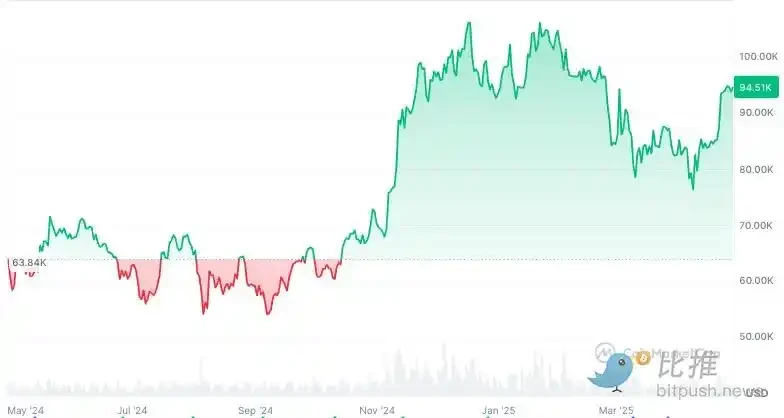
在去年的美国大选中,加密货币行业支持特朗普,寄希望于他能结束拜登政府的加密货币打压,推行有利于该行业的规则,并开启牛市。虽然一些规则有所放松,但白宫的贸易战已导致全球加密货币市场市值自去年 12 月高点以来缩水近 21% ,即约 8000 亿美元。

比特币较 1 月 20 日特朗普就职典礼前一天的水平下跌超过 10% ,那天比特币价格创下了 109, 225 美元的历史新高。道琼斯市场数据显示,本月早些时候,受关税担忧的影响,比特币与其他风险资产一起受到冲击,在 4 月 7 日跌至 74, 500 美元以下,截至本文撰写时,又反弹至 94, 500 美元左右。
政策红利未至,市值先跌8000亿:特朗普百日加密答卷解析

那么,特朗普迄今为止兑现了哪些承诺,该行业又将何去何从?

拜登时代的「加密货币战争」

美国前总统乔·拜登曾严厉批评加密货币,他推动严格监管该行业,并支持由时任证券交易委员会(SEC)主席 Gary Gensler 发起的加密打击行动。

在竞选期间,特朗普承诺结束拜登的「加密货币战争」。上任后,特朗普用亲加密货币的新主席 Paul Atkins 取代了根斯勒,后者承诺为加密货币监管带来清晰度。今年,SEC 撤销了针对加密货币公司 Coinbase、Ripple 和 Kraken 等公司的诉讼。

特朗普还任命了行业支持者,如支持 Tether 的金融大鳄 Howard Lutnick 担任商务部长,以及 David Sacks 担任加密货币沙皇。在他执政的头 100 天里,特朗普发布了一系列全面命令,禁止创建数字美元,保护自我托管,成立监管加密货币咨询小组,并建立战略性比特币储备。

他还赦免了丝绸之路的创始人罗斯·乌布利希,并举办了首届白宫加密货币峰会。今年,联邦监管机构撤销了多项拜登时代的加密货币指导方针,这为金融机构进军加密货币服务铺平了道路。

象征意义>实质利好?

简而言之,特朗普似乎兑现了他的大部分加密货币承诺。那么,为什么一些市场观察人士感到不满呢?

监管科技公司 eflow Global 高管 Jonathan Dixon 对 DL News 表示:「到目前为止,许多竞选承诺似乎更具象征意义,而非实质性。」

「比特币储备本质上是一次品牌重塑——这些资产早已由政府持有,并非积极参与市场的迹象。」Dixon 表示,虽然特朗普的举措标志着「与前任政府的言辞转变」,但「仅仅言辞并不能转化为监管确定性」。

特朗普政府尚未推动通过新的法律,但一些法律正在国会山推进。南卡罗来纳州共和党参议员 Tim Scott 在 4 月初表示:「我们进展顺利。」

StoneX Digital 数字资产执行主管 Eric Rose 指出:「这些对于该领域来说都是非常利好的因素,但它们需要时间来证明…仅仅因为允许银行参与数字资产领域,并不意味着他们明天就能进入,对吧?他们需要时间来制定战略,决定他们想要发展的方向、如何实施该战略,并为此招聘相关人员」。

Eric Rose 在接受 Market Watch 时表示,这可能需要长达两年的准备时间。

贸易战

Ari 10 首席执行官 Mateusz Kara 表示:「市场可能对特朗普的执政感到失望,因为我们没有看到数据上涨。这是迟迟不降息和特朗普给市场带来的混乱的结果。」特朗普迄今未能兑现其降息承诺,美联储的降息被视为加密货币和股票等风险资产的催化剂。

这就是为什么当央行在 9 月和 11 月降息时,比特币飙升的原因之一。问题在于,美联储独立于白宫运作,美联储主席杰罗姆·鲍威尔不愿降息,特别是在特朗普对近 100 个国家(包括大部分居民是「企鹅」的岛国)实施全面关税,并使美国的金融未来更加不确定之后。

在特朗普停止这些关税后,整体加密货币市场略有回升,但任何敌对行动都可能抵消这一影响。加密货币风险管理公司 CoinCover 首席商务官 Anthony Young 表示:「美国政府的贸易战将不可避免地影响加密货币行业,而关注点在于加密货币是否能继续充当全球市场行为的对冲。」

一些人认为,特朗普的贸易战可能对加密货币有利。金融科技初创公司 Keepz 首席执行官兼联合创始人,国际货币基金组织前顾问 Papuna Lezhava 表示:「特朗普的对外贸易政策实际上可能使加密货币对那些希望避免传统金融体系或政府控制货币的人更具吸引力。」


原文链接

Related Reads

Crypto Payment Cards with $1.5 Billion Monthly Transaction Volume, Stuck in the 1990s

Monthly crypto payment card transaction volume has reached $15 billion, but the industry's development stage is comparable to debit cards in the 1990s, before they became a mainstream financial staple. A key limitation is the lack of established daily financial relationships, such as direct salary deposits and recurring bill payments, with crypto wallets. Despite annualized transaction volumes of approximately $18 billion, the market is concentrated and immature. The leading provider, RedotPay, commands over half the market share. User adoption is heavily skewed towards emerging markets like Bangladesh, India, and Nigeria, where access to USD and stable financial services is limited, rather than developed economies. The sector features four primary business models: 1) Card-issuing infrastructure providers, 2) Exchange-affiliated cards for user retention, 3) Decentralized wallet/DeFi cards with self-custody but high complexity, and 4) Stablecoin-focused digital banks, which dominate transaction volume by offering integrated financial services. The article argues that a pure payment functionality is insufficient for long-term success, mirroring the historical trajectory of traditional debit cards. Future winners will need to: 1) Control the upstream flow of funds, 2) Secure defensible niches in underserved markets, and 3) Most crucially, build core account relationships that integrate into users' daily financial lives. Without this evolution, crypto cards risk remaining niche prepaid tools rather than becoming universal financial infrastructure.

Foresight News5m ago

Crypto Payment Cards with $1.5 Billion Monthly Transaction Volume, Stuck in the 1990s

Foresight News5m ago

$7.8 Billion in Theft and Losses Reveals the Truth: Security Costs Have Become an Unavoidable Liquidity Tax for DeFi

"7.8 Billion in Thefts Reveals the Truth: Security Costs Have Become DeFi's Unavoidable 'Liquidity Tax'" A summary of Q2 2026 data reveals that security risks are now a fundamental capital cost in DeFi, directly impacting user returns and liquidity decisions. DeFiLlama recorded 88 hacking incidents with quantified losses totaling $780.3 million in Q2. April was the worst month with $644.8 million lost. DeFi protocol attacks accounted for $735.8 million, while cross-chain bridge exploits resulted in $354.4 million in losses (note: some event categorizations overlap). Cumulatively, DeFi hacks have reached $7.85 billion, with bridge losses at $3.26 billion. The quarter highlighted two primary risk categories: high-value infrastructure vulnerabilities (e.g., bridges, oracles, admin keys) causing massive single losses, and more frequent contract logic bugs. This signals a critical market shift: from post-incident analysis to preemptive pricing of risk. Users and liquidity providers now implicitly factor in the security of the entire asset pathway—not just pool APY—into their decisions. This hidden "risk premium" manifests through wider spreads, higher liquidity incentives, and capital migration towards perceived safer routes. Cross-chain bridge risks, responsible for over $353 million in Q2 losses, exemplify this change. Asset routing credibility is now part of the transaction. Following incidents like KelpDAO and THORChain, markets are demanding safer bridges, asset insurance, and clearer risk disclosure, increasing the cost of capital for riskier pathways. Consequently, security spending is transforming from a defensive cost into a core distribution cost for attracting liquidity. Protocols must invest more in audits, bug bounties, real-time monitoring, and insurance to remain competitive. Users are increasingly demanding transparency about fund flow paths, associated risks, and contingency plans. The key indicators for the industry's direction will be whether capital continues consolidating in trusted channels, if projects delay launches for enhanced audits, if insurance premiums rise, and if aggregators start displaying security risk metrics. Q2 2026 may be remembered not just as a bad period, but as the point when DeFi underwent a fundamental asset risk repricing, where security became a persistent,隐性 tax on all on-chain activity.

Foresight News34m ago

$7.8 Billion in Theft and Losses Reveals the Truth: Security Costs Have Become an Unavoidable Liquidity Tax for DeFi

Foresight News34m ago

Breaking News: The "Worker's Edition" Claude 5 Is Here, Everyone Can Use It

BREAKING: Claude Sonnet 5, dubbed "Fennec," is now the default model for all Free and Pro users. This mid-tier model boasts the strongest Agent capabilities in the Sonnet line yet, with performance rivaling the flagship Opus 4.8. It features autonomous planning and can utilize browser and terminal tools—capabilities previously exclusive to costly, large models. Key benchmarks highlight significant gains over its predecessor, Sonnet 4.6, in reasoning, tool use, coding, and knowledge work. Sonnet 5 scores 63.2% on SWE-bench Pro (surpassing GPT-5.5's 58.6%), 80.4% on Terminal-Bench 2.1, and 57.4% on Humanity's Last Exam (just 0.5% behind Opus 4.8). It even slightly outperforms Opus 4.8 in some knowledge tasks. Anthropic positions it as delivering ~90% of Opus's capability at a fraction of the cost. Pricing is aggressive: a limited-time promotional rate of $2 per million input tokens and $10 per million output tokens (reverting to $3/$15 after August 31). This undercuts Opus 4.8 ($5/$25) and GPT-5.5 ($5/$30). However, a new tokenizer may increase token counts by 1.0-1.35x, affecting final costs post-promotion. Notably, Sonnet 5 excels in security, with a mere 0.93% browser injection attack success rate, outperforming Mythos 5 and Opus 4.8. Its prompt injection defense matches Opus 4.8 at 0.19%. Launching amid uncertainty around the region-restricted Fable 5, Sonnet 5 is globally available. It targets the mid-market, offering near-flagship performance at a competitive price, effectively lowering the barrier for multi-Agent development and presenting a compelling alternative for cost-conscious developers.

marsbit49m ago

Breaking News: The "Worker's Edition" Claude 5 Is Here, Everyone Can Use It

marsbit49m ago

Trading

Spot
活动图片