从糖果小贩到加密富豪,Coinbase 创始人的创业秘诀与行业预言

marsbitPublished on 2025-04-21Last updated on 2025-04-22

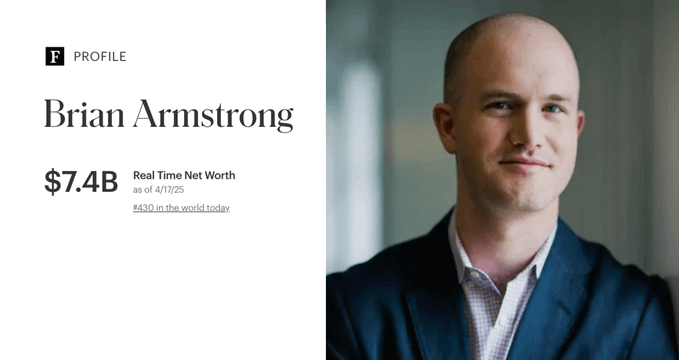
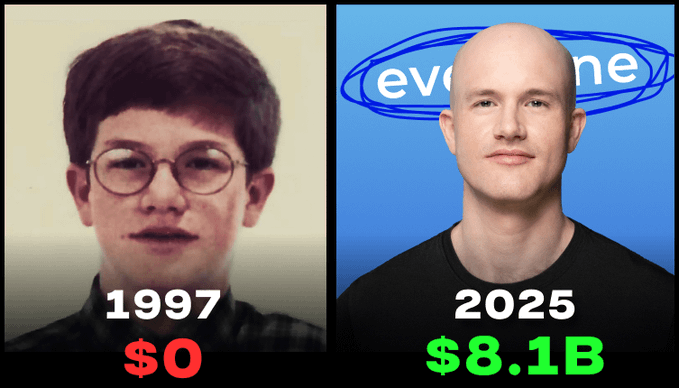
Brian Armstrong 是加密货币领域最富有的人物之一,他创立了 Coinbase 交易所,在短短五年内赚取 80 亿美元,《福布斯》将他评为全球顶级投资者之一。

以下是他的 Memecoin 秘诀、策略及五大预测。


Brian Armstrong


加密货币行业的巨大发展需要感激少数几位人物,而 Brian Armstrong

正是其中之一。


他因技术信仰踏入这个领域,并凭借对比特币的信念彻底改变了人生轨迹。


Brian Armstrong 的成长经历与行业洞见值得反复品读,并从中得出启示:


Brian Armstrong


Brian 出生于加利福尼亚州圣何塞,从小便具有创业的潜质。


他曾在一档采访中坦言,自己因在校园操场上售卖糖果被请进校长办公室。


高中时期,他对互联网技术产生热情并开始学习编程。


Brian Armstrong


此后,他进入 Rice University 深造并获得了硕士学位。


毕业后,他选择在阿根廷布宜诺斯艾利斯生活一年,期间亲历了恶性通货膨胀。


而对抗这种经济动荡的方法:加密货币,成为了他日后钻研的方向。


Brian Armstrong


大学毕业,在经历了一系列工作之后,他与朋友共同创建了一个寻找私人教师的中介服务平台。


该平台允许教师发布个人信息,并向潜在学生客户提供教学服务。


Brian Armstrong 担任该项目首席执行官长达八年,最终以相当于他年收入 21 倍的价格成功将其出售。


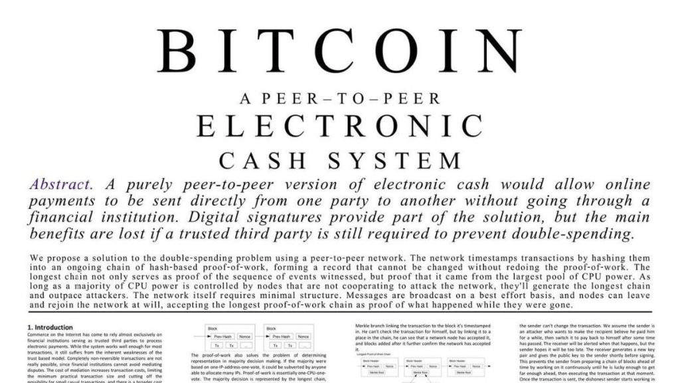
Brian Armstrong 在 2010 年圣诞节期间首次了解到比特币,当时他正住在圣何塞的父母家中,偶然发现了中本聪撰写的奠基性文件——《比特币:一种点对点电子现金系统》。


从那一刻起,他开始考虑开创一番大事业。


Brian Armstrong


他将一句话作为创业准则:「致富之人并非淘金者,而是卖铲人」。


当时行业里有一家直接竞争对手,也就是著名的 Mt. Gox,但该平台存在严重的交易延迟问题。


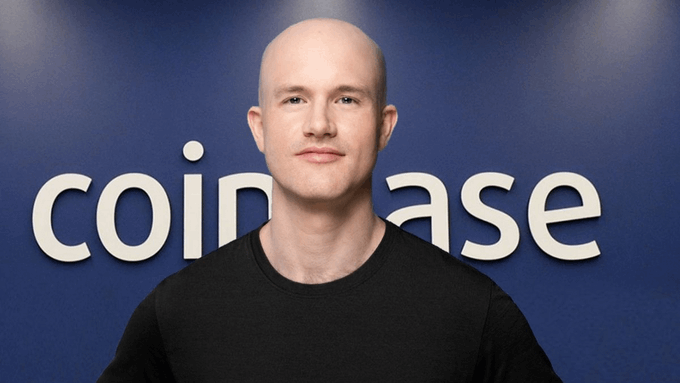
2021 年,Brian Armstrong 与 Fred Ehrsam 正式注册 Coinbase。


Brian Armstrong


Coinbase 开始获得大量投资,估值是 Brian 的原先目标 8 倍多。他刚开始打算创建一家估值 10 亿美元公司。


如今 Brian Armstrong 正过着理想生活,坐拥亿万财富。


他还积极分享自己的观点建议,这些你绝对应该参考:


Brian Armstrong


当前,Brian Armstrong 坚信有必要改革加密货币监管政策。


上届政府严重阻碍了该行业的发展,现在是纠正这一问题的最佳时机。


各界正在讨论任命支持加密货币的 SEC 主席并建立明确稳定的法律框架,这对加密货币市场构成重大利好。


Brian Armstrong


Brian Armstrong 对 Memecoin 持有相当积极的看法,并认为它们有一定发展前景。


在他看来,正如 GIF 动图和网络 Meme 已成为互联网经济的一部分,Memecoin 也可能成为重要的文化甚至经济现象。


这是个颇具分量的观点,值得深入思考。


Brian Armstrong


Brian 还分享了一条媒体浏览建议:你千万不要听 YouTube 上那些推销者的话。


分析项目时需要重点关注的 3 个核心要素:


  • GitHub 代码贡献数量
  • 团队在 Twitter 和 Discord 的活跃程度
  • 对批评意见的回应,如果项目方保持沉默,这就是危险信号


特朗普新政府当前的政策可能会显著增加市场中的机构资金流动性流入,这一切都源于政府行动将有效增强金融机构的信心,核心推动力在于政府正在推进有关稳定币和数字美元的相关立法工作。


Brian Armstrong 认为,加密货币永远不会取代传统金融体系,但会对其形成有力补充。

交易所交易基金 ETF、资产托管服务及与银行、金融科技平台的深度融合产品将成为发展趋势。


这本质上是一条实操建议:务必开发能与传统金融架构对接的产品。

Trending Cryptos

Related Reads

The Trillion-Dollar Credit Market Leveraged by Stablecoins, Stuck in Off-Chain Risk Control

**Stablecoins Fueling Trillion-Dollar Private Credit Market, Hampered by Off-Chain Risk Management** This article examines how interest-bearing stablecoins are replicating the business model of money market funds to democratize access to the $2 trillion private credit market, while highlighting the significant risks posed by inadequate off-chain risk controls. Historically, private credit investments had high minimums (e.g., $1 million+) due to costly due diligence and loan servicing. Stablecoins like Apollo's ACRED and Figure's YLDS are bridging this gap. They tokenize institutional credit funds, allowing small investors to gain exposure and enabling new functionalities like using these tokens as collateral in DeFi for leveraged yield. The on-chain private credit market has grown 15x in a year to $5.87 billion, yet remains a tiny fraction of the global total. However, the core challenge is not blockchain technology but managing the inherent risks of lending, which occur off-chain. The failure of Goldfinch, a pioneer in on-chain private credit, serves as a stark warning. It raised funds in crypto (USDC) to lend to small businesses in markets like Kenya and Nigeria. While smart contracts handled fund distribution, critical functions—local due diligence, monitoring loan use, and debt collection—relied on off-chain partners. A major breach, where a local partner misappropriated nearly 40% of funds, went undetected for months. When borrowers defaulted, crypto depositors had no effective legal recourse or means to seize assets, leaving $56 million trapped in non-performing loans with a projected 8-15 year recovery timeline. The article concludes that tokenization addresses only 10% of the credit business—the distribution. The remaining 90%—rigorous risk assessment and collection infrastructure—is expensive and localization-dependent. Without solving these fundamental off-chain challenges, the sector risks repeating Goldfinch's collapse.

Foresight News2m ago

The Trillion-Dollar Credit Market Leveraged by Stablecoins, Stuck in Off-Chain Risk Control

Foresight News2m ago

Solana Expands Validator Power With Launch of On-Chain Governance

Solana has formally launched its on-chain governance system, empowering token holders and validators with a more open and decentralized way to influence major protocol decisions. Governance debates and voting are now conducted entirely on-chain using the new Solana Governance Proposals (SGP) framework, supported by stake-weighted voting and cryptographic verification. Validators with at least 100,000 SOL in delegated stake can submit an SGP. To proceed to a formal vote, a proposal must first gain support from at least 15% of the network's total staked SOL, ensuring only ideas with significant backing move forward. SGPs serve a distinct purpose from the technical Solana Improvement Documents (SIMDs). While SIMDs focus on *how* to implement protocol upgrades, SGPs determine *whether* the broader ecosystem believes a proposal should proceed, via an on-chain, stake-weighted vote. This separation allows core developers to continue building effectively while reserving community-wide votes for impactful decisions. A key feature grants delegators greater control: they can now override their validator's governance vote. If a validator votes against a delegator's preference or abstains, the delegator can cast a vote directly using their own stake weight through Solana's governance portal. The voting process is secured using Merkle proofs to verify participant stakes against an on-chain consensus snapshot. With this implementation, Solana aims to broaden community participation in governance without hindering development, combining decentralized decision-making with efficient protocol evolution.

TheNewsCrypto32m ago

Solana Expands Validator Power With Launch of On-Chain Governance

TheNewsCrypto32m ago

Trillion-Won Bet on Semiconductors: Is South Korea Really Panicking This Time?

**Summary:** South Korea, traditionally adept at "counter-cyclical" investments during industry downturns, has launched an unprecedented trillion-dollar (approximately 6.4 trillion RMB) semiconductor investment plan during a current AI-driven boom. This shift signals deep strategic anxiety, driven by the rapid rise of China's memory chip challengers. The article traces this dynamic through the history of East Asian semiconductor competition. In the 1980s, Japan used a "national system + industrial capital" model to surpass the US in DRAM, only to be overtaken in the 1990s by South Korea employing the same aggressive, efficiency-focused tactics—most notably massive, loss-tolerant investments during downturns to crush competitors like Japan's Elpida. Now, China's memory giants, Yangtze Memory (YMTC) and ChangXin Memory Technologies (CXMT), are employing a strikingly similar playbook. Starting from near-zero a decade ago, they've used a combination of government-backed capital, strategic technology acquisition (e.g., CXMT leveraging Qimonda's legacy), and innovative architectural leaps (e.g., YMTC's Xtacking) to achieve rapid technological catch-up. Crucially, during the severe industry downturn of 2023, while Korean and US giants cut production, the Chinese firms expanded capacity and competed on price, rapidly gaining global market share (reaching ~11% in NAND and ~7.67% in DRAM by 2025). South Korea's current massive investment, therefore, is a defensive move born of fear. The historical pattern suggests that once a technological gap closes, scale and integrated supply chain advantages—areas where China holds significant potential—can determine the leader. Having used counter-cyclical strategies to become the incumbent, South Korea now faces the prospect of a formidable challenger using those very same tactics. This investment marks not just a bet on the AI cycle, but the opening chapter in a new battle for dominance in the memory industry.

marsbit42m ago

Trillion-Won Bet on Semiconductors: Is South Korea Really Panicking This Time?

marsbit42m ago

Trading

Spot

Hot Articles

What is G$

Understanding GoodDollar ($G$): A Blueprint for Decentralized Universal Basic Income Introduction In the ever-evolving landscape of cryptocurrency and blockchain technology, initiatives that seek to address pressing social issues have garnered increased attention. One such project is GoodDollar ($G$), a Web3-based universal basic income (UBI) solution. GoodDollar endeavors to tackle inequality and bridge the wealth gap by creating and distributing accessible economic resources to those most in need. Through its innovative use of decentralized finance (DeFi), GoodDollar presents a unique model that could potentially reshape the way financial assistance is perceived and delivered globally. What is GoodDollar ($G$)? GoodDollar is a cryptocurrency protocol that facilitates the issuance and distribution of digital tokens, referred to as $G$, to its registered users on a daily basis. These tokens function as a form of universal basic income, promoting financial empowerment for individuals from various backgrounds, especially those traditionally excluded from the financial system. Operating on the blockchain, GoodDollar utilizes multiple chains, including Ethereum, Celo, and Fuse, ensuring broad access and usability. The fundamental goal of GoodDollar is to make cryptocurrency accessible and beneficial to everyone, irrespective of their economic starting point. The Creator of GoodDollar ($G$) Details concerning the creator of GoodDollar remain somewhat obscure. However, it is notably highlighted that the project has strong backing from eToro, a widely recognized investment platform that provided the initial funding and foundational support for GoodDollar's development. The vision behind the project is not solely profit-driven but leans heavily towards social entrepreneurship, aiming for a systemic change in economic accessibility. Investors of GoodDollar ($G$) GoodDollar enjoys the financial backing and operational support of eToro. This partnership has played a significant role in launching the protocol and its subsequent developments. While eToro was instrumental in establishing the foundation of the project, GoodDollar envisions transitioning towards a model funded by its community in the long run. This shift to community funding is in line with GoodDollar's commitment to decentralization, allowing its users to have a direct stake in the project's future. How Does GoodDollar ($G$) Work? GoodDollar's operational framework relies heavily on DeFi principles to generate interest from staked cryptocurrencies. This mechanism allows the project to mint and distribute $G$ tokens as a digital basic income for users worldwide. Several key features contribute to GoodDollar's uniqueness and innovation: Universal Basic Income (UBI): Every day, registered users receive free tokens, establishing an automatic income stream intended to alleviate financial pressures. Sustainable Economic Model: The project’s tokenomics aim to balance supply and demand for $G$ tokens, ensuring that the value remains stable over time. Reserve-Backed Tokens: Each $G$ token is backed by a reserve of cryptocurrencies, providing it with inherent value and reliability, a crucial aspect for maintaining user trust. Decentralized Governance: GoodDollar incorporates a democratic approach to decision-making through token-powered decentralized governance. This allows community members to actively participate in the shaping of the project's trajectory, making it truly community-driven. Global Accessibility: GoodDollar has established a considerable community footprint, boasting over 640,000 members spanning 181 countries. Such widespread reach is instrumental in facilitating UBI on a global scale. Timeline of GoodDollar ($G$) The evolution of GoodDollar is marked by several significant milestones throughout its history: 2019: The launch of the GoodDollar wallet marked the first step in operationalizing its vision of delivering UBI through cryptocurrency. 2020: Following the successful wallet rollout, the GoodDollar protocol officially debuted. This marked a crucial phase in its mission to provide daily distributed income. 2021: The project advanced further with the introduction of its Decentralized Autonomous Organization (DAO), fostering a greater level of community involvement and governance. 2022: GoodDollar unveiled its DeFi-friendly version 2 (V2), striving for enhanced user engagement and operational efficiency. The same year also saw the transition to a decentralized governance structure via GoodDAO. 2022: A new roadmap was conceptualized, focusing on initiatives like a grant program designed to promote $G$-related entrepreneurial ventures and an upgraded GoodDollar Marketplace. Key Features of GoodDollar ($G$) The GoodDollar project introduces numerous critical features aimed at redefining the landscape of basic income: Universal Basic Income: Delivering daily free tokens to its users fundamentally underscores its mission to eliminate economic precarity. Multi-Chain Operation: Leveraging multiple blockchain networks enhances accessibility and scalability, ensuring broader participation. Engagement with Decentralized Finance: The use of DeFi allows for sustainable funding of the UBI model, reinforcing its viability as an economic solution. Community Engagement and Governance: GoodDollar envisions a model where the community influences operations through democratic participation, fostering transparency and accountability. Global Community: Boasting a diverse global community enables the project to implement UBI solutions tailored to various cultural and economic contexts. Conclusion GoodDollar represents a transformative leap towards incorporating the principles of universal basic income through the innovative lens of blockchain technology. By harnessing decentralized finance, the project not only provides a solution to financial inequality but also actively engages users in its governance and operations. With a growing community and evolving roadmap, GoodDollar stands as a significant player in the intersection of cryptocurrency and social good, paving the way for a more equitable financial future. As it continues to evolve, GoodDollar’s journey may ultimately inspire other initiatives to consider similar models, furthering the cause of economic empowerment for all.

1.1k Total ViewsPublished 2024.04.01Updated 2024.12.03

What is G$

How to Buy G

Welcome to HTX.com! We've made purchasing Gravity (G) simple and convenient. Follow our step-by-step guide to embark on your crypto journey.Step 1: Create Your HTX AccountUse your email or phone number to sign up for a free account on HTX. Experience a hassle-free registration journey and unlock all features.Get My AccountStep 2: Go to Buy Crypto and Choose Your Payment MethodCredit/Debit Card: Use your Visa or Mastercard to buy Gravity (G) instantly.Balance: Use funds from your HTX account balance to trade seamlessly.Third Parties: We've added popular payment methods such as Google Pay and Apple Pay to enhance convenience.P2P: Trade directly with other users on HTX.Over-the-Counter (OTC): We offer tailor-made services and competitive exchange rates for traders.Step 3: Store Your Gravity (G)After purchasing your Gravity (G), store it in your HTX account. Alternatively, you can send it elsewhere via blockchain transfer or use it to trade other cryptocurrencies.Step 4: Trade Gravity (G)Easily trade Gravity (G) on HTX's spot market. Simply access your account, select your trading pair, execute your trades, and monitor in real-time. We offer a user-friendly experience for both beginners and seasoned traders.

6.2k Total ViewsPublished 2024.07.18Updated 2026.06.02

How to Buy G

What is @G

Graphite Network, $@G: Bridging TradFi and Web3 Introduction to Graphite Network, $@G In the vibrant world of cryptocurrencies and web3 projects, Graphite Network emerges as a beacon of innovation. With its native token, $@G, this Layer-1, Proof-of-Authority (PoA) blockchain is tailored to bridge the gap between traditional finance (TradFi) and the rapidly evolving Web3 ecosystem. As digital currencies gain traction, Graphite Network strives to offer a blockchain platform that prioritizes security, compliance, and speed, presenting itself as a facilitator of trust and accountability. What is Graphite Network, $@G? Graphite Network is not merely another blockchain project; it aims to redefine how decentralization, security, and user accountability are perceived in the digital finance realm. The project boasts a series of distinctive features: Reputation-Based Blockchain: At its core, Graphite Network implements a one-user, one-account policy, fortified with integrated Know Your Customer (KYC) verification and scoring mechanisms. This design ensures a balance between user privacy and transparency—a critical aspect of financial operations in today’s digital world. Entry-Point Node Income: The network incentivizes users to set up entry-point nodes, allowing operators to earn rewards from network transactions. This income generation model not only boosts user engagement but also reinforces network health and decentralization. EVM Compatibility: With an Ethereum-compatible virtual machine (VM), Graphite Network enables seamless integration of existing Solidity decentralized applications (dApps) and smart contracts, thereby inviting developers to leverage its capabilities without extensive modifications. KYC Integration: In an era where compliance is paramount, the integrated KYC framework with multiple verification tiers enhances the control over financial operations without mandatory participation, setting a precedent for user autonomy. Who is the Creator of Graphite Network, $@G? The Graphite Network is borne out of the endeavors of the Graphite Foundation, a non-profit organization dedicated to the development, maintenance, and evolution of the Graphite Network. The foundation’s commitment underscores the project’s vision to create a secure and sustainable blockchain environment focused on genuine user engagement and compliance. Who are the Investors of Graphite Network, $@G? Currently, there is limited information available on the specific investors backing the Graphite Network initiative. The founding organization, the Graphite Foundation, functions independently in fostering the project’s growth while seeking partnerships that resonate with its vision of a compliant and accessible blockchain platform. How Does Graphite Network, $@G Work? Graphite Network’s operation is grounded in its unique Proof-of-Authority consensus mechanism, which strikes an impressive balance between high throughput and decentralization. Let's delve into the various components that define its operation: Transport Nodes: Serving as the entry-point nodes, these are critical to the ecosystem. Operators can earn revenue from transactions that traverse the network, which not only empowers individual users but also bolsters network decentralization. Authorized Nodes: At the heart of the Graphite Network are core validators who undergo rigorous compliance tests, encompassing robust KYC verification along with technical assessments. This layer of trust is essential for ensuring that transactions within the network maintain a high level of integrity. Ticker System: Graphite Network employs a distinctive ticker system for its wrapped tokens, denoted as @G. This feature enhances clarity in asset integration, making user transactions comprehensible and straightforward. Graphite Network’s innovative approach reflects a significant step in addressing the crucial issues of digital finance, positioning itself favorably for the future as more users transition from traditional forms of finance into the world of decentralized applications. Timeline of Graphite Network, $@G To understand the progression and milestones of Graphite Network, it is beneficial to overview key events in its timeline: 2021: The inception of Graphite Network by the Graphite Foundation marks the commencement of a new chapter in blockchain development, focusing on compliance and user empowerment. Key Developments: Following its launch, the introduction of entry-point node income, the establishment of a reputation-based model, integrated KYC verification, and the provision of EVM compatibility represent significant advancements in the project. Recent Activities: The continuous development and nurturing efforts of the Graphite Foundation have focused on augmenting network features while fostering the ecosystem's growth, demonstrating a long-term commitment to sustainability and innovation. Additional Key Points Beyond its foundational components, Graphite Network encompasses several tools and features that bolster its usability: Graphite Wallet: A user-friendly Chrome extension that facilitates access to various network features and applications across Ethereum-compatible chains, enhancing user convenience. Graphite Bridge: This utility allows seamless transfers of Graphite assets across different networks, fostering an integrated and interoperable ecosystem. Graphite Explorer: Serving as an essential tool within the ecosystem, this feature enables users to view and verify smart contract source code, track transactions, and explore other vital information in real-time. Graphite Testnet: The project provides a robust testing environment for developers, allowing them to ensure stability and scalability prior to mainnet deployment. This initiative not only empowers developers but also enhances the reliability of the entire network. Conclusion Graphite Network, with its native token $@G, represents a significant stride toward bridging traditional finance and cutting-edge blockchain technology. By focusing on security, compliance, and decentralization, this innovative platform is set to lead the transition into the Web3 era. As user engagement grows and more projects leverage its capabilities, Graphite Network is poised to make lasting contributions to the rapidly evolving digital landscape. In conclusion, Graphite Network stands as a testament to what can be achieved when innovative thinking meets the growing demands of modern finance and technology. As the world explores the potential of decentralized finance, Graphite Network will undoubtedly remain a noteworthy player in this arena.

584 Total ViewsPublished 2025.01.06Updated 2025.01.06
What is @G

Discussions

Welcome to the HTX Community. Here, you can stay informed about the latest platform developments and gain access to professional market insights. Users' opinions on the price of G (G) are presented below.

活动图片