Crypto market’s biggest losers – Ethereum, Solana, XRP fall by +10% after…

AmbcryptoPublished on 2025-04-07Last updated on 2025-04-07

Abstract

Assessing altcoins’ next move amid renewed Trump tariff fears and macro uncertainty.

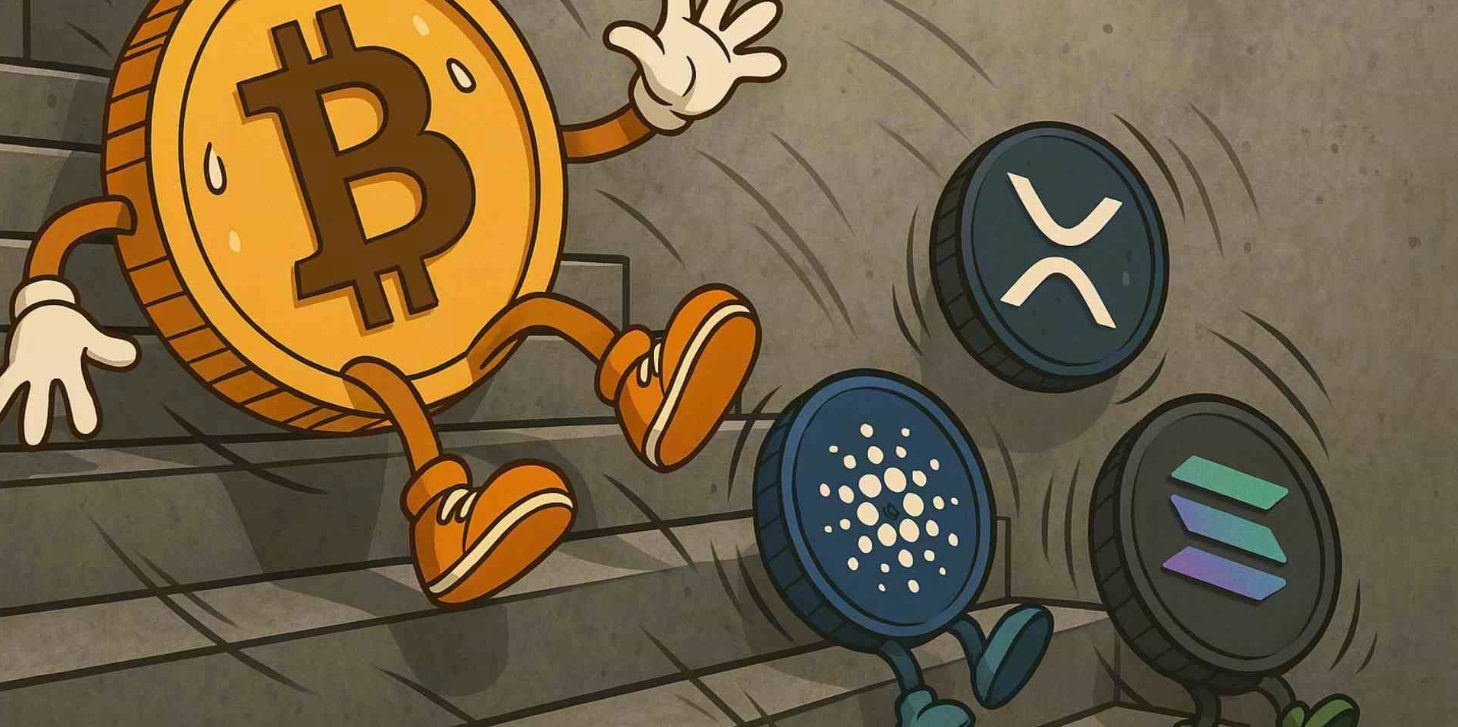
Bitcoin [BTC] fell below $80k and retested its March lows of $76k after hotter-than-expected Trump tariffs, sparking sell-offs across traditional markets, major altcoins, and memecoins.

Amid the macro uncertainty, BTC’s dominance surged to 63%, capping altcoins’ recovery as investors rotated capital to Bitcoin. Will top majors like ETH, SOL, ADA, XRP, or memecoins record relief?

ETH, XRP, ADA, XRP price analysis
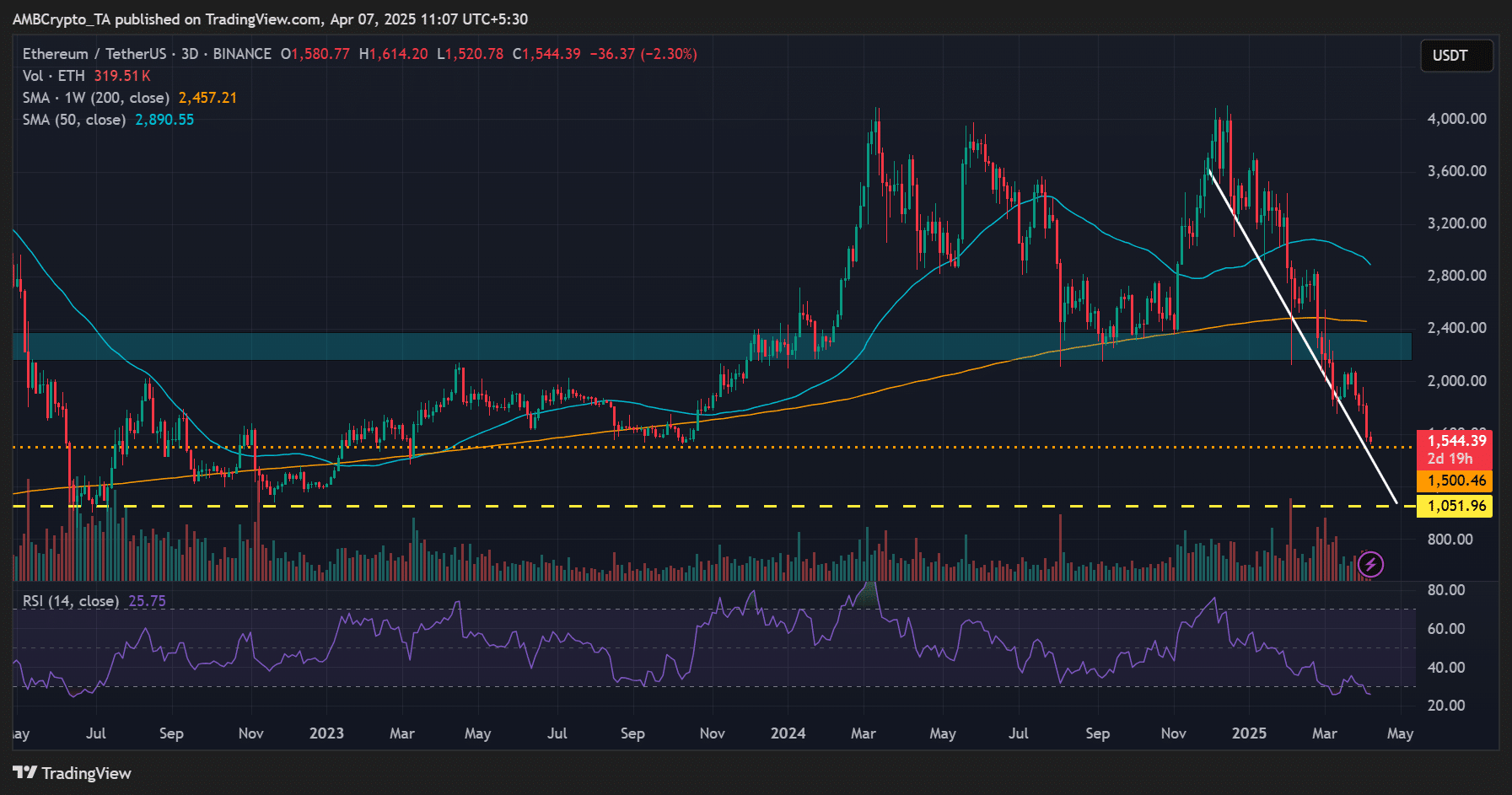
For Etherem, short-sellers are now firmly in charge, with the RSI in oversold territory. While this could also suggest a likely reversal, ETH has suffered from a strong negative sentiment. This has dragged the ETH/BTC ratio to a 5-year low.

If bulls fail to hold above $1.5k, ETH could range between $1K-$1.5k in the short to medium term. However, only a move above 200WMA (weekly moving average) of $2.4k could reinforce bulls’ leverage again.

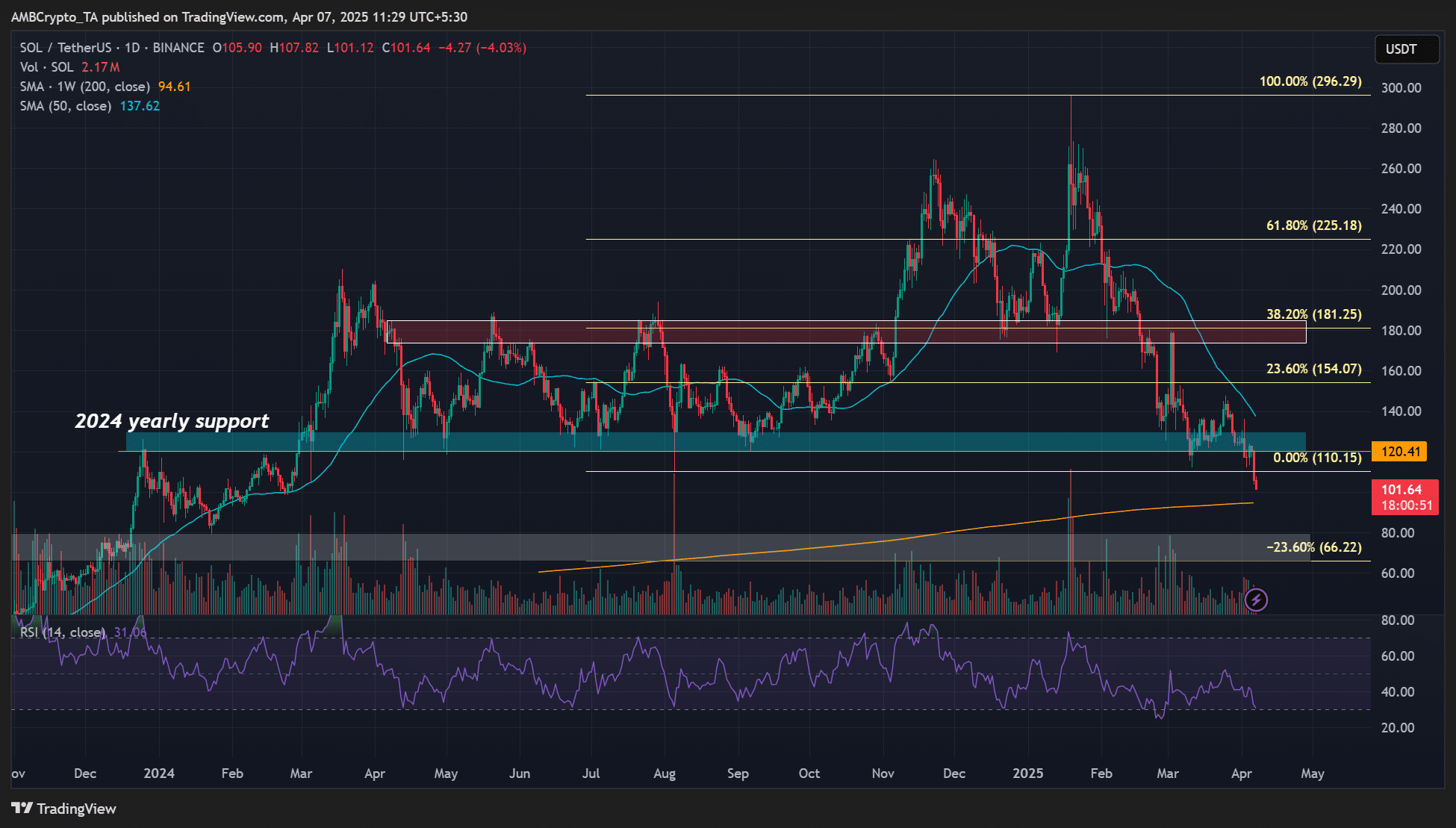
Solana also lost its 2024 yearly support of $120, giving short sellers more market edge. It dipped to $100 for the first time since early 2024, bringing losses to 67% from its peak of $295.

If the broader weak sentiment persists, the early 2024 price range of $80-$120 and the 200WMA (weekly moving average) of $94 would be key levels to watch in the short term.
Surprisingly, only Cardano [ADA] and XRP held part of their U.S election gains. Worth noting, however, that they are still at risk of erasing the remaining gains.

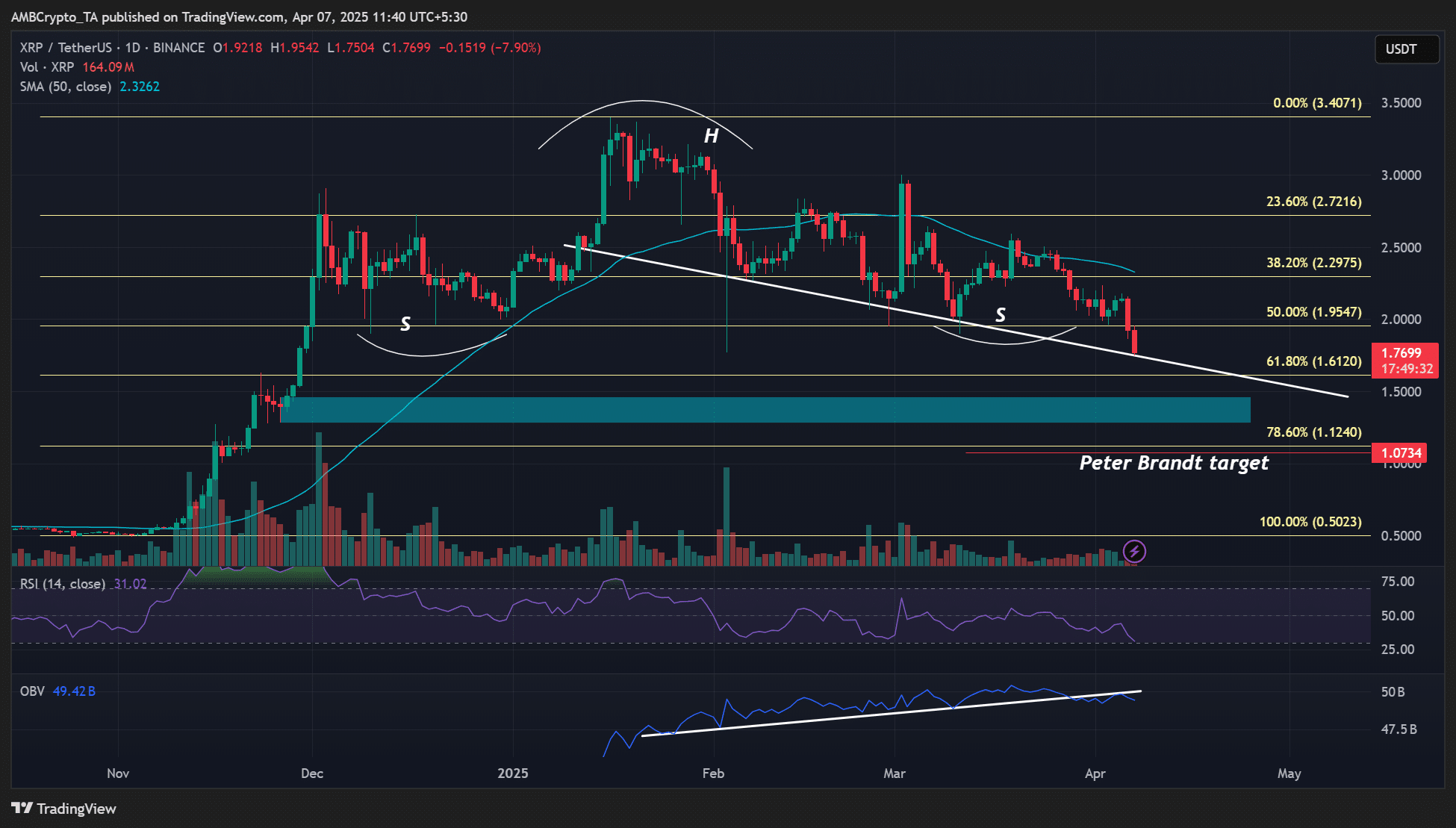
XRP still holds 220% gains since the U.S elections. However, it dropped below $1.9 – A level that Peter Brandt warned could validate a bearish head-shoulder pattern and drag XRP to $1.0. The weak demand in March, per the RSI, and muted volumes, according to the OBV, corroborated Brandt’s outlook.

Even so, Brandt’s projection might be validated only if XRP short sellers breach the trendline support (white) or the bullish order block (cyan) at $1.5.
For Cardano, capital inflows and demand slowed down in April after a slight recovery in March. As such, if sellers crack below the trendline support, a drop towards the pre-U.S election level below $0.40 might be likely.
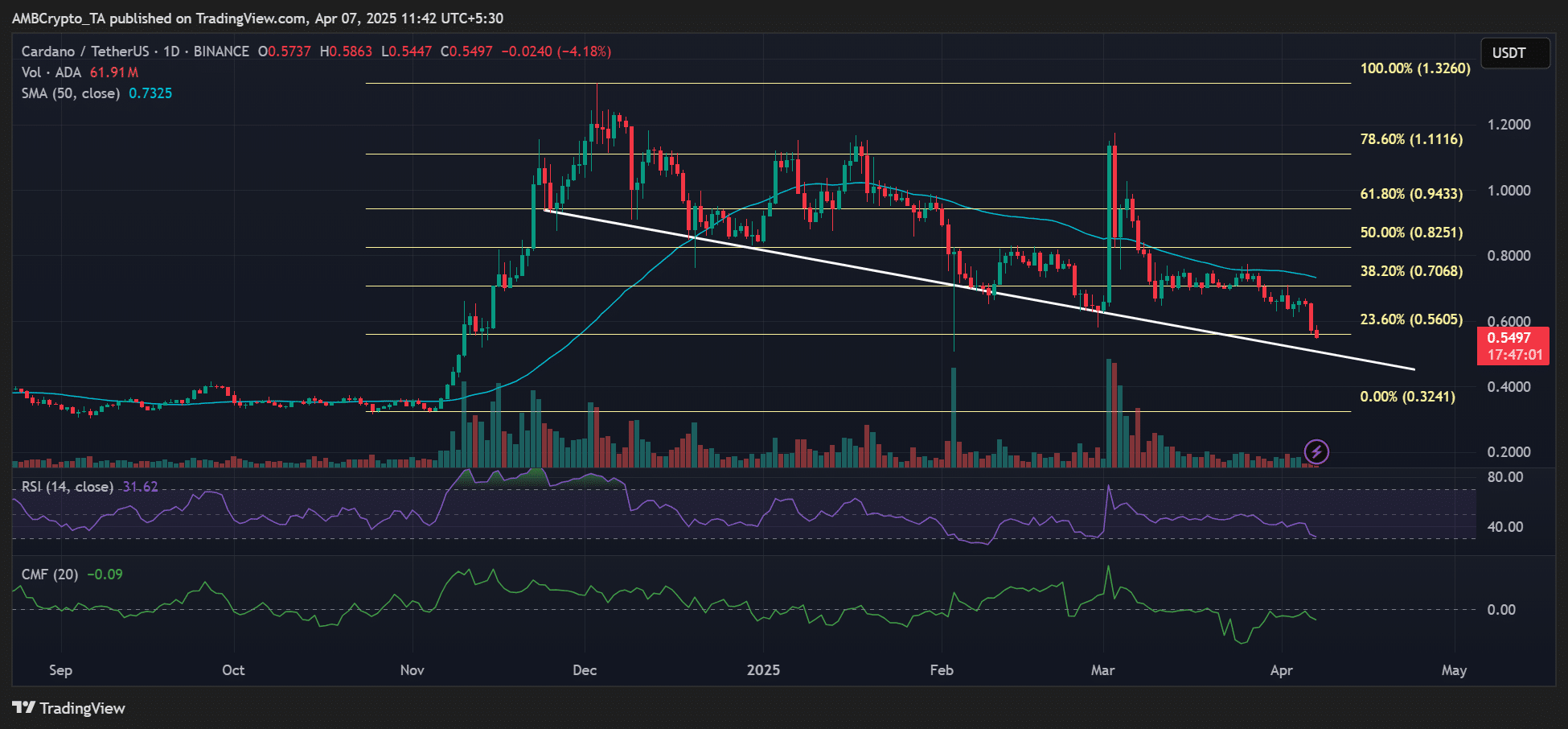
However, most of the top majors’ RSIs were in the oversold zone, which could reverse in case of positive catalysts.

That being said, speculative interest in memecoins was hit hardest by investors’ risk-off mode. According to Coinglass data, Open Interest (OI) in the sector dropped by 20% and was ranked 11th in the last 24 hours.

Investors should track updates on Trump’s tariffs, as they could impact inflation, Fed rate cut expectations and assets’ price direction in the medium term.


Related Reads

Global Asset Rotation: Why Does Liquidity Drive the Cryptocurrency Cycle? (Part 1)

This article introduces a new series on global asset allocation and rotation, arguing that liquidity—not new narratives—is the primary driver of cryptocurrency market cycles. While narratives like RWA or X-402 can attract attention, they are triggers, not fundamental drivers. The real force is capital flow: ample liquidity amplifies even weak narratives, while liquidity contraction undermains the most compelling ones. The framework begins by mapping global assets not by traditional labels (stocks, bonds, commodities) but by their roles and dependencies within economic and liquidity cycles. Cryptocurrency is reclassified not as a traditional risk asset (like equities, which have cash flows and valuation models) but as a non-cash-flow alternative asset. Its price action is driven primarily by capital inflows and outflows, making it highly sensitive to liquidity and risk appetite. Five key macro indicators are identified as core drivers: interest rates (especially real rates), inflation metrics (CPI, PCE), economic growth indicators (PMI, GDP), systemic liquidity (central bank balance sheets, money supply), and risk appetite (volatility indices, credit spreads). A causal chain is proposed: inflation influences interest rates, which affect liquidity, which then drives risk preference and ultimately asset prices. The U.S. remains the anchor for global capital flows, and understanding its monetary policy cycle is crucial. During loose monetary conditions, risk assets like crypto thrive; during tightening, defensive assets like cash and bonds outperform. The article concludes that a structured framework focusing on macro drivers and cyclical patterns is essential for understanding asset rotation, avoiding emotional decisions, and identifying when liquidity shifts toward high-risk assets like cryptocurrency.

marsbit8m ago

Global Asset Rotation: Why Does Liquidity Drive the Cryptocurrency Cycle? (Part 1)

marsbit8m ago

From Aztec to Zcash: Privacy Evolving from 'Gray Industry Tool' to 'Institutional Necessity'

From Aztec to Zcash: The Rise of Pragmatic Privacy in Blockchain In 2025, blockchain privacy evolved from a niche concern to a mainstream priority, driven by the concept of "pragmatic privacy" that balances individual anonymity with regulatory compliance. This shift is marked by the strong performance of privacy-focused assets like Zcash and new institutional initiatives. Several new privacy-centric blockchains launched or advanced significantly. Aztec Network's Ignition L2 mainnet went live, raising over 6,100 ETH. Nillion launched its "blind computer" mainnet for encrypted data computation. Cosmos-based Namada introduced a "composable privacy" L1, while Miden spun out from Polygon to build its own privacy chain. Umbra raised $154.9 million in an ICO to build on Solana. Horzen transitioned to a Base L3 privacy solution. Institutions are actively embracing privacy. Coinbase hired a team from Iron Fish to develop privacy primitives for Base. Circle is testing a privacy-preserving wrapped USDC (USDCx) on Aleo. The Canton Network and EY's Nightfall L2 are focusing on confidential enterprise solutions. The Ethereum Foundation formed a dedicated "Privacy Cluster" and an "Institutional Privacy Working Group." Vitalik Buterin also launched Kohaku, an open-source wallet framework for compliant privacy. At the application layer, tools like 0xbow's Privacy Pools (based on Vitalik's research) and Railgun (using "proof of innocence") allow users to anonymize transactions without aiding illicit activity. Zcash's shielded pool supply grew to nearly 25%, indicating steady adoption. This collective progress signals that privacy is no longer a marginal feature but a core institutional and user requirement.

比推1h ago

From Aztec to Zcash: Privacy Evolving from 'Gray Industry Tool' to 'Institutional Necessity'

比推1h ago

Trading

Spot
Futures

Hot Articles

Discussions

Welcome to the HTX Community. Here, you can stay informed about the latest platform developments and gain access to professional market insights. Users' opinions on the price of BTC (BTC) are presented below.

活动图片