Ethereum's large purchase: Potential rebound or investor trick?

AmbcryptoPublished on 2025-03-06Last updated on 2025-03-06

Abstract

Funding volume trends indicate possible upside if sustained, with $2,500 as a key level and $3,500 as a potential target. However, a drop below $2,000 remains a risk if selling pressure increases.

Ethereum’s [ETH] market remains highly reactive to large purchases and institutional activity, which can influence price trends and overall sentiment.

The recent acquisition of 17,855.3 ETH by “7 Siblings” raised speculation about a potential market rebound or strategic investor positioning.

The mysterious entity, “7 Siblings,” acquired 17,855.3 ETH for $36.68M in DAI, USDC, and USDT, averaging $2,054 per ETH.

This entity reportedly held over 1,169,015 ETH valued at $2.53B across two wallets. Such a significant investment indicated strong confidence in Ethereum’s long-term value.

Institutions typically accumulate assets during market dips, aiming for strategic entry points. The $2,054 price level aligned with recent lows, suggesting a calculated move.

If additional institutions followed suit, ETH could rise beyond $2,500, attracting retail investors. However, large players also manipulate markets, triggering FOMO before selling at peaks.

The $2.53B valuation indicated substantial influence, making a sell-off a risk that could push prices below $2,000.

Signs of strength or weakness?

ETH’s active address showed total addresses at 847.59K, with 160.89K new addresses, 587.72K active addresses, and 98.98K zero-balance addresses as of the 5th of March.

Over the past seven days, new addresses declined 2.09%, active addresses dropped 2.13%, and zero-balance addresses increased 11.29%.
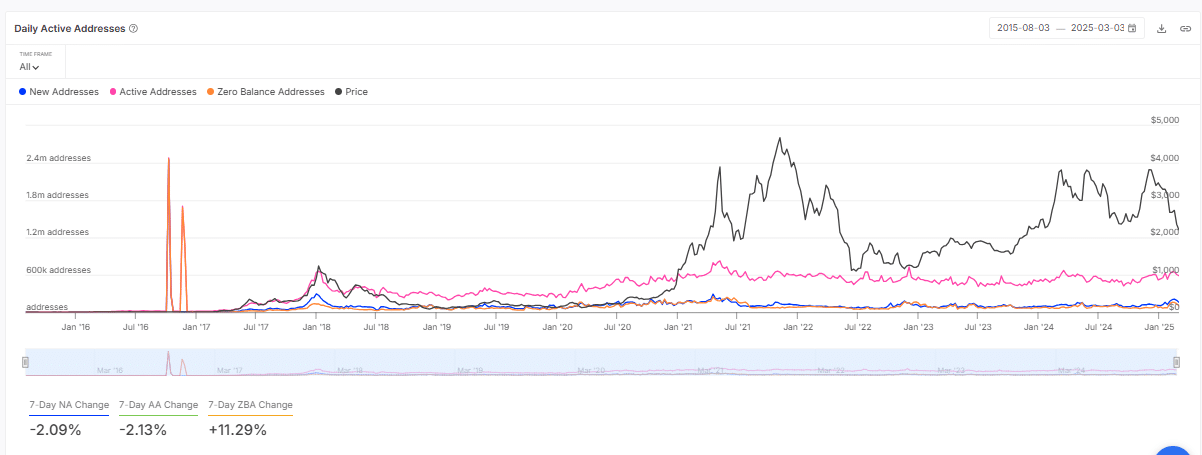
The peak of 160.89K new addresses in early 2021 mirrored the recent 17,855.3 ETH purchase, suggesting fresh investor interest.

The 587.72K active addresses indicated steady engagement, aligning with the $2.53B holdings from “7 Siblings.”

However, an 11.29% rise in zero-balance addresses signaled profit-taking or abandoned wallets, hinting at possible bearish sentiment.

If new addresses stabilize above 150K, it could confirm growing adoption. Conversely, a continued 2.09% decline might suggest weakening demand, pushing ETH below $2,054.

Traders should watch for a reversal, as 2021’s address surge preceded a $4,800 rally, hinting at potential institutional-driven price action.

Liquidity trends

Consequentially, ETH’s funding volume chart from 2023 to March 2025 showed ETH price fluctuations and trading activity.

The price peaked at $4,250 in late 2023, dropped to $2,194, then rebounded to $2,925 by March 2025.
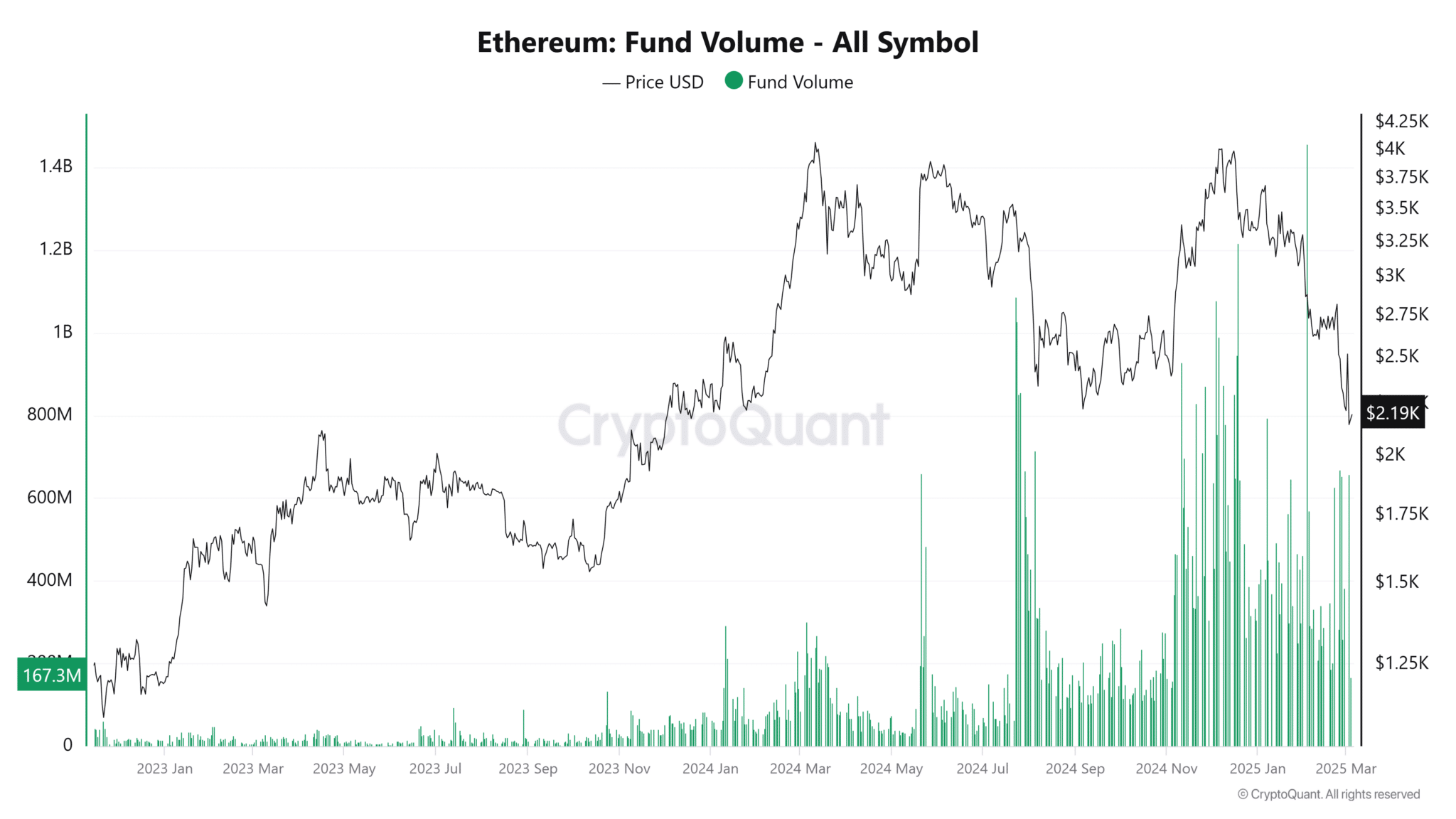
Funding volume hit 1.4B in mid-2024, saw a low of 167.3M in early 2023, and spiked to 800M recently. This surge aligned with the “7 Siblings” $36.68M ETH purchase at $2,054, boosting fund volume to 800M.

Strong buying pressure at $2,925 suggested ETH could reach $3,500 if volume remains high. A drop below 400M might signal a correction toward $2,194.

Historical trends show 2021’s 1B volume surge led to a $4,800 breakout, indicating a similar move could occur with institutional backing.

Finally, Ethereum’s market remains highly reactive to institutional activity, with the 17,855.3 ETH purchase signaling potential bullish momentum.

Funding volume trends indicate possible upside if sustained, with $2,500 as a key level and $3,500 as a potential target. However, a drop below $2,000 remains a risk if selling pressure increases.


Trending Cryptos

Related Reads

Li Fei-Fei's Latest Long-Form Article: When Video Generation, Robotics, and NVIDIA All Call Themselves World Models, We Need a Taxonomy

In a new article, Dr. Fei-Fei Li addresses the widespread and often inconsistent use of the term "world model" in AI. She proposes a clear, functional taxonomy rooted in the classic Partially Observable Markov Decision Process (POMDP) loop (agent → action → state → observation → agent). According to this framework, current systems called "world models" are different projections of this loop, categorized by their primary output: 1. **Renderers**: Output observations (pixels). Their goal is visual fidelity for human consumption (e.g., video generation models like Sora). They are the most commercially mature but are limited by a focus on appearance over physical accuracy. 2. **Simulators**: Output states (geometric, physical, dynamic representations). They provide a structurally accurate world for both human professionals (e.g., architects) and computational agents (e.g., robots for training). Li argues simulators are the crucial, underappreciated bridge, as they can underpin both rendering and planning. 3. **Planners**: Output actions. Given an observation and a goal, they decide what an agent should do next (e.g., robotic action models). This area is highly promising but remains the least mature for real-world deployment. Li highlights a key trend: the boundaries between these three categories are beginning to blur, as they all rely on a shared underlying understanding of geometry, physics, and dynamics. The logical endpoint is a unified world foundation model capable of switching between rendering, simulation, and planning based on downstream needs. This convergence, she concludes, is central to advancing spatial intelligence—enabling machines not just to talk about the world, but to truly understand, imagine, and interact with it.

marsbit3h ago

Li Fei-Fei's Latest Long-Form Article: When Video Generation, Robotics, and NVIDIA All Call Themselves World Models, We Need a Taxonomy

marsbit3h ago

Forbes Feature: Stablecoin Cross-Border Payments Are Faster, But Not Yet Cheaper

A Forbes feature delves into the state of stablecoin-based cross-border payments, noting rapid growth but a key shortfall: while faster and more accessible, they are not yet cheaper. At a recent industry conference in Mexico City, optimism about technology, regulation, and volume was tempered by discussions with practitioners. The core issue is liquidity. Traditional FX brokers charge 60-70 basis points, and stablecoins promise to slash this to 2-5 basis points. However, this theoretical cost advantage cannot be realized until deep liquidity pools are established at scale, requiring significant institutional capital inflow. A major adoption barrier is trust. Businesses often rely on long-standing relationships with traditional brokers, valuing reliability over marginal cost savings. This shift will be gradual. Furthermore, successful companies in the space are not positioning themselves as replacements for legacy systems like SWIFT, but as complements. They leverage stablecoins for speed while using traditional rails for their standardization and reliability in ensuring accurate payment details—a critical factor for supplier payments to avoid customs issues. Companies like Caliza, experiencing high monthly growth, exemplify this hybrid approach. The industry anticipates consolidation, as long-term viability will depend on securing the essential trifecta: proper licensing, robust fiat on/off-ramps, and deep liquidity. Without these, firms risk being mere intermediaries rather than building sustainable businesses.

marsbit3h ago

Forbes Feature: Stablecoin Cross-Border Payments Are Faster, But Not Yet Cheaper

marsbit3h ago

Trading

Spot

Hot Articles

Discussions

Welcome to the HTX Community. Here, you can stay informed about the latest platform developments and gain access to professional market insights. Users' opinions on the price of ETH (ETH) are presented below.

活动图片