比特币价格持续下跌,微策略会被破产清算吗?

Odaily星球日报Published on 2025-02-28Last updated on 2025-02-28

Abstract

如果比特币价格出现长期、深度下跌,其高杠杆策略可能会导致严重财务压力。

原文作者:XinGPT(X:@xingpt)

比特币价格持续下跌,微策略会被破产清算吗?

TLDR:先说结论:理论上有可能,但实际非常小概率

  • 杠杆比例不高,债务期限较长,短期无明显偿债压力

  • 财务危机的前提是:比特币价值长期处于极端低位,发生概率较低;

  • 创始人 Michael Saylor 拥有 46.8% 投票权,可以避免优先股债务中提前赎回的条款,牢牢掌握公司的运营方向

1. 微策略的比特币持仓与策略 

MicroStrategy 已经从一家传统的软件公司转型为全球最大的比特币持有企业,截至 2024 年底,公司共持有约 471, 107 枚比特币。这些比特币的总成本约为 279.7 亿美元,平均购入成本约 62, 500 美元/枚,而 2024 年底这些比特币的市值约为 417.9 亿美元。

MicroStrategy 的比特币投资是通过发行债券和增发股票融资实现的。其管理层(以联合创始人 Michael Saylor 为代表)将比特币视为公司的主要储备资产,不断通过外部融资购买更多比特币,而不是依赖自身业务的现金流。 MicroStrategy 主要通过四种途径筹集资金购买比特币。

• 使用自有资金购买

不是主要的资金来源,微策略一共大概使用了不超过 5 亿资金购买比特币。 

• 发行可转换优先债券(Convertible Senior Notes)

为了购买更多比特币,微策略开始采用发行可转债的方式融资买币。

可转换优先债券是一种金融工具,允许投资者在特定条件下将债券转换为公司股票。这种债券的特点是利率较低,甚至为零,同时设定高于当前股价的转换价格。投资者之所以愿意购买此类债券,主要因为其提供了下行保护(即债券到期可收回本金和利息)以及在股价上涨时的潜在收益。微策略发行的几期可转债利率在 0% -0.75% 之间居多,说明投资者实际是对 MSTR 的股价上涨有信心,寄希望于债券转换为股票以赚取更多收益。 

• 发行优先担保债券(Senior Secured Notes)

除了可转换优先债券,微策略还发行过一次 4.89 亿美元 2028 年到期 6.125% 利率的优先担保债券。

优先担保债券是一种有抵押的债券,风险比可转换优先债券更低,但是这类债券只有固定利息收益。微策略发行的这一批优先担保债券,已经选择提前还款。

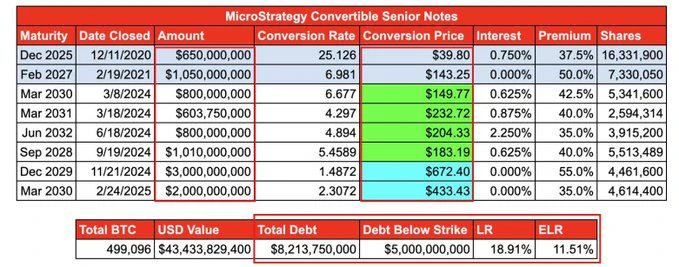
下图是当前微策略实际在途的债务情况:
比特币价格持续下跌,微策略会被破产清算吗?

可以看出:当前微策略总负债为 82.13 亿,总资产(以比特币为主)市值 430 亿美金,杠杆倍数(leverage ratio)为 19% 。 也就是说比特币要跌 16500 以下,并且这个价格持续到 2028 甚至更久才会让微策略资不抵债。

• 市价股票发行(At-the-Market Equity Offerings)

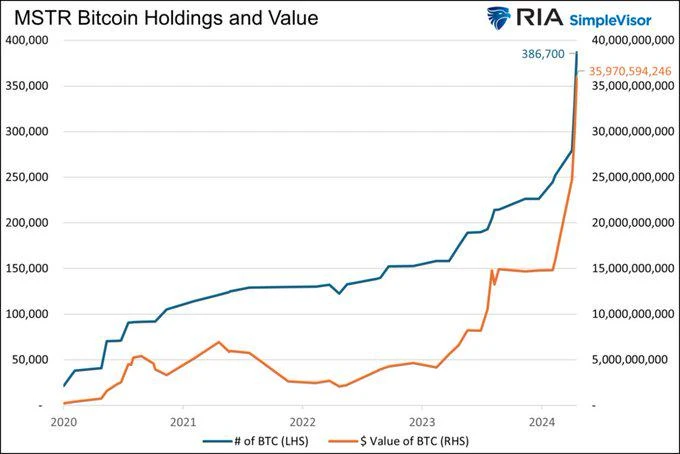
微策略增发股票融资购买比特币,不产生债务,但发行股票稀释了现有股东权益。之所以现有股东会同意这种增发的方式,是因为微策略提出了一个新的指标 BTC Yield, 即每股比特币收益,为比特币持有量和稀释后总股本的比值。也就是说,在行情上升阶段通过增发股票融资去购买比特币,虽然用户持有的持股比例降低了,但是每股的比特币含量增加了,总体来说用户持有的比特币量还可能增加。

比如 2024 年微策略的 BTC Yield 就是 74% ,意味着每股的比特币数量增加了 74% ,而 2025 目前的 BTC Yield 是 6.9% ,目标是年底达到 15% 
比特币价格持续下跌,微策略会被破产清算吗?

2. 比特币价格下跌的短期 vs. 长期影响

短期影响:

• 比特币价格下跌会直接影响 MicroStrategy 的财报表现。会计规则要求公司在比特币价格下跌时计提减值损失,但价格上涨时不能直接反映收益。

• 例如, 2022 年比特币暴跌时,公司在第四季度计提了 1.97 亿美元的减值损失,导致季度亏损。而 2023 年比特币回升时,公司则因会计处理减少了减值损失,甚至一度出现盈利。

• 目前公司没有比特币质押贷款,因此短期内比特币价格波动不会引发追加保证金的风险。但股价与比特币高度相关,比特币下跌往往会导致 MicroStrategy 股价同步下跌,进而影响公司融资能力。

长期影响:

• 如果比特币进入长期熊市,公司可能面临严重的融资压力。目前 MicroStrategy 的软件业务规模较小, 2024 年全年收入仅约 5 亿美元,且仍在亏损,因此无法通过自身业务积累大量现金来覆盖债务或继续购买比特币。

• 公司目前的运营模式高度依赖资本市场,如果比特币长期低迷,投资者可能会减少对 MicroStrategy 的融资支持,或者要求更高的融资成本。

• 如果比特币价格长期低于公司平均买入价 62, 500 美元/枚,MicroStrategy 的比特币资产账面价值将持续低于实际成本,这可能会影响投资者信心,进一步加剧股价压力。

• 由于公司管理层高度信奉比特币的长期价值,即便财务状况恶化,公司也不太可能主动出售比特币,而是会通过新的债务或股权融资来维持运营。但如果融资受阻,可能会被迫调整策略。

3. 关键财务数据分析

比特币持仓与估值:

• 截至 2024 年底,MicroStrategy 持有的比特币账面价值约 239 亿美元(计提减值后),但按市场价格计算约 417.9 亿美元。 

• 由于公司采用的会计准则,如果比特币价格跌至 3 万美元以下,公司将不得不进一步计提减值,这可能会加剧股价压力。

债务水平:

 • MicroStrategy 目前的总债务约为 82 亿美元,主要是可转换债券,票息较低,部分甚至为 0% 。

• 其中: 

  • 2025 年 12 月到期: 6.5 亿美元,票息 0.75% 

  • 2027 年 2 月到期: 10.5 亿美元,票息 0% 

  • 2029 年 12 月到期: 30 亿美元,票息 0% 

• 由于部分可转换债券的转换价格低于当前股价,这些债券更可能被转换为股票,而不是要求现金偿付,因此短期债务风险较低。

• 但如果未来比特币价格持续低迷,MicroStrategy 的股价跌破转换价格,债券持有人可能会要求现金偿付,这将增加公司的现金流压力。

现金流与流动性:

• 2024 年,公司运营业务的现金流净流出 5300 万美元,仅有 4680 万美元现金储备,这意味着 MicroStrategy 几乎没有任何现金缓冲。

• 2024 年底,公司通过增发股票融资 151 亿美元,但如果股价下跌,公司未来的融资能力可能受到影响。

• 2025 年,公司还额外发行了一批 10% 股息率(之前预计 8% )的优先股,说明融资成本已经开始上升。

盈利能力:

• 公司本身的软件业务收入增长停滞, 2024 年软件收入同比下降 3% ,全年软件业务仅贡献约 5 亿美元营收。

• 公司依靠比特币投资带来的账面收益,但由于减值规则影响,财报利润波动较大,无法形成稳定盈利模式。

• 未来,如果比特币价格不持续上涨,公司可能会长期处于亏损状态,进一步增加融资压力。

4. 股价走势与比特币的相关性

• 过去几年,MicroStrategy 的股价与比特币价格的相关性达到了 0.7 ~ 0.8 ,几乎成为一个比特币杠杆 ETF。

• 2024 年底,比特币创下历史新高(接近 10 万美元),MicroStrategy 股价也一度飙升至 500 美元以上。但随后比特币回调,公司股价在短时间内暴跌 50% 。

• 由于公司持有比特币的杠杆效应,MicroStrategy 的股价波动往往大于比特币本身。例如,比特币 2025 年初下跌 40% ,MicroStrategy 股价跌幅超过 55% 。

• 目前市场对 MicroStrategy 的估值通常高于其持有比特币的净值,部分投资者愿意支付溢价来通过 MSTR 间接投资比特币。但如果比特币价格下跌,这种溢价可能会消失,甚至出现低于净值交易的情况。

5. 破产或财务危机的可能性

短期来看,MicroStrategy 仍然具备较强的偿债能力,但如果比特币进入长期熊市,可能会引发财务困境。

• 资产 vs. 负债比:目前公司持有 417.9 亿美元的比特币,远高于 82 亿美元的债务,短期偿债压力较小。

但如果比特币价格跌至 1.2 万~ 1.5 万美元,公司的比特币资产将低于债务总额,此时可能出现技术性破产。

• 债务到期风险: 2025 年 6.5 亿美元的债务可能会通过股权转换解决,但 2027 ~ 2029 年将有超过 40 亿美元债务到期。

如果届时比特币仍处于低位,MicroStrategy 可能难以通过增发股票或新发债务进行再融资,可能需要出售比特币偿债。

• 管理层立场:Michael Saylor 控制 46.8% 投票权,可以阻止公司出售比特币或改变战略。

但如果比特币价格跌破某个临界点,公司可能被迫采取紧急措施,包括出售部分比特币、重组债务,甚至考虑破产保护

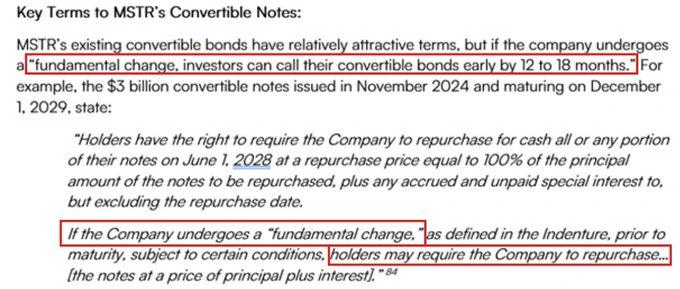
• 如下图,如下图所示,可转债条款中规定公司发生重大变化,投资者可以要求公司提前 12-18 个月偿还债务,但是定义“重大变化”主要是指公司股东决定清算,公司股东的投票权大多数在 Michael Saylor 手里
比特币价格持续下跌,微策略会被破产清算吗?

结论

MicroStrategy 目前仍然保持财务稳定,但如果比特币价格出现长期、深度下跌,其高杠杆策略可能会导致严重财务压力。公司的命运完全取决于比特币的未来走势——如果比特币长期低迷,MicroStrategy 可能会陷入债务危机甚至破产;但如果比特币继续上涨,公司将保持强劲增长。

Reference:

1. 

2. https://d1x7dwosqaosdj.cloudfront.net/images/2025-02/232aba2ceb23418a8ac27bddf2011abd.jpg

3. Deep Research of ChatGPT

原文链接

Trending Cryptos

Related Reads

1600 Lines of Code Create an Underwater Manhattan, Fable 5 Leaves Karpathy Stunned

Title: Fable 5 Stuns Karpathy with 3D Worlds Built from 1600 Lines of Code An AI model, Fable 5, has demonstrated a remarkable leap in generating complex, interactive 3D worlds with minimal code. Showcased by Peter Gostev of Arena.ai, the model created 63 diverse 3D environments across themes like immersive cityscapes, explorable famous paintings, natural wonders, and cosmic phenomena. Many were generated in a single attempt. A standout creation is a detailed, submerged Manhattan built with only 1600 lines of Three.js code. Other highlights include traversable versions of Van Gogh's "Starry Night," a bear catching a salmon with realistic physics, and a split Red Sea. The model's ability to cohesively manage vast numbers of elements within a scene represents a significant technical advancement. Andrej Karpathy, who recently joined Anthropic's pre-training team, expressed amazement, particularly at how the model intuitively understood and rendered complex real-world interactions like a fish struggling when caught. He coined the term "fablemaxxing" to describe this qualitative leap. While Fable 5 excels at world-building, Gostev notes current limitations in creating engaging, long-form gameplay. The model also sometimes requires prompting to fully utilize its capabilities. Having topped the Agent Arena benchmark for real-world task completion, Fable 5 signals that the boundaries of AI-generated content are rapidly expanding, with its full potential yet to be discovered.

marsbit3m ago

1600 Lines of Code Create an Underwater Manhattan, Fable 5 Leaves Karpathy Stunned

marsbit3m ago

From ANSEM to CZ, The Celebrity Coin Relay Race Between Solana and BSC

The past week was a whirlwind of on-chain activity, sparked by the meteoric rise of $ANSEM, a Solana-based meme coin that surged 600x and hit a $100 million market cap in a single day. This rally began when crypto influencer Ansem announced his return to buying Solana meme coins and publicly advocated for an airdrop from the platform pump.fun. Ansem’s subsequent "soft claim" of the token—promising to airdrop creator revenue to followers—ignited a frenzy, drawing comparisons to past community-led token distributions. However, his dual role as a co-founder of the trading terminal Bullpen, which later hosted the $ANSEM airdrop, suggests a strategic promotional element. The narrative quickly shifted to "celebrity coins," where tokens named after influencers are sent to their public addresses in hopes of endorsement. While a similar coin, $TJR, briefly gained traction, it faltered after the influencer TJR urged focus back on $ANSEM. Attention then turned to projects Ansem endorsed and coins found in his wallet, like $manlet, but momentum on Solana began to stall. The action then migrated to BSC with the viral resurgence of a 2021 tweet from former Binance CEO CZ, referencing a "final form" bull. This sparked the explosive launch of $CZ, which briefly approached a $90 million market cap despite expectations that CZ wouldn't actively engage like Ansem. Another BSC token, $TCC, gained attention due to CZ's interactions with its promoter. The BSC ecosystem saw faster-paced, albeit volatile, "celebrity coin" plays, with tokens like $dingaling experiencing rapid pumps and dumps without official endorsements. Currently, BSC shows more momentum for new token launches than Solana, with the market awaiting a new narrative to succeed the fleeting "celebrity coin" trend.

marsbit14m ago

From ANSEM to CZ, The Celebrity Coin Relay Race Between Solana and BSC

marsbit14m ago

A Decade of Change: The Demise of Crypto Startups

"The Decade-Long Transformation: The Demise of Crypto Startups" The article traces the dramatic evolution of the cryptocurrency industry from its anarchic beginnings to its current highly regulated and institutionalized state. In the early days (circa 2017), launching a crypto startup was remarkably simple: a whitepaper, a GitHub repository, and a Telegram group could attract thousands of retail investors via an Initial Coin Offering (ICO). Founders operated anonymously with near-zero regulatory and financial barriers, enabling rapid, global innovation but also widespread fraud. By 2026, the landscape is fundamentally different. To operate in major markets like the US, EU, and Asia, crypto businesses must now navigate a complex web of regulations akin to traditional finance. Compliance costs are prohibitive: estimates for a US multi-state operation range from $750,000 to $1.2 million in the first three years, with annual costs exceeding $2 million thereafter. Regulations like MiCA in the EU and New York's BitLicense have created high capital and operational hurdles that act as barriers to entry. Simultaneously, venture capital investment has shifted dramatically. Following the collapses of Terra and FTX, funding has concentrated in later-stage, established companies, creating a "barbell market." Early-stage and seed funding has shrunk significantly, while mega-funds like Andreessen Horowitz's $15 billion pool dominate. Most capital now flows to trading platforms, lending infrastructure, and B2B services. This environment favors mergers and acquisitions as the primary path for growth. Companies like Coinbase and Ripple are acquiring firms like Deribit and Hidden Road not for their technology, but for their licenses, banking relationships, and institutional trust—assets far more valuable than code. Distribution channels, compliance, and brand reputation have become the new moats, overshadowing pure technical innovation. The industry's maturation brings benefits: reduced scams, increased institutional participation, and clearer regulatory frameworks. However, it comes at a cost. The low-barrier, experimental ethos that defined crypto's first decade is fading. Entrepreneurs without substantial capital, pre-existing licenses, or institutional connections face immense challenges. Funding for exploratory fields like decentralized social media or novel governance models is drying up. Ultimately, the crypto industry is replicating the consolidation pattern seen in banking and tech after the 2008 financial crisis. While this brings stability and legitimacy, it raises a critical question: in this new, resource-intensive reality, is there still room for the disruptive, from-scratch innovation that gave birth to the sector?

Foresight News1h ago

A Decade of Change: The Demise of Crypto Startups

Foresight News1h ago

Trading

Spot

Hot Articles

What is $BITCOIN

DIGITAL GOLD ($BITCOIN): A Comprehensive Analysis Introduction to DIGITAL GOLD ($BITCOIN) DIGITAL GOLD ($BITCOIN) is a blockchain-based project operating on the Solana network, which aims to combine the characteristics of traditional precious metals with the innovation of decentralized technologies. While it shares a name with Bitcoin, often referred to as “digital gold” due to its perception as a store of value, DIGITAL GOLD is a separate token designed to create a unique ecosystem within the Web3 landscape. Its goal is to position itself as a viable alternative digital asset, although specifics regarding its applications and functionalities are still developing. What is DIGITAL GOLD ($BITCOIN)? DIGITAL GOLD ($BITCOIN) is a cryptocurrency token explicitly designed for use on the Solana blockchain. In contrast to Bitcoin, which provides a widely recognized value storage role, this token appears to focus on broader applications and characteristics. Notable aspects include: Blockchain Infrastructure: The token is built on the Solana blockchain, known for its capacity to handle high-speed and low-cost transactions. Supply Dynamics: DIGITAL GOLD has a maximum supply capped at 100 quadrillion tokens (100P $BITCOIN), although details regarding its circulating supply are currently undisclosed. Utility: While precise functionalities are not explicitly outlined, there are indications that the token could be utilized for various applications, potentially involving decentralized applications (dApps) or asset tokenization strategies. Who is the Creator of DIGITAL GOLD ($BITCOIN)? At present, the identity of the creators and development team behind DIGITAL GOLD ($BITCOIN) remains unknown. This situation is typical among many innovative projects within the blockchain space, particularly those aligning with decentralized finance and meme coin phenomena. While such anonymity may foster a community-driven culture, it intensifies concerns about governance and accountability. Who are the Investors of DIGITAL GOLD ($BITCOIN)? The available information indicates that DIGITAL GOLD ($BITCOIN) does not have any known institutional backers or prominent venture capital investments. The project seems to operate on a peer-to-peer model focused on community support and adoption rather than traditional funding routes. Its activity and liquidity are primarily situated on decentralized exchanges (DEXs), such as PumpSwap, rather than established centralized trading platforms, further highlighting its grassroots approach. How DIGITAL GOLD ($BITCOIN) Works The operational mechanics of DIGITAL GOLD ($BITCOIN) can be elaborated on based on its blockchain design and network attributes: Consensus Mechanism: By leveraging Solana’s unique proof-of-history (PoH) combined with a proof-of-stake (PoS) model, the project ensures efficient transaction validation contributing to the network's high performance. Tokenomics: While specific deflationary mechanisms have not been extensively detailed, the vast maximum token supply implies that it may cater to microtransactions or niche use cases that are still to be defined. Interoperability: There exists the potential for integration with Solana’s broader ecosystem, including various decentralized finance (DeFi) platforms. However, the details regarding specific integrations remain unspecified. Timeline of Key Events Here is a timeline that highlights significant milestones concerning DIGITAL GOLD ($BITCOIN): 2023: The initial deployment of the token occurs on the Solana blockchain, marked by its contract address. 2024: DIGITAL GOLD gains visibility as it becomes available for trading on decentralized exchanges like PumpSwap, allowing users to trade it against SOL. 2025: The project witnesses sporadic trading activity and potential interest in community-led engagements, although no noteworthy partnerships or technical advancements have been documented as of yet. Critical Analysis Strengths Scalability: The underlying Solana infrastructure supports high transaction volumes, which could enhance the utility of $BITCOIN in various transaction scenarios. Accessibility: The potential low trading price per token could attract retail investors, facilitating wider participation due to fractional ownership opportunities. Risks Lack of Transparency: The absence of publicly known backers, developers, or an audit process may yield skepticism regarding the project's sustainability and trustworthiness. Market Volatility: The trading activity is heavily reliant on speculative behavior, which can result in significant price volatility and uncertainty for investors. Conclusion DIGITAL GOLD ($BITCOIN) emerges as an intriguing yet ambiguous project within the rapidly evolving Solana ecosystem. While it attempts to leverage the “digital gold” narrative, its departure from Bitcoin's established role as a store of value underscores the need for a clearer differentiation of its intended utility and governance structure. Future acceptance and adoption will likely depend on addressing the current opacity and defining its operational and economic strategies more explicitly. Note: This report encompasses synthesised information available as of October 2023, and developments may have transpired beyond the research period.

627 Total ViewsPublished 2025.05.13Updated 2025.05.13

What is $BITCOIN

Discussions

Welcome to the HTX Community. Here, you can stay informed about the latest platform developments and gain access to professional market insights. Users' opinions on the price of BTC (BTC) are presented below.

活动图片