The truth about Pi coin: Could it be the next Bitcoin?

CointelegraphPublished on 2025-02-13Last updated on 2025-02-13

Abstract

Pi Network, one of 2025’s most controversial projects, promises mobile cryptocurrency mining but faces criticism over centralized control, inflated user numbers and its inflationary tokenomics.

What is Pi coin?

Pi Network, one of 2025’s most controversial projects, promises mobile cryptocurrency mining but faces criticism over centralized control, inflated user numbers and its inflationary tokenomics.

Everyone is talking about Pi coin. It’s arguably the most controversial project of 2025.

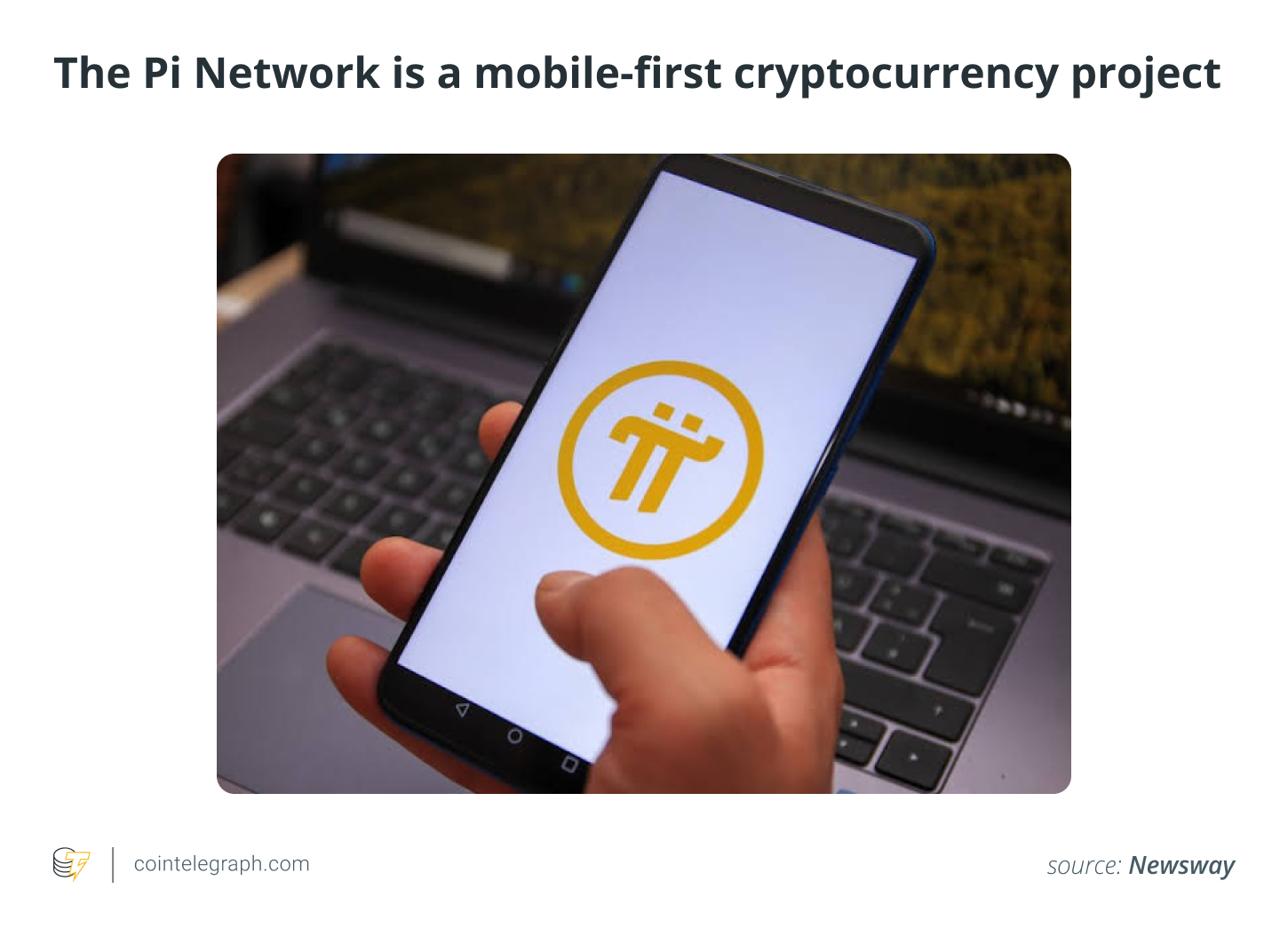
On the surface, Pi Network is a digital currency and decentralized finance project developed by Stanford graduates Nicolas Kokkalis, Chengdiao Fan and Vince McPhillip. In development since 2019, it is built on the premise that anyone should be able to mine cryptocurrency through a mobile application.

However, if you dig deeper, the project has faced continuous criticism. For instance, while Pi Network claims to have over 60 million users globally, blockchain data suggests significant discrepancies between these figures and actual activity.

Additionally, the project’s inflationary tokenomics, centralization of control and reliance on advertising revenue have drawn criticism for prioritizing user monetization over decentralization and innovation.

With its transition to the “open network” anticipated in the first quarter of 2025, the ecosystem is approaching a pivotal moment –— a trial in the gladiator ring, so to speak — fueling the ongoing buzz.
Pi Coin: A timeline of key events

Pi Network, initially launched in 2019 for smartphone-based crypto mining, has progressed through various phases, including Testnet, node program and enclosed mainnet. It is now transitioning to an open network with its mainnet migration in early 2025.

March 14, 2019: Official launch - Pi Network was officially launched on Pi Day (March 14), symbolizing the mathematical constant π (3.14). The initial version of the mobile application allowed users, referred to as “Pioneers,” to mine Pi cryptocurrency directly from their smartphones.

March 14, 2020: Testnet phase initiation - On its first anniversary, Pi Network commenced the testnet phase, marking a critical step toward decentralization. This phase enabled the deployment of distributed nodes worldwide, allowing community developers to test the blockchain and create utilities using Test-Pi.

Late 2020: Introduction of node program - Pi Network introduced its node program, allowing users to operate network nodes on personal computers. This initiative empowered Pioneers to contribute to the network’s security and transaction validation, fostering decentralization.

December 2021: Enclosed mainnet launch - Pi Network transitioned to the Enclosed Mainnet phase, where the mainnet became live but with a firewall preventing external connectivity. This period allowed users to complete Know Your Customer (KYC) verification and migrate their Pi to the live mainnet blockchain while the community built apps and utilities within the enclosed network.

October 2023: Roadmap announcement - The Pi Core Team released a milestone-based roadmap outlining past accomplishments, ongoing projects and future endeavors. This roadmap provided transparency and detailed the steps leading up to the Open Mainnet.

December 2024: Open network update - The Pi Network team announced that the Open Mainnet launch, originally expected by the end of 2024, would be postponed to the first quarter of 2025. This decision aimed to allow more users to complete KYC verification and migrate their tokens to the mainnet, ensuring a more inclusive and secure ecosystem.

January 2025: Mainnet migration progress - By January 2025, Pi Network had over 18 million KYC-verified users, with more than eight million having migrated their tokens to the mainnet. The team extended the KYC and Mainnet Migration Grace Period deadlines to Jan. 31 to facilitate the transition.

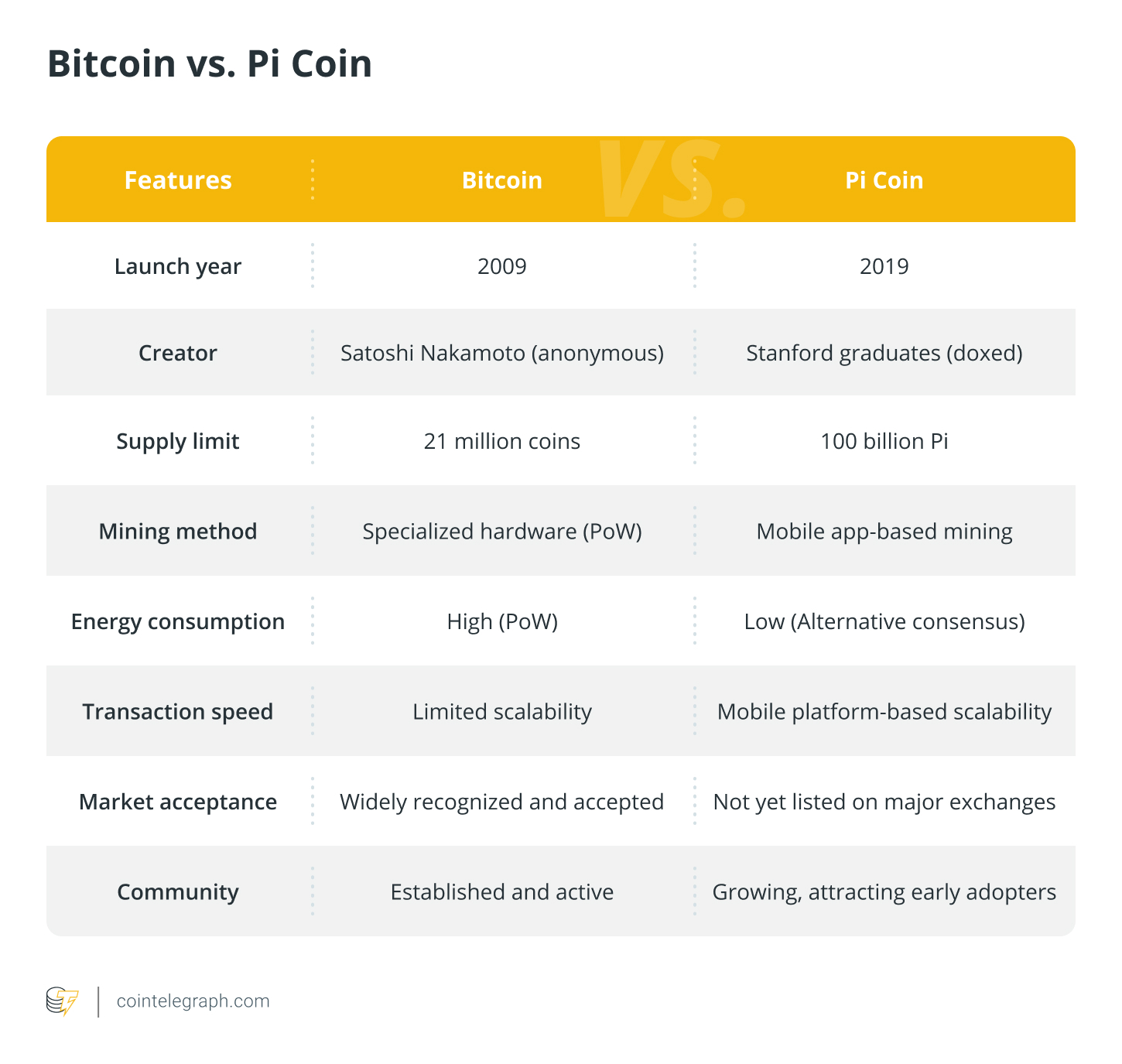
Differences between Pi coin and Bitcoin, launched in 2009, is a widely accepted digital asset with a capped supply. Pi coin, launched in 2019, offers mobile app-based mining and aims for broader accessibility but is still in its early stages with an undetermined market value.

Pi coin is certainly breaking the mold of traditional cryptocurrencies. To better understand this, let’s take a look at the table below:
Advantages of the Pi Network

By allowing users to mine Pi coins directly from their smartphones, the Pi Network removes traditional barriers like the need for expensive mining equipment or access to banking services.

Its straightforward design not only simplifies the mining process but also encourages more people to explore Web3 technologies, making cryptocurrency more approachable to a wider audience.

The Pi Network also uses the Stellar Consensus Protocol (SCP), which brings with it advantages such as energy efficiency, decentralized control and quick transaction speeds.

That said, the SCP does present some challenges, such as the complexity of setting up trust relationships between nodes and its dependence on stable network connections, which can be a drawback in areas with limited connectivity.

Despite these hurdles, one can see how the Pi Network aims to combine the strengths of SCP with its user-centric approach, creating a platform that has the potential to provide a more inclusive, scalable and sustainable digital currency solution.

Did you know? Pi Network allows users to "mine” Pi coins on their smartphones without draining the battery or using significant computational resources. This is possible because the actual work of validating transactions and securing the blockchain is handled by specialized computer nodes running the SCP.

Step-by-step guide to mining Pi coin

How the Pi Network approaches mining is its stand-out feature. However, with an “invite-only” system reminiscent of 2020’s Clubhouse, things might not be as simple as they seem.

Let’s take a look at the steps involved:

Download the Pi Network app:

For Android devices, visit the Google Play Store and search for “Pi Network.”

For iOS devices, go to the Apple App Store and search for “Pi Network.”

Create an account:

Open the app and sign up using your phone number or Facebook account.

Choose a unique username and set a strong password for security.

Enter an invitation code:

Pi Network operates on an invite-only basis to build a trusted community.

You’ll need an invitation code from an existing user to join. If you don’t have a code, you can search online or ask friends who are already using Pi Network.

Complete your profile:

Provide your real name, as it will be required for future verification processes.

Select your country and enter a valid phone number for account recovery purposes.

Start mining:

After setting up your account, you’ll see a lightning bolt icon on the home screen.

Tap the lightning bolt to initiate your first mining session.

Each mining session lasts for 24 hours. After that, you’ll need to open the app and tap the lightning bolt again to continue mining.

Increase your mining rate:

Invite friends and family to join Pi Network using your unique invitation code.

For each active referral, your mining rate increases.

Engage with the Pi Network community and participate in discussions to stay informed and potentially boost your mining rate further.

Build your security circle:

After mining for three days, you can enhance the network’s security by adding trusted members to your security circle.

Related Reads

After $HYPE Hits a New High, Is It Worth Considering the Stock of "HYPE Version MicroStrategy" $PURR?

**HYPE Hits New Highs: Is $PURR, the "HYPE Version of MicroStrategy," Worth Considering?** The stock of Hyperliquid Strategies (NASDAQ: $PURR), a publicly-traded company that exclusively buys and holds the cryptocurrency HYPE, has gained over 100% year-to-date, mirroring HYPE's own 150% surge to new all-time highs. This has sparked discussions about PURR being a more "capital-efficient" play than MicroStrategy's bitcoin strategy, given its reported ~$1 billion unrealized gain on a ~$220 million investment. The article clarifies that PURR is essentially a pure-play wrapper for HYPE, with no other business. It resulted from a 2025 SPAC merger led by firms like Paradigm and Atlas Merchant Capital, bringing traditional finance veterans to its board. Its value is entirely derived from the price of HYPE. While PURR offers a crucial compliance bridge for US-based institutional and retirement accounts unable to access HYPE directly, the analysis questions the "capital efficiency" narrative. The outsized gains are attributed to HYPE's exceptional performance, not superior corporate strategy. For investors who can buy HYPE directly, holding PURR introduces unnecessary risks: potential shareholder dilution from future stock offerings, incomplete passthrough of staking rewards, market hour mismatches, and counterparty risk via its single custodian. A key metric is its mNAV (modified net asset value). Current calculations show PURR trades at a discount to its HYPE holdings, but this could flip to a premium depending on the execution of registered share issuances. The article concludes that PURR is primarily a "conduit product." The investment thesis hinges entirely on one's bullishness on HYPE itself, not on the PURR wrapper, which adds friction and risk for those with direct crypto access.

marsbit26m ago

After $HYPE Hits a New High, Is It Worth Considering the Stock of "HYPE Version MicroStrategy" $PURR?

marsbit26m ago

The Real Progress and Investment Opportunities of Decentralized AI Computing Power Networks in 2026

In 2026, the AI compute market is marked by centralized GPU consolidation and a significant GPU shortage for smaller players. In this context, Decentralized Physical Infrastructure Networks (DePIN), valued at $9.4B+, have emerged as a viable, revenue-generating alternative. Leading protocols like Aethir ($150M ARR), io.net (130k+ GPUs), Akash, Bittensor, and Render are carving out distinct niches, moving beyond hype to deliver verifiable income primarily from non-crypto-native clients. The key advantage of decentralized GPU networks lies in serving latency-tolerant, cost-sensitive workloads like AI inference, fine-tuning, data preprocessing, and agent operations, offering substantial cost savings (45-80%) compared to major cloud providers. However, reliability variance, lack of robust SLAs, and fragmented tech stacks remain significant adoption hurdles. The sector is maturing with critical 2026 shifts: 1) Evolution of tokenomics towards demand-driven, revenue-linked models (e.g., Render's BME, io.net's IDE), and 2) Clearer enterprise adoption pathways, with traditional firms integrating decentralized compute. For new entrants, opportunities are now concentrated in specialized tooling layers (orchestration, verification, SLA management), vertical applications (e.g., bio-med, content generation), and innovative token designs tied to real usage, rather than generic GPU aggregation. The convergence with the emerging AI Agent economy presents a significant future growth vector.

marsbit27m ago

The Real Progress and Investment Opportunities of Decentralized AI Computing Power Networks in 2026

marsbit27m ago

We Captured Thousands of Job Postings and Discovered ByteDance is Reviving Smartphone R&D

This article analyzes ByteDance's recent hiring activities, revealing a potential restart of smartphone hardware development. By scraping and analyzing thousands of ByteDance job postings, the authors identify three key categories: roles for the "Doubao Phone Assistant" (an AI agent), for a "Mobile OS" (system-level development), and for hardware/engineering positions in Shenzhen (a manufacturing hub). The piece traces the context to the 2025 launch of the "Doubao Phone," a concept device that integrated an AI agent directly into a smartphone, allowing it to see the screen, operate apps, and perform tasks like shopping or booking tickets. While innovative as an early AI Agent prototype, it faced operational restrictions from major platforms like WeChat and Alipay. The new hiring signals a deeper commitment. "Doubao Phone Assistant" roles focus on core Agent capabilities (task execution, memory, cross-app operation). "Mobile OS" positions involve deep system work (kernel, chip adaptation, power/thermal management) necessary for a responsive, always-on AI. Shenzhen-based hardware roles (structure design, testing, production) suggest preparation for physical device manufacturing. The article concludes that in the AI era, where phones may become an Agent's "body," controlling the operating system and hardware is critical. For a company like ByteDance, being merely an app within others' ecosystems is no longer sustainable if it aims to own the next-generation user interface. Therefore, while a consumer phone brand isn't confirmed, ByteDance is decisively moving beyond app development into the complex domain of system-level and hardware-integrated AI.

marsbit57m ago

We Captured Thousands of Job Postings and Discovered ByteDance is Reviving Smartphone R&D

marsbit57m ago

AI Impact on SaaS Software Stocks: Deconstructing the Bottom-Fishing Logic of Salesforce, ServiceNow, and Snowflake

"AI Nightmare for SaaS Stocks: Unpacking the Bottom-Fishing Logic for Salesforce, ServiceNow, and Snowflake" A deep dive analysis argues that the recent collapse in SaaS software stocks, dubbed the "SaaS Doom," presents a contrarian buying opportunity. The market panic, triggered by fears that AI will disrupt traditional per-user subscription models through "seat compression" and AI agents bypassing software UIs, has led to extreme selling in the software sector. The analysis evaluates three major players under a unified framework: 1. **Salesforce (CRM):** Positioned as a "margin of safety" play. Trading at historically low valuations (13-14x forward P/E), with strong cash flow and a massive buyback, it offers value. Its key challenge is transitioning from a "seat economy" to an AI-driven "task economy" with its Agentforce platform. 2. **ServiceNow (NOW):** The "clearest AI narrative" play. Its "AI Control Tower" strategy aims to become the governance and orchestration layer for enterprise AI agents, benefiting from AI proliferation. Backed by Nvidia's CEO, it trades at a relatively low valuation post-correction. 3. **Snowflake (SNOW):** The "high-risk, high-reward" bet. Its consumption-based model aligns with rising AI workloads, and its RPO growth is strong. However, it faces intense competition (e.g., Databricks), is not yet GAAP profitable, and carries the highest valuation. The conclusion counters the simplified "AI kills software" narrative. AI is eliminating software that sells only functional interfaces but rewarding platforms that provide essential infrastructure, data, and governance. The current sell-off may have created a buying opportunity for resilient software leaders positioned as future AI infrastructure platforms.

marsbit1h ago

AI Impact on SaaS Software Stocks: Deconstructing the Bottom-Fishing Logic of Salesforce, ServiceNow, and Snowflake

marsbit1h ago

Trading

Spot
Futures
活动图片