Dogecoin Whale Makes $84 Million Coinbase Deposit, Bearish Sign?

bitcoinistОпубліковано о 2024-11-26Востаннє оновлено о 2024-11-26

Анотація

On-chain data shows a Dogecoin whale has just transferred a large amount of DOGE to Coinbase, something that could be...

On-chain data shows a Dogecoin whale has just transferred a large amount of DOGE to Coinbase, something that could be bearish for the price.

Dogecoin Whale Has Made A Large Exchange Inflow Today

According to data from the cryptocurrency transaction tracker service Whale Alert, a couple of large transactions have occurred on the DOGE network during the past day.

Both of these transfers are of a scale that’s generally attributed to the whale entities. The whales are the investors who hold massive amounts of the asset in their addresses and as such, carry a notable degree of influence in the market.

Because of their key position on the network, the moves of these humongous investors can be worth following, for even if they may not directly influence the memecoin’s value, they can still tell us about the sentiment among these titans.

A lot of the time, though, it’s hard to say anything about exactly what a whale intended to do with a transaction, given the anonymous nature of the blockchain. That said, sometimes one of the wallets is connected with a centralized platform and in those cases, there is indeed room for speculation to be done.

One of the large Dogecoin transactions from the last 24 hours is of this type. Below are the details for the transfer in question.
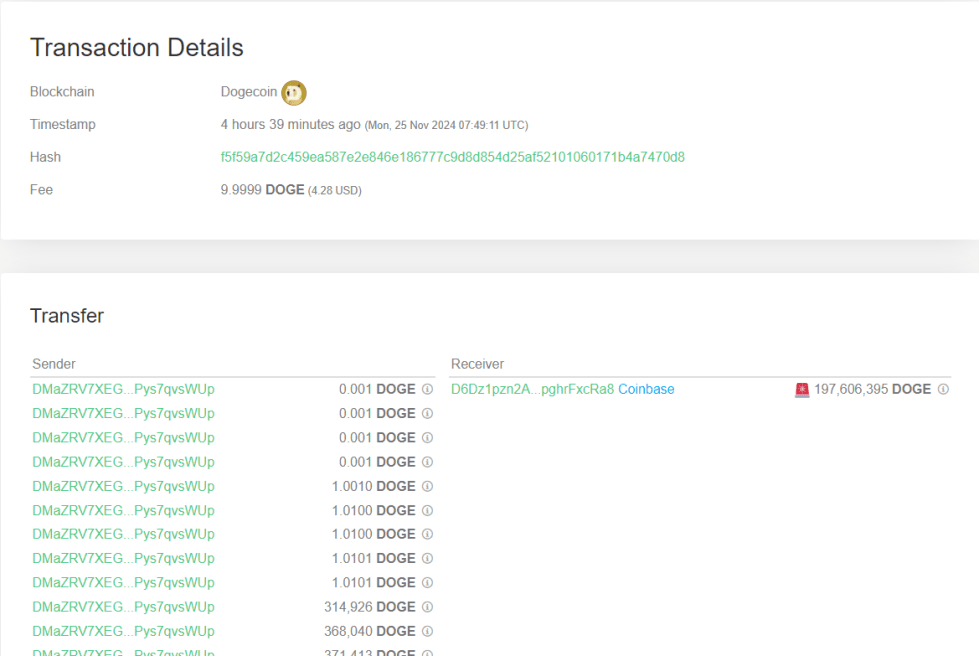
Dogecoin Exchange Inflow

This DOGE transfer appears to have needed a fee of just $4.3 to go through | Source: Whale Alert

As is visible above, the sending address for this Dogecoin transaction was an unknown wallet, meaning that it was likely the investor’s personal address, but the receiver is connected to a known entity: the Coinbase exchange.

In total, the whale has moved 197,606,395 DOGE to the platform with this transfer. At the time that the transaction was executed, this stack was worth almost $84.6 million.

Moves of this type, where coins flow from a self-custodial address to an exchange-associated wallet, are known as exchange inflows. As one of the main reasons why investors deposit to these platforms is for selling-related purposes, exchange inflows can carry a bearish implication for the asset’s price.

While the amount involved in this whale Coinbase inflow is notable, it alone may not be enough to move the asset. The deposit can still be bad news, however, as it may signal that the whales are looking to exit now that the memecoin’s run has gone cold.

The other Dogecoin whale transaction from today involved a transfer of 130 million DOGE ($56.2 million), but this move took place between two unknown wallets, so it’s not possible to guess what purpose it might have had.

It could be a sign of selling through an over-the-counter (OTC) deal or it could be as simple as the holder moving their funds to a fresh address.

DOGE Price

At the time of writing, Dogecoin is trading around $0.42, up 16% over the last week.

Dogecoin Price Chart

Looks like the price of the coin has gone stale during the last few days | Source: DOGEUSDT on TradingView
Featured image from Dall-E, whale-alert.io, chart from TradingView.com
Keshav Verma

Keshav Verma

Keshav is a Physics graduate who has been employed as a writer with Bitcoinist since June 2021. He is passionate about writing and through the years, he has gained experience working in a variety of niches. Keshav holds an active interest in the cryptocurrency market, with on-chain analysis being an area he particularly likes to research and write about.

Пов'язані матеріали

Sinking Servers into the Sea? They're Dead Serious About This

Sinking Servers into the Sea: A Serious Undertaking The article details China's launch of the world's first offshore, directly wind-powered, subsea data center in the East China Sea near Shanghai. This 1.95 billion yuan project houses over 2,000 servers in a submerged 10-meter-deep module. It is directly powered by a nearby offshore wind farm (over 95% green energy) and cooled by seawater. This innovative approach tackles the two core challenges of data centers: massive power consumption and heat dissipation. It achieves an exceptional Power Usage Effectiveness (PUE) of 1.15, far better than China's national average of 1.48, saving an estimated 61 million kWh of electricity annually. It also uses no freshwater and requires significantly less land. The concept builds upon earlier experiments, like Microsoft's Project Natick, which proved servers could reliably operate underwater with lower failure rates due to a stable, inert environment. The Shanghai project advances the model by co-locating with wind farms, simultaneously solving both the power source and cooling source problems in an economically viable way. This integration reduces infrastructure costs and eliminates grid transmission losses for the electricity used on-site. Looking ahead, the vision is to integrate data center modules directly into the foundations of future large-scale, deep-sea wind turbines. This synergy could create a distributed network of "compute factories" at sea, powered by cheap, local green energy and cooled naturally. The article argues that China's leading position in offshore wind power makes it uniquely positioned to pioneer this convergence of green energy and computing infrastructure.

marsbit10 хв тому

Sinking Servers into the Sea? They're Dead Serious About This

marsbit10 хв тому

Duan Yongping Makes First Investment in Crypto Company: Why Circle?

Duan Yongping, a renowned Chinese investor known as the "Chinese Buffett," has made his first investment in the cryptocurrency space through his family office, H&H International Investment LLC. According to a recent 13F filing, the firm acquired a position in stablecoin issuer Circle (CRCL), valued at approximately $19.08 million. While this amount represents only 0.2% of Duan's total portfolio, the move is symbolically significant. Historically cautious towards Web3 and crypto assets, Duan's investment philosophy aligns with traditional value investing principles—emphasizing understandable business models, strong moats, and stable cash flows. Most crypto projects have not met these criteria. Circle, however, stands apart. Its core business revolves around issuing the USDC stablecoin and generating interest income from its reserve assets, primarily U.S. Treasuries. This model resembles a money market fund or digital dollar bank, providing predictable revenue. Circle's Q1 2026 financials showed strong growth: revenue reached $694 million (up 20% year-on-year), with 94% from reserve interest, and adjusted EBITDA was $151 million (up 24%). USDC circulation grew 28% to $77 billion. Duan's investment signals a shift: stablecoin infrastructure like Circle's is becoming legible to traditional value investors. It represents a bridge between crypto and mainstream finance, underscored by Circle's recent $222 million pre-sale for its Arc layer-1 blockchain, backed by major firms like a16z and BlackRock. This move suggests that as regulatory clarity improves and business models mature, more crypto-native companies may gain acceptance from traditional capital.

链捕手40 хв тому

Duan Yongping Makes First Investment in Crypto Company: Why Circle?

链捕手40 хв тому

Morse Code "Stole" $440,000 from Bankr, Undermining Trust in AI Agent Interactions Again

On May 20th, the AI agent platform Bankr reported an attack where 14 user wallets were compromised, resulting in losses exceeding $440,000. The incident, confirmed by security firm SlowMist, was a social engineering attack exploiting the trust layer between automated agents, similar to an attack on May 4th that stole $150k-$200k from a Grok-associated wallet. Bankr allows users and AI agents to manage wallets and execute transactions via instructions sent to @bankrbot on X. The platform monitors posts from specific agents like @grok, treating them as potential transaction commands, especially if the agent holds a "Bankr Club Membership" NFT which grants high-permission operations. The attacker exploited this design. First, they airdropped the required NFT to Grok's wallet. Then, they posted a Morse code message on X requesting a translation from Grok. The AI agent helpfully decoded and replied, but the decoded text contained a direct instruction to @bankrbot to transfer a large sum of DRB tokens to the attacker's address. Bankr's system, monitoring Grok's feed and verifying the NFT permissions, automatically signed and broadcast the transaction. The core issue is a flawed trust assumption: Bankr treated Grok's natural language output as authorized financial commands without verifying the intent. LLMs like Grok cannot distinguish between a genuine user request and a manipulated instruction. Using encoded messages like Morse code bypasses potential content filters, as the translation task itself appears harmless. This attack highlights a systemic vulnerability in platforms granting on-chain execution rights to AI agents. While Bankr has paused transactions and promised full reimbursement from its treasury, the incident underscores that defenses against "malicious-injection-via-LLM-output" were not part of the original security model. As AI agents gain financial agency, such trust-layer exploits represent a growing threat class.

marsbit1 год тому

Morse Code "Stole" $440,000 from Bankr, Undermining Trust in AI Agent Interactions Again

marsbit1 год тому

Торгівля

Спот
Ф'ючерси
活动图片





