Iran Launches Bitcoin-Based Maritime Insurance Platform 'HormuzSafe', Claims Annual Revenue Could Exceed $100 Billion

marsbitОпубліковано о 2026-05-20Востаннє оновлено о 2026-05-20

Анотація

Iran has launched "HormuzSafe," a Bitcoin-based maritime insurance platform for shipping through the Strait of Hormuz, aiming for potential annual revenue exceeding $10 billion. The platform, announced by Iranian semi-official media, offers "cryptographically verifiable insurance policies" settled in Bitcoin for Iranian shippers and cargo owners. However, its operational status is unconfirmed, and analysts highlight significant challenges including Bitcoin's price volatility, risks of violating U.S. sanctions, and the controversial background of some involved figures. This initiative is part of Iran's broader strategy to institutionalize control over the critical waterway—which handles roughly 20% of global seaborne oil trade—following its closure after U.S.-Israel airstrikes in late February. Iran has also established the Persian Gulf Strait Authority (PGSA) to manage traffic and fees. While positioning Bitcoin as a sanctions-resistant settlement layer, the platform faces skepticism regarding its technical feasibility, user adoption, and the potential for it to be confused with existing crypto-related shipping scams.

Shenchao Digest: Iran's Ministry of Economy has launched a Bitcoin-settled maritime insurance platform called 'Hormuz Safe', targeting Iranian shipowners and cargo owners transiting the Strait of Hormuz with 'cryptographically verifiable insurance policies'. Iranian state media claims the platform could generate over $100 billion in annual revenue.

However, independent verification of whether the platform is actually operational has not been obtained. Its feasibility faces severe challenges due to Bitcoin's high volatility, compliance risks from US sanctions, and the controversial background of its alleged backer, Babak Zanjani. This represents Iran's most prominent attempt to convert its military control over the Strait of Hormuz into a crypto-financial product.

Iran is attempting to turn one of the world's most critical maritime chokepoints into a Bitcoin-settled insurance market.

According to a Bloomberg report on May 18, Iran's semi-official Fars news agency, citing documents from the country's Ministry of Economic Affairs and Finance, reported that Iran has launched a Bitcoin-backed maritime insurance service named 'Hormuz Safe' for Iranian shipping companies and cargo owners wishing to pass through the Strait of Hormuz.

Fars stated that the plan could generate over $100 billion in revenue for Iran but did not provide a timeframe or operational details.

Since the US and Israeli airstrikes on Iran on February 28, Iran has effectively closed the Strait of Hormuz. In peacetime, the strait handles about 20% of global seaborne oil trade and 20% of liquefied natural gas exports.

The Iranian government and the Islamic Revolutionary Guard Corps (IRGC) have since sought to formalize control over the waterway, including charging tolls and other fees. The insurance service is the latest link in its chain of revenue-generating tools.

Crypto-Verified Policies, Bitcoin Instant Settlement

According to a screenshot of the 'Hormuz Safe' website shared by Fars, the platform claims to provide Iranian shipping companies and cargo owners with 'fast, verifiable digital insurance'. As reported by Bitcoin Magazine, coverage includes risks such as vessel inspection, seizure, and confiscation, but war damage claims are excluded.

Fars quoted the description from the website hormuzsafe.ir, stating that the platform will provide 'cryptographically verifiable insurance policies' for cargo transiting the Persian Gulf, the Strait of Hormuz, and surrounding waters, with payments settled in Bitcoin. Coverage begins the moment the cargo is confirmed on the blockchain, and the cargo owner will receive a signed receipt. The website currently appears inaccessible outside Iran.
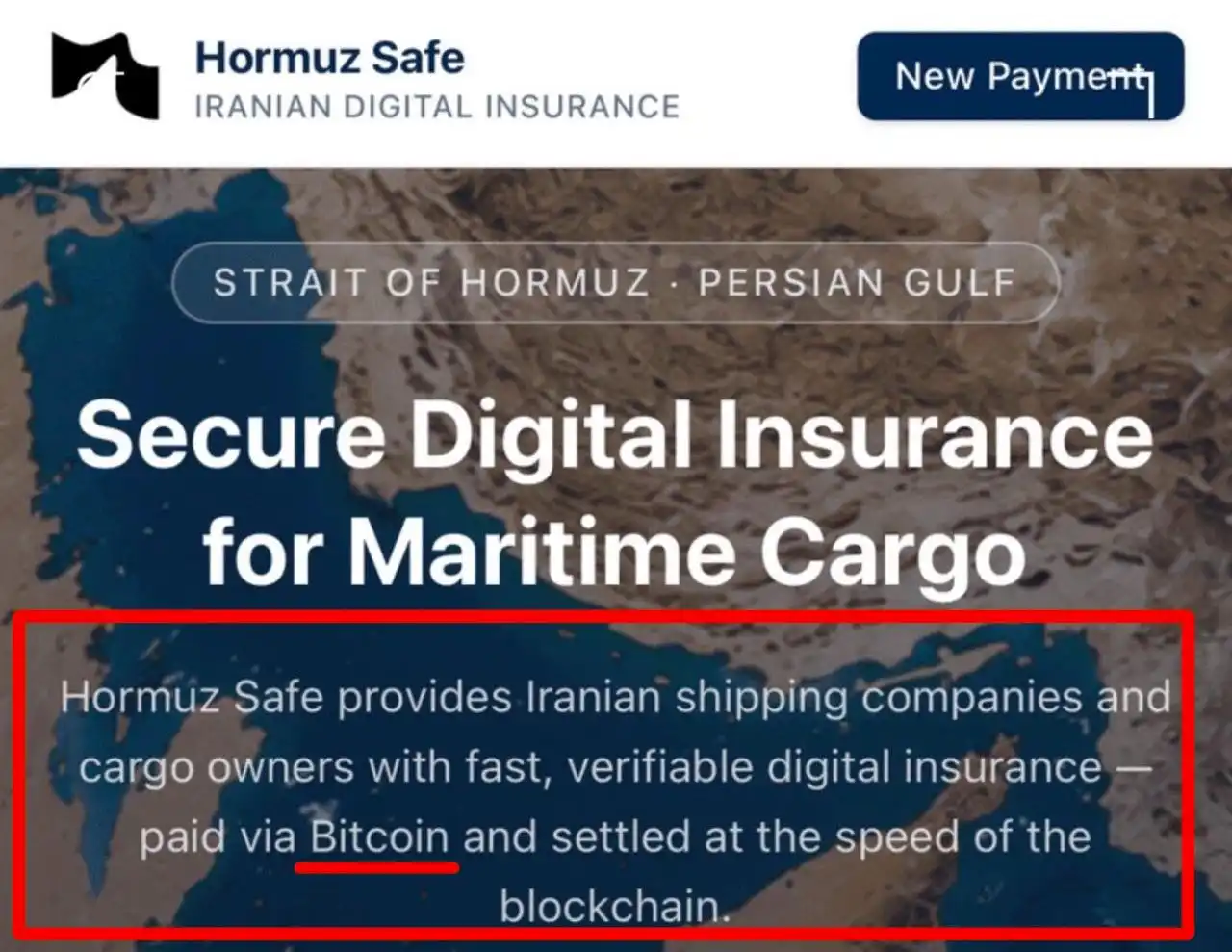
According to Bitcoin Magazine, Iran's Ministry of Economy began advancing this insurance plan from late April (early Ordibehesht in the Persian calendar). In April, Hamid Hosseini, spokesman for the Iranian Oil, Gas, and Petrochemical Products Exporters Union, told the Financial Times that shipping companies could settle Strait of Hormuz passage fees using non-dollar currencies like Bitcoin or Chinese Yuan.

Accelerating Institutionalization: From Tolls to Insurance Platform

Hormuz Safe is not an isolated move but the latest component of an entire institutional framework Iran is building around the Strait of Hormuz.

According to Bitcoin Magazine, in March 2026, the Iranian parliament passed the 'Strait of Hormuz Management Plan', formalizing into law the toll system operated by the IRGC since mid-March. Under this framework, the IRGC charges fees to ships passing through the strait; operators must submit information on vessel ownership, cargo type, destination, and crew to obtain a passage permit code.

Fees start at about $1 per barrel of oil, with fully loaded oil tankers facing charges up to $2 million, payable in Chinese Yuan.

On May 18, Iran's Supreme National Security Council announced the formal establishment of the 'Persian Gulf Strait Authority' (PGSA) and opened an official account on X.
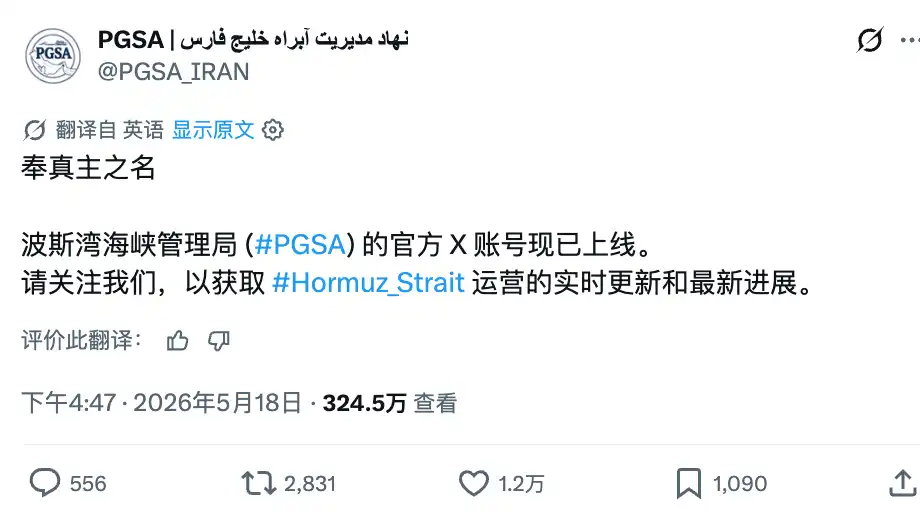
According to Euronews, the agency is positioned as an administrative entity to manage Strait of Hormuz traffic and collect tolls, operating in coordination with the IRGC Navy.

Ships must submit complete information, including ownership, insurance, crew lists, cargo declarations, and planned routes, via the PGSA's official email for approval and payment before receiving passage permits.

Ebrahim Azizi, chairman of the National Security and Foreign Policy Committee of the Iranian parliament, stated on X that only commercial vessels cooperating with Iran will benefit from this mechanism, and parties involved in US-Israeli military operations will be banned from using the route.

According to Windward intelligence analysis, as of May 18, strait traffic remains only about 38% of pre-conflict levels, with central Qeshm-Larak anchorage showing fixed dark vessel positioning for six consecutive days. Approximately 369 IRGC fast boats are concentrated in a single area about 30 nautical miles northeast of Khasab, shifting from coastal patrols to a presence in the main body of the strait.

Volatility, Sanctions Risks, and Shadow of Fraud

Several analysts have expressed skepticism about the practical feasibility of Hormuz Safe.

Bloomberg points out that, unlike stablecoins pegged to the US dollar, Bitcoin's price is highly volatile, limiting its adoption as a payment method. Foreign shipowners may be reluctant to use the mechanism for fear of violating US sanctions against Iran.

Ryan Yoon, senior analyst at Tiger Research, told Decrypt that the platform's technical and legal feasibility is 'highly questionable'; despite the announcement of its launch, no actual users have been confirmed. Shipping companies using Hormuz Safe would face the risk of 'immediate expulsion from the global financial system'.

Cake Wallet CEO Vikrant Sharma told BeInCrypto that Bitcoin can reduce some payment friction but is not a clean path to bypass the sanctions system. Liquidity at the scale of maritime insurance is a limiting factor. Activity on public blockchains can be monitored, and any exchange, broker, custodian, or counterparty tied to the US dollar brings compliance risks.

Sam Lyman, Research Director at the Bitcoin Policy Institute, explained Iran's logic from another angle: Bitcoin's core appeal lies in the fact that 'no one can freeze it'.

According to Decrypt, since the war began, crypto 'safe passage fee' scams have proliferated. Scammers impersonate Iranian authorities, demanding Bitcoin or USDT from ship operators. Hormuz Safe appears to be an independent national-level plan, but the line between genuine and fake is extremely blurred in the current environment.

The Bigger Picture: Iran Building a De-dollarized Maritime Financial System

According to Bitcoin Magazine data, Iran's crypto ecosystem was estimated at $7.8 billion in 2025, with IRGC-linked transactions accounting for about 50% of the country's total crypto volume (as of Q4 2025). The Iranian government has reportedly used mined Bitcoin to fund imports and hedge against oil revenue losses, with a stated national mining cost of about $1,300 per coin.

CoinDesk's analysis was quite precise: an insurance structure is more sophisticated than directly charging tolls. On paper, cargo owners are not paying for passage but purchasing insurance and financial responsibility certificates for sailing in waters that Tehran claims it can secure. This allows Iran to monetize its geographical advantage in a more palatable way.

A comment by Hacker News user everdrive received high votes in the tech community: The post-WWII US-led world order was partly built on the premise that the US military kept international waters open. Iran challenging the US at this level is astonishing. Everyone knew Iran had the capacity to close the strait if backed into a corner, but the arrival of this outcome still exposes serious policy-level miscalculations.

Regardless of whether Hormuz Safe ultimately operates at scale, the signal it sends is clear: Iran is building a complete set of administrative governance and financial infrastructure around the Strait of Hormuz, converting military blockade into a sustainable sovereign revenue mechanism, with Bitcoin serving as the settlement layer for this system.


Трендові криптовалюти

Пов'язані питання

QWhat is 'Hormuz Safe' and what is its primary purpose?

A'Hormuz Safe' is a Bitcoin-based maritime insurance platform launched by Iran's Ministry of Economy. Its primary purpose is to offer 'cryptographically verifiable insurance policies' to Iranian shipping companies and cargo owners for voyages passing through the Strait of Hormuz, with settlements to be made in Bitcoin.

QWhat are the main challenges and risks associated with the 'Hormuz Safe' platform, according to the article?

AThe main challenges and risks include: Bitcoin's high price volatility making it an unstable payment method; the risk of users violating US sanctions against Iran, potentially leading to exclusion from the global financial system; unconfirmed operational status and user adoption; and concerns about the feasibility of its legal and technical framework.

QWhat institutional frameworks is Iran building around the Strait of Hormuz alongside the 'Hormuz Safe' platform?

AIran is building a broader institutional framework for the Strait of Hormuz, including the passage of the 'Strait of Hormuz Management Plan' in March 2026 to formalize transit fees, and the establishment of the 'Persian Gulf Strait Authority' (PGSA) in May 2026 to manage traffic and collect fees, operating alongside the Islamic Revolutionary Guard Corps (IRGC) Navy.

QHow is Iran reportedly using Bitcoin within its national economy according to the article?

AThe article states that Iran's crypto ecosystem was estimated at $7.8 billion in 2025, with IRGC-linked transactions accounting for about 50% of the country's total crypto volume. The government reportedly uses Bitcoin mined domestically (at a cost of around $1,300 per coin) to fund imports and hedge against losses in oil revenues.

QBeyond simple transit fees, what strategic advantage does the 'Hormuz Safe' insurance model offer Iran, according to analysts?

AAnalysts, such as from CoinDesk, note that the insurance model is more sophisticated than direct transit fees. It allows Iran to monetize its geographic control by having cargo owners pay for insurance and financial responsibility certificates for sailing in waters Tehran claims to secure, rather than directly paying a toll. This makes the revenue stream more palatable and packageable internationally.

Пов'язані матеріали

WEEX TradFi Trading Competition Kicks Off, 50,000 USDT Prize Pool First-Come, First-Served, Open a Position and Get 5 U

WEEX Exchange Launches "TradFi Trading Competition" with a 50,000 USDT Prize Pool Amidst a crypto market downturn, WEEX Exchange highlights the growth of tokenized traditional finance (TradFi) assets as a key trend, allowing users to trade stocks, ETFs, and commodities using crypto. The platform has launched a "TradFi Trading Competition" from July 9th to 23rd, featuring a 50,000 USDT prize pool. The campaign offers three reward tiers: 1. **New User Bonus (25,000 USDT pool):** New users depositing ≥100 USDT, completing a specified spot trade, and one TradFi contract trade (margin ≥10 USDT) receive 200 USDT. 2. **Volume-Based Rewards (20,000 USDT pool):** All users can earn tiered bonuses for achieving TradFi contract trading volumes of 5,000 USDT (3 USDT), 20,000 USDT (10 USDT), and 100,000 USDT (50 USDT). Rewards are stackable. 3. **Participation Reward:** Any user opening a TradFi contract trade during the event receives 5 USDT instantly. The article promotes WEEX's TradFi features, which include trading tokenized shares of companies like NVIDIA and Tesla using USDT, 24/7 trading, fractional share investing starting from $5, and high leverage up to 100x for hedging. It positions these features as solutions to traditional investing barriers like high fees, strict trading hours, and high share prices. The summary concludes by encouraging users to join the competition and leverage WEEX's platform to access global TradFi markets.

marsbit24 хв тому

WEEX TradFi Trading Competition Kicks Off, 50,000 USDT Prize Pool First-Come, First-Served, Open a Position and Get 5 U

marsbit24 хв тому

Switching Chains for Another Shot at Success: Can It Really 'Change One's Destiny'?

Recent months have witnessed a wave of established blockchain projects migrating to new public chains, notably Base and Arbitrum, coupled with strategic pivots in their business models—essentially "re-starting" elsewhere. Examples include Sophon (moving from ZKsync to Base to cut $3M+ annual costs and focus on consumer apps), Moonbeam (shifting from Polkadot to Base to pursue decentralized AI), and Secret Network (planning a move from Cosmos to Arbitrum to explore privacy-AI integrations, though its token price plunged 30% post-announcement). A common thread is that these migrating projects are primarily layer-1 or layer-2 chains now seeking relevance in AI and real-world consumer applications. This trend highlights the relative stagnation of ecosystems like Polkadot and Cosmos, which are seeing significant outflows. However, the community remains skeptical about whether such chain-hopping truly enables a turnaround. Historical cases like y00ts NFTs (which moved from Solana to Polygon and back to Ethereum) and Synthetix (which retreated from a multi-chain strategy) show that migration often fails to deliver expected benefits and can add complexity. In today's more rational market, devoid of easy narrative or airdrop红利, simply changing chains is unlikely to be a silver bullet. For both migrating projects and destination chains, the real challenge lies not in attracting projects but in developing actual use cases that retain users.

marsbit27 хв тому

Switching Chains for Another Shot at Success: Can It Really 'Change One's Destiny'?

marsbit27 хв тому

Does Switching Chains to Re-entrepreneur Really "Change One's Destiny"?

Amid a recent wave of blockchain migrations, several established projects, including Sophon, Moonbeam, and Secret Network, are moving to new ecosystems like Base and Arbitrum. Unlike past migrations driven by hype or security, these moves are often accompanied by strategic pivots, such as shifting focus to consumer applications, AI, or privacy-AI integration, effectively representing a "re-startup" attempt. However, the crypto community has reacted cautiously. Following Secret Network's announcement of its planned migration to Arbitrum, its token price plummeted over 30% in 24 hours. While migrating to more cost-efficient, higher-traffic, or technologically suitable chains can be a pragmatic choice, history shows that such moves rarely guarantee success. Examples like the y00ts NFT project, which moved from Solana to Polygon and then to Ethereum, or Synthetix’s retreat from a multi-chain strategy, illustrate the challenges and often underwhelming results. The current market environment, characterized by greater user rationality and the partial validation of past narratives, makes a successful "pivot via migration" even more difficult. Simultaneously, destination chains themselves face challenges in demonstrating sustainable user adoption beyond merely attracting migrating projects. Ultimately, the competition is shifting from which chain can onboard the most projects to which can genuinely foster real-world application and retain users.

链捕手32 хв тому

Does Switching Chains to Re-entrepreneur Really "Change One's Destiny"?

链捕手32 хв тому

June Transaction Volume Doubles: x402 Ecosystem Continues to Expand, Content Monetization Narrative Faces Crucial Test

X402, a protocol for AI and data services, experienced significant growth in June. Its transaction volume doubled compared to May, primarily driven by the AI inference routing service BlockRun. The ecosystem expanded with new integrations: Apify enabled data scraping services, Exa extended its AI search to Solana, and Seal launched 'Hacks', a marketplace for automated AI agents. The protocol itself received crucial upgrades, including 'Builder Codes' for tracking and affiliate systems and 'Batch Settlement' to enable practical micropayments for high-frequency AI tasks. Major external validation came from tech giants. Amazon Web Services (AWS) launched a solution for AI traffic metering at its edge nodes. More significantly, Cloudflare opened its waitlist for a Content Monetization Gateway. This gateway allows websites to charge AI bots and other automated agents for accessing content, using x402 for stablecoin payments. This addresses a core internet monetization problem and represents x402's most promising path to mass adoption, though Cloudflare's CEO noted current blockchain scalability remains a critical hurdle. Current leading use cases are AI inference routing and paid data feeds. However, the large-scale real-world test with Cloudflare's gateway will be decisive in determining if x402 can transition from a useful tool to a fundamental infrastructure component for a new web economy where AI agents pay for the content they consume.

Foresight News58 хв тому

June Transaction Volume Doubles: x402 Ecosystem Continues to Expand, Content Monetization Narrative Faces Crucial Test

Foresight News58 хв тому

Торгівля

Спот

Популярні статті

Що таке BITCOIN

Розуміння HarryPotterObamaSonic10Inu (ERC-20) та його позиції у крипто-просторі Останніми роками ринок криптовалют спостерігав за зростанням популярності мем-коінів, які привертають інтерес не тільки трейдерів, але й тих, хто шукає спілкування та розважальну цінність. Серед цих унікальних токенів є HarryPotterObamaSonic10Inu (ERC-20), інтригуючий проект, що поєднує культурні посилання з тканинами криптовалюти. Ця стаття досліджує ключові аспекти HarryPotterObamaSonic10Inu, вивчаючи його механізми, спільноту та його взаємодію з ширшим крипто-ландшафтом. Що таке HarryPotterObamaSonic10Inu (ERC-20)? Як випливає з його назви, HarryPotterObamaSonic10Inu є мем-коіном, побудованим на блокчейні Ethereum, класифікованим за стандартом ERC-20. На відміну від традиційних криптовалют, які можуть підкреслювати практичну корисність або інвестиційний потенціал, цей токен процвітає завдяки розважальній цінності та силі своєї спільноти. Проект спрямований на створення середовища, де зацікавлені користувачі можуть об'єднуватися, ділитися ідеями та брати участь у заходах, натхненних різноманітними культурними явищами. Однією з примітних особливостей HarryPotterObamaSonic10Inu є нульовий податок на транзакції. Цей привабливий елемент має на меті заохочувати торгівлю та участь у спільноті, позбавлену додаткових витрат, які можуть відлякувати дрібних трейдерів. Загальна пропозиція монет становить один мільярд токенів, що позначає намір підтримувати суттєву циркуляцію в межах спільноти. Творець HarryPotterObamaSonic10Inu (ERC-20) Походження HarryPotterObamaSonic10Inu дещо окутане таємницею; деталі про творця залишаються невідомими. Розвиток цього токена позбавлений впізнаваної команди або чіткої стратегії, що не є рідкістю в секторі мем-коінів. Натомість проект виник органічно, а його розвиток значною мірою залежить від ентузіазму та участі його спільноти. Інвестори HarryPotterObamaSonic10Inu (ERC-20) Щодо зовнішніх інвестицій та підтримки, HarryPotterObamaSonic10Inu також залишається невизначеним. Токен не зазначає жодних відомих інвестиційних фондів або значної організаційної підтримки. Натомість життєва сила проекту полягає в його базовій спільноті, яка інформує про його зростання та стійкість через колективні дії та залученість у крипто-просторі. Як працює HarryPotterObamaSonic10Inu (ERC-20)? Як мем-коін, HarryPotterObamaSonic10Inu функціонує передусім поза традиційними рамками, що часто регулюють вартість активів. Є кілька відмінних аспектів, що визначають, як працює проект: Транзакції без податку: Завдяки відсутності податкових зборів на транзакції, користувачі можуть вільно купувати та продавати токен, не турбуючись про приховані витрати. Залучення спільноти: Проект процвітає завдяки взаємодії спільноти, використовуючи соціальні медіа для створення шуму та сприяння залученню. Обговорення, обмін контентом та залученість є ключовими елементами, що допомагають розширити його охоплення та зміцнити лояльність серед прихильників. Відсутність практичної корисності: Слід зазначити, що HarryPotterObamaSonic10Inu не пропонує конкретної корисності в рамках фінансової екосистеми. Натомість він класифікується як токен, що призначений в основному для розваги та спільнотних активностей. Культурне посилання: Токен кмітливо вплітає елементи популярної культури, щоб привернути інтерес, зв'язуючи з ентузіастами мемів та крипто-стежками. HarryPotterObamaSonic10Inu ілюструє, як мем-коіни функціонують інакше, ніж традиційні криптовалютні проекти, увійшовши на ринок як інноваційні соціальні конструкти, а не утилітарні активи. Хронологія HarryPotterObamaSonic10Inu (ERC-20) Історія HarryPotterObamaSonic10Inu відзначена кількома значними етапами: Створення: Токен виник з вірусного мему, захопивши уяву багатьох крипто-ентузіастів. Конкретні дати створення недоступні, що підкреслює його органічний розвиток. Лістинг на біржах: HarryPotterObamaSonic10Inu з'явився на різних біржах, дозволяючи зручніший доступ і торгівлю спільноти. Ініціативи залучення спільноти: Ведення діяльності, спрямованої на покращення взаємодії спільноти, включаючи конкурси, кампанії в соціальних мережах та створення контенту від фанатів та прихильників. Плани на майбутнє: Дорожня карта проекту включає запуск колекції NFT, мерчандайзинг та електронну комерцію, пов'язану з його культурними темами, що далі залучає спільноту та намагається додати більше вимірів до його екосистеми. Ключові моменти про HarryPotterObamaSonic10Inu (ERC-20) Спільнотний підхід: Проект надає пріоритет колективному внеску та креативності, забезпечуючи, щоб участь користувачів була в центрі його розвитку. Класифікація як мем-коін: Це є його епігенез розважальної криптовалюти, що відрізняється від традиційних інвестиційних інструментів. Жодного прямого відношення до Bitcoin: Незважаючи на схожість у назві, HarryPotterObamaSonic10Inu є відмінним і не має жодного зв’язку з Bitcoin або іншими усталеними криптовалютами. Зосередженість на співпраці: HarryPotterObamaSonic10Inu створено для того, щоб надати простір для співпраці та обміну історіями серед його власників, забезпечуючи шлях для творчості та спільного зв'язку. Перспективи на майбутнє: Амбіція розширитися за межі початкової концепції в NFT та мерчандайз відкриває шлях для проекту потенційно потрапити в більш мейнстрімні сфери цифрової культури. Оскільки мем-коіни продовжують захоплювати уяву спільноти криптовалют, HarryPotterObamaSonic10Inu (ERC-20) вирізняється своїми культурними зв'язками та орієнтованим на спільноту підходом. Хоча він може не відповідати типовій моделі утилітарного токена, його суть полягає в радощах і товариськості, що підтримуються серед його прихильників, підкреслюючи еволюційну природу криптовалют в усе більш цифрову епоху. Оскільки проект продовжує розвиватися, важливо спостерігати за тим, як динаміка спільноти вплине на його траєкторію в постійно змінюваному ландшафті технології блокчейн.

2.2k переглядів усьогоОпубліковано 2024.04.01Оновлено 2024.12.03

Що таке BITCOIN

Як купити BTC

Ласкаво просимо до HTX.com! Ми зробили покупку Bitcoin (BTC) простою та зручною. Дотримуйтесь нашої покрокової інструкції, щоб розпочати свою криптовалютну подорож.Крок 1: Створіть обліковий запис на HTXВикористовуйте свою електронну пошту або номер телефону, щоб зареєструвати обліковий запис на HTX безплатно. Пройдіть безпроблемну реєстрацію й отримайте доступ до всіх функцій.ЗареєструватисьКрок 2: Перейдіть до розділу Купити крипту і виберіть спосіб оплатиКредитна/дебетова картка: використовуйте вашу картку Visa або Mastercard, щоб миттєво купити Bitcoin (BTC).Баланс: використовуйте кошти з балансу вашого рахунку HTX для безперешкодної торгівлі.Треті особи: ми додали популярні способи оплати, такі як Google Pay та Apple Pay, щоб підвищити зручність.P2P: Торгуйте безпосередньо з іншими користувачами на HTX.Позабіржова торгівля (OTC): ми пропонуємо індивідуальні послуги та конкурентні обмінні курси для трейдерів.Крок 3: Зберігайте свої Bitcoin (BTC)Після придбання Bitcoin (BTC) збережіть його у своєму обліковому записі на HTX. Крім того, ви можете відправити його в інше місце за допомогою блокчейн-переказу або використовувати його для торгівлі іншими криптовалютами.Крок 4: Торгівля Bitcoin (BTC)Легко торгуйте Bitcoin (BTC) на спотовому ринку HTX. Просто увійдіть до свого облікового запису, виберіть торгову пару, укладайте угоди та спостерігайте за ними в режимі реального часу. Ми пропонуємо зручний досвід як для початківців, так і для досвідчених трейдерів.

4.9k переглядів усьогоОпубліковано 2024.12.12Оновлено 2026.06.02

Як купити BTC

Що таке $BITCOIN

ЦИФРОВЕ ЗОЛОТО ($BITCOIN): Комплексний аналіз Вступ до ЦИФРОВОГО ЗОЛОТА ($BITCOIN) ЦИФРОВЕ ЗОЛОТО ($BITCOIN) — це проект на основі блокчейну, що працює в мережі Solana, який має на меті поєднати характеристики традиційних дорогоцінних металів з інноваціями децентралізованих технологій. Хоча він має таку ж назву, як і Bitcoin, який часто називають “цифровим золотом” через його сприйняття як засобу збереження вартості, ЦИФРОВЕ ЗОЛОТО є окремим токеном, розробленим для створення унікальної екосистеми в ландшафті Web3. Його мета — позиціонувати себе як життєздатний альтернативний цифровий актив, хоча деталі щодо його застосувань і функціональностей все ще розробляються. Що таке ЦИФРОВЕ ЗОЛОТО ($BITCOIN)? ЦИФРОВЕ ЗОЛОТО ($BITCOIN) — це токен криптовалюти, спеціально розроблений для використання в блокчейні Solana. На відміну від Bitcoin, який виконує широко визнану роль зберігання вартості, цей токен, здається, зосереджується на більш широких застосуваннях і характеристиках. Помітні аспекти включають: Інфраструктура блокчейну: Токен побудований на блокчейні Solana, відомому своєю здатністю обробляти швидкі та низьковартісні транзакції. Динаміка постачання: ЦИФРОВЕ ЗОЛОТО має максимальне постачання, обмежене 100 квадрильйонами токенів (100P $BITCOIN), хоча деталі щодо його обігового постачання наразі не розголошуються. Утиліта: Хоча точні функціональності не викладені, є вказівки на те, що токен може бути використаний для різних застосувань, потенційно пов'язаних з децентралізованими додатками (dApps) або стратегіями токенізації активів. Хто є творцем ЦИФРОВОГО ЗОЛОТА ($BITCOIN)? На даний момент особа творців і команди розробників, що стоять за ЦИФРОВИМ ЗОЛОТОМ ($BITCOIN), залишається невідомою. Ця ситуація є типовою для багатьох інноваційних проектів у сфері блокчейну, особливо тих, що пов'язані з децентралізованими фінансами та феноменом мем-коінів. Хоча така анонімність може сприяти культурі, орієнтованій на спільноту, вона посилює занепокоєння щодо управління та підзвітності. Хто є інвесторами ЦИФРОВОГО ЗОЛОТА ($BITCOIN)? Доступна інформація вказує на те, що ЦИФРОВЕ ЗОЛОТО ($BITCOIN) не має жодних відомих інституційних спонсорів або помітних венчурних капіталовкладень. Проект, здається, працює за моделлю “рівний до рівного”, зосереджуючись на підтримці та прийнятті спільноти, а не на традиційних шляхах фінансування. Його активність і ліквідність переважно розташовані на децентралізованих біржах (DEX), таких як PumpSwap, а не на встановлених централізованих торгових платформах, що ще більше підкреслює його підхід знизу вгору. Як працює ЦИФРОВЕ ЗОЛОТО ($BITCOIN) Операційні механізми ЦИФРОВОГО ЗОЛОТА ($BITCOIN) можна детальніше розглянути на основі його дизайну блокчейну та характеристик мережі: Механізм консенсусу: Використовуючи унікальний proof-of-history (PoH) Solana в поєднанні з моделлю proof-of-stake (PoS), проект забезпечує ефективну валідацію транзакцій, що сприяє високій продуктивності мережі. Токеноміка: Хоча конкретні дефляційні механізми не були детально описані, велике максимальне постачання токенів вказує на те, що воно може задовольняти мікротранзакції або нішеві випадки використання, які ще потрібно визначити. Інтероперабельність: Існує потенціал для інтеграції з більш широкою екосистемою Solana, включаючи різні платформи децентралізованих фінансів (DeFi). Однак деталі щодо конкретних інтеграцій залишаються невизначеними. Хронологія ключових подій Ось хронологія, яка підкреслює значні віхи, пов'язані з ЦИФРОВИМ ЗОЛОТОМ ($BITCOIN): 2023: Початкове розгортання токена відбувається на блокчейні Solana, позначене його адресою контракту. 2024: ЦИФРОВЕ ЗОЛОТО набуває видимості, оскільки стає доступним для торгівлі на децентралізованих біржах, таких як PumpSwap, що дозволяє користувачам торгувати ним проти SOL. 2025: Проект спостерігає спорадичну торгову активність і потенційний інтерес до ініціатив, очолюваних спільнотою, хоча на даний момент не зафіксовано жодних значних партнерств або технічних досягнень. Критичний аналіз Сильні сторони Масштабованість: Основна інфраструктура Solana підтримує високі обсяги транзакцій, що може підвищити утиліту $BITCOIN у різних сценаріях транзакцій. Доступність: Потенційно низька торгова ціна за токен може привабити роздрібних інвесторів, сприяючи більш широкій участі завдяки можливостям дробового володіння. Ризики Відсутність прозорості: Відсутність публічно відомих спонсорів, розробників або процесу аудиту може викликати скептицизм щодо стійкості та надійності проекту. Волатильність ринку: Торгова активність сильно залежить від спекулятивної поведінки, що може призвести до значної волатильності цін і невизначеності для інвесторів. Висновок ЦИФРОВЕ ЗОЛОТО ($BITCOIN) постає як цікавій, але неоднозначний проект у швидко розвиваючійся екосистемі Solana. Хоча він намагається використати наратив “цифрового золота”, його відхід від встановленої ролі Bitcoin як засобу збереження вартості підкреслює необхідність чіткішого розмежування його передбачуваної утиліти та структури управління. Майбутнє прийняття та адаптація, ймовірно, залежатиме від вирішення поточної непрозорості та більш чіткого визначення його операційних та економічних стратегій. Примітка: Цей звіт охоплює синтезовану інформацію, доступну станом на жовтень 2023 року, і можуть відбутися події, що виходять за межі дослідницького періоду.

150 переглядів усьогоОпубліковано 2025.05.13Оновлено 2025.05.13

Що таке $BITCOIN

Обговорення

Ласкаво просимо до спільноти HTX. Тут ви можете бути в курсі останніх подій розвитку платформи та отримати доступ до професійної ринкової інформації. Нижче представлені думки користувачів щодо ціни BTC (BTC).

活动图片