BTC波动率周回顾(11月11日-11月18日)

Odaily星球日报Published on 2024-11-18Last updated on 2024-11-18

Abstract

过去一周市场开始加速上涨,任何一开始看似超买的信号最终被强劲的动量取代。市场应该是在90k附近积攒了大量的Gamma,因为市场最开始在这一点位多次受阻,然后试图向上突破,并最终到达93.25k美元的位置。目前,91.75k-93.5k美元将会是我们的顶部阻力位水平...

BTC波动率周回顾(11月11日-11月18日)

关键指标( 11 月 11 日 下午四点-11 月 18 日 下午四点 香港时间)

  • BTC/USD 价格上涨 13.0% ( 81.2 k-91.75 k 美元),ETH/USD 价格下跌 0.3% ( 3.14 k-3.13 k 美元)

  • BTC/USD 年底(十二月) ATM 波动率上涨 5.2 点( 51.8->57.0),十二月 25 d 偏度上涨 2.7 点( 3.2->5.9)

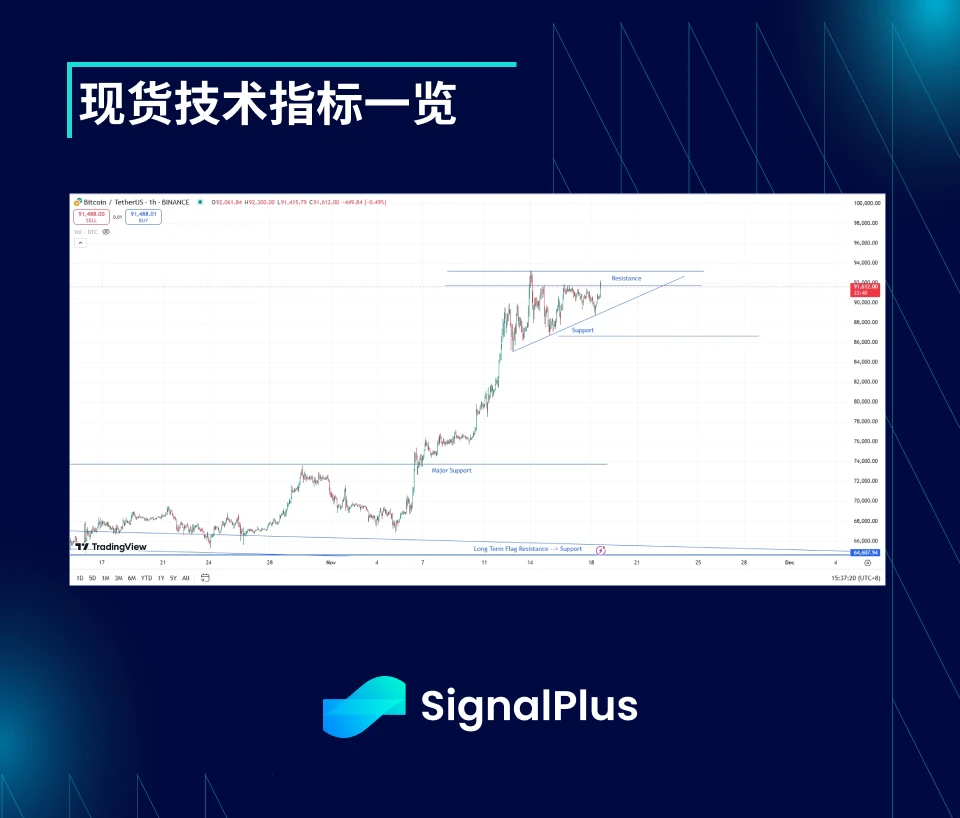
现货技术指标一览

BTC波动率周回顾(11月11日-11月18日)

过去一周市场开始加速上涨,任何一开始看似超买的信号最终被强劲的动量取代。市场应该是在 90 k 附近积攒了大量的 Gamma,因为市场最开始在这一点位多次受阻,然后试图向上突破,并最终到达 93.25 k 美元的位置。目前, 91.75 k-93.5 k 美元将会是我们的顶部阻力位水平。

参考上图,第一个支撑位是略低于当前价格水平的对角支撑,这会继续施加压力引导市场试探价格高点。如果价格完全向下突破了这个支撑水平,我们会再次在 85 k-86.25 k 美元附近找到良好的支撑点。但再往下我们预计将会看到一波猛烈的仓位清算浪潮。

日线和小时线的波动范围已经开始显示收缩的迹象。如果币价无法突破 93.5 k 美元,我们预期会看到实际波动率的下调。我们依然保持长期看涨的观点并合理预测明年一季度的目标是 105 k-115 k 美元。但在此期间,我们预期在接下来的 6 个月内市场会逐渐稳定稍作休整。在接下来的一两周如果我们看到更强劲支持波动范围收缩的证据(至少是短期的),这一观点将会得到证实并开始对 Gammashi 头寸施加压力。

市场主题

本周,“特朗普交易”继续全力进行。美元对其他法币持续走高,同时美债收益率也在继续攀升。加密货币再次展现出了与美元毫不相关的表现。比特币大涨至 90 k 美元以上,与此同时其他小币也出现了令人惊叹的涨势。美国股市经历了不错的一周并看到了急剧下跌的 VIX 指数,之后在周末稍作休整。但这也仅仅只是这波牛市趋势中的小幅修正。

大家的焦点现在转向了特朗普的内阁人选,加密货币的关注点放在了即将公布的财政部长任命上。斯科特·贝森特最开始看上去是最有希望的候选人,但埃隆·马斯克在周末表示支持霍华德·卢特尼克。两人都可以说是支持加密货币的人选,尽管卢特尼克更甚。然而,看起来最终人选离敲定还有很远的距离。因为在过去 24 小时内,凯文·沃什和马克·罗文又被列入候选名单。

看起来 MSTR 宣布在选举前后购买了超过 27, 000 个比特币之后仍然有持续的购买需求。因为该公司的股价依然在最高点成交,其净资产溢价是比特币现货价格的 2.5 倍。BTC 对 USD 的价格在每次回调时都得到了良好的支撑。即使是周四周五出现了来自 ARKB 和 BITB 的 ETF 资金流出,周末币价依然重新站上 90 k 美元。

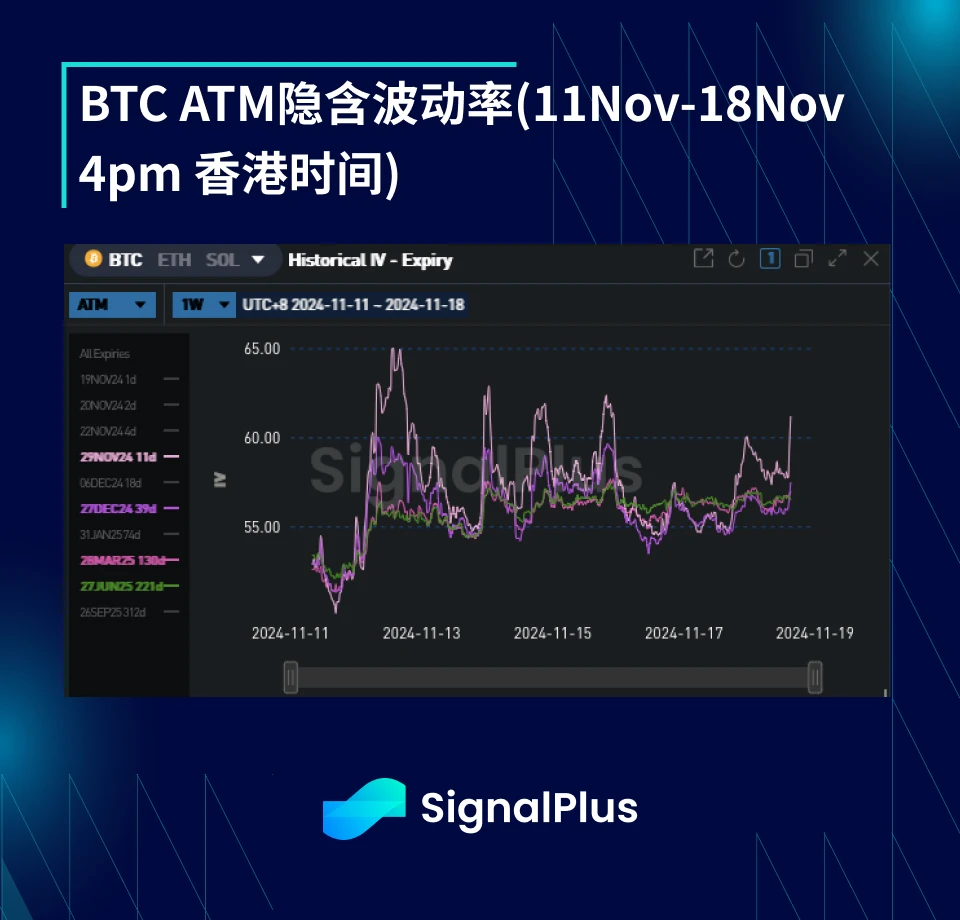
ATM 隐含波动率

BTC波动率周回顾(11月11日-11月18日)

  • 在上周一晚间币价强劲突破 80 k-82 k 美元的阻力位后一路高歌向上,同时隐含波动率水平全面急剧上扬。伴随着市场上探到 93 k 美元的水平,高频实际波动率被推至 60 大几,随后币价以相当剧烈的振荡水平回到了 87 k-93 k 美元的范围。

  • 币价的波动比市场预期更早到来,与此同时快速上涨的实际波动导致波动率期限结构快速倒挂。29 Nov 的 ATM 隐含波动率从 10 天前的 47-48 低位上涨至 65 的高点。曲线较远处的波动率水平也以时间加权的方式被拖高。

  • 有一个结构性的论点认为新局势下波动率会逐渐削弱。如果特朗普成功推动对加密货币的监管,一大波资金将会流入并最终为币价提供支撑,进一步削弱波动率。况且目前的币价水平很大一部分程度上已经考虑了这方面的因素。尽管币价仍在大幅波动,实际波动率依然没有超过 60 几的水平,同时当日到期的隐含波动率持续在最低 50 几到最高 60 几的范围内游走(今年的平均水平是 45-50)。但就目前来讲,看涨动量激发了对年底到明年一月底 100 k-150 k 价格区间的需求,同时为隐含波动率提供了支撑。

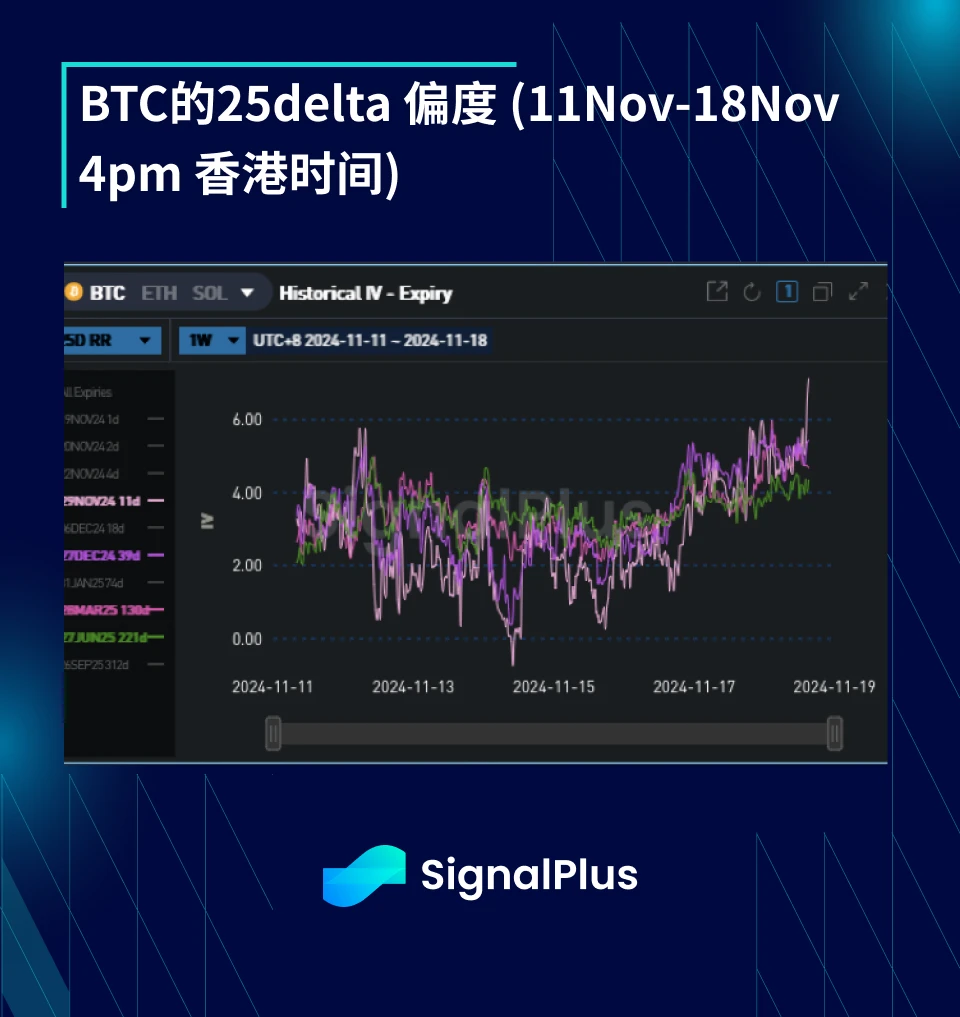
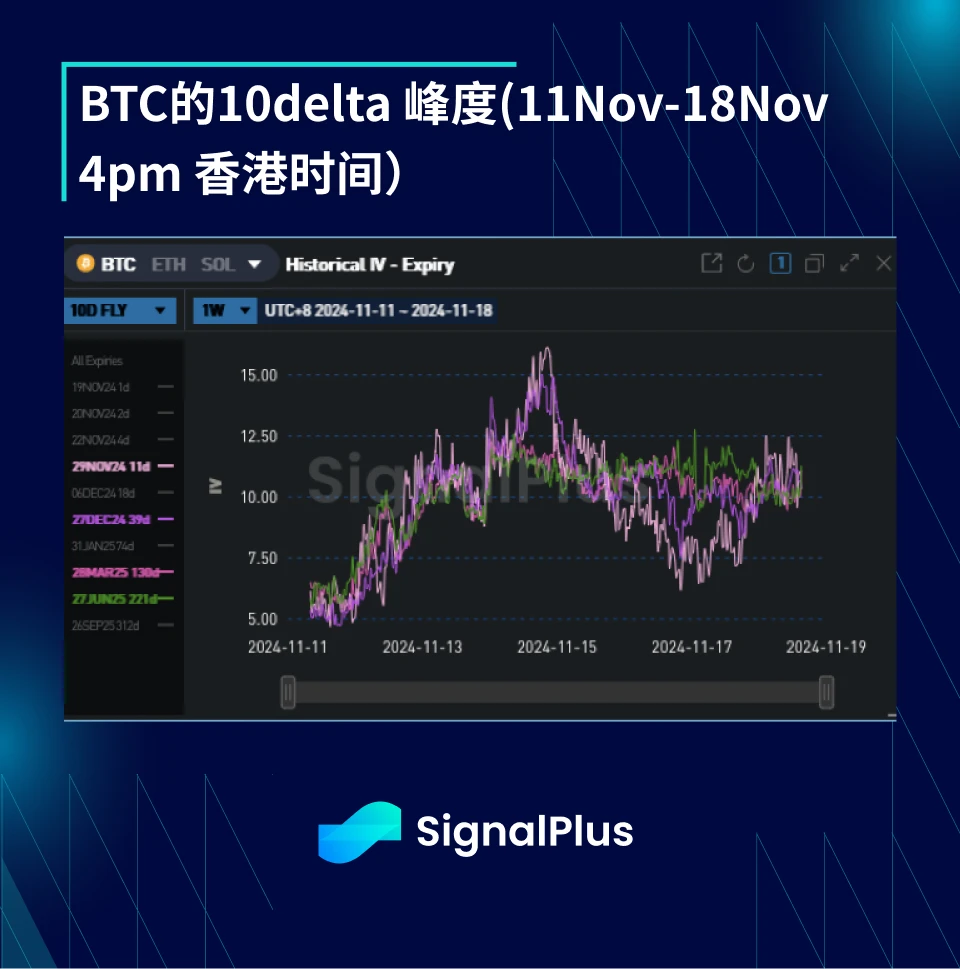
偏度/峰度

BTC波动率周回顾(11月11日-11月18日)

BTC波动率周回顾(11月11日-11月18日)

  • 本周偏度依然持续上涨(主要是看涨一侧),主要是因为市场对币价持续进一步向上突破翘首以盼。隐含波动率持续显示与币价的正相关性。当币价下跌到 87-88 k 范围时,隐含波动率在整条曲线上被压低,但每当币价重新试图向上突破 91.5 k-93.5 k 美元范围时,卖方就会迅速撤离。此外,实值的看涨价差平仓以及滚仓也推动偏度的上涨。

  • 随着实际波动率的波动快速上涨,峰度也大幅增加。本周观察到了对上行翼的需求量增加,尤其是 100 k 美元以上。市场上同时也看到了一些对较短期内下行翼的需求,主要用来对现货或者保证金进行保护。

祝大家接下来的一周好运!

BTC波动率周回顾(11月11日-11月18日)

您可在 t.signalplus.com 使用 SignalPlus 交易风向标功能,获取更多实时加密资讯。如果想即时收到我们的更新,欢迎关注我们的推特账号@SignalPlusCN,或者加入我们的微信群(添加小助手微信:SignalPlus 123)、Telegram 群以及 Discord 社群,和更多朋友一起交流互动。

SignalPlus Official Website:https://www.signalplus.com

Trending Cryptos

Related Reads

The Illusion of a Prodigy

The Illusion of the "Genius Youth" The article discusses the recent interview incident involving Li Bojie, a former "Huawei Genius Youth," and AI company DeepSeek. It highlights the core conflict not as a simple case of suspected cheating during a coding test, but as a profound mismatch in expectations. Li, with an impressive background including entrepreneurship, a role at Huawei, and a position as a chief scientist, was deeply affected by a standard remote interview where the interviewer questioned his actions. The key point is his stated view of DeepSeek as the "pinnacle of the Chinese tech world." For him, the interview was a quest for identity validation—proof he belonged at the center of the new AI era. For DeepSeek, it was a routine skills assessment. The article argues that Li, while publicly rejecting the "genius" label, subconsciously expected to be treated as a peer for discussion, a courtesy extended by other companies like MiniMax and Xiaomi. DeepSeek, however, adhered strictly to its standardized process, prioritizing consistent, merit-based evaluation over individual prestige. This clash symbolizes a larger shift in the tech industry. The core thesis is that the AI era is dismantling the old system where past titles, companies, and accumulated experience guaranteed status. Now, with rapid knowledge obsolescence, "excellence is calculated in real-time." Li's anxiety—waiting weeks for the DeepSeek interview despite other offers—stems from the fear that rejection means being left behind by technological progress. The article concludes that this incident is a harbinger; soon, everyone will face a constant, implicit "interview" with the AI age itself, asking: "You were excellent yesterday. What about today?"

marsbit7m ago

The Illusion of a Prodigy

marsbit7m ago

Vanguard Group Enters the Arena, Opening a New Crypto Portal for 50 Million Traditional Investors

Vanguard Group, the world's second-largest asset manager with $12 trillion in assets under management and over 50 million investors, has signaled a significant strategic shift by posting a job opening for a "Head of Digital Assets, Personal Wealth." The role entails developing a comprehensive digital asset strategy, establishing long-term plans, and overseeing the full integration of digital assets into Vanguard's wealth management platform, covering areas like custody, settlement, asset tokenization, and stablecoins. This move marks a notable reversal from the firm's previous stance. In 2024, Vanguard refused to list spot Bitcoin ETFs and removed Bitcoin futures products. By late 2025, it allowed some third-party crypto ETF trading but reiterated it would not create its own crypto funds. The new hire represents a third step: building an internal team to integrate digital assets into its core infrastructure, moving beyond merely listing products. The initiative focuses on foundational financial infrastructure—how tokenized assets and digital settlement systems can connect to Vanguard's existing platform, which primarily serves long-term, conservative investors. While Vanguard maintains it will not launch proprietary crypto ETFs, it is proactively preparing its systems for a future involving tokenized assets and stablecoins, which Citigroup projects could reach a $5.5 trillion market by 2030. Vanguard's scale means its chosen standards for custody, settlement, and compliance could set de facto rules for the broader wealth management industry. The firm is acting despite regulatory uncertainty and cautious market sentiment (e.g., Citi recently lowered crypto price targets). Analysts suggest even a minimal 0.01% allocation from Vanguard's asset base would bring ~$12 billion into digital assets, forcing the development of robust risk and operational frameworks. Ultimately, Vanguard's focus is on building the plumbing for digital assets to potentially serve its vast client base, an effort whose impact may extend far beyond any single market cycle.

Foresight News20m ago

Vanguard Group Enters the Arena, Opening a New Crypto Portal for 50 Million Traditional Investors

Foresight News20m ago

Paradigm's New Playbook: Crypto in One Hand, AI and Robotics in the Other

Title: Paradigm's New Strategy: Crypto in One Hand, AI and Robotics in the Other On July 8, 2026, top-tier venture capital firm Paradigm announced the successful $12 billion close of its fourth fund, marking a strategic evolution beyond its pure-play crypto roots. While remaining committed to cryptocurrency, the firm is now formally extending its investment focus to include artificial intelligence, robotics, and other frontier technologies. This shift was foreshadowed by a subtle but significant change to its official social media description earlier in March, from "A research-driven crypto investment firm" to a broader "We build and invest in the companies and ideas shaping the frontier." The move is driven by the firm's recognition of transformative technological waves beyond crypto, particularly in AI and robotics, and a response to the shifting capital allocation landscape. Despite significant AI sector fundraising, Paradigm emphasizes its commitment remains grounded in deep technical rigor. A key intersection for Paradigm lies in AI Agents, where decentralized blockchain networks and stablecoins are seen as a natural financial infrastructure for autonomous digital operations. The firm is active in promoting open-source, decentralized AI (e.g., investing in Nous Research) and building agent-friendly blockchains (e.g., incubating Tempo). It is also developing tools like EVMbench (with OpenAI) and the Centaur AI Agent platform. Within its crypto stronghold, Paradigm will continue focusing on core infrastructure areas. These include derivatives and new liquidity layers (e.g., Hyperliquid), prediction markets (with plans for a proprietary trading terminal), and developer tools (continuing development of Reth and Foundry). In summary, Paradigm's expansion reflects a broader realignment in venture capital, where the intense capital concentration in AI and the search for exponential growth compel even crypto-native funds to broaden their narratives. However, this does not signify an abandonment of crypto; instead, the focus is sharpening on real-world financial applications like stablecoins, RWA, on-chain derivatives, prediction markets, and the convergence of Crypto and AI Agents.

Foresight News55m ago

Paradigm's New Playbook: Crypto in One Hand, AI and Robotics in the Other

Foresight News55m ago

The Preferred Stock Domino Effect: Strive Incurs a 7.08 Million Dollar Loss, Strategic Risk Spreading in a Chain Reaction

"Priority Stock Domino Effect": Strive's $7.08 Million Loss Reveals Chain-Reaction Risk in Bitcoin Reserve Sector Bitcoin reserve company-issued preferred shares are no longer just yield assets but a credit test for balance sheet health. While focus remains on Strategy, Strive, the 7th largest public Bitcoin holder, disclosed a tangible spillover effect: its holding of Strategy's (STRC) preferred shares lost $7.08 million in fair value over eight days, despite no change in share count. This exposes a clear cross-company risk transmission channel within the sector. Strive's filing shows its 505,000 STRC shares fell from ~$88.59 to ~$74.57 per share. While Strive remains solvent with 19,864 BTC and $141.7M cash, the loss signals that preferred stock risks can spread via inter-company holdings, shifting their perception from stable income to credit-like, high-risk assets dependent on issuer liquidity and dividend sustainability. In response, Strategy unveiled a "Digital Credit Capital Framework," raising STRC's annual dividend to 12%, mandating a 12-month cash reserve for dividends, and authorizing up to $1B each for STRC/common stock buybacks and a $1.25B Bitcoin sale plan to bolster reserves. This marks a shift to active credit risk management, formally incorporating potential Bitcoin sales to stabilize its capital structure. Third-party valuation tools, like Farside's calculator estimating STRC's net present value at ~$49.89, highlight that pricing now hinges critically on perpetual dividend sustainability and the issuer's ability to pay amid market volatility. Bitcoin's price (~$62k) remains below Strategy's average cost basis ($75,651), intensifying focus on reserve policies. The market faces two scenarios: 1) Contained risk, where STRC's discount narrows and stress is limited to Strategy; or 2) Systemic risk, where deep STRC discounts persist, dividend hikes fail, Bitcoin sales commence, and pressure spreads to other issuers like Strive's SATA shares. Key indicators to watch are STRC/SATA discount levels, dividend coverage credibility, equity issuance rates, and any actual Bitcoin divestment. Strive's future reports will be crucial in determining if its loss is an isolated event or the first sign of sector-wide credit risk contagion via preferred shares.

marsbit1h ago

The Preferred Stock Domino Effect: Strive Incurs a 7.08 Million Dollar Loss, Strategic Risk Spreading in a Chain Reaction

marsbit1h ago

Trading

Spot

Hot Articles

What is $BITCOIN

DIGITAL GOLD ($BITCOIN): A Comprehensive Analysis Introduction to DIGITAL GOLD ($BITCOIN) DIGITAL GOLD ($BITCOIN) is a blockchain-based project operating on the Solana network, which aims to combine the characteristics of traditional precious metals with the innovation of decentralized technologies. While it shares a name with Bitcoin, often referred to as “digital gold” due to its perception as a store of value, DIGITAL GOLD is a separate token designed to create a unique ecosystem within the Web3 landscape. Its goal is to position itself as a viable alternative digital asset, although specifics regarding its applications and functionalities are still developing. What is DIGITAL GOLD ($BITCOIN)? DIGITAL GOLD ($BITCOIN) is a cryptocurrency token explicitly designed for use on the Solana blockchain. In contrast to Bitcoin, which provides a widely recognized value storage role, this token appears to focus on broader applications and characteristics. Notable aspects include: Blockchain Infrastructure: The token is built on the Solana blockchain, known for its capacity to handle high-speed and low-cost transactions. Supply Dynamics: DIGITAL GOLD has a maximum supply capped at 100 quadrillion tokens (100P $BITCOIN), although details regarding its circulating supply are currently undisclosed. Utility: While precise functionalities are not explicitly outlined, there are indications that the token could be utilized for various applications, potentially involving decentralized applications (dApps) or asset tokenization strategies. Who is the Creator of DIGITAL GOLD ($BITCOIN)? At present, the identity of the creators and development team behind DIGITAL GOLD ($BITCOIN) remains unknown. This situation is typical among many innovative projects within the blockchain space, particularly those aligning with decentralized finance and meme coin phenomena. While such anonymity may foster a community-driven culture, it intensifies concerns about governance and accountability. Who are the Investors of DIGITAL GOLD ($BITCOIN)? The available information indicates that DIGITAL GOLD ($BITCOIN) does not have any known institutional backers or prominent venture capital investments. The project seems to operate on a peer-to-peer model focused on community support and adoption rather than traditional funding routes. Its activity and liquidity are primarily situated on decentralized exchanges (DEXs), such as PumpSwap, rather than established centralized trading platforms, further highlighting its grassroots approach. How DIGITAL GOLD ($BITCOIN) Works The operational mechanics of DIGITAL GOLD ($BITCOIN) can be elaborated on based on its blockchain design and network attributes: Consensus Mechanism: By leveraging Solana’s unique proof-of-history (PoH) combined with a proof-of-stake (PoS) model, the project ensures efficient transaction validation contributing to the network's high performance. Tokenomics: While specific deflationary mechanisms have not been extensively detailed, the vast maximum token supply implies that it may cater to microtransactions or niche use cases that are still to be defined. Interoperability: There exists the potential for integration with Solana’s broader ecosystem, including various decentralized finance (DeFi) platforms. However, the details regarding specific integrations remain unspecified. Timeline of Key Events Here is a timeline that highlights significant milestones concerning DIGITAL GOLD ($BITCOIN): 2023: The initial deployment of the token occurs on the Solana blockchain, marked by its contract address. 2024: DIGITAL GOLD gains visibility as it becomes available for trading on decentralized exchanges like PumpSwap, allowing users to trade it against SOL. 2025: The project witnesses sporadic trading activity and potential interest in community-led engagements, although no noteworthy partnerships or technical advancements have been documented as of yet. Critical Analysis Strengths Scalability: The underlying Solana infrastructure supports high transaction volumes, which could enhance the utility of $BITCOIN in various transaction scenarios. Accessibility: The potential low trading price per token could attract retail investors, facilitating wider participation due to fractional ownership opportunities. Risks Lack of Transparency: The absence of publicly known backers, developers, or an audit process may yield skepticism regarding the project's sustainability and trustworthiness. Market Volatility: The trading activity is heavily reliant on speculative behavior, which can result in significant price volatility and uncertainty for investors. Conclusion DIGITAL GOLD ($BITCOIN) emerges as an intriguing yet ambiguous project within the rapidly evolving Solana ecosystem. While it attempts to leverage the “digital gold” narrative, its departure from Bitcoin's established role as a store of value underscores the need for a clearer differentiation of its intended utility and governance structure. Future acceptance and adoption will likely depend on addressing the current opacity and defining its operational and economic strategies more explicitly. Note: This report encompasses synthesised information available as of October 2023, and developments may have transpired beyond the research period.

684 Total ViewsPublished 2025.05.13Updated 2025.05.13

What is $BITCOIN

Discussions

Welcome to the HTX Community. Here, you can stay informed about the latest platform developments and gain access to professional market insights. Users' opinions on the price of BTC (BTC) are presented below.

活动图片